Daily insights for city builders, delivered every morning at 6 AM ET. I’m Brandon Donnelly — a Toronto-based real estate developer and founder of Globizen. I’ve been writing here since 2013.

Tag: london

  • Urban pet peeve: copycatting

    One of my biggest pet peeves is when cities copy things from other cities. 

    Let me give you an example. Whenever I see one of those red double decker tourist buses roaming around Toronto, I always look to see if it’s the type that has London signage and destinations plastered all over it. And when it is, I cringe. (I saw one earlier today.)

    Why would anyone design a tourist bus that makes you feel like you’re half in another city? I don’t get it. The whole reason people are getting on that bus is because they’ve come to visit this city. It should make you feel like you’re here and nowhere else. It should feel locally authentic.

    To be clear, I’m not saying that we shouldn’t be learning from other cities and building on top of other’s great ideas. That’s precisely what we should all be doing. I’m talking about kitschy copies with little additional thought put into them. And I can think of many examples beyond just tourist buses.

    Am I just being pedantic?

    What about you? Any urban pet peeves?

  • One lease for the world

    image

    If you’re looking for more evidence that the way we live and work is changing, then check out a new startup called Roam. They describe themselves as an international network of communal spaces. So far, they have locations in Ubud (Bali), Miami, and Madrid. Buenos Aires and London are coming soon.

    The way it works is that you start by signing a lease for either a week or a month. You get a private room and bathroom, but everything else, from the co-working spaces to the kitchens, are shared amongst the community. Like other co-working and co-living environments, the community they build is critical.

    However, what really differentiates Roam is that you can sign one lease and then live all over the world, freely traveling across their properties. All of the locations are offered up at the same price and you can stay for as long as you’d like.

    In my line of work, I don’t have the flexibility of living like a global nomad. But today, there are many people who can. And I also know that there are many people who would prefer to live like this. It’s liberating in so many ways.

    My friend and I actually had a similar idea to this back in University and we spent some time working on it. At the time, and this was over a decade ago, we felt that there was a segment of people who increasingly wanted to live like global citizens. I still believe that to be true and, clearly, so do others.

    To date, Roam has raised $3.4 million in funding.

    Image: Ubud kitchen via Roam

  • The most fascinatingly boring city in the world

    The Guardian Cities UK is currently focusing on all things Canada for a special week-long series. The first post is up and it’s about why Toronto is “the most fascinatingly boring city in the world.” The piece is by Stephen Marche.

    I don’t agree with everything in the essay – or maybe I just despise being called boring, steady, and predictable – but there are a number of great gems that I would like to reblog today. Here are the 5 that stood out for me.

    1. Chicago vs. Toronto:

    “What Chicago was to the 20th century, Toronto will be to the 21st. Chicago was the great city of industry; Toronto will be the great city of post-industry. Chicago is grit, top-quality butchers, glorious modernist buildings and government blight; Toronto is clean jobs and artisanal ice-creameries, identical condos, excellent public schools and free healthcare for all. Chicago is a decaying factory where Americans used to make stuff. Toronto is a new bank where the tellers can speak two dozen languages.”

    2. London vs. New York vs. Toronto Bankers:

    “In London and New York, the worst stereotype of a banker is somebody who enjoys cocaine, Claret and vast megalomaniac schemes. In Toronto, a banker handles teachers’ pension portfolios and spends weekends at the cottage.”

    3. Montreal vs. Toronto:

    “I was 19 when he said that, and I knew even then that for the rest of my life, Canada’s future would be built on money and immigrants. I wasn’t wrong. Most Canadian business headquarters had already taken the five-hour drive west. After 95, the rest followed. Montreal decided to become a French-Canadian city. Toronto decided to become a global city.”

    4. The last time Toronto built a white elephant subway line:

    “On any given morning on the Sheppard subway line in the north of the city, you can sit down in perfect peace and order, although you will find little evidence of good government. As the latest addition to Toronto’s fraying infrastructure, the Sheppard subway is largely untroubled by urban bustle. The stations possess the discreet majesty of abandoned cathedrals, designed for vastly more people than currently use them, like ruins that have never been inhabited. Meanwhile, in the overcrowded downtown lines, passengers are stacked up the stairs. The streetcars along a single main street, Spadina, carry more people on a daily basis than the whole of the Sheppard line, whose expenses run to roughly $10 a passenger, according to one estimate. A critic has suggested that sending cabs for everybody would be cheaper.”

    5. On Mayor Tory:

    “The current mayor, John Tory, is not an idiot, although he is hardly a figure of the “new Toronto”. He represents, more than any other conceivable human being, the antique white anglo-saxon protestant (Wasp) elite of Toronto, his father being one of the most important lawyers in the city’s history. The old Wasps had their virtues, it has to be said – it wasn’t all inedible cucumber sandwiches and not crying at funerals.”

  • How the UK voted

    For some reason, I woke up extra early this morning, well before my alarm. As soon as I came to and noticed the time, I immediately reached for my phone to pull up Twitter and see what happened with the UK referendum. And frankly, I was shocked to see that they had voted to leave the EU. 

    Once I saw what had happened, I then went to my computer and started looking for maps of the voting results. 

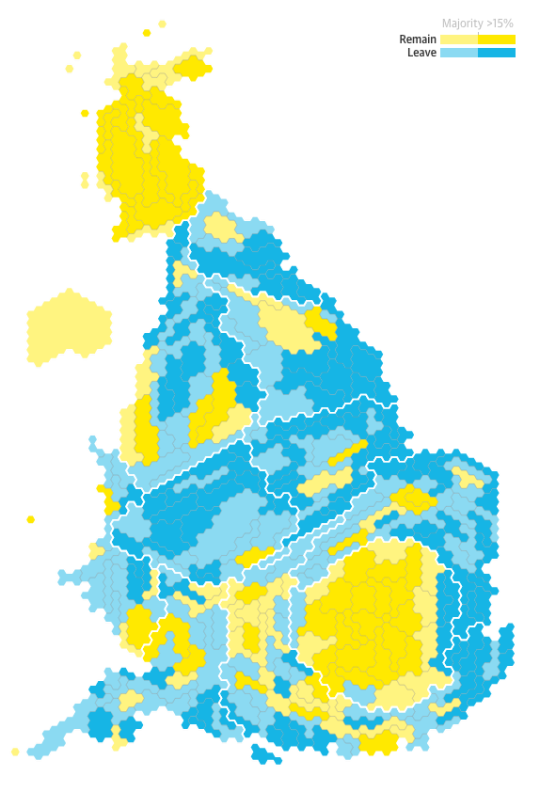
    Here’s one from the Guardian:

    image

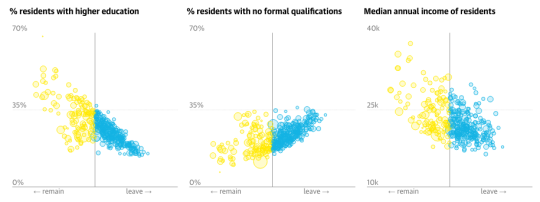
    They also found that the best predictor of how people voted (with Scotland being a bit of an exception) was whether or not they had a degree. Residents with higher education were more likely to vote “remain.”

    image

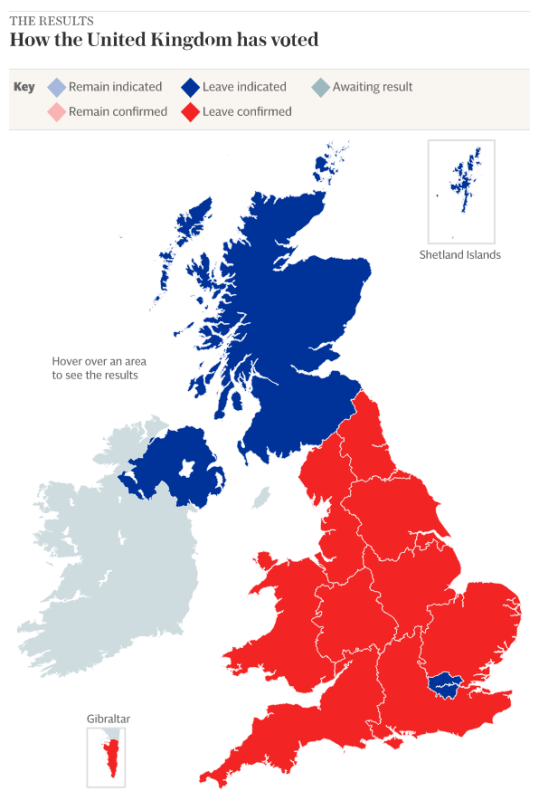
    Here’s another vote map from the Telegraph, broken down by 12 regions:

    image

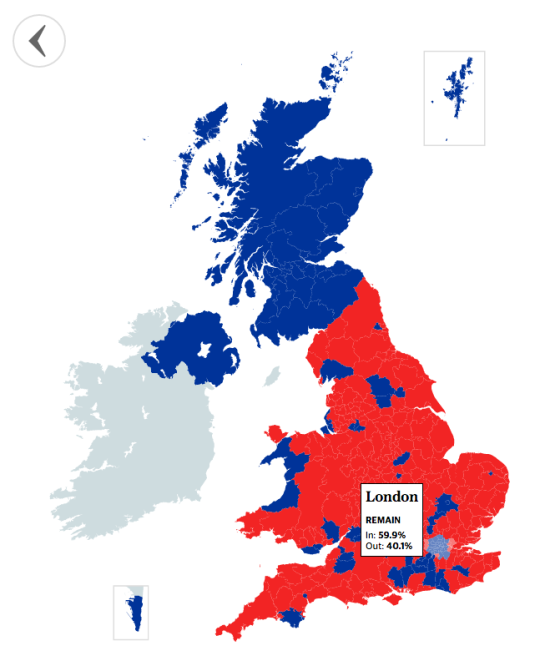
    According to these regions, only Northern Ireland, Scotland, and London voted to remain. If we get a bit more granular though, the map turns into this:

    image

    Not surprisingly, it is London and other big cities (remain) vs. the rest of England (leave). Here’s another case of urban divide.

  • Crowdsourcing unsafe cycling conditions with a small yellow handlebar button

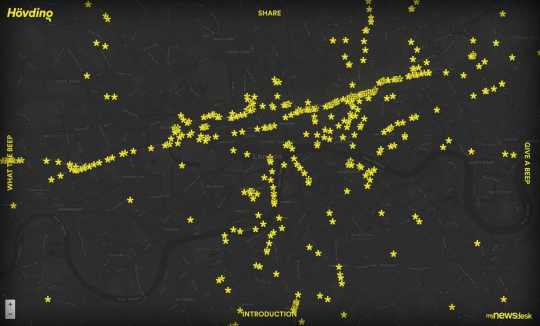
    Hövding – a Swedish company best known for its radical airbag cycling helmets (definitely check these out) – is currently crowdsourcing unsafe conditions and cyclist frustration in London.

    Working with the London Cyclist Campaign, they distributed 500 yellow handlebar buttons. Cyclists were then instructed to tap these buttons whenever they felt unsafe or frustrated with current cycling conditions. 

    Here’s what the button looks like:

    Every time the button is hit, the data point gets logged to a public map and an email gets sent to the Mayor of London reminding him of his promises around cycling. Both of these things happen via the rider’s smartphone.

    Here’s what the public map looks like at the time of writing this post:

    Not only does it tell you pain point locations, but it also seems to suggest the primary cycling routes. I think this is a brilliant initiative because, it’s entirely user-centric. It’s telling you how people feel on the ground.

    Supposedly, Hövding is actively looking for other cyclist groups around the world to help them distribute their buttons. So if you’re a group in Toronto or in another city, I would encourage you to reach out to them. The more data the better.

  • Coffee shops vs. fried chicken

    When it comes to a real estate market, there are always the typical metrics: sale prices, rents, vacancy and so on. But I’m always interested when somebody looks at the market in a different way and comes up with other kinds of metrics.

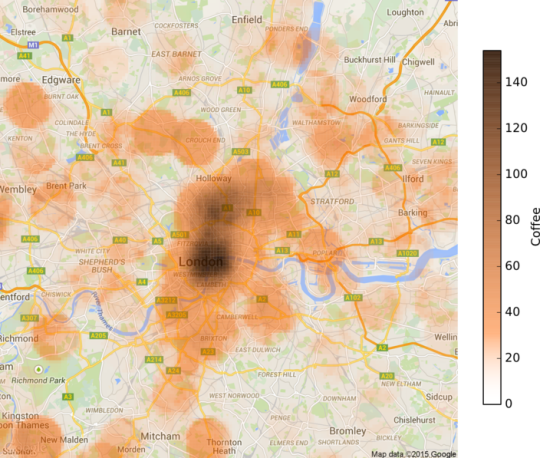
    That’s why I was intrigued when I stumbled upon this post by Sam Floy, where he looks at the concentration of coffee shops and friend chicken shops across London in order to determine which neighborhoods are in fact “up and coming.”

    To give you a taste, here’s his coffee shop map:

    His thinking was that if a neighborhood had a high density of coffee shops, a low density of fried chicken shops, and relatively low house prices, then it could probably be thought of as up and coming. 

    Coffee shops are often considered to be leading indicators of urban change (i.e. gentrification), and, well, friend chicken places I guess speak to a different kind of neighborhood.

    These sorts of playful studies aren’t going to tell you exactly which numbers you should be plugging into your development pro forma. But I think unconventional analyses can sometimes tell you a bit more of the story behind the numbers.

  • Why Toronto needs a night mayor

    Recently I wrote about the first Night Mayor Summit being held in Amsterdam. As part of this, I spoke about Amsterdam’s first night mayor – Mirik Milan.

    Since then (but obviously not because of my post), the idea has seemingly taken off. Below are a couple of excerpts from a recent Guardian article.

    This pragmatic and classically Dutch notion is now being copied across Europe: Toulouse, Zurich, Paris as well as several other Dutch cities have night mayors too.

    This week the mayor of London, Boris Johnson, announced plans for a “Night-Time Commission”, a six-month assessment of how to protect and manage the city’s £66bn night-time economy which is likely to recommend the creation of a “night-time champion” role. 

    Berlin is considering it too, and in April, Amsterdam will host the first global Night Mayors’ Summit.

    Why is this happening? Simple:

    “Late-night people are typically young, educated, creative, entrepreneurial – people you want in your city, and who work in the creative industries and startups you also want. If places like Berlin have flourished, it’s not just because of low rents. It’s because they’re nightlife capitals.”

    So if you’re reading this, Mayor John Tory, now is probably your last chance to make Toronto a North American leader in this regard. 

    It’s great that we are trying to push the Toronto – Waterloo region as a global startup hub, but so is every other major city and region in the world. A focus on startups is so commonplace in today’s economic development strategies, that at this point it almost feels meaningless. What are we going to do to stand out in this competition for the world’s best talent?

    If everyone believes something to be true – such as, there’s value in having a robust startup ecosystem – then it’s no longer innovative. It’s just the way things are. To take it to the next level, we’re going to have to do things that will probably feel uncomfortable at first – particularly for old establishment Toronto.

    I’m not saying that having a night mayor is going to be the silver bullet for our startup ecosystem. There’s no such thing. But I am saying that it should be one component of our larger strategy. 

    Because already there’s a growing number of European cities who have come to this one simple realization: people are drawn to kickass places.

    If you agree with this post, I would encourage you to leave a comment below and also tweet the Mayor of Toronto.

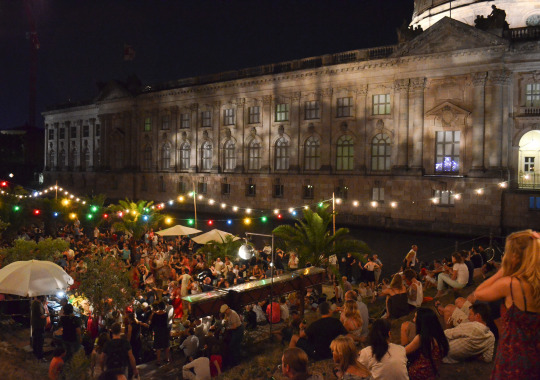
    Image: Berlin nightlife by Tom Stromer

  • Developer Profile: The Adir Group

    In 2010, Gal and Tania Adir, aged 23 and 24, respectively, began renovating high-value apartments in central London.

    Today, they are known as The Adir Group and have about £50m in development under way.

    But more than just a developer, the group has grown to become “the parent company of a quickly expanding collection of complementary brands bound together by a desire to enhance people’s lifestyle through quality and beauty.”

    In addition to G&T (their residential development arm), they also founded Net.Works (a co-working space) and Nuper (a co-op living scheme). This last focus isn’t up on their website yet, but I read about it on Michael Mortensen’s blog. The goal of Nuper is to create affordable living solutions for young talent in London.

    I wanted to profile The Adir Group because I think it’s incredible how young they were when they got started (I was just starting graduate school at 23) and because I like their approach of creating a collection of complementary companies.

    I am excited to see where the next generation of developers (myself included) take this business. Already we are seeing some new approaches emerge.

  • A new era of (digital) globalization

    McKinsey recently published a report called Digital globalization: The new era of global flows.

    The overarching thesis is that we are transitioning to a data-driven global economy:

    “Flows of physical goods and finance were the hallmarks of the 20th-century global economy, but today those flows have flattened or declined. Twenty-first-century globalization is increasingly defined by flows of data and information. This phenomenon now underpins virtually all cross-border transactions within traditional flows while simultaneously transmitting a valuable stream of ideas and innovation around the world.”

    One of the benefits of this shift is that it has become easier for emerging economies and individuals from all around the world to participate.

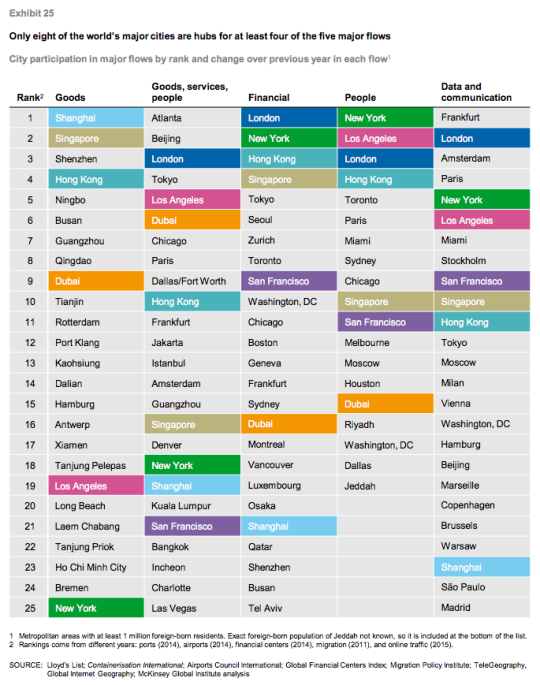
    Of course, not all countries and cities are participating equally. In their report, McKinsey ranks the top cities according to five global flows. In each case a proxy was used:

    “Unfortunately, data on global flows are not available at the city level. However, we have obtained data that serve as proxies for each of our five global flows. Container port volumes approximate goods flows; airport passenger volumes serve as a proxy for goods, service, and people flows; the ranking of cities in the Global Financial Centers Index by the Z/Yen Group provides an indication of financial flows; the number of foreign-born residents in a city measures people flows; and Internet bandwidth approximates data flows.” 

    Using this methodology, they believe that the world only has 8 truly global cities right now: New York, Los Angeles, San Francisco, London, Singapore, Shanghai, Hong Kong, and Dubai. They are the colored cities listed below:

    I always take these city rankings with a grain of salt. This stuff is not easy to quantify and a lot depends on the methodology that you use. 

    For instance, Atlanta sits on the top of “goods, services, and people” because it has the busiest airport in the world according to passenger volume. (It’s the primary hub of Delta Air Lines.) But is that enough to assert that Atlanta is #1? Maybe. Maybe not.

    In any case, the report is packed full of information. If you’d like to take a look, click here.

  • Residential population densities compared

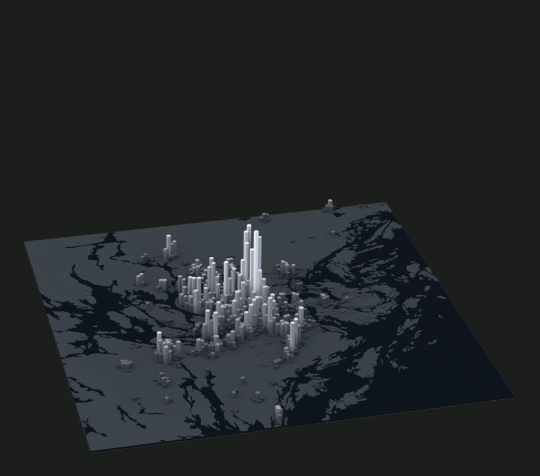
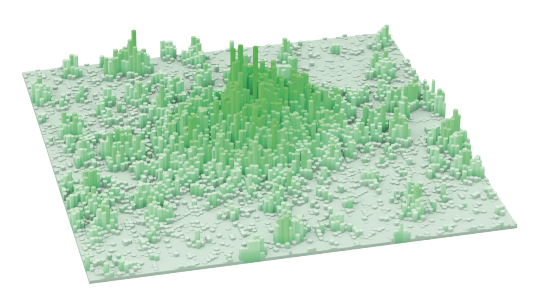
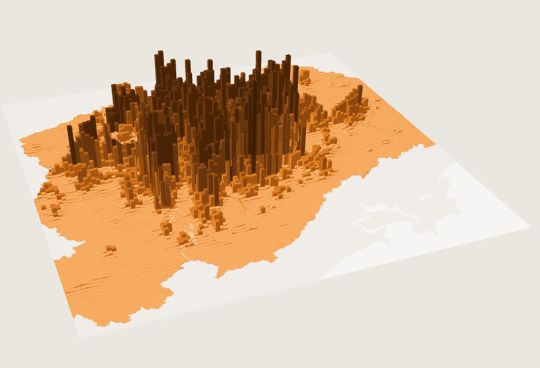
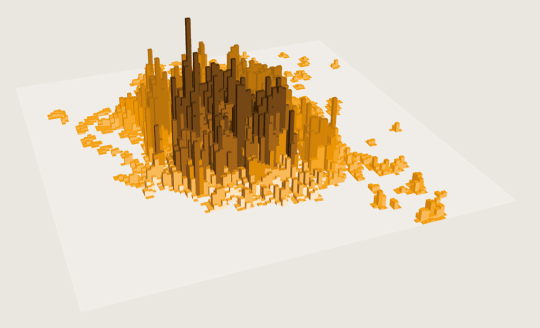
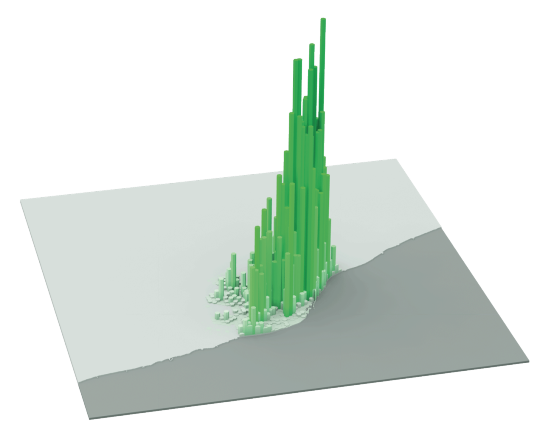
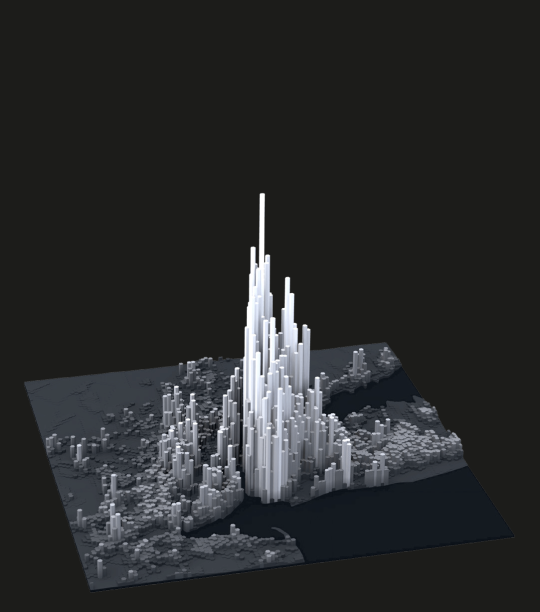
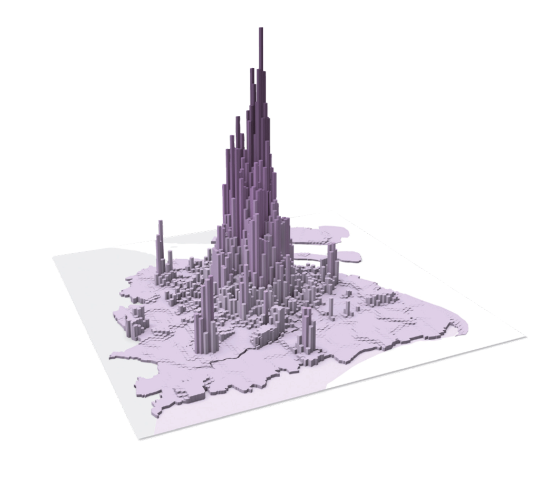
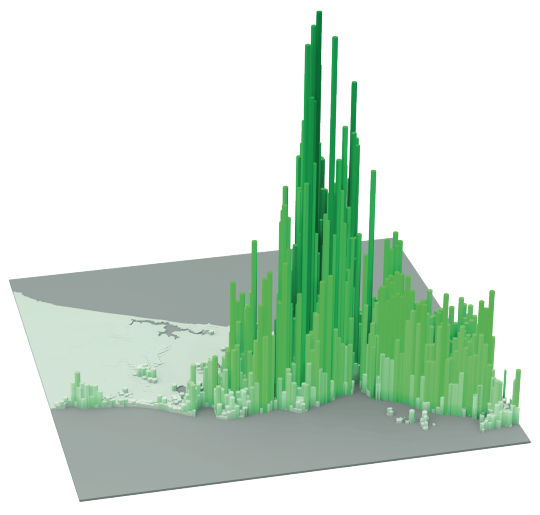
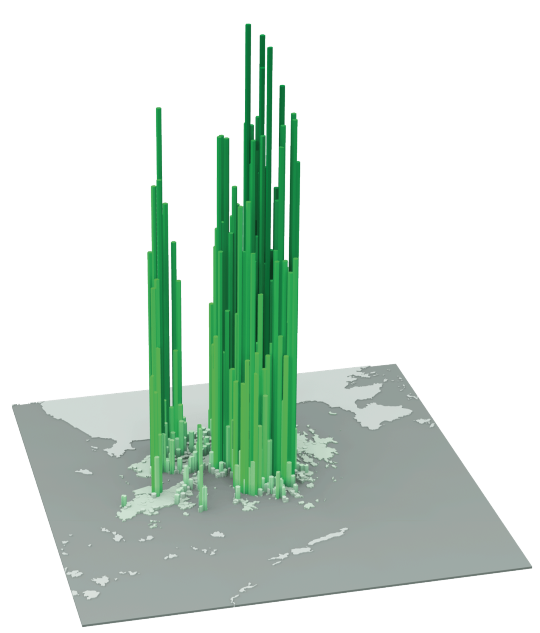
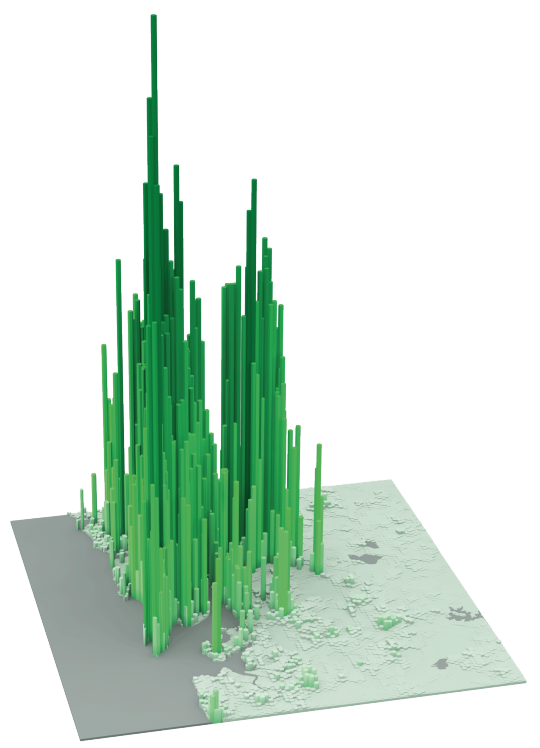
    The following diagrams were taken from LSE’s Urban Age website. I’ve sorted them from lowest to highest peak residential population density. In each case I’ve also included the year of the dataset. 

    It’s amazing how much these simple extrusion diagrams can tell you about the city. It also shows you that high population densities don’t necessarily need to equate to tall buildings. Barcelona, in particular, stands out for me.

    Berlin (Peak residential density: 21,700 people/km2, 2009)

    image

    Stockholm (Peak residential density: 24,900 people/km2, 2012)

    image

    London (Peak residential density: 27,100 people/km2, 2013)

    image

    São Paulo (Peak residential density: 29,380 people/km2, 2009)

    image

    Mexico City (Peak residential density: 48,300 people/km2, 2009)

    image

    Barcelona (Peak residential density: 56,800 people/km2, 2013)

    image

    New York (Peak residential density: 59,150 people/km2, 2012)

    image

    Shanghai (Peak residential density: 74,370 people/km2, 2011)

    image

    Istanbul (Peak residential density: 77,300 people/km2, 2013)

    image

    Hong Kong (Peak residential density: 111,100 people/km2, 2013)

    image

    Mumbai (Peak residential density: 121,300 people/km2, 2013)

    image