Daily insights for city builders, delivered every morning at 6 AM ET. I’m Brandon Donnelly — a Toronto-based real estate developer and founder of Globizen. I’ve been writing here since 2013.

Tag: london

  • European cities by rail connectivity

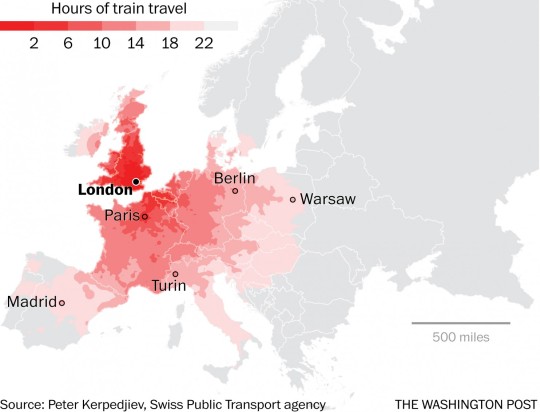
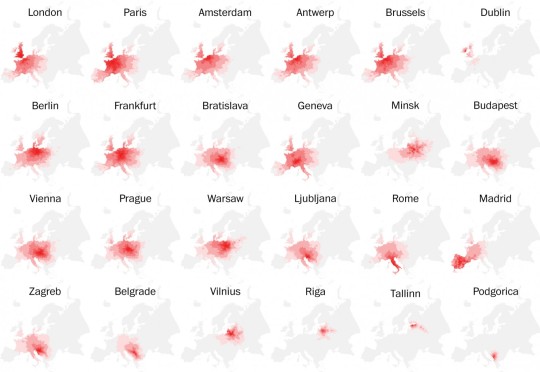
    This is a terrific set of maps published by The Washington Post (2015) using data originally collected and published by Peter Kerpedjiev:

    What they show is how far you can travel in a 24 hour period using only trains and brisk walking from a collection of 28 European cities. In a few cases, such as from London to Dublin, a ferry ride is also included.

    Here’s a zoom in on London:

    The obvious takeaway is that Western Europe is very well connected, whereas many parts of Eastern Europe are not. Some cities, such as Tallinn (Estonia) and Podgorica (Montenegro) are almost completely disconnected.

    Of course today there’s stiff competition from air travel.

  • World’s best city brands

    Resonance Consultancy – they do brands and strategies for places and products – has just released a new report called: World’s Best City Brands – A Global Ranking of Place Equity.

    With all of these sorts of rankings, it really depends on the research methodology being used and the rigor in which it is being applied. In this case, they evaluated each city based on “six pillars of equity”:

    1. Place: Perceived quality of a city’s natural and built environment
    2. Product: A city’s key institutions, attraction and infrastructure
    3. Programming: The arts, culture and entertainment in a city
    4. People: Immigration and diversity of a city
    5. Prosperity: Employment, GDP per capita entertainment in a city and corporate head offices
    6. Promotion: Quantity of articles, references of a city and recommendations online

    What’s perhaps unique about this study is that it combines measurable statistics with “visitor perception metrics” – data that they mined from social media. Here’s an excerpt from the methodology page:

    “Our team became interested in the way visitors and citizens themselves influence the identity and perception of cities. Increasingly, they do it through their evaluation of experiences on social media and via the comments, images and reviews they share with family, friends and people around the world. These opinions and attitudes, much more than traditional marketing, influence the way people perceive places today.”

    This is a fascinating shift for city brands and is something that we have discussed before on this blog. All of us are now involved in telling the story of the places in which we live and visit.

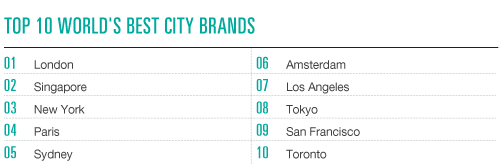
    The entire report is well done and worth a read. It’s also a free download (you’ll need to enter your contact info). But below are the top 10 world’s best city brands. Not really any surprises for me. What about for you?

    image

  • Case Study: Lumiere London

    Last week I wrote about the value of urban lighting.

    Another case study worth looking at is Lumiere London. It was a four day light festival that took place in January, which is normally a pretty quiet and dark month. This past year in London the festival saw over 1 million visitors who spent over £22 million.

    Here’s a time lapse video of the festival in action:

    [youtube https://www.youtube.com/watch?v=ESxG9KsaeJo&w=560&h=315]

    Click here if you can’t see the embedded video.

    It’s obviously a temporary festival, but it’s a great example of how lighting can transform a city. After the event, the Guardian (which gave it 4/5 stars) talked about the city itself becoming the story. They also said that it managed to “unzip and open out the city” in a way that politicians and town planners often struggle to do.

    Sounds like fun.

  • The rise of paradiplomacy

    In the words of Mike Bloomberg, then mayor of New York: “We’re the level of government closest to the majority of the world’s people. We’re directly responsible for their well-being and their futures. So while nations talk, but too often drag their heels, cities act”. Whereas diplomacy is carried out for the state, paradiplomacy is executed for the population.

    Rodrigo Tavares has an interesting article up at the World Economic Forum talking about the rise of foreign policy and international relations at the local level. The argument is that as cities rise (and they are certainly rising) paradiplomacy is inevitable.

    He admits that the diplomatic networks tend to be stronger for regions who have “flirted with sovereignty.” Regions such as Quebec, Catalonia, and Scotland are given as examples. However, this shift is by no means exclusive to them. Lots of examples in his article.

    It is also manifesting itself very differently compared to at the national level. And that’s part of the advantage. One example is London & Partners, which is an arm of the City of London that sells consulting services to other cities and nations who want to replicate its successes. Do nations do this?

    I have argued before on this blog that our governance structures do not accurately reflect today’s urban reality. Rodrigo’s article is a reminder that we continue to underestimate the role of cities in the global economy.

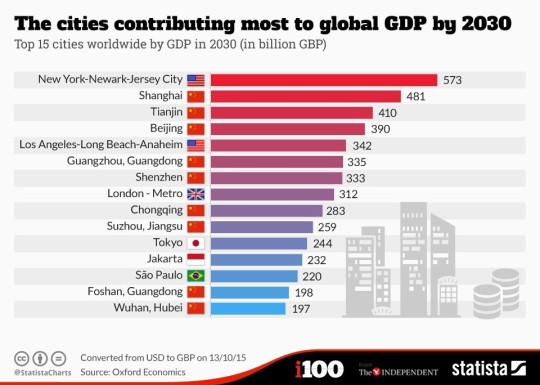
    I’ll end with this chart from his article:

    image

  • The lure of super-places

    image

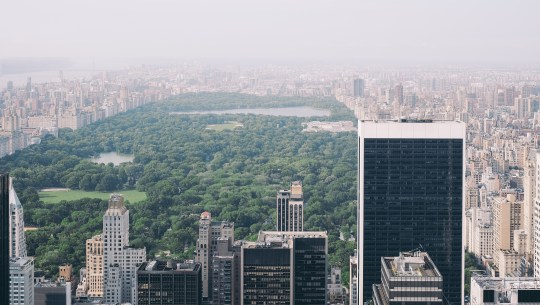
    If you’re a very talented person, you have two choices: you either move to New York or you move to Silicon Valley. This is the message that Peter Thiel delivered to a conference being held in Chicago earlier this month. Not surprisingly, it pissed a few people off.

    Peter responded by saying that he was simply illustrating the “extreme version” of a metaphor about the impacts of globalization and technology. And while it certainly doesn’t sound very nice if you’re sitting in Chicago, or the countless other fantastic cities between the coasts, I can appreciate what Peter is getting at.

    Saskia Sassen is known for coining the term global city. These are cities which play an important role in the functioning of the global economy. But what has happened, she acknowledges, is an even further concentration of activity within a select few “super-places.”

    Here is an excerpt from a Financial Times article by Simon Kuper (2014) talking about Amsterdam’s position in the world:

    “…a new, higher category of cities may now be emerging: global capitals. Amsterdam has risen but New York, London and Hong Kong have risen faster. The Dutch elite is moving to Amsterdam; but many ambitious Dutch people no longer want to join the Dutch elite. They want to join the global elite. That often requires moving to a global capital.”

    Anecdotally, I can say that almost everyone I know who has left Toronto for an opportunity has moved to New York, Silicon Valley, London, and so on. They have moved up the rank of global cities/capitals.

    So while Peter may not have chosen the right way to deliver this message, I do believe it is a message worth delivering.

  • Open for business

    I just received the September issue of Monocle magazine. One of the features I always read is the “Observation” on the very last page. It reads as the editor in chief’s personal blog.

    In this issue he talks about the recent EU referendum and the changes he is making to his business in response to that. Monocle is headquartered in London, but he is now finding it challenging to be “an international media business in a country that hasn’t figured out how it’s going to move forward.”

    His response?

    They are shoring up the Zürich office. They are looking at the possibility of a second bureau somewhere on the continent. And they are similarly looking to increase staff in both Toronto and Singapore.

    When one place closes up, the companies and talent will find other cities that are open for business. 

    As someone who is closing one chapter this week and starting a new one, Tyler Brûlé’s Observation also reminded me of the importance of change. Oftentimes change feels uncomfortable. But that’s not necessarily a bad thing. In fact, it’s more likely a sign that you’re on to something.

    What have you done lately that made you feel uncomfortable?

  • Job Opportunity: London Night Czar

    The City of London is looking for a “Night Czar” to help shape and grow the city as a 24-hour destination. Here’s a snippet from the job posting:

    “The Night Czar will champion the value of London’s night time culture whilst developing and diversifying London’s night time economy.

    Working with the Mayor, the Night Time Commission, local authorities, businesses, the Metropolitan Police Service, Transport For London and other agencies, the Night Czar will create a vision for London as 24-hour city and a roadmap showing how the vision will be realised. The Night Czar will have proven leadership ability, public profile and convening power, plus a thorough understanding of the night time economy and the ability to work in a political environment.”

    I think 2016 will turn out to be the year of the “night mayor.” This trend is really picking up momentum in Europe, as more and more cities look to capitalize on their night time economies.

    The job will pay £35,000 per year for 2.5 days of work per week. The closing date for the application is Monday, September 12, 2016. If you’d like to apply, you can do that here.

    I’ve been writing about this trend all year. Hopefully a decision maker in Toronto is reading this.

  • Should the Olympic Games be held in the same place every 4 years?

    I have argued before that hosting major events, such as the Olympics, can serve as a catalyst for completing meaningful public projects. But there is also an argument to be made that it’s not entirely worth it. The economic legacy is weak. The ROI simply isn’t there.

    Recently Harvard Business Review interviewed a gentleman named Chris Dempsey. Dempsey was a former Bain & Company consultant and the cofounder of the No Boston Olympics organization. He played a big part in Boston withdrawing their bid to host the 2024 Summer Games. Los Angeles ending up taking its place.

    His rationale is as follows.

    The International Olympic Committee was founded on June 23, 1894 by a Frenchman by the name of Pierre de Coubertin. At the time of its creation, the World’s Fair had already pioneered the rotational model of traveling to different cities.

    The most famous of these exhibitions was arguably “The Great Exhibition” held in London in 1851. Indeed, the plate-glass Crystal Palace structure which actually hosted the event was later seen as an important turning point in the history of architecture. It was designed by Joseph Paxton, who was an English gardener and architect.

    Of course, the world was a different place at the end of the 19th century.

    The events weren’t being broadcasted around the world in HD. We didn’t have social media. And transportation costs were high (economist Edward Glaeser reminds us of this in the talk I posted yesterday). So rather than ask people to spend weeks traveling the world by boat, it was decided that the show should travel to them. It should rotate places.

    This made sense then, but does it make sense now? I would love to hear your thoughts on this in the comment section below.

  • Low cost energy efficient homes perched atop of surface parking

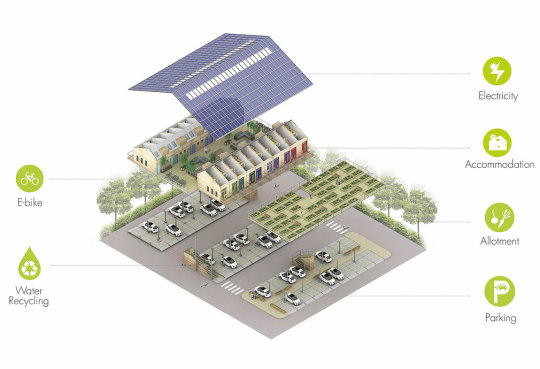
    A regular of this blog recently suggested (in the comments) that I take a look at the London-based design firm ZED Factory. ZED stands for Zero Energy Development.

    The first project that caught my attention was ZED Pod. ZED Pod is a small, low cost energy efficient modular home that is designed to sit atop of surface parking lots. In other words, it’s a way to repurpose under-utilized surface parking without compromising existing parking ratios. All you really need are the air rights. And since the “land” is cheaper, the homes can be cheaper. They can also be easily relocated if the parking lot were to get developed in the future (though they are designed as permanent structures).

    image

    In some ways, there is something perverse about the way that driving and parking have such a profound impact on the urban landscape. Even when it’s buried underground and hidden from sight, the structural column grid needed to layout efficient parking will often carry up through the building impacting suite layouts. We’ll even restrict housing supply when parking requirements can’t be met. Should it be parking or people who come first?

    But cars aren’t going away. And ZED Pod is a clever way of dealing with an existing urban condition – however suboptimal it may be. I found the concept interesting and I thought you all might as well.

    Image: ZED Factory

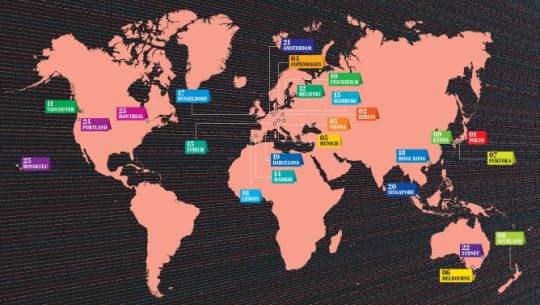
  • Monocle’s Top 25 Liveable Cities — 2016 Edition

    Monocle’s annual survey of the top 25 most liveable cities in the world was just released. It’s now in its 10th year. I found it in my inbox this morning and it was a good reminder that it was about time I renewed my subscription. I’ve been a regular reader of Monocle since 2007, but I let my membership lapse last year.

    Of course, any sort of list like this is going to be subjective. It all depends on the methodology you use. Still, their annual survey is an interesting way to see what each city is up to and where the tides are going. This year Monocle put extra weighting on each city’s nightlife. If you’re not a subscriber, here’s a short video you can watch. It will give you a rundown of all the cities. (I was happy to see Montréal creep onto the list. Incredible city.)

    This focus on the night is something that I’ve been writing about a lot both on this blog and elsewhere. It’s an idea that’s picking up momentum around the world as an economic development strategy. But for whatever reason, uptake seems to be slower here in North America.

    I like how architect Anna Dietzsch puts it in this video. She says that Rio may have the beaches, but Sao Paulo (where she’s based) has the night. That’s exactly how cities should be thinking about this opportunity. It used to be that cities thrived almost entirely because of location, waterways, transport, and other natural features (example: Buffalo). But increasingly, it’s becoming about things like nightlife.

    Vancouver may have the mountains, but Toronto has…

    Image: Monocle