Daily insights for city builders, delivered every morning at 6 AM ET. I’m Brandon Donnelly — a Toronto-based real estate developer and founder of Globizen. I’ve been writing here since 2013.

Tag: london

  • Editions of Edition

    A few weeks ago Surface Magazine interviewed Ian Schrager. If you don’t know who Ian Schrager is, you should look him up. He started Studio 54 in New York (along with Steve Rubell) and is largely credited with inventing the boutique hotel genre. His latest project is Edition Hotels, which launched in London in 2013 and in Miami in 2014.

    What I found particularly interesting about the interview are the “serious snafus” that Edition experienced at the outset. There was a project in Waikiki and a project in Istanbul. Both failed. Here’s a guy who invented the genre and had partnered up with Marriott to pioneer a new brand. And it wasn’t until Edition London that they were able hit their stride.

    I say all of this not to poke fun at their failures. Nobody should do that. Poke fun at not trying instead. My point is the exact opposite. To create something new and amazing, such as Edition, you often have to subject yourself to a few scrapes and bruises along the way.

  • The geography of superstars

    We often talk about superstar cities such as New York, London and, in the case of tech, San Francisco. But what about the superstar people that drive these economies?

    Aaron Renn recently wrote a post called “The Superstar Gap”, where he argues that the interior of the U.S. is suffering from a big handicap because of its lack of superstars. Chicago is one example he gives. Very good, but not the best.

    He also cites a 2010 analysis by Carl Wohlt that shows the “100 Most Creative People in Business” predominately living in the West and Northeast, compared to the Midwest and South.

    This is interesting because – if we assume this gap to be true – it gets me thinking about a number of important questions:

    • Is it that the interior isn’t effectively fostering superstar talent?
    • How much superstar talent is actually latent and untapped?
    • Is it that superstar talent is getting sucked into a select few superstar cities, away from other places? Definitely happening.
    • How many superstar cities (filled with superstar people) can sustainably exist in today’s world?

    Now by definition, superstar talent is going to be a smaller segment of the population – it’s one tail of the bell curve. 

    But I do think we should be careful not to assume that the raw talent doesn’t exist in certain cities. People and place are linked, and superstar cities are arguably just empowering new forms of individual superstardom.

    If we are to use successful startups as one measure of superstardom, it’s important to keep in mind that they are incredibly fragile in their nascent stages. The right people need to come together. The right funding has to fall into place. And the list goes on. 

    Below is an excerpt from a 2006 essay by Paul Graham (Y Combinator) called, Want to start a startup?

    Successful startups are almost never started by one person. Usually they begin with a conversation in which someone mentions that something would be a good idea for a company, and his friend says, “Yeah, that is a good idea, let’s try it.” If you’re missing that second person who says “let’s try it,” the startup never happens.

    That someone might have been a superstar.

  • Escalator etiquette

    image

    I am one of those people that gets annoyed when people don’t follow proper escalator etiquette. The etiquette being: stand on the right; walk on the left. Some cities – London and Tokyo come to mind – are draconian about this.

    But it turns out that this is not always the best way to optimize throughput. A recent study conducted in London found that during peak periods – such as the morning rush hour – it is actually better for everyone to stand still.

    What they found was that when 40-60% of people chose to walk up on the left, maximum throughput was 115 passengers per minute. But when everyone stood still maximum throughput increased to 151 passengers per minute.

    The reason for this is that walking takes up more space than staying put on one step. When demand is low, this has no impact on capacity. But as soon as people start slowing down to avoid the set of legs in front of them, a bottleneck occurs and capacity starts to drop. 

    This is not dissimilar to what happens in traffic jams. Imagine if during peak periods all of the cars could separate themselves by only a few inches and travel at exactly the same (slow) speed. That’s not going to happen until self-driving cars hit the road, but it would be more efficient than the current chaos of distracted drivers starting and stopping.

    All of this being said, since this finding only applies during very busy times, I plan to continue being annoyed when proper escalator etiquette is not followed.

  • The winter garden

    Balconies, outdoor spaces and, more broadly, the relationship between inside and outside are important considerations in multi-family residential design.

    Earlier this year, Mansion Global ran a piece talking about a recent trend in cities such as New York, Toronto, and London, where high-rise outdoor spaces often go unused because of the wind and the cold. It’s called the winter garden.

    “So luxury developers are trying an option that they tout as both lush and cozy: the winter garden. Enclosed by glass on three sides, and often designed as an alcove off the living room or bedroom, these spaces can feature fireplaces, radiant-floor heating and sliding glass doors to maximize the breeze, weather permitting. For developers, the amenity can bump up asking prices, because winter gardens add interior square footage to a unit.”

    This, of course, is not a new idea. In fact, solariums are very common in Toronto condos of a particular vintage. But they are rare today, for probably a few reasons. Policy changes removed the incentive to build these spaces. Unit sizes have come down. And many people like the idea of being able to step outside.

    The other way to think about this trend, though, is that it’s about creating adaptability within the skin of the building. You want to be hermetically sealed off in the winter, but you want the opposite in the summer and/or swing seasons. This is about making indoor spaces feel more like outdoor spaces when you want them to be that way.

    There are countless examples of vernacular architecture figuring out how to strike this balance. Today we typically think in terms of mechanical systems. But I love the idea of a building that responds to the changing seasons.

    Thanks for sharing this article with me, Rick.

  • Why what happens after dark matters to creative industries

    I have been very vocal on this blog about the importance “nighttime economies” for cities and for its creative industries. So I continue to be encouraged by all of the attention that this topic is getting over the last year or so.

    Recently, the Creative Industries Federation released a report called: Because the Night – Why what happens after dark matters to the creative industries. It’s a look at creative industries in the UK and the role that nightlife plays in supporting them.

    Here are some of their takeaways:

    Creative industries in the UK have been growing faster than any other sector since 2008. CIF estimates that 1/11 people now work in this space, with the number being much higher in London: 1/6.

    The value of restaurants, clubs, bars, pubs, live music venues, and theaters, is that they are places to connect, showcase talent, develop ideas, and so on. They are also critical in attracting top talent because, well, people not surprisingly like to have fun.

    In the span of one decade (2005 to 2015), it is estimated that the UK lost roughly half of its nightclubs. The total went from 3,144 to 1,733. From 2007 to 2015, London lost 35% of its “grassroots music venues”, which, historically, have served to support emerging artists.

    Arguably, some of this may be due to changes in consumer preference and broader shifts in terms of the way people discover/consume music. But it’s also thought to be because of rising urban rents, concerns around noise and revelry, and so on.

    Still, the nighttime economy in the UK is thought to be worth £66 billion per year and to employ some 1.3 million people. It’s an integral part of our urban economies and so it’s time we acknowledged and celebrated it as such.

  • The Green View Index

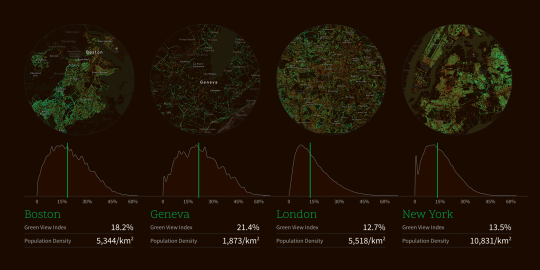
    The MIT Senseable City Lab recently developed something called the Green View Index. It is a measure of a city’s tree canopy. Below are the GVIs for Boston (18.2%), Geneva (21.4%), London (12.7%), and New York (13.5%). You may have to zoom in.

    image

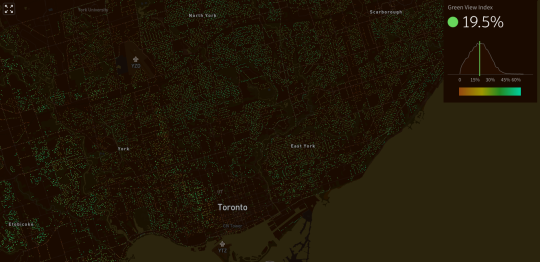
    And here is a screenshot of Toronto. We have a GVI of 19.5%.

    image

    The index was developed by methodically scanning for trees in Google Street View panoramas. The reason street view was used – as opposed to aerial photography – was so that they could capture the human experience at street level.

    All of MIT’s interactive city maps can be found here. It’s also interesting to pan around and see which neighborhoods are the greenest – particularly if you are familiar with the city.

    One thing I noticed is that large green spaces such as Central Park, High Park, and Stanley Park don’t show up as very green. And that’s because the index uses car-based street view data. I feel like these green spaces should count for something though.

  • Photographing architecture studios

    Marc Goodwin – who is part of a photography studio called Archmospheres – has an ongoing project where he photographs the studios of architects. 

    He has photographed well known practices such as MAD, Renzo Piano, and David Chipperfield, as well as a number of geographic niches such as Paris architecture studios, Nordic architecture studios, and London architecture studios

    He also varies the size of the firm. Some of them only have a few people working out of a small streetfront retail space.

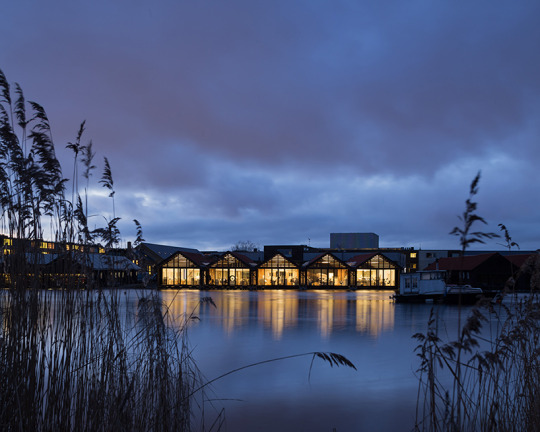
    As an architect, you are pretty much required to have a cool studio space. So this is certainly an interesting photography project to take on. The photo at the top of this post is 3xn in Copenhagen.

    Image: Marc Goodwin via Designboom

  • And the award for the tallest building of the year goes to…

    The Guardian recently published an article on vanity height in skyscrapers. What this is referring to is the unoccupied portions of tall buildings which are built purely for vanity reasons – that is, to increase the face height of the building and claim some superlative title.

    Example: 

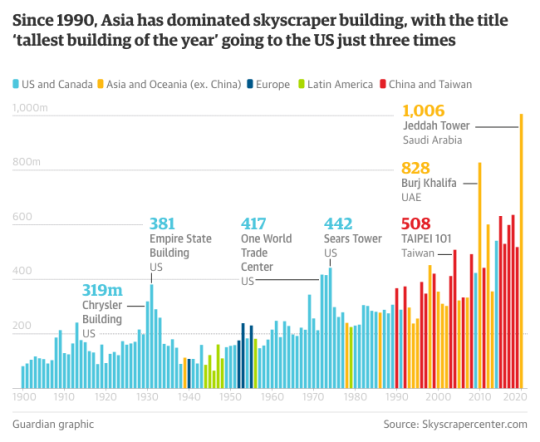
    The tallest building in the world is currently the Burj Khalifa in Dubai. It’s 828m tall. To put that into perspective, the CN Tower in Toronto is 553m. But according to the Council on Tall Buildings and Urban Habitat, 29% of the Burj Khalifa’s height is actually unoccupied or “vanity space.” In other buildings, such as the Burj al Arab (also in Dubai), the amount of unusable space is as high as 39%. 

    For the purists out there, this of course raises the question of what should should be counted when assessing building height. Should it only be spaces where humans typically inhabit? The CN Tower has a lot of unoccupied space, which is why it is frequently excluded from these sorts of ego rankings. 

    But semantics aside, this is obviously not a new phenomenon and it’s interesting to think about this race to the sky as a proxy for what’s going on in the world. Below is a chart showing which regions have been able to lay claim to the “tallest building of the year” since 1900. 

    Since 1990, it has been all about Asia and Oceania and China and Taiwan…

  • Blaze Laserlights

    This is a great idea:

    It is a bicycle light – by a London-based company called Blaze – that forward projects a bicycle symbol 6m in front of you as you ride. It also has a really bright white light.

    They will be (or have been) installed on London’s entire bike-share fleet and they are currently being piloted in New York City. Here is a video of it in action.

    One of the things I always watch for when I’m cycling is being in a car’s blindspot. Signalling seems to be a dying art, so you never know when someone might turn into you. If this light is able to project in front of the car and signal to the driver that a cyclist is nearby, then I could see this being a big safety improvement. Of course, this is just one scenario where a light like this might be helpful.

    Have any of you tried it?

    Image: Blaze

  • Yardhouse for sale

    The London-based architecture firm, Assemble, has recently put their old studio space up for sale at

    £150,000 (building only). It’s called the Yardhouse.

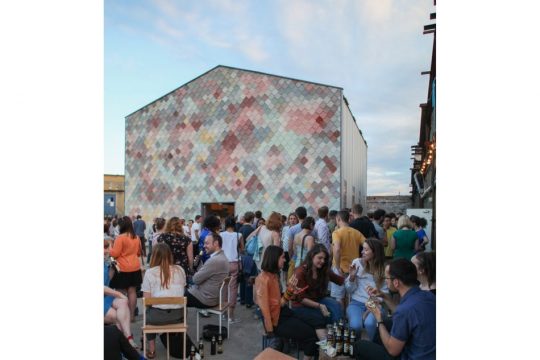
    Completed in 2014, the 250 square meter building was designed and constructed by the firm using modest and, in some cases, prefabricated materials. Total construction costs were £291/m².

    The building has since been disassembled and put into storage until a buyer comes along, which tells you a lot about how it was built in the first place.

    But what’s great about the building is that, despite its modest roots, it was highly celebrated. The front facade is clad in colorful concrete tiles, which supposedly made it one of the most Instagrammed buildings in London.

    Here’s a photo of what that looked like when the building was still put together:

    image

    The front faced a “public yard” – hence all of the people in the photo and why it seems appropriate to call it a Yardhouse.

    According to The Modern House (they have the listing), the building is already under offer. So if you were in the market for a Yardhouse clad in multicolored concrete tiles, you may be too late.

    But perhaps you’ll draw some inspiration for your next project.

    Image: The Modern House