Daily insights for city builders, delivered every morning at 6 AM ET. I’m Brandon Donnelly — a Toronto-based real estate developer and founder of Globizen. I’ve been writing here since 2013.

Tag: john tory

  • What happened in 2022 and how I did on my predictions

    It has become tradition around here that at the end of each year I write down my predictions for the following one. And in 2022, I did that here. The overarching point of writing something like this down publicly is not necessarily to be right (because you can do that through obvious predictions). The point is to dedicate time to thinking (which is oftentimes hard to do throughout the year), to search for non-obvious things, and to generally be okay with being wrong. So I plan to do this again in the coming weeks for 2023.

    But first, let’s see how I did with my 2022 predictions:

    1. COVID: I argued that 2022 would be the year that the pandemic becomes endemic and it reaches a point where it no longer factors into decision making in the same way that it has since 2020. Some of you may disagree whether this is a good thing, but I would still say that this happened, at least in this part of the world. I started the year in lockdown here in Toronto and I ended the year having taken multiple overseas trips where testing was no longer required. (Right)
    2. Return to office: I was kind of close. I thought that the majority of people would be back in their offices by September. I didn’t say that hybrid/flex work was going to disappear, but that we would see a great return. That did happen, according to my super scientific Jimmy the Greek Reopening Index. But if you look at the latest swipe card data for the 10 largest US cities, average occupancy is hovering just below 50%, which is not a majority. (Wrong)
    3. Recreational/fringe housing: I felt very strongly that we would see a pullback in residential real estate this year, specifically recreational properties and properties in tertiary markets. This 100% happened, but I’ll be honest in that I was not thinking about the interest rate hikes that we saw. I just saw it as a pandemic bubble. I also thought that apartment rents would do very well and surpass pre-pandemic levels. This happened in many markets. (Right)
    4. Return of travel: Yup. (Right, but maybe too obvious?)
    5. Intensification of single-family home neighborhoods: This continued to be an important topic in 2022. Did we see some a tipping point-like moment, like I had predicted? I think it depends on the market, but here in Toronto we did see things like Bill 23, as well as additional efforts on the part of Mayor John Tory. (Right)
    6. Autonomous vehicles: Progress was made this year. You can now hail an autonomous taxi in places like San Francisco. But I also thought that this would be a fantastic year for Uber as the world reopened, and that they’d finally become profitable. As of Q3 of this year, that had not happened. (Wrong)
    7. Public transit and micromobility: I got the public transit ridership piece correct. I assumed that ridership levels would remain depressed. Perhaps an obvious one. But I also figured that e-scooters would be one of the main beneficiaries. While it is true that e-scooters remain very popular, particularly with French people, we did see ridership decline in the US, as the availability of cheap capital waned. (Mostly right)
    8. NFTs and augmented reality: There’s a lot happening in this digital world and I continue to be incredibly bullish. But we are certainly in a “crypto winter.” I also thought that Apple would announce something big related to augmented reality this year, but supposedly that has been pushed to next year. (Wrong)
    9. Climate change and carbon prices: I thought that the price of carbon on the EU’s Emissions Trading System would surge this year. It did not. Right now it’s looking like it’ll end up being fairly flat for the year. Of course, I also had no idea that Russia would do terrible terrible things to Ukraine, which has had dramatic impact on energy markets. (Wrong)
    10. More crypto (Ethereum, Bitcoin, and Solana): Well, I got this last one really wrong. ETH is down ~70% over the last year relative to the US dollar. I was not predicting a “crypto winter.” And I did not know that Sam Bankman-Fried was operating a weird cult-like ponzi scheme out of a penthouse in the Bahamas. None of this changes my views on crypto, but I was still wrong in 2022. (Wrong)

    Looks like I’m somewhere around 5/10.

    Stay tuned for my predictions for 2023. In the meantime, if any of you have predictions of your own, I would love to hear from you in the comment section below or on Twitter.

  • A story about Toronto

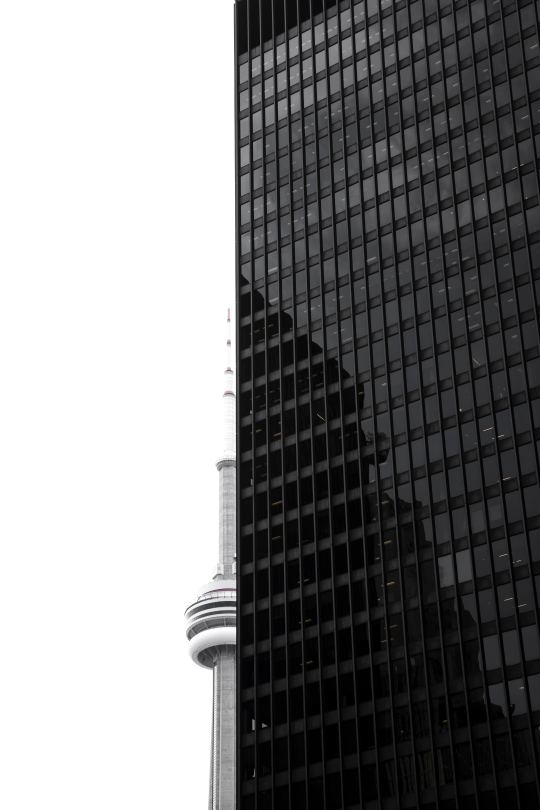
    Marcus Gee of the Globe and Mail recently published “a made-up story about Toronto that never appeared, but should.”

    It goes like this:

    Toronto city hall is pressing a prominent developer to put up a taller building.

    Mayor John Tory is telling Big City Condo Corp. that the condominium it has planned for the downtown corner of Maple and Oak streets is simply too small. The proposal calls for a 25-storey residential tower. Mr. Tory said it could easily rise to 40 or even 50 storeys.

    He dismissed complaints from locals who said the tower would overshadow the neighbourhood and put too many more cars on the street. The intersection is well served by public transit, with two lines crossing there. The mayor called it a golden opportunity to create urban density.

    He insisted the city must build up instead of out if it wants to avoid more sprawl. “We love tall buildings,” he said. “We need more of them. We can’t keep spreading out and out and out. We need to grow up, and I mean that quite literally.”

    Again, this is made-up. And if you’re from Toronto, you knew that. 

    We are still grappling with the urban intensity that should come along with being an important global city.

    Photo by Redd Angelo on Unsplash

  • This is not right

    I have largely avoided commenting on politics and Trump on this blog, but at this stage it is almost impossible to do that.

    Donations are starting to pile up for the American Civil Liberties Union (ACLU) as the tech community, and many others, begin to respond to Friday’s executive orders. Lyft announced a $1 million contribution to the non-profit group.

    Today, venture capitalist Fred Wilson wrote: Make America Hate Again. And yesterday, his business partner Albert Wenger wrote: Misleading the World on Immigration.

    At 6 AM this morning, Richard Florida started a tweet storm where he argued that “Trump’s immigration insanity” will fundamentally threaten the core of America’s innovation hegemony. 

    (He also argued that Canada, and more specifically Toronto, serve to “gain substantially”, as there will no doubt be a doubling down on tolerance to attract the best talent from around the world.)

    The Canadian tech community penned an open letter to reinforce the message that, here in Canada, diversity is our strength. This echoes similar messages from Prime Minister Justin Trudeau and Mayor John Tory.

    Mass protests have broken out at US airports (links to photos) spanning San Francisco to New York. 

    And I am seeing folks from Toronto offer up their homes (publicly on Twitter) to anyone who might be stranded at Pearson International Airport as a result of the orders. Many have even tweeted out their phone numbers.

    Everywhere I look this weekend I am seeing these sorts of messages. So while I could remain quiet, that doesn’t feel right. And that’s because what is happening is not right.

  • Province rejects Toronto’s proposed road toll plan

    Earlier this week I was in an Uber heading up to Charles Street and the driver made a comment to me. He said that since he moved to Toronto in the 90′s, traffic has gotten progressively worse every single year. He continued on to say: and yet we continue to build, build, build.

    My response won’t surprise anyone who reads this blog. I said that Toronto has become a far more exciting city since the 90′s because of intensification (though 1992 and 1993 were pretty awesome) and that the problem is our mental model. We haven’t moved beyond the car as the perceived solution to urban mobility.

    A perfect example of this is what just happened with the province vetoing Toronto’s proposed road toll plan. 

    Firstly, I fully agree with Marcus Gee of the Globe and Mail that this is both an act of cowardice (the province gave every indication that they initially supported the plan) and an act of arrogance (we are talking about roads owned by the city, not the province).

    I also find it incredibly frustrating that Toronto cannot control its own destiny. This is a mistake and it needs to change if we – and the rest of the cities in this great country – are to continue competing at a high level in this urban century.

    But to my initial point, the problem with this move is that it signals a status quo mental model. It is a clear reluctance to make any sort of bold moves to move Toronto in a new direction. I guess we are happy with the current trend line. More traffic.

    We shouldn’t be.

  • Toronto mayor proposes road tolls, finally

    When I wrote yesterday’s post about road tolls, it hadn’t been announced that Toronto Mayor John Tory was going to call for road tolls on both of the highways coming into downtown. That didn’t leak until late in the evening. So I was just writing another post on a topic that I care about.

    Today, however, that announcement was made and the proposal is a flat $2 toll on both the Gardiner Expressway and the Don Valley Parkway. It is expected that this could bring in close to $200 million a year in new revenue for the city – all of which would be dedicated towards transit and roads. Good.

    First, I want to applaud the mayor for coming out in support of road pricing. I didn’t agree with him on the Gardiner East, but I agree with him on this – mostly. It is a bold move.

    The reason I say mostly is because I hope that we don’t simply default to a fixed and blunt road toll. There are more sophisticated options out there, such as variable pricing models that change based on demand/congestion levels.

    Here’s a post that explains how that works and why I think it’s a good model.

    With this approach, it becomes more of a congestion charge rather than a toll. It also gives commuters the option of driving during off-peak times to save money. And if we implemented something like this, I am sure that we would see employers and office hours adapt. More on this in the above post.

    Still, I absolutely believe that it’s a step in the right direction for this great city. So thank you Mayor Tory.

  • The most fascinatingly boring city in the world

    The Guardian Cities UK is currently focusing on all things Canada for a special week-long series. The first post is up and it’s about why Toronto is “the most fascinatingly boring city in the world.” The piece is by Stephen Marche.

    I don’t agree with everything in the essay – or maybe I just despise being called boring, steady, and predictable – but there are a number of great gems that I would like to reblog today. Here are the 5 that stood out for me.

    1. Chicago vs. Toronto:

    “What Chicago was to the 20th century, Toronto will be to the 21st. Chicago was the great city of industry; Toronto will be the great city of post-industry. Chicago is grit, top-quality butchers, glorious modernist buildings and government blight; Toronto is clean jobs and artisanal ice-creameries, identical condos, excellent public schools and free healthcare for all. Chicago is a decaying factory where Americans used to make stuff. Toronto is a new bank where the tellers can speak two dozen languages.”

    2. London vs. New York vs. Toronto Bankers:

    “In London and New York, the worst stereotype of a banker is somebody who enjoys cocaine, Claret and vast megalomaniac schemes. In Toronto, a banker handles teachers’ pension portfolios and spends weekends at the cottage.”

    3. Montreal vs. Toronto:

    “I was 19 when he said that, and I knew even then that for the rest of my life, Canada’s future would be built on money and immigrants. I wasn’t wrong. Most Canadian business headquarters had already taken the five-hour drive west. After 95, the rest followed. Montreal decided to become a French-Canadian city. Toronto decided to become a global city.”

    4. The last time Toronto built a white elephant subway line:

    “On any given morning on the Sheppard subway line in the north of the city, you can sit down in perfect peace and order, although you will find little evidence of good government. As the latest addition to Toronto’s fraying infrastructure, the Sheppard subway is largely untroubled by urban bustle. The stations possess the discreet majesty of abandoned cathedrals, designed for vastly more people than currently use them, like ruins that have never been inhabited. Meanwhile, in the overcrowded downtown lines, passengers are stacked up the stairs. The streetcars along a single main street, Spadina, carry more people on a daily basis than the whole of the Sheppard line, whose expenses run to roughly $10 a passenger, according to one estimate. A critic has suggested that sending cabs for everybody would be cheaper.”

    5. On Mayor Tory:

    “The current mayor, John Tory, is not an idiot, although he is hardly a figure of the “new Toronto”. He represents, more than any other conceivable human being, the antique white anglo-saxon protestant (Wasp) elite of Toronto, his father being one of the most important lawyers in the city’s history. The old Wasps had their virtues, it has to be said – it wasn’t all inedible cucumber sandwiches and not crying at funerals.”

  • #WeTheOther

    We may not all agree on things like bike lanes and transit, but if there’s one thing that can generally unite a city it’s playoff sports. 

    I love the solidarity that it creates. You may have nothing else in common with the person sitting next to you at the bar, but suddenly you’re best friends because your team is winning.

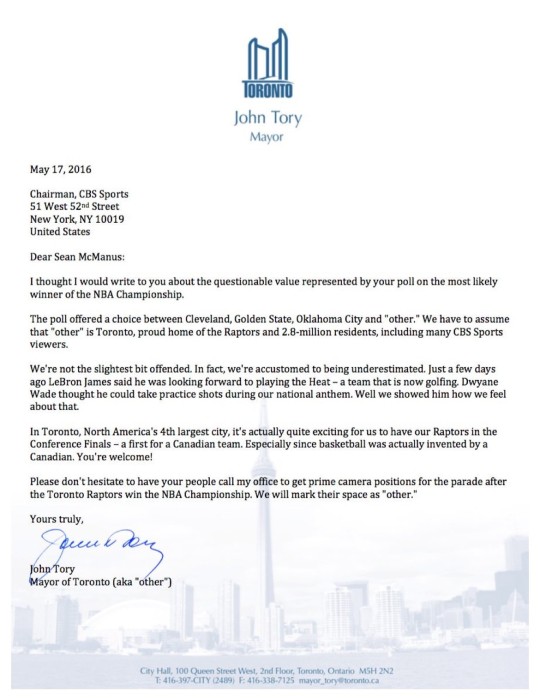
    As I write this post, #WeTheOther is currently breaking the internet after CBS Sports ran a cheeky online poll asking: Who will win the NBA title? The four options were:

    1. Warriors
    2. Thunder
    3. Cavaliers
    4. Other

    For those of you who don’t follow basketball, there are only 4 teams left in the NBA playoffs right now! So in what was likely a deliberate snub to the Toronto Raptors, CBS conveniently obfuscated them in their poll.

    Here’s how Mayor John Tory quickly responded:

    What would sports be without the trash talking?

  • Why Toronto needs a night mayor

    Recently I wrote about the first Night Mayor Summit being held in Amsterdam. As part of this, I spoke about Amsterdam’s first night mayor – Mirik Milan.

    Since then (but obviously not because of my post), the idea has seemingly taken off. Below are a couple of excerpts from a recent Guardian article.

    This pragmatic and classically Dutch notion is now being copied across Europe: Toulouse, Zurich, Paris as well as several other Dutch cities have night mayors too.

    This week the mayor of London, Boris Johnson, announced plans for a “Night-Time Commission”, a six-month assessment of how to protect and manage the city’s £66bn night-time economy which is likely to recommend the creation of a “night-time champion” role. 

    Berlin is considering it too, and in April, Amsterdam will host the first global Night Mayors’ Summit.

    Why is this happening? Simple:

    “Late-night people are typically young, educated, creative, entrepreneurial – people you want in your city, and who work in the creative industries and startups you also want. If places like Berlin have flourished, it’s not just because of low rents. It’s because they’re nightlife capitals.”

    So if you’re reading this, Mayor John Tory, now is probably your last chance to make Toronto a North American leader in this regard. 

    It’s great that we are trying to push the Toronto – Waterloo region as a global startup hub, but so is every other major city and region in the world. A focus on startups is so commonplace in today’s economic development strategies, that at this point it almost feels meaningless. What are we going to do to stand out in this competition for the world’s best talent?

    If everyone believes something to be true – such as, there’s value in having a robust startup ecosystem – then it’s no longer innovative. It’s just the way things are. To take it to the next level, we’re going to have to do things that will probably feel uncomfortable at first – particularly for old establishment Toronto.

    I’m not saying that having a night mayor is going to be the silver bullet for our startup ecosystem. There’s no such thing. But I am saying that it should be one component of our larger strategy. 

    Because already there’s a growing number of European cities who have come to this one simple realization: people are drawn to kickass places.

    If you agree with this post, I would encourage you to leave a comment below and also tweet the Mayor of Toronto.

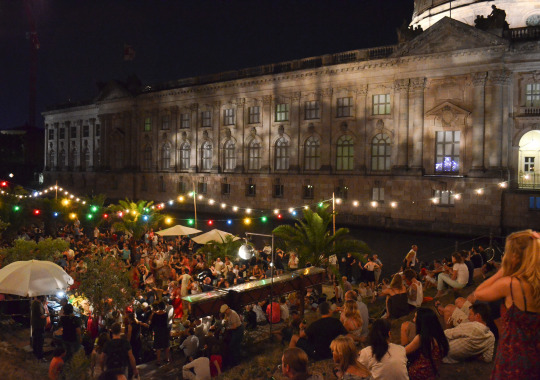
    Image: Berlin nightlife by Tom Stromer

  • 3 changes to John Tory’s SmartTrack transit plan

    Last week Oliver Moore of the Globe and Mail announced that Toronto mayor John Tory’s SmartTrack transit plan is evolving to feel less like SmartTrack and more like what Metrolinx had been planning all along.

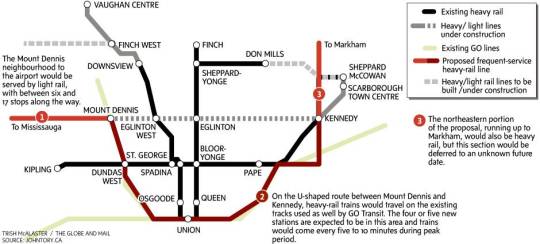
    Here’s the map from the Globe and Mail:

    The 3 big changes are as follows (and numbered accordingly on the above map):

    1. 

    The western end of the line will be replaced by an extension of the Eglinton-Crosstown LRT (currently under construction) running from Mount Dennis to Pearson Airport. This is what was originally proposed.

    2. 

    The “U” running from Mount Dennis in the west, down through downtown, and up to Kennedy in the east is what remains of the original SmartTrack line and will operate as some sort of “heavy rail” service on existing GO Transit lines. The original election campaign plan was to run trains every 15 minutes, but that was deemed too infrequent to attract riders, so now Metrolinx and everyone is trying to figure out how to get it down to every 5-10 minutes and feel more like subway.

    3. 

    The extension north of Eglinton Avenue to suburban Markham (in the northeast) is being pushed out and will be dealt with sometime in the future. Keeping the first phase of SmartTrack south of Eglinton on both ends is beneficial in avoiding the issue of SmartTrack and the Scarborough subway extension cannibalizing each other. (In my opinion, this issue is a perfect example of what happens when transit planning becomes too political.)

    The net result is a plan that is looking less and less like the original SmartTrack. I’m not complaining though because I have never been a big supporter of SmartTrack. I have always thought we should be focusing on the downtown relief subway line and on allowing Metrolinx to just execute on its regional express rail (RER) strategy.

    For more on this topic, check out Steve Munro’s post, SmartTrack: Now You See It, Now You Don’t! He’s far more of an expert than I am on these sorts of issues.

  • The London Crossrail

    On Thursday afternoon the mayor of Toronto, John Tory, was in London meeting with their mayor, Boris Johnston, and talking about Toronto-London business relations, the economy, and transit.

    Here is the tweet:

    //platform.twitter.com/widgets.js

    On the topic of transit, the big item to see and discuss was The Crossrail. For those of you who might not be familiar with it, here are a few bullet points from their website:

    Crossrail is Europe’s largest construction project – work started in May 2009 and there are currently over 10,000 people working across over 40 construction sites.

    The Crossrail route will run over 100km from Reading and Heathrow in the west, through new tunnels under central London to Shenfield and Abbey Wood in the east.

    Crossrail will transform rail transport in London and the south east, increasing central London rail capacity by 10%, supporting regeneration and cutting journey times across the city.

    Crossrail will bring an extra 1.5 million people to within 45 minutes of central London and will link London’s key employment, leisure and business districts – Heathrow, West End, the City, Docklands – enabling further economic development.

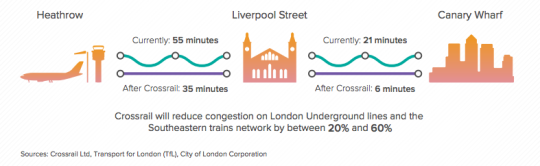
    And below is a neat diagram that I found in this City of London report. I think it does a good job summarizing some of the spatial impacts of The Crossrail.

    image

    In the past I’ve been negative about John Tory’s SmartTrack proposal, which is clearly inspired by The London Crossrail. I had my reasons for that. But I want to be clear that I am not in any way negative on Regional Express Rail as a mobility solution.

    Toronto would benefit greatly from RER and Metrolinx is working diligently to deliver it to the region. I can’t wait for that to happen so I can drive even less than I already do.