Daily insights for city builders, delivered every morning at 6 AM ET. I’m Brandon Donnelly — a Toronto-based real estate developer and founder of Globizen. I’ve been writing here since 2013.

Tag: john tory

  • Teaming up to fix Toronto’s traffic troubles

    image

    “This will be a game changer and will establish Toronto as a leader in running a truly smart city.”
    – John Tory, Mayor of the City of Toronto

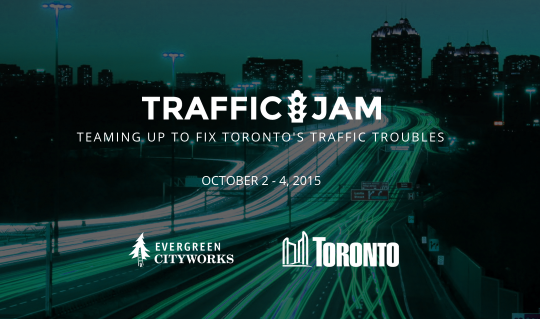
    Yesterday I registered for a hackathon called TrafficJam that’s taking place this October 2 – 4, 2015 here in Toronto. It’s being organized by Evergreen CityWorks and the City of Toronto, with the goal of fixing Toronto’s traffic troubles.

    Tickets are free, but going fast. If you’re interested in this sort of thing, I would encourage you to sign up today. And if you do register or are already registered, drop me on a line so we can connect. I’m excited to see what kind of solutions we’re all able to come up with over the course of a weekend.

    But as I was registering and reading through the website, I couldn’t help but think about some of the traffic problems that we won’t be solving over the hackathon weekend, namely the politicization of transportation planning in this city.

    As an example of that check out a post by transit blogger Steve Munro called, The Vanishing Relevance of SmartTrack

    SmartTrack is the transit platform that Mayor John Tory ran on last year. And this post explains why it is unlikely to achieve its pitch promises.

  • Gardiner East vote shows that Toronto is not yet ready to be an urban leader

    image

    Today is very sad day for Toronto. 

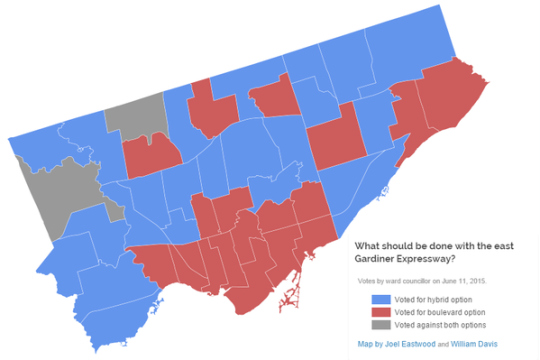
    After 2 days of debate, City Council voted this afternoon, 24-21, in favor of rebuilding the elevated Gardiner Expressway East (”hybrid” option) that runs along the city’s eastern waterfront.

    And once again, Toronto is largely divided. See above image prepared by Joel Eastwood and William Davis.

    It’s the old city of Toronto (who uniformly wanted the elevated highway replaced with a boulevard) versus the rest of the city (who for the most part voted for the hybrid).

    I can’t begin to tell you how deeply disappointed I am by not only the outcome, but also by how it happened and why it may have happened. For all of our talk about being a progressive global city, today we are clearly not that. 

    Because more than a vote on what to do with the Gardiner East, today was a vote on how we believe we should be building this city for the future. 

    When the Gardiner East was first built, the vision was one of fluid private mobility, where it would be possible to quickly circle around and across the city on an endless sea of highways. Detroit was doing it. Baltimore was doing it. Everybody was doing it.

    In other words, we were building our environment around the car. And our primary – some would say singular – focus was to ensure that the car could move unencumbered around the city. That’s why Toronto is now home to the busiest and one of the widest highways in the world.

    But despite all this, Toronto remains crippled by gridlock. And so does every other big city city in the world that has bet on cars as the solution. Why is that?

    Because that model doesn’t work.

    The I-10 Katy Freeway in Houston is 26 lanes at its widest point. It is the largest highway in the world by number of lanes. But from 2011 to 2014, commute times in some sections increased by as much as 51%. Is that because they haven’t built enough highway? How much is enough?

    By comparison let’s look at a city that has bet on transit as the solution: Tokyo. 

    The metropolitan area of Tokyo is approximately 37.8 million people. That’s more than the entire population of Canada and by most accounts is the largest urban region in the world. But despite its size, Tokyo is consistently ranked as one of the most livable cities in the world and also one of the most efficiently run.

    Interesting.

    So when I heard Councillors going on today about how a vote for the “hybrid” is a vote not to increase congestion and gridlock, it became abundantly clear that many – apparently most – people in this city still do not appreciate what it is going to take to get us efficiently moving as this region approaches 10 million people by 2041.

    This should not have been a debate about 3 minutes. That, as I’ve said before, is a red herring.

    Of course, there was lots of lip service to transit. Many seemed to agree that transit is the future. And some even went so far as to say that removing the Gardiner East and replacing it with a boulevard is the right thing to do, but that we simply can’t do it now because we haven’t made the requisite investments in transit. 

    If transit is truly what we want, then we why don’t we take the boulevard savings and put it directly into transit?

    To me it’s like saying: I really want to be homeowner, but I can’t afford it right now. So instead, I’m going spend more on rent so that I can burn through more money and make it even more difficult for myself to eventually become a homeowner.

    Because that is what happened today. 

    We voted to overspend on a stretch of elevated highway that is used by a small sliver of downtown commuters (~3%), instead of replacing it with a cost-effective surface boulevard (with similar road capacities) and then prioritizing the proven solution to urban congestion: transit.

    At the same time, we also made a number of other things clear in today’s vote. 

    We made it clear that cars matter more than our city’s public realm; that cars matter more than our waterfront revitalization plans; that cars matter more than our environment and our “efforts” to reduce GHG emissions; and, frankly, that cars matter more than our overall quality of urban life.

    I believe that cars will always be a part of our cities, but I don’t believe in putting them ahead of you and I. I guess old habits die hard. That my friends, really sucks.

  • 14 CityBuilders come together in support of removing the Gardiner East

    This will probably be my last Gardiner East post before the decision goes to City Council next week on June 10th. But I have such good news that I need to share it with you all.

    This morning 14 “CityBuilders” came together for the first time in support of removing the elevated Gardiner East and replacing it with a surface boulevard. They are real estate developers, investors, and other prominent business leaders in the city. And they sent a letter this morning to every single Toronto City Councillor outlining their position. 

    I can’t tell you how thrilled I am to see this happen, so I’d like to call out each and every member of the CityBuilders. They are (in alphabetical order):

    1. Castlepoint Numa
    2. Cityzen Development Corporation
    3. Context Development
    4. Continental Ventures
    5. Daniels Corporation
    6. Distillery Historical District
    7. Dream Unlimited Corporation
    8. Greybrook Capital and Greybrook Realty Partners
    9. Kerbel Group Inc.
    10. Manulife Real Estate
    11. QQE 162
    12. Streetcar Developments
    13. TAS
    14. Tridel Group of Corporations

    These are some of Toronto’s most important city builders and I am sure this will get the attention of both Mayor John Tory and the rest of City Council.

    If you haven’t yet signed the Gardiner East petition that Stephen and I started, please do so by clicking here.

    Happy Friday 🙂

  • Guest Post: Three minutes that rule the world – Will demolishing the Gardiner East actually make traffic worse?

    Today on Architect This City, we have a guest post by Darren Davis, who is a transport planner in Auckland, New Zealand. He’s a regular commenter on this blog, and I know he’s been following the Gardiner East debate quite closely – as many urbanists around the world are. I appreciate him offering and taking the time to write this piece. Thank you.

    ——————————–

    The decision this month on whether to demolish the Gardiner East Expressway and replace it with a surface boulevard or to rebuild it with a similar elevated structure will be a watershed moment for Toronto, akin to the decision not to have freeways in the urban core of Vancouver in the late 1970s.

    There are numerous good reasons why removing the Gardiner East elevated structure is the right move for Toronto, covered previously by The Globe and Mail and in the Council for Canadian Urbanism’s open letter to Toronto City Council. If you aren’t aware of these, I strongly recommend reading them. 

    Also of note are two things:

    1. Just 3% of Downtown commuters drive on the Gardiner Expressway East, a tiny fraction of the 68% who arrive Downtown on public transit.
    2. The “remove” option does not reduce traffic capacity over the “hybrid” option but could reduce travel speeds in uncongested conditions (read on for why I don’t think that this will happen in real life).

    However, one element of this debate that has not got much airtime is the transportation modelling that claims an additional two to three minutes travel time with the “remove” option over the “hybrid” option which retains the elevated expressway in a slightly modified form. 

    Toronto Mayor John Tory has stated that "I didn’t get elected to make traffic worse. And let’s be clear, removing that piece of the Gardiner will almost certainly make traffic worse.” But is it in fact true that demolishing the Gardiner Expressway East will make traffic worse as the transportation modelling claims?

    The key thing to understand is that transportation modelling, which tries to predict future travel times, is the product of a bunch of assumptions which may not in fact be borne out in real life. 

    For example, the effect of induced traffic, where additional traffic capacity leads to additional traffic being attracted to the route, is reasonably well known but generally not factored into transportation modelling. Induced traffic happens because increased travel speeds attracts traffic that would have otherwise avoided the route at congested times; attracts people to drive where they previously used other modes and encourages trips that would not otherwise have taken place. The effect of induced traffic is to quickly nullify the benefits of adding traffic capacity.

    However, what is less well known is that the reverse happens where there is either a reduction in traffic capacity (not the case in Toronto as the “remove” option retains the same traffic capacity) or speed.

    This is because in this situation, four things happen:

    1. Some travel re-routes. The “remove” option with a widened Lakeshore Boulevard as part of the street grid simply gives more ability for traffic to re-route away from congestion over an elevated expressway structure where drivers are literally trapped until they reach their exit.
    2. Some travel re-times. Some people will retime trips to avoid congested travel times, such as starting and/or finishing work at less congested times.
    3. Some travel changes mode. Some people will be encouraged to change mode by the perceived worsening in traffic conditions.
    4. Some travel is avoided entirely. Some people will choose not to travel at all in the peak of the peak. For example, this could take the form of working from home or shopping on the internet instead of by car.

    Transportation models only take into account the first item but not the others. The modelling is also sensitive to traffic growth assumptions and assumed mode split and trip distribution. Often transportation models assume continued growth in car travel even though per capita kilometres travelled peaked about a decade ago.

    While this may all sound well and good theory, does this actually happen in practice?

    In Auckland city centre, we have extensive experience with the reallocation of road space away from general traffic. Many busy key city centre approach routes have had general vehicle lanes reduced to make way for bus lanes (which generally carry around 65-70% of the people moving capacity of the street). 

    This has involved up to a 50% reduction in private vehicle capacity (whereas in Toronto, the “remove” option retains the same traffic capacity but may slow throughput). Auckland has done two of these in the past twelve months – both involved converting a general traffic lane to a bus lane. 

    Don’t get me wrong: There is sometimes pain at implementation with about a three week period of congestion as car drivers adapt to the new reality – and most likely negative media coverage will accompany this. But after about a month, equilibrium will be restored and life will continue much as it did prior to the change. 

    Part of this is that there will be various “optimisations” during this introductory period where signal timings are adjusted and other tweaks made – the sort of tweaks that can only be fine-tuned in a real world situation. But a bigger part of this is that the four factors above – re–routing, re-timing, mode change and avoided travel – come into play.

    I cannot overemphasise enough that life will return to normal surprisingly soon if the Gardiner East Expressway is demolished and replaced by a widened Lakeshore Boulevard.

    My advice

    When people talk about two to three minutes of extra travel time, take the foregoing into account and take those claims with the very big grains of salt that they deserve. If Toronto makes the right choice and chooses the “remove” option, my bet is that the biggest surprise of all will be how little difference it makes to peak travel times for the 3% of Downtown commuters who used to use the Gardiner Expressway East.

    Disclaimer

    The author of the above post is an employee of Auckland Transport, however, the views, or opinions expressed in this post are personal to the author and do not necessarily represent the views of Auckland Transport, its management or employees. Auckland Transport is not responsible for, and disclaims any and all liability for the content of the article.

  • A petition to Toronto City Council to remove the Gardiner Expressway East

    image

    “If the decision ultimately of the council is to support the hybrid I think frankly it’ll be a major step backwards and you’re going to miss a once in a lifetime opportunity, and I’ll be very frank, we’ll be the laughingstock of the world.” 

    -Paul Bedford, former chief planner of Toronto

    As many of you I’m sure know, I have been a vocal and passionate supporter of removing the eastern portion of the elevated Gardiner Expressway in downtown Toronto. I have written about it so many times that a lot of you are probably sick of hearing about it.

    I’m sorry if that’s the case. But it’s a hot and important topic in Toronto right now. We’re just over 3 weeks away from City Council finally making a decision. That is scheduled to happen on June 9th and/or 10th. 

    For the most part though, I was pretty confident that we would ultimately make what many of us believe is the right decision. But then this past week Mayor John Tory went public in his support for the “hybrid” option, which is basically to rebuild the elevated expressway in a slightly different configuration. And that really upset me.

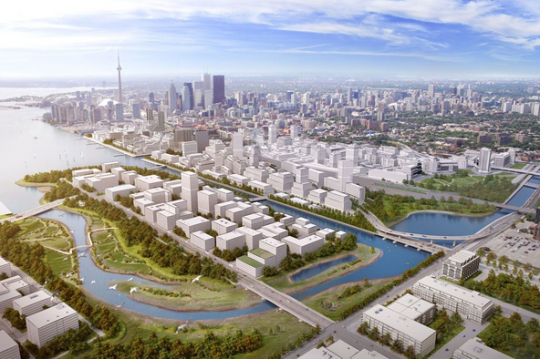
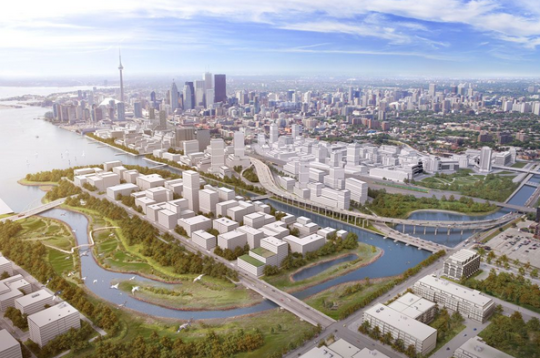
    Here’s what that looks like (versus the remove option shown at the top of this post):

    image

    Have we learned nothing from our past city building mistakes?

    Since that announcement, I went on Twitter every night this week to check out the discussions that were happening around #GardinerEast. And every night it got me so worked up that I then had trouble falling asleep. I have since stopped reading about the Gardiner East before bed.

    But rather than just get frustrated, my friend (a fellow city builder named Stephen Job) and I decided to do something about it and create a petition using Change.org.

    It is a petition that we will ultimately be sending to Toronto’s entire City Council prior to their June 9 meeting and we hope that you will consider signing it and sharing it with your network – regardless of whether or not you happen to live in Toronto. (Although it’ll certainly help if you’re a taxpayer and voter in the City of Toronto.)

    We just finished getting it up and you can check it out and sign it by clicking here.

    Images: Toronto Star

  • Why Canada needs a true urban agenda

    It should start from the premise that the fundamental underpinning of the Canadian economy to have prosperity is dependent on the success of the cities, because 80 per cent of Canadians live in cities.
    -Toronto mayor John Tory

    This week the leaders of Canada’s 22 largest municipalities are gathering in Toronto to figure out how to put urban issues on our national agenda. This is a topic I’ve touched upon many times before on Architect This City, but I continue to believe that it’s one of our most pressing issues.

    We know that the vast majority of Canadians live in cities (see above quote) and we know that the vast majority of our economic output is concentrated in cities. In fact, roughly half of Canada’s GDP is produced in our 6 biggest cities alone – Toronto, Montreal, Vancouver, Calgary, Edmonton, and Ottawa-Gatineau.

    But despite this concentration of wealth and economic activity, our governance structures do not reflect this reality. They’re outdated. They were built for a Canada that has passed. And so in my view, there’s a significant amount of untapped potential lying dormant in our cities if only we could get around to properly empowering them. There’s a “stimulus package” waiting to be unleashed.

    In anticipation of this week’s leadership meeting, the Globe and Mail published an article called, Canada’s big city mayors ready to push urban agenda. And in it they included a number of interviews with Canadian mayors. It’s fairly long, but definitely worth a read. Here are a few relevant sound bites…

    Vancouver mayor Gregor Robertson

    We have an archaic system. Cities aren’t recognized in our constitution. It’s unbelievable. But Big City Mayors have set aside those important gaps because the needs are now so urgent on housing and transit, we can’t afford to spend a couple years debating structural change. For the time being, the focus is just on ensuring there’s more federal capital provided for transit and other urban infrastructure.

    Calgary mayor Naheed Nenshi (on municipal funding sources)

    I would prefer to levy myself, so that I’m ultimately accountable to my citizens and, if they don’t like it, they can get rid of me. Allowing others to levy the tools takes away predictability and stability, as well. That said, we’re starving here, and any improvement to the system that leads to those predictable, stable cash flows is a good thing.

    Winnipeg mayor Brian Bowman (on the most pressing issue facing Canadian cities)

    I’d say without question infrastructure and new funding models to modernize the ways that cities fund themselves. That’s something I’ve started discussions on already with some of my counterparts, Mayor [Naheed] Nenshi in Calgary, Mayor [Don] Iveson in Edmonton as well as Gregor Robertson in Vancouver. We’ve talked about a number of topics including the missing and murdered indigenous women and girls issue, public transit and rapid transit development. But the one consistent theme is that the way cities are funded is outdated.

    Toronto mayor John Tory

    I start from this premise: Are people paying enough taxes? In many cases, you could argue, not only are they paying enough taxes, they can’t afford to pay any more. We should be looking at the total amounts paid to all three levels of government and how that is being allocated. Do we believe that, in the case of Toronto, the federal and provincial governments are making adequate investments in transit, given the amount of money they take out of this area in taxation? I would say the answer is: not yet. [But] they have been doing better.

    Montreal mayor Denis Coderre

    We are negotiating a new pact between the province and Montreal, and it’s all about municipal autonomy. We need tools so we’re not always waiting in the hallway at the end of legislative sessions looking for amendments to make the city work better. Since 85 per cent of immigration in Quebec is going to Montreal, we need more control over tools of integration, like job creation and housing. Montreal needs financial leverage…

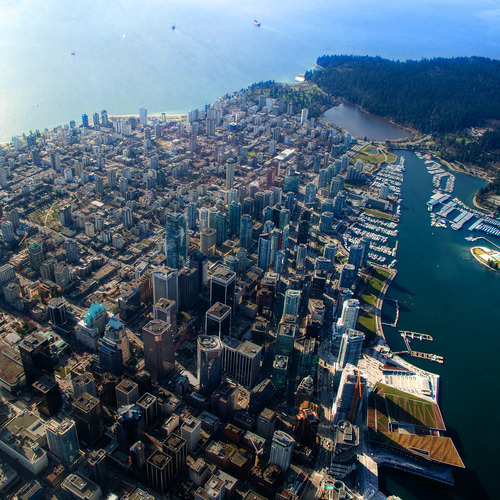
    Image: Vancouver via Flickr

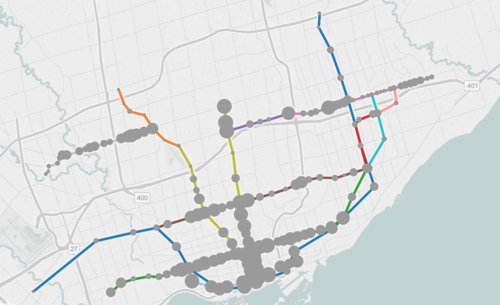
  • The ultimate Toronto transit map

    image

    If you live in Toronto and only give serious thought to one thing today, it should be to this interactive transit map created by Metro.

    The map shows all existing, planned, and proposed transit lines in the city, and then overlays population densities, commuting patterns, household income, and so on. It’s a super valuable map that I think reveals a lot about how we should be focusing our energies to get Toronto moving.

    So what sorts of things does it tell us? I’ll give 2 examples.

    If you look at commuting patterns across the Bloor-Danforth subway line, you’ll see that Runnymede station in the west is where people switch over from taking transit to driving. People west of that station tend to drive. Naturally, it also happens to coincide with where population densities start to fall off.

    By contrast, if you look at the east side of the city along the Danforth and beyond, the entire stretch more or less relies on transit to get around. Part of this likely has to do with income levels, but it’s also because of the availability of the Gardiner Expressway. There’s no equivalent in the east end. Dylan Reid of Spacing Magazine believes this makes a case for some sort of road pricing along the Gardiner, and I would agree.

    As a second example, look at the population densities along the proposed Downtown Relief Line, Finch LRT, and John Tory’s SmartTrack line. Outside of the core, the population densities are relatively low along the proposed SmartTrack line – which is never a good thing for rapid transit.

    There’s also no Sherbourne station on the SmartTrack line, which happens to have the highest population density across the entire Relief Line – 22,131 people per square kilometre! That’s more than any other stop along the Yonge-University subway line except for Wellesley station.

    I’ve written about this a lot before, but I think we need to do a better job of matching up transit investment with expected customer demand. Too often we let politics get in the way of rationale decision making. Maybe it’s time we did something like set minimum population densities. If you want a subway line in your area, you have to first bring the people.

    What else does this map tell you?

  • Toronto seeks injunction to stop Uber

    image

    One evening this past spring I was leaving a Rotman School event at Liberty Grand on the west side of Toronto. There aren’t a lot of taxis coming through this part of the city, so I figured I was going to have to wait while I hailed one from my phone. But as luck would have it, one happened to be pulling up just as I walked out of the hall.

    As he drove up and rolled down the window, I told him that I was going to the St. Lawrence Market area and that I needed to pay by credit card (I was trying to be a nice guy and avoid the inevitable fight when he was dropping me off). He responded by saying, “My machine is broken. Can’t you pay with cash?” I told him, “No, unfortunately I don’t have any cash on me. I need to pay with credit card.” He then rolled up his window and drove up closer to the entrance of the hall.

    Faced with this scenario, I did what most people would probably do nowadays: I pulled out my phone so that I could hail either an Uber or a Hailo cab (I’m sad that Hailo has since left the North American market). I decided on Hailo (it was cheaper until UberX came along) and ordered a car.

    But within a few minutes, the same taxi with the broken credit card machine circled back around, rolled down his window, and told me that his machine was now working and he would take me to the St. Lawrence Market. Knowing exactly what had happened, I said to him, “Wooooow, that’s funny that within the span of a few minutes your machine has magically started working again.” He wasn’t happy with that response.

    Now, we all know why he didn’t want to take my credit card. He didn’t want to pay the fees and he wanted the cold hard cash. And who can really blame him for wanting to maximize his profits. But for the end user, this experience sucks. When it’s 2 in the morning and all you want to do is go home to bed, you don’t care about the few dollars he’s trying to save. You just, want, to go, home.

    And that’s one of the reasons why Uber (and previously Hailo) is having such a huge impact on the market. Even before UberX arrived (the cheaper alternative), lots of people were more than willing to pay the Uber premium. And they continue to pay their controversial surge prices. But that’s because the experience is so much better than what’s offered today.

    We all know that Uber is under a lot of fire for what they do, but Toronto mayor Tory is 100% right in saying that ridesharing and peer-to-peer taxis are here to stay. Toronto may be seeking a court injunction to stop the service in this city, but I would agree that it’s likely going to be a big waste of money. The cat is already out of the bag.

    What’s happening here is no dissimilar to what happened with Napster. A court order may have forced the company to shut down, but it didn’t maintain the status quo for the music industry. That industry went, and continues to go through, a lot of change. So a better option, would be for everyone to sit down together and figure out what the future of the taxi industry is going to look like. Because I can guarantee you that it’ll continue to change.

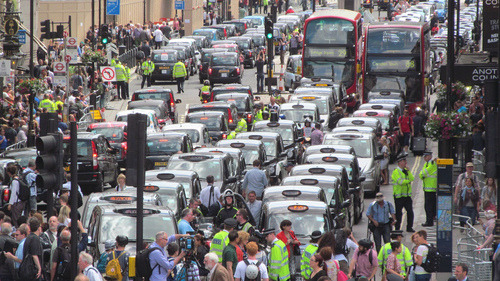
    Image: Anti-Uber protest in London (Flickr)

  • How Toronto voted

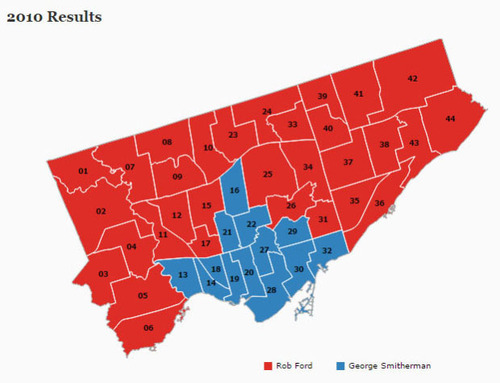
    In 2010, Toronto voted for its new mayor, Rob Ford, like so:

    image

    It was basically the core of the city (old Toronto) versus all of the boroughs. And it was perfect ammunition for anyone who believed that Toronto’s amalgamation was a mistake. (I personally don’t think it was.)

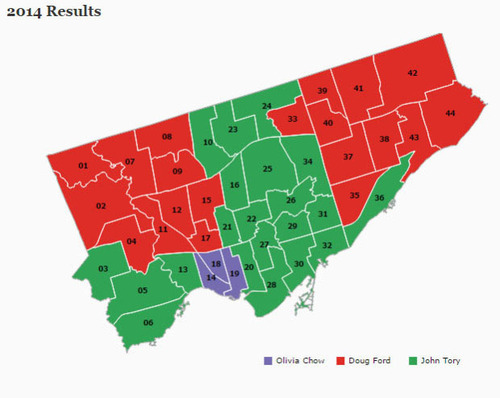
    Yesterday, Toronto did better.

    While we’re still a divided city — with Etobicoke and Scarborough largely remaining loyal to Ford Nation — we’re not quite as divided as we were 4 years ago:

    image

    However, there is one thing that Torontonians did largely agree on last night: the next mayor should be white and male. And this got the Guardian Cities out of the UK asking why one of the most multicultural cities on the planet (apparently we’re third behind Luxembourg City and Dubai), continues to elect middle-aged white guys.

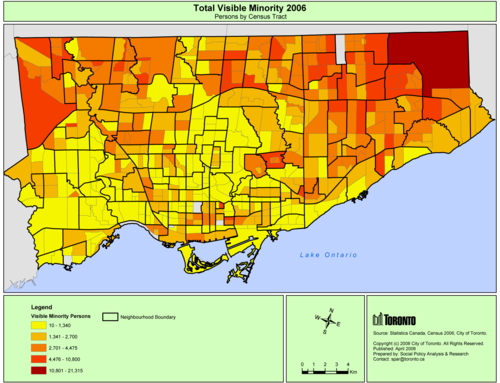
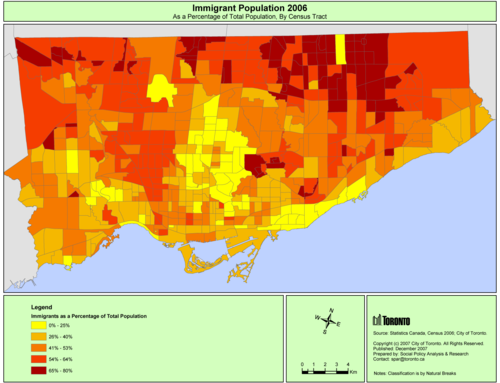
    Now, I’m not a fan of the article. And I take offence to the way Toronto is portrayed. But it did get me thinking. And I thought it would be interesting to see how some of Toronto’s demographic data overlays on top of these election maps.

    Looking at 2006 census data (2011 isn’t available in map form yet), here is a map showing the total number of visible minorities broken down by census tract. The darker the red the more visible minorities.

    image

    And here is a map showing immigrants as a percentage of the population. Again, the darker the red, the higher the percentage.

    image

    What should be apparent from these maps is that Ford Nation is actually, in some ways, immigrant and visible minority nation. In the above map, the darkest red areas indicate that immigrants represent anywhere from 65-80% of the population. That’s a significant number.

    So why didn’t this group vote for the Hong Kong-born Olivia Chow? It’s because she wasn’t telling them the right story. Rob and Doug Ford, on the other hand, were.

  • Toronto mayoral candidate announces regional express line

    image

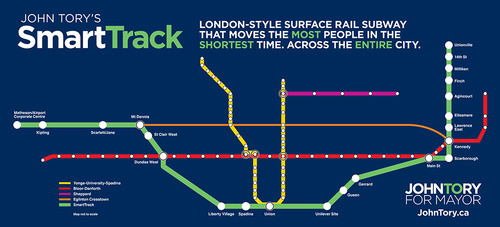
    Yesterday Toronto mayoral candidate, John Tory, proposed a transit line called SmartTrack. It’s part of his One Toronto transit plan. If you’re interested in watching the full 30 minute announcement, click here.

    As somebody who came out of the gate as a strong proponent of the “Yonge Relief Subway Line” (and as somebody I immediately supported for that reason), this proposal first hit me yesterday as a disappointment. Not because I don’t think we need a regional express rail network in the region (we do), but because I feel that he is backing away from that initial commitment and depriving the core of the transit infrastructure it needs.

    As soon as I found out about the plan, I immediately emailed one of my friends at Metrolinx. I told him I thought it was an “epic fail”. He pushed back and asked me to consider the merits of Tory’s plan. After having slept on it (and calmed down), I’m now prepared to talk about both the benefits of SmartTrack and why I was disappointed. 

    SmartTrack is basically a regional rail plan, intended to move people from the outer and inner suburbs to and from downtown using an integrated fare system. That is, riders will not have to pay a separate fare to transfer from subway to SmartTrack. 90% of the track needed for the plan is already existing, which means it will be cheaper and quicker to build compared to the full relief subway line. It will also bring employment centers such as Airport Corporate Centre in Mississauga into the transit network. For these reasons, the SmartTrack plan would certainly be beneficial for the region. 

    But, there’s a densities mismatch.

    If you look at the number of stops proposed in Scarborough and Markham, and compare it to the number of new stations proposed for downtown (1 – Spadina station) and the downtown shoulder neighborhoods (2 – Liberty Village and the Unilever site), the plan starts to look lopsided. SmartTrack would help residents of downtown get out to the suburbs, but it would do little to help them move in and around the core.

    If you look at the way Toronto is intensifying on a map, it looks like an upside down letter T. Density now hugs the waterfront and then follows our subway lines up north. I believe that the SmartTrack plan would help to relieve the pressures on those subway lines, but I don’t think it adequately addresses the bar of the T that now runs parallel to the lake.

    So while I do think that the Toronto region would be well served by regional express rail, I don’t think we can forget about the central part of the city. This shift in focus may have something to do with where Tory believes his voter base now sits, but let’s not forget that there’s a strong correlation between population density and transit ridership levels. 

    Now, let’s hear from you. What do you think of Tory’s One Toronto plan and SmartTrack proposal?