Daily insights for city builders, delivered every morning at 6 AM ET. I’m Brandon Donnelly — a Toronto-based real estate developer and founder of Globizen. I’ve been writing here since 2013.

Tag: joe berridge

  • The resilient city and road pricing

    Joe Berridge’s recent opinion piece in the Globe and Mail is a good reminder — in the face of a whole lot of uncertainty — about the resiliency of our cities.

    Those previous decades saw a surge of people and jobs locating downtown, with consequent escalation in rents and prices of offices and housing. Why? Partly demographic, as the well-educated children of the baby boom reached adulthood, and partly lifestyle and work style. Young people go to big cities not just to work and live, but for sex, style, money and power. For ambition and anonymity. And for risk. All in the petri dish of downtown density. These drives have always been as powerful as their subsequent search for suburban security and community.

    The structure of the modern megalopolis is not an accident – the dramatic rise of tech employment, two-earner families, the decline of manufacturing, the later date of marriage, smaller households, lifestyle consumerism, teamwork cultures, serial re-education and training – none of these societal trends looks to be diminished by COVID-19. All of them seem to prefer high-density, high-interaction environments.

    For those of us in Toronto, it’s also important to remember just how quickly this city region was growing pre-COVID-19. That is unlikely to change on the other side of this.

    But Berridge does also point out some of the potential fallouts from this pandemic. The economics of urban transit, for example, could remain a problem for quite some time. This will strain public purses. (Car usage rebounded quickly, but transit ridership has not.)

    We are also likely to see increased traffic congestion as a result of people eschewing transit (and probably a bunch of other factors). Like Berridge, I am a supporter of road/congestion pricing, and have been writing about that on this blog for many years.

    The best things to tax/price are things that are generally viewed as bad and where demand is largely inelastic. That is, even if you increase the price, many or most people will probably still do it anyway. Think of things like smoking.

    Up until now, Toronto hasn’t had the moxie to make difficult (political) decisions like this one. Perhaps this pandemic will leave us no other choice.

  • The grandeur of Montreal

    I was in Montreal for the long weekend and I decided to take the time off from writing. I don’t do that very often, but it was the right thing to do this past weekend.

    Montreal is one of my favorite cities. I spent quite a bit of time there when I was in my early 20s and I almost ended up at McGill for my undergraduate degree. So I have a soft spot for the place.

    One of my friends once described Montreal to me (and contrasted it against Toronto) by saying that it has grandeur. And I think that is exactly the right word.

    There are so many moments throughout the city where you just feel its impressiveness. It’s almost as if, from the very beginning, the city knew what it was destined to become.

    In contrast to this, urban planner Joe Berridge has, in the past, referred to Toronto as an accidental metropolis. And I think that is a similarly accurate way of describing our city.

    Sometimes in Toronto (or perhaps oftentimes, depending on who you ask), you have to scratch a little beneath the surface to find what makes Toronto a truly great city.

    It’s as if the city didn’t know what it was destined to become, and built accordingly. Things just happened — accidentally.

    Grandeur isn’t usually something that is discussed today in city planning circles. We instead talk about things like angular planes, context and, of course, building height.

    But maybe it’s time we rethink our list of requirements. Maybe it’s time we ask ourselves: “Are we creating a city with grandeur?”

    Image: Drone photo from the top of Mount Royal

  • City-to-city airline routes expected to decline by 20% this year

    Supposedly there are more than 14,000 airplanes parked around the world right now. And according to the latest numbers from IATA, this is expected to translate into an $84 billion loss for global commercial airlines in 2020. The industry is not expected to return to profitability until 2022. As a point of comparison, net profits were about $26.4 billion last year.

    Some more numbers from IATA:

    Here is something else from the Journal. The number of airline routes has doubled over the past two decades. That has included the number of city-to-city routes. IATA is predicting that by the end of this year we will see these urban routes decline by about 20% compared to last year. And who knows when they will return. Perhaps in 2022, along with profitability.

    The reason I point this out is because if you follow the work and writing of planner Joe Berridge, you will know that he often cites airports as being a key piece of infrastructure for global cities. At one point, having a deep harbor was everything you needed in order to bring in goods and people. But today a solid airport is paramount.

    Will the loss of this city-to-city connectivity have an impact on some cities?

  • Building the perfect city

    Over the long weekend, and across a couple of flights, I read Perfect City by Joe Berridge. I thoroughly enjoyed it. Each chapter focuses on a different world city, starting with the one and only Toronto. From New York to Singapore and London to Belfast, Joe hones in on what is working and what is not working.

    No city is perfect.

    I found myself folding the top corner of the page on numerous occasions. I did this every time I came across an interesting takeaway or stat, such as this one here: “Angela Merkel, the German chancellor, recently observed that Europe has 7 per cent of the world’s population, 25 per cent of its GDP, and 50 per cent of its social expenditures.”

    However, the thread that really stood out to me is one about individuals. We all know that great things happen as a result of great teams. But as Joe profiles the various city building initiatives that he has come across throughout his work and travels, a common theme seems to emerge.

    From Jane Jacobs to Lee Kuan Yew, there’s often a determined individual who is set on making something happen, or set on stopping something from happening, as is the case with Jane Jacobs and Toronto’s (proposed) Spadina Expressway.

    This is not meant to discredit the value of teamwork. We all know that is essential. Instead, I think it speaks to the power of individual passion, conviction, and tenacity — all of which are ingredients required to build a perfect, or almost perfect, city. Wonderful things don’t just happen on their own.

    Photo by Fraser Cottrell on Unsplash

  • The capital of the future: Shanghai

    Joe Berridge’s recent opinion piece in the Globe and Mail makes the case for why Shanghai is destined to become “the capital of future.” Brash city building, massive scale, and entrepreneurial hustle are among some of the reasons why he believes the city is on a path to global supremacy. And similar to other great capitals, it has benefited from a strategic geographic position on an important waterway — in this case the Yangtze River.

    By way of comparison, Toronto is said to be the fastest growing urban region in both North America and Europe right now. We add somewhere around 125,000 people each year. Shanghai, on the other hand, is adding between 700,000 and 800,000 people each year — much of it from internal migration. The city currently has a population of around 24 million people and it is expected to grow to somewhere between 35 and 45 million people by 2050. (Figures from the Globe.)

    Notwithstanding all of our successes as a global city region, as I was reading Berridge’s piece I couldn’t help but come back to this comparison. Shanghai opened its first subway line in 1993. Today it has one of the most extensive networks in the world; whereas, it would probably take Toronto this long to figure out if that first line should be light rail or a below-grade subway. And we haven’t even gotten to the number of stops yet.

    But that’s one of the differences between top-down and bottom-up city building: speed.

    Photo by Denys Nevozhai on Unsplash

  • The perfect city

    “This book is a love story of cities. It is so well observed — the places, the people, the history and what the future holds. Joe tells a very personal and beautifully written story direct from the front line. An absolute must read for everyone who cares about, and wants to understand, what makes cities and their citizens tick.” 

    – Dame Alison Nimmo, Chief Executive of the Crown Estate

    Joe Berridge, of Urban Strategies, has a new book coming out called, Perfect City: An Urban Fixer’s Global Search for Magic in the Modern Metropolis. Perfect may be the enemy of good (as they say), but Joe argues that all great cities have moments of perfection that we can learn from.

    I just preordered a copy. If you’re interested, you can do the same here.

  • Toronto: 2000 vs. 2025

    Last week, Joe Berridge, Partner at Urban Strategies, gave a presentation at the Institute on Municipal Finance & Governance titled, Toronto: The Accidental Metropolis. I’ve seen Joe give similar presentations to this one before, and I always thoroughly enjoy his focus on Toronto’s position as a global city.

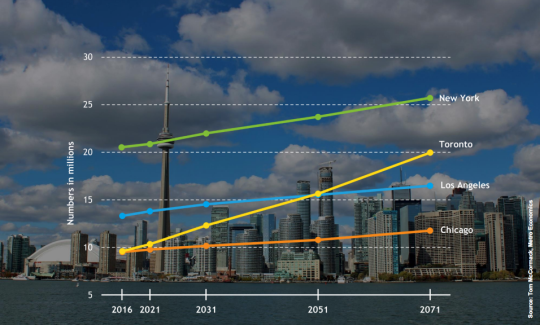
    Here is a slide from the presentation that projects out Toronto’s population to 2071 and compares it to the largest cities in the US.

    image

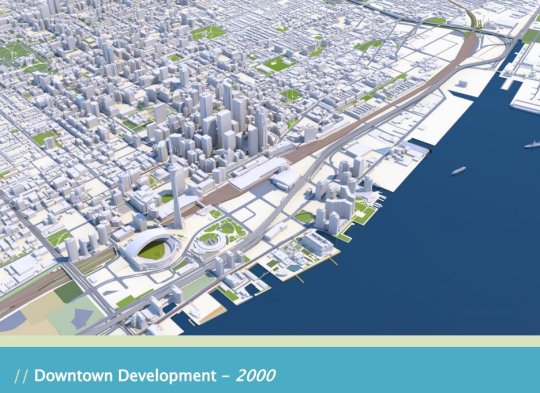
    But the two slides that have been really making the rounds online are the following ones. The first is a rendering of what downtown Toronto looked like in 2000. 

    image

    I remember this time clearly. Queen West seemed to end at Spadina. King West and Ossington weren’t things. And “Richmond and Adelaide” felt like the greatest club district in the world. (If you’re not from Toronto, these references will likely mean nothing to you. Sorry.)

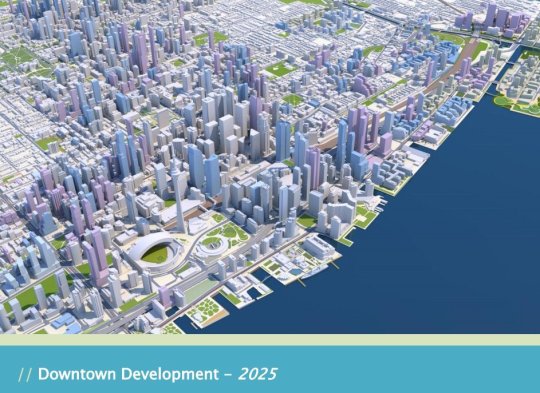
    The second slide is a rendering of what Toronto will look like in 2025. The transformation is just incredible.

    image

    I’ve seen some people comment that the Toronto of 2000 was relatively affordable; the Toronto of 2018 is unaffordable; and the Toronto of 2025 will be even more unaffordable with all of this new development.

    But I don’t understand that logic. Considering the growth rate shown in the first slide, imagine how unaffordable this city would be if we weren’t building new places for people to live and new places for people to work.

    For the full slide deck, go here. And for recent aerial photos of Toronto’s downtown core, check out my Instagram page.

  • Big, bold, and global

    I love the way that urban planner Joe Berridge thinks about Toronto and city building. He is constantly considering our position on the global stage and urging us to fight for a top position by executing on real and meaningful projects. 

    Here is a recent article from the Toronto Star which lists some of those projects. They include everything from a new convention center to creating a fourth university (in addition to the University of Toronto, York, and Ryerson).

    Here’s a snippet:

    We could get “lost in domesticity — very nice, but that’s not enough,” he says, drawing on his experience leading urban renewal projects around the world.

    Toronto’s social cohesion is enough to attract 125,000 new people each year to the region. But they won’t stay if we can’t employ them and provide opportunities. And that requires global thinking.

    Berridge says it is the city’s “moral obligation” to use its taxing power, its wealth, its status as Canada’s only global city and the historical advantages of public education, public health and public services to propel Toronto into super city status.

    Cities will often talk in nebulous terms about being “world class.” That isn’t all that helpful. Let’s be specific and also acknowledge that great things cost money. Are we a top tourist destination? Are we a top convention destination? Are we attracting the smartest people in the world with the best schools? Do we have the best transit and health care systems in the world?

    Toronto is a great city and so it’s perhaps easy to become complacent. But past performance is not an indicator of future outcomes. We need to think in global terms. We need to keep in mind that this is an international competition. And every day all of us step onto that field.

    Thank you Joe for constantly reminding us of that.

  • Happy 100th Birthday, Jane Jacobs

    “We came to Toronto,” she says, “because it’s a place where you can work, it’s a place where you can live well, it’s a place where there is hope.” –Jane Jacobs (1971)

    It was my birthday this week (May 2nd). But it was also the birthday of someone far more noteworthy. This past May 4th marks what would have been Jane Jacob’s 100th birthday. (She passed in Toronto in 2006.)

    In commemoration of this, Toronto Life published a photographic essay, along with a short piece by Joe Berridge. Joe is a partner at the urban design and planning firm Urban Strategies. He’s also a great storyteller.

    Here’s an excerpt:

    Jane didn’t do nice—Toronto’s default emotional setting. She was cantankerous and argumentative: once you got on the wrong side of her, that was that. About 20 years ago, when I was working as an urban planner, we were on a panel together at Boston College. I was making some remarks about city planning she clearly thought rubbish—and she just interrupted me. “Joe, Joe, Joe,” she said (her squawky Scranton, Pennsylvania, accent made it sound like “jaw, jaw, jaw”). “You’re tacking nansense.” The audience agreed. After I spoke, an incomprehensible social science professor took the stage. Jane wasn’t fond of academics—she didn’t think they knew much—but to make matters worse, he kept addressing her as Professor Jacobs. “Staap calling me prafessa,” she barked. “I barely graduated high school.” He and I both slunk offstage in shame, clutching our notes.

    Jacobs was certainly a force to be reckoned with. Without a doubt, she left her mark on this city, as well as others, like New York. And I believe that she is part of the reason why – almost 50 years after she first moved to Toronto – we remain a city where you can work, live well, and where there is hope. I like that simple characterization.

    If you’d like to read/see the full piece by Toronto Life, click here.

  • Merry Christmas from post-tribe Toronto

    Belfast Christmas Market by Peter Holloway on 500px.com

    https://500px.com/embed.js

    Merry Christmas and/or happy whatever you happen to celebrate around this time of year.

    Hopefully things have slowed down for you all and you’re relaxing with family and friends either at home or somewhere on vacation. I’ll be doing that here in Toronto and making pancakes for breakfast, because that’s what I like to do on Christmas morning.

    If you’re in the market for some long form reading material while you relax, I recommend you check out an article in The Walrus called, After the Troubles. It’s by Toronto-based planner Joe Berridge – who is a partner at Urban Strategies – and it’s the story behind his team’s Belfast City Centre Regeneration Strategy and Investment Plan.

    It’s a fascinating and entertaining read, and there are lots of comparisons between Toronto and Belfast. Here’s a little taste:

    “IT WOULD BE HARD to conceive of two cities more different than Belfast and Toronto. One old world, one new; one grand, one utilitarian; one barely ticking over, one growing like topsy. And of course, one tribal, the other the epitome of post-tribe. Belfast is 96 percent white—forget about Catholic-Protestant, that’s the critical urban statistic. And yet it’s important to remember that Toronto itself was once the largest Orange town in the world. (Wikipedia asserts that every mayor of Toronto since its founding was an Orangeman until Nathan Philips, a wonderful Jewish mayor, was elected in 1954.) Even the current mayor, John Tory, draws his name from a bunch of brigands and royalist cattle thieves in the Irish backcountry.”

    I spent a bit of time in Belfast when I was working in Dublin (2007) and so it was particularly interesting for me to read about his assessment of the city. Like Berridge, I found the city eerily empty during off-peak times. But it’s an architecturally rich city and a fascinating city for urbanists because of all that has happened.

    Though now we are talking about “after the troubles.” Things are progressing. And that strikes me as a positive thought while I make my pancakes on Christmas morning.