Daily insights for city builders, delivered every morning at 6 AM ET. I’m Brandon Donnelly — a Toronto-based real estate developer and founder of Globizen. I’ve been writing here since 2013.

Tag: housing

  • The answer to San Francisco’s housing affordability problem

    Blogger and programmer Eric Fischer has an excellent post up on his site where he looks at: “Employment, construction, and the cost of San Francisco apartments.” It’s worth a good solid read.

    What he did was dig deep into whatever data he could find – the data goes back to the beginning of the 20th century in some cases – to try and figure out a solution to San Francisco’s housing affordability problem.

    Many (including myself) have argued that, at least part of the solution, is to build more, not less, housing. However, others, such as Tim Redmond of 48 Hills, have argued that building more market-rate housing would simply exacerbate the current situation.

    In Eric’s analysis, he looked at everything from median rents and new housing units constructed (above graph) to annual wage growth and income inequality. I particularly liked his summary of the city’s various building booms. 

    In the end, here’s the conclusion that he came to:

    “In the long run, San Francisco’s CPI-adjusted average income is growing by 1.72% per year, and the number of employed people is growing by 0.326% per year, which together (if you believe the first model) will raise CPI-adjusted housing costs by 3.8% per year. Therefore, if price stability is the goal, the city and its citizens should try to increase the housing supply by an average of 1.5% per year (which is about 3.75 times the general rate since 1975, and with the current inventory would mean 5700 units per year). If visual stability is the goal instead, prices will probably continue to rise uncontrollably.”

    By visual stability, he is referring to maintaining the current urban fabric of San Francisco just the way it is. In other words, he is making the link between preservation and affordability in a prosperous and growing city.

    Intuitively, this makes sense to me. It’s unrealistic to think that you can maintaining some level of housing affordability without allowing supply to increase alongside demand.

    At the same time, I do not believe that preservation needs to equate to no changes whatsoever. Urban preservation, to me, should be about dutifully respecting the past while still looking firmly towards the future. And that’s how I believe successful should be approaching this problem.

  • Nest or cave?

    I was recently introduced to the work and writing of Japanese architect Sou Fujimoto. One concept that he writes about that I really like is the idea of nest vs. cave.

    The way Fujimoto describes a cave is that it’s a naturally occurring and pre-existing condition. It is exists independent of humans. So if and when a human decides to occupy a cave, he or she must assimilate their lives to that which is already there. They have to deal with the ambiguity of the spaces because it is not clear how everything should be used.

    A nest, on the other hand, is something completely created by and for the benefit of a person or animal. It would not exist without someone creating it and so it is prescriptive and functional in a way that a cave is not.

    Fujimoto is interested in exploring architecture that is analogous to caves. Which is why he designs houses like this one (House NA) in Tokyo:

    In most countries, a house like this would not meet code and would be illegal. But in Tokyo it’s obviously allowed. And his hope is that the owners will discover new and unintended ways to interact with the unusual pairing of levels and platforms.

    However, I think about this juxtaposition differently – likely incorrectly in the mind of Fujimoto.

    I’m actually more interested in nests. Because in a way, mass produced housing is like a cave. It exists whether or not we decide to occupy it. And it is generally created to appeal to lots of people, rather than to the idiosyncratic tastes of one person. So when someone does occupy it, they invariably end up trying to shape it.

    But not to the extent of a nest. A nest is custom. It is what you would build for yourself given the opportunity to do so. And that thought is really appealing to me. Maybe it’s because I don’t like the ambiguity of a cave. That could be a possibility.

    I could also be thinking about it differently because I tend to think of Japanese homes as being quite individualistic. Since Japanese people generally don’t care about resale value, they don’t have the same fixation with marketability and future value. That means they’re more likely to just build what they want.

    I’d love to have my own nest.

    Image: Wall Street Journal

  • Coffee shops vs. fried chicken

    When it comes to a real estate market, there are always the typical metrics: sale prices, rents, vacancy and so on. But I’m always interested when somebody looks at the market in a different way and comes up with other kinds of metrics.

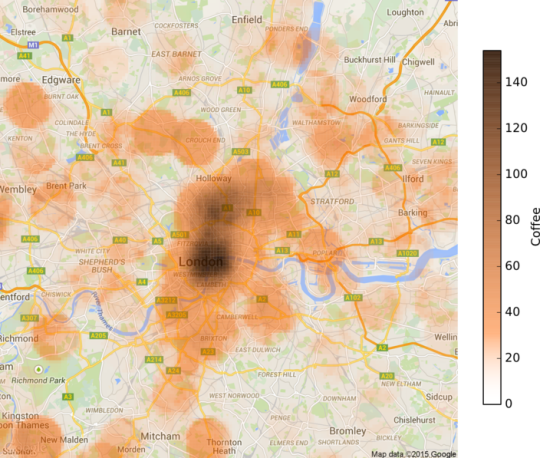
    That’s why I was intrigued when I stumbled upon this post by Sam Floy, where he looks at the concentration of coffee shops and friend chicken shops across London in order to determine which neighborhoods are in fact “up and coming.”

    To give you a taste, here’s his coffee shop map:

    His thinking was that if a neighborhood had a high density of coffee shops, a low density of fried chicken shops, and relatively low house prices, then it could probably be thought of as up and coming. 

    Coffee shops are often considered to be leading indicators of urban change (i.e. gentrification), and, well, friend chicken places I guess speak to a different kind of neighborhood.

    These sorts of playful studies aren’t going to tell you exactly which numbers you should be plugging into your development pro forma. But I think unconventional analyses can sometimes tell you a bit more of the story behind the numbers.

  • Population growth across North American cities

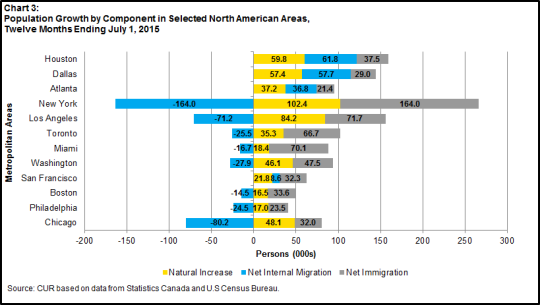
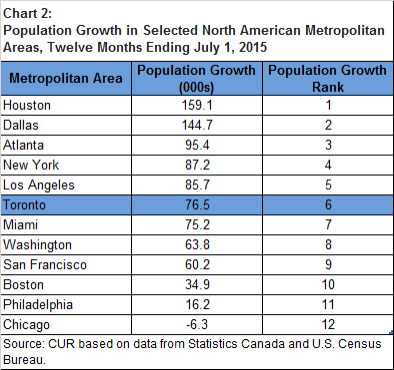
    The Centre for Urban Research and Land Development at Ryerson University recently published the following chart on their blog:

    It’s a look at population growth across a few North American cities, broken down according to natural increases, net internal migration from other parts of the respective country, and net immigration from outside of the respective country.

    When you sum up the pluses and minuses shown above, you get to population growth numbers that look like this:

    Houston, Dallas, and Atlanta are monsters in terms of population growth. They’re obviously smaller than New York and Los Angeles, and so on a percentage basis they are really adding a lot of people. Much of this has to do with the ease in which housing can be added in those cities and their relative affordability.

    Toronto is competitive with New York and Los Angeles in terms of an absolute number, but again our base is smaller so on a percentage basis we are growing faster. The big story with Toronto is our dependence on immigration to grow.

    The one city on this list that might surprise some of you is Chicago. Toronto and Chicago share many similarities and are often compared. But when you look at how the Chicago metropolitan area is shedding people, you see that, at least in this regard, it’s in structural decline.

  • BARF is fighting for more housing in San Francisco

    A new YIMBY activist group is starting to gain meaningful traction in San Francisco. They were recently featured in the New York Times and they have managed to secure the financial backing of people like Jeremy Stoppelman – co-founder and CEO of Yelp. 

    (All excerpts in this post were taken from the NY Times.)

    image

    The group is called SF BARF, which stands for SF Bay Area Renters’ Federation. The group, however, supports new development of all kinds. So I think the name is more driven by the fact that the founder, Sonja Trauss, wanted the acronym to be BARF. It speaks to their shit disturbing approach:

    “Her group consists of a 500-person mailing list and a few dozen hard-core members — most of them young professionals who work in the technology industry — who speak out at government meetings and protest against the protesters who fight new development. While only two years old, Ms. Trauss’s Renters’ Federation has blazed onto the political scene with youth and bombast and by employing guerrilla tactics that others are too polite to try. In January, for instance, she hired a lawyer to go around suing suburbs for not building enough.”

    The impetus for all of this, of course, is San Francisco’s lack of affordability and severe housing shortage. Housing supply is decades behind the city’s population and job growth. 

    Most people are directing the blame at the tech community for bidding up housing. But there’s clearly growing recognition that housing supply matters.

    As a real estate developer, my industry obviously benefits from fewer barriers to building. So let’s get that out there:

    “Ms. Trauss’s cause, more or less, is to make life easier for real estate developers by rolling back zoning regulations and environmental rules. Her opponents are a generally older group of progressives who worry that an influx of corporate techies is turning a city that nurtured the Beat Generation into a gilded resort for the rich.”

    But let’s also be clear that I don’t believe we should be developing roughshod over our cities. New development should respond to what’s already there and give back. 

    At the same time, housing supply matters a great deal. A big part of the reason that cities like San Francisco, New York and Vancouver are so expensive is that they’re naturally supply-constrained markets. Geographically, they are either peninsulas or islands.

    When you overlay tight land use restrictions, fierce community opposition and/or foreign investment on top of this geography, it should come as no surprise to anyone that demand is outstripping supply. 

    New supply won’t solve every problem, but I do agree that it is an important part of the solution.

  • A short history of redlining

    In 1933, the United States Congress created the Home Owners’ Loan Corporation (HOLC). With foreclosures rising as a result of The Great Depression, the task of the agency was to provide new low-interest mortgages to both homeowners and private mortgage lenders. Between 1993 and 1936, the agency served about one million households.

    By 1935, the parent company of the agency (the Federal Home Loan Bank Board) decided to initiate something called the “City Survey Program.” The idea was to look at local real estate trends – including the racial and ethnic composition of the country’s largest cities – in order to get a better understanding of how to manage all of these outstanding loans.

    One outcome of this program was the creation of the HOLC’s infamous “residential security maps.” (Philadelphia’s is shown at the top of this post.)

    These were maps that categorized city neighborhoods according to 4 grades. Grade A neighborhoods (green) were the best ones. They were ethnically homogenous and had room to be further developed. Grade B neighborhoods (blue) were the second-best ones. They were already completely developed, but were still considered desirable. Grade C neighborhoods (yellow) were starting to decline and showed an “infiltration of a lower grade population.” And finally, grade D neighborhoods were considered “hazardous” and colored in red. These neighborhoods had low homeownership rates, old crappy housing, and an “undesirable population”, which, at the time, largely referred to Jews and African Americans.

    Some have argued that the HOLC and their “residential security maps” are what kicked off systematic mortgage discrimination in America’s inner city neighborhoods – later referred to as “redlining.” This was the practice of denying credit to people who lived in these undesirable neighborhoods (and even to real estate developers who wanted to build in these undesirable neighborhoods).

    But University of Pennsylvania professor Amy Hillier has argued that these maps simply reflected the ethos of the time period. Using a sampling of HOLC mortgages, she found that 62% of them were issued to grade D (red) neighborhoods. The agency, itself, was not actually redlining in practice.

    Furthermore, she also looked at private mortgages issued in Philadelphia between 1937 and 1950 and found that security grade rating actually had no impact on the total number of loans issued. She did, however, discover slightly higher interest rates for properties located near and in the bottom security grades.

    All of this is to say that “redlining” is likely not the only culprit for inner city decay. There are other factors at play.

    To that end, the National Bureau of Economic Research recently published a working paper, which I discovered through CityLab, called, “Racial Sorting and the Emergence of Segregation in American Cities.” The key finding here is as follows:

    “Our preferred estimates suggest that white flight was responsible for 34 percent of the increase in segregation over the 1910s and 50 percent over the 1920s. Our analysis suggests that segregation would likely have arisen in American cities even without the presence of discriminatory institutions as a direct consequence of the widespread and decentralized relocation decisions of white urban residents.”

    In other words, it wasn’t just mortgage discrimination; it was also just general discrimination. That actually makes a lot of sense, because, if you think about it, the former couldn’t have occurred without the latter being present.

    Here’s how the research paper puts it (via CityLab):

    “Policies that reduce barriers faced by blacks in the housing market may thus not prevent or reverse segregation as long as white households have the ability and desire to avoid black neighbors.”

    (Note: Most of the information and data used in this post was sourced from the work and research of Amy Hillier.)

  • Pocket two bedroom

    I recently started reading the blog of Michael Mortensen. Michael is a real estate developer and urban planner based in the UK. And if you like my blog, I think you’ll also like his.

    Last week he published a post talking about a UK development company called Pocket and a recent design competition that they organized called “Pocket two bedroom.”

    Historically the firm has been focused on well-designed and compact one bedroom apartments (38 square meters) that they deliver at a minimum 20% discount relative to typical market rate housing in London.

    But over time, they found that they had to turn people away because they were looking for larger – yet still affordable – two bedroom apartments. So the firm decided to figure out how to scale their model to larger units.

    To do this, they went out and asked 19 architects to come up with ideas for a two bedroom Pocket apartment. They then published all of the ideas online.

    Firstly, I applaud them for making their competition results public. Most real estate companies wouldn’t do this.

    Secondly, it’s interesting to take note of the recurring design themes, as they have on page 24-25 of their competition book. 

    Some of the themes include “deep thresholds” that blur private and communal spaces; “thick walls” that allow for storage and servicing; flexible spaces and fewer dedicated spaces; and dual entry apartments.

    This last item was particularly interesting to me. It’s a simple idea – two separate doors leading into one apartment – but it can allow for a number of flexible sharing scenarios. I am already imagining somebody creating an Airbnb rental out of their second bedroom.

    Housing is certainly undergoing a transformation.

  • A mapping of single family home prices in Vancouver

    Bing Thom Architects recently published a blog post looking at the property values of single family homes in Vancouver. The data was taken from the City of Vancouver Open Data Catalogue and is based on British Columbia Assessment data.

    The precise timing of the data is likely a bit off, but here’s how the city looked in 2015:

    23% of single family homes in the city had an assessed value over $2 million.

    A year later, this number increased 32% of all single family homes:

    It’s interesting to see how divided the city is along Main Street. But the big takeaway – thanks to BTA – is that $2 million seems to be the new $1 million.

  • How should cities manage their own awesomeness?

    Conor Maguire introduced me to an interesting site today called Airbnb vs. Berlin. The site does a deep dive into Berlin’s Airbnb market with the hope of answering the question: Is Airbnb contributing to a shortage in affordable housing?

    The site is very well done. It’s filled with lots of great market stats and diagrams such as this one here: 

    Of course, the impetus for a site like this is that cities all around the world, from San Francisco to Berlin, are grappling with rising home prices. If you happen to live in a successful, growing city, that’s probably what is happening.

    But when this happens, we seem to want to look for something or someone to blame. In San Francisco it’s the tech workers. They’re the ones driving up homes prices. In Vancouver, it’s the foreign Chinese buyers. And in Berlin, it’s those Airbnb users who are just out to make a profit. In all of these cases, we like to tell ourselves that if we could just get rid of “X”, everything would be much better. 

    But I think sometimes we forget that this is also the result of doing many things right.

    If Berlin wasn’t a brilliantly cool place to visit, then tourists wouldn’t come. And if tourists didn’t come, then Berlin wouldn’t have, by far, the largest Airbnb market in Germany. If Vancouver wasn’t one of the most enjoyable places in the world to live, you wouldn’t have the same attention from overseas buyers looking to snatch up properties. 

    So in a way, we should be asking ourselves: How do we, as a city, manage our own awesomeness?

    The other thing that Airbnb vs. Berlin reminded me of is the viewpoint that profits are some dirty little secret. I hear it all the time in the real estate development business. People will say: “That developer is just out to make money.” Of course she/he is! They operate a business. And like all for-profit businesses, one of the objectives – it may not be the only one – is to make money.

    I say all this not as a direct response to the website. They remained fairly neutral in their analysis. Instead, I raise it as an alternate viewpoint in the seemingly universal battle against “X.”

    In case you’re wondering about Berlin’s Airbnb market, the site estimates that there are roughly 11,701 Airbnb listings in the city out of a total of about 1.9 million flats. Of these listings, it is estimated that somewhere around 30% are by “professional users” who are only out to make a profit and are not participating in the “sharing economy” in its purest sense. That equates to about 0.18% of all Berlin flats.

    Based on this number, I’d say that Berlin’s cool factor probably has a lot more to do with the city’s rising rents than do the profit seeking Airbnb users.

  • Why multi-family developers are shifting their customer focus

    One aspect of the Toronto housing market that I’ve been paying close attention to is the adoption of multi-family dwellings by both long-term end-users and families. 

    I’ve written about this before (here and here, over a year ago) and have argued that here in Toronto we are at an inflection point. Multi-family dwellings – both rental and condo – are evolving to now target these new customer segments. Whereas previously, the new construction multi-family housing market was heavily geared towards investors and first-buyers. And often it was simply a stepping stone towards a single family home.

    Now, every city and real estate market is different. And I have heard many people in U.S. cities say that Millennials are simply deferring what we saw with previous generations. At the end of the day they (or we, I’m a Millennial) are going to move to the suburbs and buy that car. The current trends we are seeing around city living and reduced driving are just that – short-term current trends.

    But I think it’s worth reiterating: I do not believe that the status quo is what’s happening right now in Toronto. And I’m sure it’s also happening elsewhere. Time and time again I speak to developers in this city who are starting to shift at least some, and in some cases all, of their focus towards end-users, families, and larger units – particularly for new mid-rise product in the “neighborhoods.”

    And if you think about it, this makes perfect sense. 

    The average price of a detached single family house in Toronto is well north of a million dollars. So when a developer brings to market a 1,200 sf family sized apartment at $600 psf ($720,000) or even at $700 psf ($840,000), that home now becomes a relatively “affordable” option in many desirable areas of the city. Particularly if you value location amenities and your time (i.e. shorter commutes) over raw quantity of space. I know I certainly do.

    I know this isn’t going to appeal to everyone. But there is a big market here. Get ready.

    What are you seeing in your city? Let us know in the comment section below.