Daily insights for city builders, delivered every morning at 6 AM ET. I’m Brandon Donnelly — a Toronto-based real estate developer and founder of Globizen. I’ve been writing here since 2013.

Tag: housing

  • Tools for promoting healthy, responsive, affordable, high-opportunity housing markets

    This month the White House released a Housing Development Toolkit. The report starts by talking about the local barriers to building and makes this statement:

    “The growing severity of undersupplied housing markets is jeopardizing housing affordability for working families, increasing income inequality by reducing less-skilled workers’ access to high-wage labor markets, and stifling GDP growth by driving labor migration away from the most productive regions.”

    It then goes on to highlight a number of tools that American cities have adopted or should adopt “to promote healthy responsive, affordable, high-opportunity housing markets.” 

    They are:

    • Establishing by-right development
    • Taxing vacant land or donate it to non-profit developers
    • Streamlining or shortening permitting processes and timelines
    • Eliminate off-street parking requirements
    • Allowing accessory dwelling units
    • Establishing density bonuses
    • Enacting high-density and multifamily zoning
    • Employing inclusionary zoning
    • Establishing development tax or value capture incentives
    • Using property tax abatements

    None of this will be news to regulars of this blog. We have spoken about almost every single tool in the above list. 

    I’m not necessarily sold on all of them (good discussion to have), but I have gone on ad nauseam about eliminating parking minimums (off-street parking); the value of accessory dwelling units (commonly called laneway housing here in Toronto); and the negative impacts of barriers to building.

    The good news is that there’s growing alignment around a similar set of actions. Change takes time. There’s usually a heavy bias towards the status quo.

  • Sharing walls with strangers

    Barry Ritholtz recently published an article in Bloomberg View called: Still a Lot of Negativity on Housing

    He basically says that “many people” should go out and buy a home given the current state of the US housing market and the historically low interest rates. That’s a perfectly fine argument. But it’s not all that interesting.

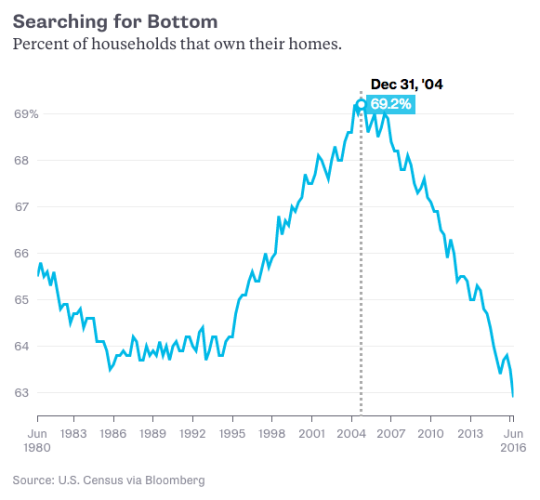
    The article does, however, have a moderately interactive chart showing the percentage of US households that own their homes.

    It shows the pre-2008 peak:

    image

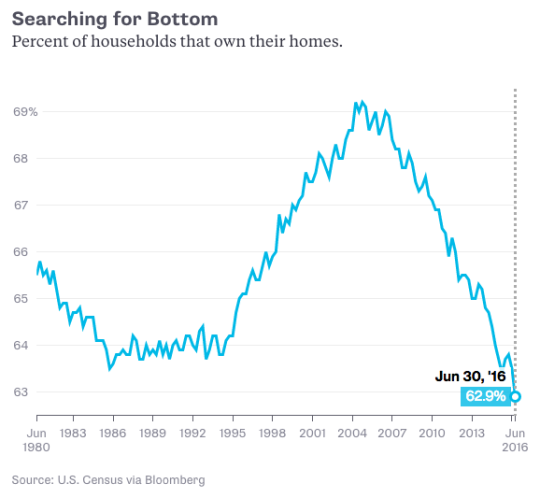
    And it shows, somewhat surprisingly, the recent “search for bottom.” I knew there was a significant post-2008 decline, but I guess I thought it had stabilized. Instead, the US is hitting homeownership rates not seen since the mid-1960s.

    image

    Big cities tend to have a higher percentage of renters. Millennials are flooding into cities. The digital economy now encourages mobility, which contradicts traditional notions of homeownership. There are all kinds of potential hypotheses that could be extracted here.

    But the other interesting thing I noticed in the article, was this:

    However, at some point in life, you probably no longer want to have a landlord telling you what color your walls can be or become tired of having strangers share a wall with you. I am not a zealous believer that everyone should go out and buy a home. However, for many people, buying makes sense – especially with mortgage rates as low as they are (the current rate of about 3.45 percent for a 30-year fixed-rate mortgage is just 0.10 percent higher than the record low).

    I couldn’t help but notice the embedded cultural bias. The inference is that when you rent, you share walls. In other words, you live in some sort of multi-family apartment. 

    But when you finally go out and buy a home, you graduate from that. You no longer need to share walls with strangers. Because an owned home equals a single-family detached dwelling. That’s how you know you’ve made it.

    Well, I have shared walls in my owned home. I guess I’m not there yet. 🙂

  • Urban migration, household type, and housing supply

    Here is an interesting discussion paper on the Toronto region’s economy, demographic outlook, and its land use. It was recently published by IBI Group and Hemson Consulting to support the 10-year review of our regional transportation plan.

    I wanted to share a couple of charts from the report that I thought were interesting. If you’re not in the Toronto region, I would be very curious to hear how your city might compare in terms of the way it is trending.

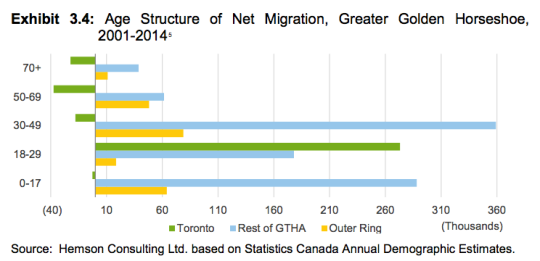
    The first chart is net migration by age group. Like Vancouver – similar chart posted here – people have been moving into the city/Toronto when they’re young and then moving out to the suburbs once they start having families. 

    Will that continue? The oldest Millennials are now hitting their mid-30′s and I am very interested to see if there will be any reversal in this.

    image

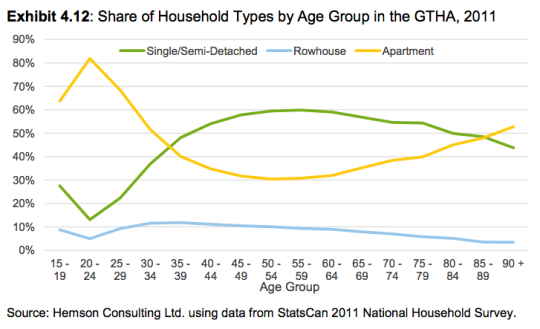
    Given the above trend, people in this region are not surprisingly also swapping apartments for ground-related housing as they get older. The crossover point seems to be (or at least has been) when people hit their mid-30′s. Again, I am curious how this may evolve as the city matures.

    image

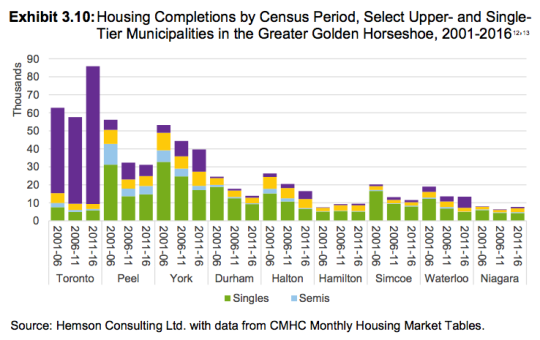
    Because if you look at housing completions from 2001 to 2016 (chart below), the only municipality that was able to meaningfully increase its housing supply was Toronto. 

    Every other municipality – except for Hamilton, which posted modest gains – experienced significant declines in the number of new homes delivered to the market over the last census periods. 

    Of course, the only reason Toronto was able to increase its housing supply was by building up – in other words by building condos and apartments. (Shown in the purple below. For some reason the legend is incomplete in the report.) 

    image

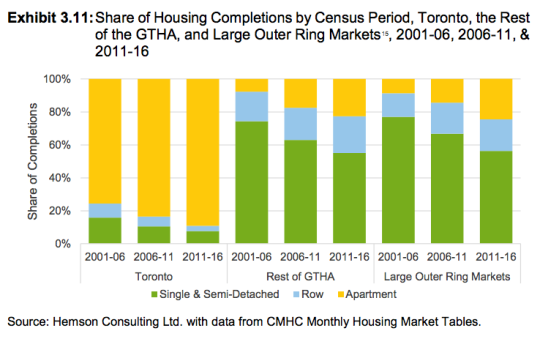
    If you look at the share of housing completions, over 80% of new homes in Toronto are now in apartment form. 

    image

    Intensification is a deliberate policy choice. And we can certainly debate whether it’s a good or bad thing (I believe it’s a good thing). 

    But putting that aside, the above charts are a great answer to the perennial question: “How is it that Toronto is building so many condos?” This is why.

  • Dear City Council

    Kate Downing was formerly a planning commissioner in the City of Palo Alto. She recently resigned from her position and, about about a day ago, she posted her resignation letter on Medium. It has since gone viral.

    The reason it has spread so quickly, I think, is because it addresses the very same issues that so many cities around the world are facing: a lack of housing supply and eroding affordability.

    As a developer, I obviously have a vested interest in this matter. But to the extent that I can put that aside, I really do believe that our goal should be to build inclusive, rather than exclusive, cities.

    For instance, when I think of great cities such as New York and Toronto, I think of their history of taking in a large number of immigrants and then empowering them to climb the socioeconomic ladder. There’s something magical about that. One of my best friends likes to talk about this potential as “immigrant hustle.”

    But when we sterilize our cities by allowing only the incumbents to survive, I believe we place that socioeconomic potential in jeopardy. So for that reason, I am reposting Kate’s entire letter. I have bolded the points that stood out for me. Let me know what you think in the comments.

    ———————————————————

    Dear City Council Members and Palo Alto Residents,

    This letter serves as my official resignation from the Planning and Transportation Commission. My family has decided to move to Santa Cruz. After many years of trying to make it work in Palo Alto, my husband and I cannot see a way to stay in Palo Alto and raise a family here. We rent our current home with another couple for $6200 a month; if we wanted to buy the same home and share it with children and not roommates, it would cost $2.7M and our monthly payment would be $12,177 a month in mortgage, taxes, and insurance. That’s $146,127 per year — an entire professional’s income before taxes. This is unaffordable even for an attorney and a software engineer.

    It’s clear that if professionals like me cannot raise a family here, then all of our teachers, first responders, and service workers are in dire straits. We already see openings at our police department that we can’t fill and numerous teacher contracts that we can’t renew because the cost of housing is astronomical not just in Palo Alto but many miles in each direction. I have repeatedly made recommendations to the Council to expand the housing supply in Palo Alto so that together with our neighboring cities who are already adding housing, we can start to make a dent in the jobs-housing imbalance that causes housing prices throughout the Bay Area to spiral out of control. Small steps like allowing 2 floors of housing instead of 1 in mixed use developments, enforcing minimum density requirements so that developers build apartments instead of penthouses, legalizing duplexes, easing restrictions on granny units, leveraging the residential parking permit program to experiment with housing for people who don’t want or need two cars, and allowing single-use areas like the Stanford shopping center to add housing on top of shops (or offices), would go a long way in adding desperately needed housing units while maintaining the character of our neighborhoods and preserving historic structures throughout.

    Time and again, I’ve seen dozens of people come to both Commission meetings and Council meetings asking Council to make housing its top priority. The City Council received over 1000 signatures from Palo Alto residents asking for the same. In the annual Our Palo Alto survey, it is the top issue cited by residents. This Council has ignored the majority of residents and has chartered a course for the next 15 years of this city’s development which substantially continues the same job-housing imbalance this community has been suffering from for some time now: more offices, a nominal amount of housing which the Council is already laying the groundwork to tax out of existence, lip service to preserving retail that simply has no reason to keep serving the average Joe when the city is only affordable to Joe Millionaires.

    Over the last 5 years I’ve seen dozens of my friends leave Palo Alto and often leave the Bay Area entirely. I’ve seen friends from other states get job offers here and then turn them down when they started to look at the price of housing. I struggle to think what Palo Alto will become and what it will represent when young families have no hope of ever putting down roots here, and meanwhile the community is engulfed with middle-aged jet-setting executives and investors who are hardly the sort to be personally volunteering for neighborhood block parties, earthquake preparedness responsibilities, or neighborhood watch. If things keep going as they are, yes, Palo Alto’s streets will look just as they did decades ago, but its inhabitants, spirit, and sense of community will be unrecognizable. A once thriving city will turn into a hollowed out museum. We should take care to remember that Palo Alto is famous the world over for its residents’ accomplishments, but none of those people would be able to live in Palo Alto were they starting out today.

    Sincerely,

    Kate Downing

  • Should we love bubbles?

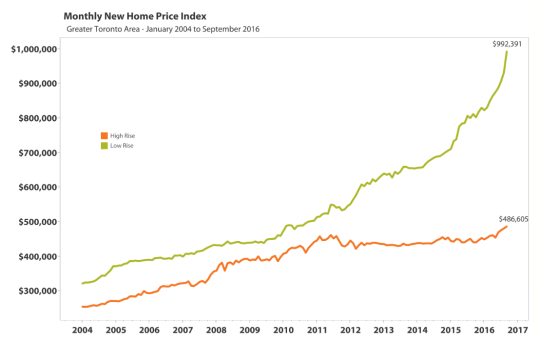
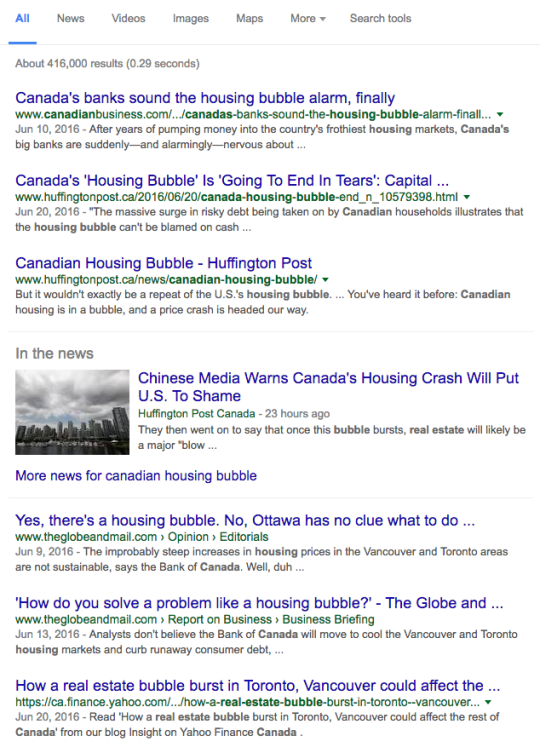
    There’s no shortage of talk about a Canadian housing bubble:

    image

    In Vancouver, the price of a single-family home (as of June of this year) increased 39% to C$1.6 million from the year prior. Does that constitute bubble territory?

    In an effort to stop prices from running away even further, I am sure you all know that the BC government has recently imposed an additional 15% transfer tax on Metro Vancouver homes purchased by foreign buyers (people who are not Canadian citizens or permanent residents).

    The data that I have seen (here and here) suggests that foreign buyers could make up somewhere around 5-10% of the market. Given that many will now get creative in terms of hiding their foreignness, I am not so sure this new tax will have a dramatic impact on affordability. But it certainly sounds nice if you’ve been grouchy about home prices and thinking “those damn foreigners.” We’ll have to see how it plays out.

    Having said all of this, if Vancouver is in fact in bubble territory, would that be so bad? Are we thinking about this the right way?

    Here’s an alternative viewpoint.

    I recently stumbled upon an old blog post by Tom Evslin (2005) called: Why we need bubbles. I discovered it via it Fred Wilson. Tom’s argument is that we need irrational exuberance because it provides the capital that allows for dramatic overbuilding. The overbuilding of things like rail infrastructure, internet infrastructure and – I’m adding this – housing infrastructure. And once this happens, it dethrones the incumbents and paves the way for future economic progress.

    Tom’s focus is on technology, but I couldn’t help but think of the parallels with city building. Is the proposed Rail Deck Park in Toronto so bold that it’s only possible during a period of irrational exuberance? Should Vancouver instead be working to dramatically expand its housing supply instead of trying to tax away a portion of demand? Is a period of irrational exuberance precisely the moment where we lay the ground work for our future successes?

    I’m not saying we’re in a bubble. I don’t believe in or know how to time markets. But I am asking whether the bubble headlines are missing the greater opportunity.

  • Low cost energy efficient homes perched atop of surface parking

    A regular of this blog recently suggested (in the comments) that I take a look at the London-based design firm ZED Factory. ZED stands for Zero Energy Development.

    The first project that caught my attention was ZED Pod. ZED Pod is a small, low cost energy efficient modular home that is designed to sit atop of surface parking lots. In other words, it’s a way to repurpose under-utilized surface parking without compromising existing parking ratios. All you really need are the air rights. And since the “land” is cheaper, the homes can be cheaper. They can also be easily relocated if the parking lot were to get developed in the future (though they are designed as permanent structures).

    image

    In some ways, there is something perverse about the way that driving and parking have such a profound impact on the urban landscape. Even when it’s buried underground and hidden from sight, the structural column grid needed to layout efficient parking will often carry up through the building impacting suite layouts. We’ll even restrict housing supply when parking requirements can’t be met. Should it be parking or people who come first?

    But cars aren’t going away. And ZED Pod is a clever way of dealing with an existing urban condition – however suboptimal it may be. I found the concept interesting and I thought you all might as well.

    Image: ZED Factory

  • Building new, better cities

    Earlier today my friend Saadat sent me the following tweet:

    //platform.twitter.com/widgets.js

    It’s a link to a new research project by Y Combinator – the famed Silicon Valley seed accelerator. They want to explore the possibility of building new and better cities.

    I don’t have the time for something like this, but if any of you are city experts (I know a lot of you are) and you’re based in or willing to be based in San Francisco (I think they are flexible on this), you should absolutely consider applying to be their full time “Cities Researcher.” The deadline is July 30, 2016.

    Here’s a taste of what they are thinking about…

    There are many high-level questions we want to think through, for example:

    – What should a city optimize for?

    – How should we measure the effectiveness of a city (what are its KPIs)?

    – What values should (or should not) be embedded in a city’s culture?

    – How can cities help more of their residents be happy and reach their potential?

    – How can we encourage a diverse range of people to live and work in the city?

    – How should citizens guide and participate in government?

    – How can we make sure a city is constantly evolving and always open to change?


    And there are tactical questions we want to dig into, for example:

    – How can we make and keep housing affordable? This is critical to us; the cost of housing affects everything else in a city.

    – How can we lay out the public and private spaces (and roads) to make a great place to live?

    – Can we figure out better zoning laws?

    – What is the right role for vehicles in a city?

    – Should we have human-driven cars at all?

    – How can we have affordable high-speed transit to and from other cities?

    – How can we make rules and regulations that are comprehensive while also being easily understandable?

    – Can we fit all rules for the city in 100 pages of text?

    – What effects will the new city have on the surrounding community?

    The convergence of city building and tech is something that I’m deeply interested in. I also think it’s inevitable. And I think that Toronto – thanks to our robust real estate industry – is in an ideal position to be a leader in this space. So I would love to see someone from here take on this job.

    But even if you’re not from Toronto, you should still apply because it’s an exciting initiative 🙂

  • Market vs. subsidized

    Miriam Zuk and Karen Chapple of the University of California, Berkeley, recently published a research brief called Housing Production, Filtering and Displacement: Untangling the Relationships

    It’s a nuanced look at the impact of both market-rate and subsidized housing production on affordability and displacement within the San Francisco Bay Area.

    The report is essentially a response to the debate around whether increasing market-rate housing production alone can address affordability and displacement concerns, or whether the only way to do it is through subsidized housing. What they found was that both matter, but…

    “What we find largely supports the argument that building
    more housing, both market-rate and subsidized, will
    reduce displacement. However, we find that subsidized
    housing will have a much greater impact on reducing displacement
    than market-rate housing. We agree that market-rate
    development is important for many reasons, including
    reducing housing pressures at the regional scale and housing
    large segments of the population. However, our analysis
    strongly suggests that subsidized housing production is even
    more important when it comes to reducing displacement of
    low-income households.”

    If you’re interested in this topic, I recommend reading the full brief. It’s only 12 pages. I particularly liked the information around filtering and how new housing steps down over time to ultimately serve lower-income households.

  • The cost of parking minimums

    Access Magazine has a good piece on parking minimums and the cost they create for our cities. The article is by Donald Shoup, who is Professor of Urban Planning at UCLA. He is also the author of The High Cost of Free Parking.

    Here is his argument:

    “Minimum parking requirements create especially severe problems. In The High Cost of Free Parking, I argued that parking requirements subsidize cars, increase traffic congestion and carbon emissions, pollute the air and water, encourage sprawl, raise housing costs, degrade urban design, reduce walkability, damage the economy, and exclude poor people. To my knowledge, no city planner has argued that parking requirements do not have these harmful effects. Instead, a flood of recent research has shown they do have these effects. We are poisoning our cities with too much parking.”

    And here’s his summary of what it costs to build a parking stall in various US cities (both underground and aboveground):

    To put these numbers into perspective, he also looks at the median net worth of US households (2011) to show just how expensive this parking is for some groups. 

    Because remember, these parking costs get embedded into the cost of housing, retail stores, and so on.

  • More thoughts on inclusionary zoning

    Alan Ehrenhalt recently published a balanced piece in Governing that largely reflects my own views on inclusionary zoning. It’s called: Why Affordable Housing Is So Hard To Build.

    His argument is that there are lots of cities trying to build more affordable housing, but that most strategies have not yet proven to be all that successful.

    I’ve written a few posts on inclusionary zoning. The most recent is this one. And though I believe that a mix of incomes is a critical component of good city building, I am having a hard time believing that inclusionary zoning is the silver bullet that will get us there. Admittedly, it sounds like a great idea. But how does that translate into reality?

    Here’s a snippet from Alan’s article (shout out to Daniel Hertz of City Observatory who seems to get cited in almost every article I read these days):

    Just about every city that has tried an inclusionary zoning law in recent years has had a similar experience. In some cases, the results have been much worse. According to BAE, Chicago’s inclusion law produced $19 million in 11 years, but only 760 affordable units. Thirteen years of inclusionary zoning in Seattle brought the city $31.6 million in fees and a grand total of 56 units. As the urbanist Daniel Hertz wrote recently, inclusionary zoning has been “more powerful as a symbol than as a way of helping people.”

    Of course, the devil is in the details. Many inclusionary zoning policies allow cash in lieu of actual housing:

    San Francisco actually has had an inclusionary zoning law since 2002, and it has been a flop. It mandates a 12 percent affordable set-aside, but allows developers to escape the mandate by paying a fee to the city. As in Arlington, this is what they have done. A study by the research firm BAE Urban Economics found in 2014 that after 12 years the San Francisco law had brought in $58.8 million in developers’ fees and had generated 1,560 units. That’s better than nothing, but it’s a drop in the bucket for a city facing an affordability problem in virtually every neighborhood.

    All this said, I’m still not so sure that it’s as simple as eradicating the cash in lieu option and forcing mandatary inclusionary zoning. As Alan rightly points out in his article, if we set the bar too high, then all of a sudden it starts making some market rate housing infeasible to build. 

    And if this ends up lowering the overall supply of new housing, then we could be hurting affordability while at the same time trying to mandate more of it. Does that make sense? Clearly this is not as simple as it may seem.

    I get the appeal for cash poor cities. It sounds like free affordable housing. But I’m always suspect of “free” lunches. In any event, I think we can all agree that this is an important discussion to be having.