Daily insights for city builders, delivered every morning at 6 AM ET. I’m Brandon Donnelly — a Toronto-based real estate developer and founder of Globizen. I’ve been writing here since 2013.

Tag: housing supply

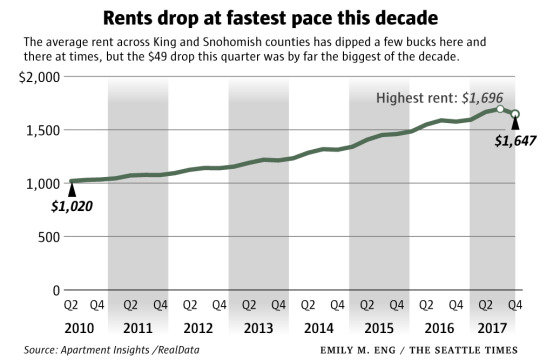
  • Why are apartment rents in Seattle dropping?

    This week I saw it reported that in this decade alone, the Seattle area is set to deliver more new rental apartments than it did in the prior 50 years combined. 

    And as a result, the sentiment is that new housing supply is finally starting to keep pace with demand and put downward pressure on rents. 

    Do you remember who was the crane capital of the US a year ago? They may still have that title.

    In some of the most desirable neighborhoods of Seattle – where much of the new supply is coming online – rents dropped 6% compared to the prior quarter. At the county level, this last quarter was by far the biggest drop of the decade according to the Seattle Times.

    Funny how that works.

    It’s also worth noting that the US as a whole is building far more rental apartments than condominiums. Here is a post I wrote in August 2015 which pegged condos as a percentage of overall multifamily construction at around 5.5%. That’s a tiny percentage.

  • New London Plan released today

    A draft version of the new London Plan was released today for public consultation. It is “the spatial development strategy for Greater London”. And you can download all 524 pages of it, here. A final copy of the Plan is expected to be published by fall 2019.

    Here is what mayor Sadiq Khan had to say about the Plan (quote from The Guardian):

    “I am using all of the powers at my disposal to tackle the housing crisis head on, removing ineffective constraints on homebuilders so we make the most of precious land in our capital.”

    And that tone comes through in the document. Here is an excerpt from the “optimising housing density” policy section:

    “For London to accommodate growth in an inclusive and responsible way every new development needs to make the most efficient use of land. This will mean developing at densities above those of the surrounding area on most sites. The design of the development must optimise housing density.” (Section 3.6.1)

    The Plan also contains a set of clear performance indicators. They cover things like the supply of new homes, the supply of affordable homes, modal share in the capital, and so on.

    The ambition is 66,000 net additional homes each year. And by 2041, the goal is that 80% of all trips in London will be by foot, cycle, or public transport. There simply isn’t road the capacity.

    Which is why the plan also specifies parking maximums, as opposed to parking minimums. The Plan wants the starting point for any development that is well-connected to transit – or to future transit – to be “car-free”.

    If you have a chance, the new London Plan is worth a scan. Maybe you don’t want to print it though.

    Photo by Rob Bye on Unsplash

  • Supply-side toolkit for greater housing affordability

    image

    McKinsey Global Institute just published a “supply-side toolkit” for cities struggling with housing affordability. This seems to be every successful city.

    The article includes a long list of potential tools. Some of them you may agree with. And others you may disagree with. But I am sure that many of them will be familiar to you. One of the tools in the toolkit is accessory dwelling units.

    Of course, the overarching theme is that housing supply has not and is not keeping pace with housing demand:

    California, for instance, added 544,000 households but only 467,000 net housing units from 2009 to 2014. Its cumulative housing shortfall has expanded to two million units.

    Another one of the tools in the toolkit is “overcoming NIMBYism.” Here is an excerpt:

    People who come to a city to work need to be able to find an affordable place to live there. But the voices of existing homeowners who want to preserve the status quo often drown out those of newcomers, young adults, low-income service workers, and renters who need more housing. After a 2009 audit found that neighborhood councils were not representative of the city’s broader population, Seattle replaced these bodies with a central Community Involvement Commission that includes mayoral and council appointees chosen to represent a broader set of stakeholders.

    I am intrigued by Seattle’s move to create a central body and a new approach to public engagement – one that moves away from local district-councils. However, it appears that this Community Involvement Commission is still very much in its infancy.

    If any of you are familiar with the Seattle market, I would be curious to hear your thoughts on it in the comment section below. I am, however, going to spend some time reading up on it.

    For the full toolkit, click here.

    Photo by Sarah Brink on Unsplash

  • The year of the condo

    Over the past 5 years or so, real estate headlines in the Greater Toronto Area have often focused on the rapid appreciation of low-rise housing. High-rise housing simply wasn’t appreciating at the same rate – at least in aggregate terms.

    But 2017 has brought a different story. 

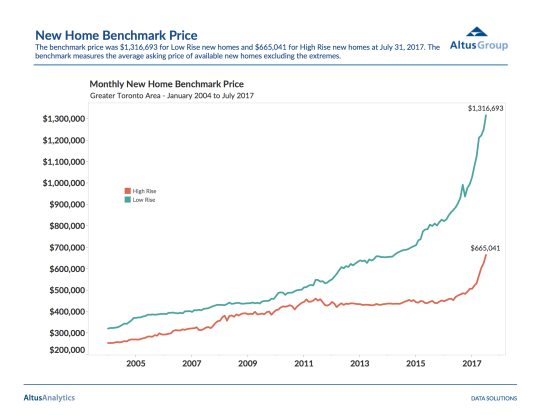
    If you look at BILD’s “New Homes Monthly Market Report” (data provided by Altus Group as of July 2017), you can see that high-rise pricing is now on a similar trajectory to low-rise pricing.

    Here is that graph:

    image

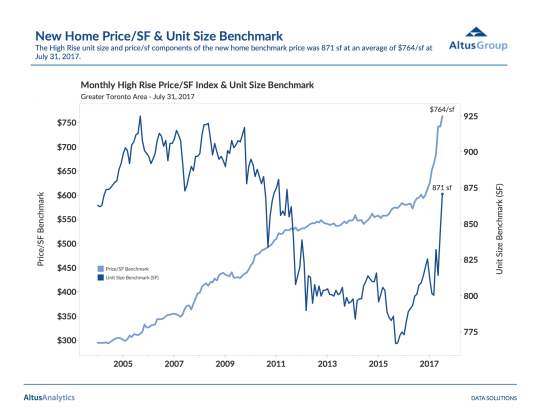
    This sharp uptick in pricing is also apparent when you look at the average price per square foot of new high-rise inventory. As of July, it was $764 psf across the GTA. See below.

    At the same time, average unit sizes have also jumped up to 871 square feet. So not only are new high-rise homes becoming more expensive on a normalized basis, they are also getting bigger, which further increases prices.

    image

    I recognize that we’re only seeing data up to the end of July, but, from the looks of it, 2017 is shaping up to be an extraordinary year for the condo.

    Of course, part of the reason this is happening is because remaining inventory for both low-rise and high-rise product is hitting 10-year lows. We’re back to the topic of supply.

    If you’re curious how some of these numbers have changed from the month prior (June 2017), check out this post.

  • The city refused my laneway house

    image

    This afternoon I stood up at the Committee of Adjustment (Etobicoke York) to present the laneway house proposal that Gabriel Fain Architects and I have been working on for the past year and that I have been working on since 2009.

    But before I could start I was told that Councillor Palacio had just submitted a last minute letter to the Committee. I was given a few minutes to read it, but the big bold “REFUSE” was probably the only word I needed to read.

    I was then asked if I had read planning staff’s report. I acknowledged that I had read it and that I was aware that they were also recommending refusal of the application. I also noted that a number of my immediate neighbors sitting behind me were also opposed to the proposal.

    That’s how my presentation started. 

    At this point you might be wondering: why bother?

    I stood up today because, as most of you already know, laneway housing is something that I feel strongly about. This isn’t just about my individual project. I mean, why do all of this work for one small dwelling unit? For me, this is about city building and trying to affect positive change. (I would also love to live on a laneway.)

    I could go on here about how the proposal was shorter than other existing structures on the lane, how the FSI was in check, how we had carefully studied shadows, and how planning staff had already supported greater densities and multiple dwellings on lots of similar size in the area. 

    But that’s not what today was really about.

    Today I heard loud and clear that whether the proposal was a laneway tiki hut or a 2 storey laneway suite, the community did not want more people living in the area and they most certainly did not want more renters living in the area.

    My message to the Committee was that in my humble opinion this is inevitable. Look to Vancouver. Look to Edmonton. Look to many other cities. What we are debating today, or at least what we should be debating today, is what these laneway houses or suites or tiki huts are going to look like.

    Right or wrong, our proposal was an attempt to answer that question. We looked carefully at what others had done before us, including our friends at Lanescape and Evergreen, and we proposed something that we believed was sensitive to its context.

    We were unsuccessful.

    But here’s the silver lining. At the end of it all, and right before a motion was made to refuse the application, one of the committee members said something very impactful. He more or less said: “I agree with you. This is inevitable.”

    Sadly today was not that day.

    I would like to thank everyone who came out today and everyone who got up to speak in support of laneway housing. It meant a lot to me. Some of you are also readers of this blog and it was great to meet you in person. Thank you.

  • Less is more

    The Wall Street Journal recently asked: Venice Beach Is a Hot Place to Live, So Why Is Its Housing Supply Shrinking? 

    According to Issi Romem, chief economist at BuildZoom, it’s because Venice Beach is the toughest place in America to build housing.

    Here are some numbers from the WSJ:

    “The Venice Beach population is shrinking even as the local economy has boomed. The neighborhood had about 27,000 residents in 2015, about 3,800 fewer than in 2000, according to U.S. Census data. At the same time, the ZIP Code has added 4,000 new jobs, according to Jed Kolko, chief economist at employment website Indeed.”

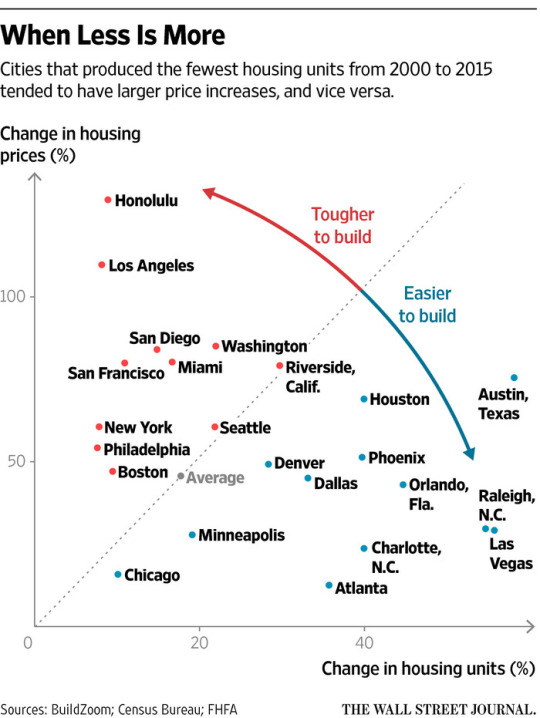
    And here is a chart that speaks to the relationship between housing prices and housing supply:

    Housing supply, alone, isn’t going to solve all of our problems. But it certainly matters. Also, what’s up with Chicago?

  • 616 Croft Ave., LLC, v. City of West Hollywood

    The Supreme Court of the United States may soon consider whether inclusionary zoning is in fact unconstitutional.

    A pending petition by the developer of an 11-unit condominium project in the City of West Hollywood is asking whether a $540,393.28 “affordable housing fee” – which is being imposed as a mandatory approval condition – is “subject to scrutiny under the unconstitutional conditions doctrine” set out in previous cases.

    The petition is supported by a collection of researchers and academics from Yale University, George Mason University, as well as many other institutions.

    More specifically, the question asks whether a “mandated permit condition” satisfies the “essential nexus” and “rough proportionality” tests established by the following decisions: Koontz v. St. Johns River Water Management District, 133 S. Ct. 2586 (2013); Dolan v. City of Tigard, 512 U.S. 374 (1994); and Nollan v. California Coastal Commission, 483 U.S. 825 (1987).

    To put it crudely, the nexus and proportionality tests essentially state that for an exaction to be constitutional, there needs to be a reasonable relationship between the ask and the adverse public impacts that can be directly attributable to the project in question.

    Here is an excerpt from the petition:

    Together, the nexus and proportionality tests hold that the government cannot condition approval of a land-use permit on a requirement that the owner dedicate private property to the public, unless the government can show that the dedication is necessary to mitigate adverse public impacts caused by the proposed development.

    In the case of 616 Croft Avenue, the argument is that this 11-unit condo project is not directly responsible for the lack of affordable housing in the city. In other words, the need for affordable housing exists independently of this project. So it fails the test.

    Another excerpt:

    Accordingly, the City
    provided no evidence of nexus and proportionality,
    admitting on the record that the in-lieu fee was not “intended to mitigate impacts caused by development.” Instead, the City explained that the fee was designed to meet “needs for affordable housing that exist independently of the Applicants’ residential
    development project.

    The petition also gets into the fact that, irrespective of this test, inclusionary zoning has not necessarily been shown to have a meaningful impact on affordable housing supply. And it may actually increase housing prices because of a reduction in overall supply and because the cost burden typically gets shifted over to the market rate units. More reading here.

    What do you think of this argument? It will be very interesting to see how this one plays out.

  • Follow the sun and sprawl

    image

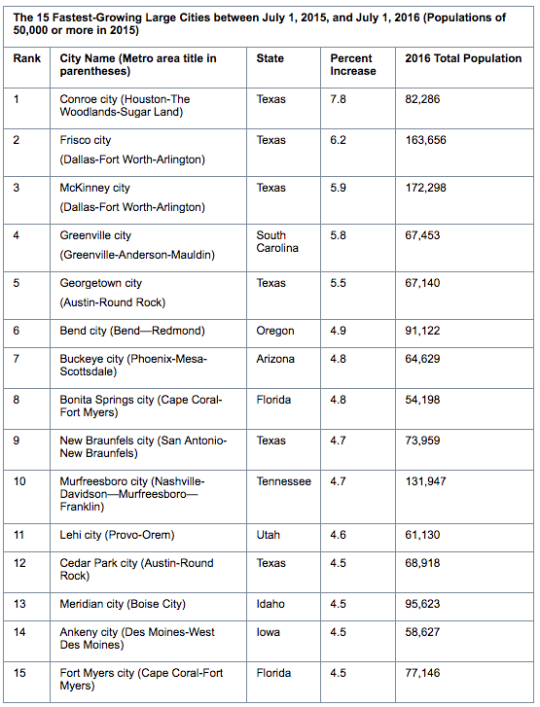
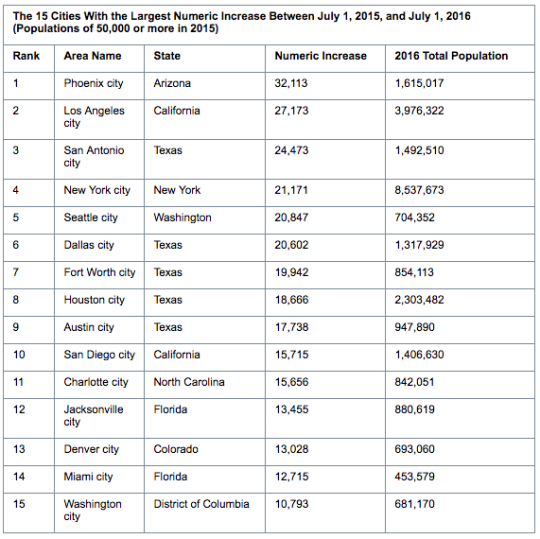
    The U.S. Census Bureau recently released it’s 2016 city and town population estimates. The press release can be found here.

    The headline isn’t a new one. Southern cities continue to grow quickly. This is not a new trend. Humans seem to like warm weather and the housing supply in southern cities tends to be more elastic. This keeps home prices relatively in check and allows the cities to more easily accommodate growth.

    From July 2015 to July 2016, 10 of the 15 fastest growing large U.S. cities were in the south (based on % growth). 4 of the top 5 were in Texas. 

    From 2010 to 2016, the population in large southern cities grew an average of 9.4%. Cities in the west clocked in at 7.3%. And cities in the northeast and midwest were at 1.8% and 3.0%, respectively.

    Two outliers near the top are Seattle and Denver. Since 2010, the population of these two cities grew 15.39% and 14.87%, respectively. I’m going to say it’s because of the skiing and snowboarding. Half-joking. For the top 25 large cities ranked by 2010-2016 growth rate, click here.

    In terms of absolute humans, Phoenix had the largest numeric increase between 2015 and 2016: 32,113 or about 88 people per day. After Phoenix it’s Los Angeles (27,173), San Antonio (24,473), New York (21,171), and Seattle (20,847). These are all city proper figures.

    It’s also worth noting which large cities aren’t growing. From 2015 to 2016, Chicago fell -0.32% and Detroit fell -0.52%. Philadelphia was only slightly positive at 0.19%. Going back to 2010, Chicago is still flat at 0.27% and Detroit is even more negative at -5.39%. Philadelphia is 2.5%.

    Follow the sun and the sprawl.

    The below charts are from the United States Census Bureau.

    imageimage

  • Is radical rezoning the solution to gentrification and displacement?

    image

    “If I meet one more anti-gentrification activist who moved to Seattle ten minutes ago, I shall scream.” –Dan Savage

    So it’s not just developers who are frustrated by the many paradoxical desires that we have of cities. We are concerned about housing affordability and we want to minimize displacement, but we do things that restrict new supply and put increasing pressure on our existing housing stock. 

    Below is another excerpt from Dan Savage. It’s from an article called: Doing Something Real About Gentrification and Displacement. Dan writes a sex-advice column, but clearly also feels passionate about urban issues. When he talks about “this city” he’s talking about Seattle.

    “Housing scarcity—exacerbated by the ridiculous amount of this city zoned for single-family housing—deserves as much blame for the displacement crisis as gentrification. More. And unlike gentrification (“a once in a lifetime tectonic shift in consumer preferences”), scarcity and single-family zoning are two things we can actually do something about. Rezone huge swaths of the city. Build more units of affordable housing, borrow the social housing model discussed in the Rick Jacobus’ piece I quote from above (“Why We Must Build”), do away with parking requirements, and—yes—let developers develop. (This is the point where someone jumps into comments to point out that I live in a big house on Capitol Hill. It’s true! And my house is worth a lot of money—a lot more than what we paid for it a dozen years ago. But the value of my house is tied to its scarcity. Want to cut the value of my property in half? Great! Join me in calling for a radical rezone of all of Capitol Hill—every single block—for multi-family housing, apartment blocks and towers. That’ll show me!)”

    His overarching point is that lots of highly-educated people with money are choosing, today, to live in urban centers. And whether we like it or not, that is going to cause gentrification. We can’t stop that. But what we can do is try and alleviate housing scarcity. 

    His other solution involves building lots of transit to address geographic isolation. I agree with him on this point and I’ve argued it before on the blog. If we can all agree that one of the issues is land/housing scarcity, then transit is certainly another way to “pull in” new supply. Though I think we need to be realistic about the level of service required to make areas desirable.

    If you have a few minutes, check out Dan Savage’s article. It’s a good and entertaining read.

  • One of the most expensive neighborhoods in LA

    image

    Oftentimes when I visit a city I like to ask myself: Which neighborhood would I want to live in if I were to move here?

    Today I spent much of the afternoon hanging around Venice. After we got there, I told my friend that if I moved to LA, I would probably want to live there. I told him that, relative to the rest of the city, I liked the compressed scale of the neighborhood. There are many pedestrian-only lanes and streets beyond the boardwalk. And I told him that I thought it was interesting how the neighborhood seems to combine both bohemians and yuppies (though many people seem to hate the yuppy part).

    But I’m obviously not alone in my thinking. My friend quickly informed me that Venice is one of the most expensive neighborhoods in LA and that it’s been adding essentially no new housing supply. Here’s an excerpt from an LA Weekly article published at the beginning of this year:

    Anti-development activists like to argue that development fuels gentrification, that the construction of new, high-end apartment buildings makes the whole neighborhood more expensive.

    But the case of Venice is a counterpoint. For the last 50 years, Venice has successfully fought developers to a stalemate. The housing supply stayed constant, while demand grew. As a result, the value of property in Venice has soared.

    In 1996, according to data provided by Zillow, the average home value in Venice was $251,000 — more expensive than Silver Lake and Encino but cheaper than Westwood, Studio City, Mid-Wilshire and Los Feliz. Today, Venice’s average home value is nearly $1.6 million, more expensive than all of those neighborhoods — more expensive, in fact, than its historically tony neighbor to the north, the city of Santa Monica, which, according to Alvarez’s research, added more than 10,000 dwelling units between 1960 and 2010.

    Perhaps I should give this some more thought.