Daily insights for city builders, delivered every morning at 6 AM ET. I’m Brandon Donnelly — a Toronto-based real estate developer and founder of Globizen. I’ve been writing here since 2013.

Tag: housing market

  • How Trump’s tax plan would impact the mortgage interest deduction

    image

    In the US you can reduce your taxable income by deducting the mortgage interest you pay toward your principal residence. You can’t do this in Canada, at least not on the property where you live.

    However, there are limitations. It is capped at loans up to $500,000 or up to $1M if you’re married and you file jointly. On the other end of the spectrum, you also need a loan big enough such that an itemized deduction will save you more money than the standard deduction.

    Not surprisingly, the MID is popular among homeowners. And from a public policy standpoint, one of its selling features is that it’s supposed to stimulate homeownership. But many have argued that it doesn’t actually do this – it unequally benefits people with larger mortgages. (Canada has a higher homeownership rate than the US.)

    Right now it looks like you need to buying a home worth at least $305,000 in order for the mortgage interest deduction to make economic sense for you. Again, if your loan isn’t big enough, you’re simply going to opt for the standard deduction. 

    In 2015, about 22% of all US taxpayers opted to take advantage of the MID. According to Zillow, only about 29% of all homes in the US are valuable enough for the MID to actually make sense. Though in some cities, like San Francisco, it’s pretty much all of the homes. Of course.

    Zillow also recently looked at what the recent tax reforms put forward by the Trump Administration would mean for the MID and the real estate market

    One of proposed changes is a doubling of the standard deduction. What this means, based on Zillow’s math, is that you would need to be buying a home worth at least $801,000 today for the MID to make sense. This also means that the deduction would now only benefit about 5% of all homes in the US.

    This would seem to only exacerbate the criticism that the MID does not in fact stimulate homeownership in the segment of the market that needs it the most. But perhaps this is the only politically palatable way of removing it – gradually.

    Photo by Erol Ahmed on Unsplash
  • Superstar or bubble?

    “The term “bubble” refers to a substantial and sustained mispricing of an asset, the existence of which cannot be proved unless it bursts.” – UBS

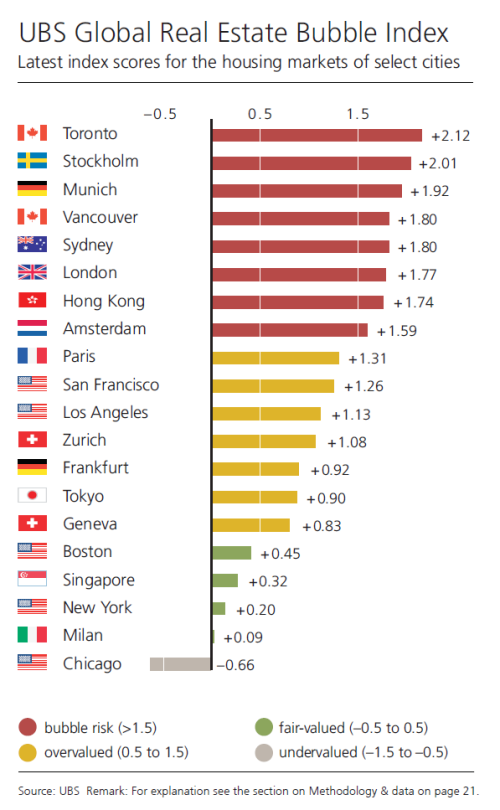
    Last week UBS released its 2017 Global Real Estate Bubble Index. At the top of the list was none other than Toronto, followed by Stockholm, Munich, Vancouver and Sydney. And at the bottom of the list was Chicago – a city that UBS feels is undervalued.

    Here is the full list of index scores:

    image

    The UBS index is a weighted average of the following five sub-indices:

    1. Price-to-income
    2. Price-to-rent (fundamental valuation)
    3. Change in mortgage-to-GDP ratio
    4. Change in construction-to-GDP ratio (economic distortion)
    5. Relative price-city-to-country indicator

    If you look at their price-to-income benchmark in isolation, Toronto drops down to the middle of the pack along with Geneva and San Francisco. Hong Kong, London and Paris sit at the top with the most unaffordable housing. 

    Still, UBS credits “an overly loose monetary policy”, foreign demand, tight zoning, and rental market regulations for the eroding housing affordability in Toronto and Vancouver.

    One of the challenges, of course, is that the capital flowing into real estate is not all local – it’s also global. And many cities around the world are seeing high price-to-income multiples, perhaps because of that. 

    So exactly how much decoupling from local fundamentals should now be considered reasonable in our globalized world? And to what extent is this a result of “superstar economics?”

    Here’s an excerpt from the UBS report:

    The economics of Superstars explains why, in some professions, show business for instance, “small numbers of people earn enormous amounts of money and dominate the activities in which they engage.” By analogous reasoning, prices in the most attractive cities are expected to outperform average cities or rural areas in the long run. Hong Kong, London and San Francisco are exemplars of this theory.

    The intuition is that the national and global growth of high-wealth households creates continued excess demand for the best locations. So, as long as supply cannot increase rapidly, prices in the so-called “Superstar cities” are supposed to decouple from rents, incomes and the respective countrywide price level.

    I guess this is one of the reasons why bubbles are proven after the fact. If you would like to download a copy of the full UBS report, click here.

  • Supply, not foreigners

    The chief economist at the Canada Mortgage and Housing Corporation (CMHC), Bob Dugan, recently published a piece in Macleans called: why the foreign buyers tax isn’t making Vancouver more affordable.

    Here’s an excerpt:

    One year after the implementation of the foreign buyers tax, monthly sales to foreign investors now hover around 4 per cent of all sales. But our latest Housing Market Assessment, released in July, still shows a red flag for Vancouver—with particular concern given to overvaluation and price acceleration. Average prices in Vancouver have rebounded to where they were before the tax’s implementation. In between, there was a marked drop, but it appears to have been temporary. In short, Vancouver is largely right back to where it was before the tax.

    He goes on to argue that while there are many factors affecting home prices, “supply is by far the chief factor.” This, of course, is a refrain you hear from everyone in the real estate business, so I’m not going to belabor the point.

    But I would like to point out some of the percentages. 

    Before the tax, foreign sales in Vancouver (to buyers who do not have a permanent address in Canada) were thought to sit at roughly 10%. Immediately following the tax, when everyone was trying to assess the impact, this dropped to ~0.9%. And now it’s back up to somewhere around 4%, according to the article.

    Arguably, there has been a slight reduction. Though who knows how accurate these percentages are. There is now a strong incentive to hide foreignness. 

    Regardless, CMHC doesn’t believe it’s working.

  • Will Zillow’s new “Instant Offers” disrupt real estate agents?

    Last month Zillow.com launched a new feature called “Instant Offers.” Press real estate can be found here.

    It is:

    “…a way for homeowners to sell their homes quickly by providing them with offers from investors and a comparative market analysis (CMA) from a local real estate agent, as an estimate for what the home might fetch on the open market.

    Here is a bit more about how it works:

    “To participate in Zillow Instant Offers, verified homeowners interested in receiving investor offers confirm information about the home (number of bedrooms, square footage, etc.), highlight any updates and provide several photos of the home. From there, select investors who buy homes in the area can present their offers alongside the CMA from a local real estate agent. Any investor offers and the CMA will include an overview of fees associated with each option, to enable sellers to make an informed apples-to-apples comparison.”

    When I first saw the headline, I thought they were copying Opendoor. But it’s not the same model. They aren’t buying the homes, like Opendoor, they are simply working to coordinate an “instant” transaction. Still, I’m sure that Opendoor provided at least some of the impetus for this feature.

    Of course, the most interesting question with these online real estate platforms is: Will they disrupt real estate agents? Mike Delprete wrote a great post about this in the wake of Zillow’s announcement.

    But ultimately he concludes something that I have felt strongly for years:

    “So, while real estate sites are best positioned to disrupt the real estate industry by displacing agents, they’re also the least likely to do so, because agents are their biggest customers and source of revenue.”

    The irony.

    About 70% of Zillow’s revenue comes from real estate agents. So it seems unlikely that they – at least currently – will be the ones that turn the tables on agents. 

    Some real estate platforms have started diversifying their revenue streams for probably this exact reason. But who knows, it may be a new entrant, rather than an incumbent, who pulls this off. 

  • One of the most expensive neighborhoods in LA

    image

    Oftentimes when I visit a city I like to ask myself: Which neighborhood would I want to live in if I were to move here?

    Today I spent much of the afternoon hanging around Venice. After we got there, I told my friend that if I moved to LA, I would probably want to live there. I told him that, relative to the rest of the city, I liked the compressed scale of the neighborhood. There are many pedestrian-only lanes and streets beyond the boardwalk. And I told him that I thought it was interesting how the neighborhood seems to combine both bohemians and yuppies (though many people seem to hate the yuppy part).

    But I’m obviously not alone in my thinking. My friend quickly informed me that Venice is one of the most expensive neighborhoods in LA and that it’s been adding essentially no new housing supply. Here’s an excerpt from an LA Weekly article published at the beginning of this year:

    Anti-development activists like to argue that development fuels gentrification, that the construction of new, high-end apartment buildings makes the whole neighborhood more expensive.

    But the case of Venice is a counterpoint. For the last 50 years, Venice has successfully fought developers to a stalemate. The housing supply stayed constant, while demand grew. As a result, the value of property in Venice has soared.

    In 1996, according to data provided by Zillow, the average home value in Venice was $251,000 — more expensive than Silver Lake and Encino but cheaper than Westwood, Studio City, Mid-Wilshire and Los Feliz. Today, Venice’s average home value is nearly $1.6 million, more expensive than all of those neighborhoods — more expensive, in fact, than its historically tony neighbor to the north, the city of Santa Monica, which, according to Alvarez’s research, added more than 10,000 dwelling units between 1960 and 2010.

    Perhaps I should give this some more thought.

  • HOT, HOT HOUSES

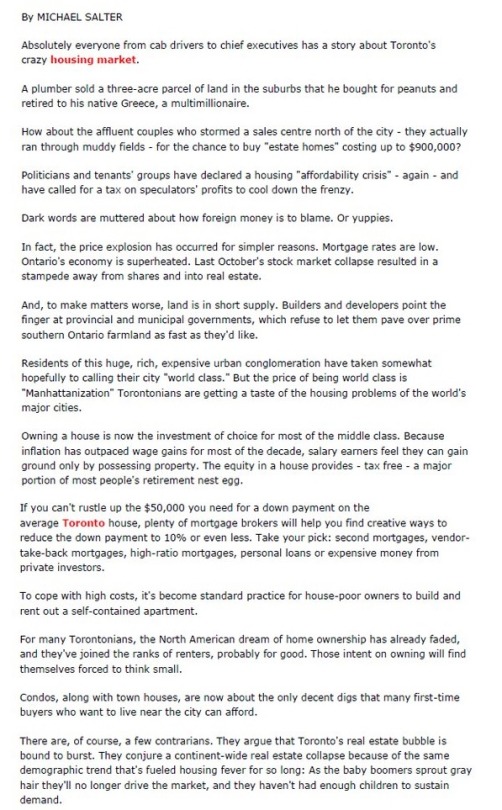
    Below is a piece by Michael Salter from the Globe and Mail. It’s all about Toronto’s HOT, HOT housing market. Michael’s message: Here are the real reasons why home prices are skyrocketing and why they are going to remain high.

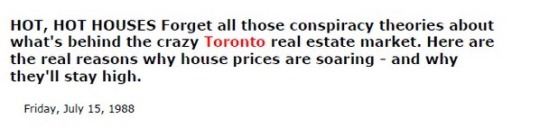
    Did you find yourself agreeing with this article or did you notice that something was off? If you noticed something, it may be because this article was originally published on Friday, July 15, 1988. And by that time, the North American dream of home ownership had already died in Toronto.

    Here’s the header I cut out from above:

    Thank you to Tamsin McMahon for tweeting this out last weekend.

  • 16 new housing measures

    The big news today in Toronto real estate is that the province of Ontario introduced 16 new measures intended to rein in the housing market. 

    Some of the most notable measures, which many of you will have seen in the headlines, include a 15% tax on home purchases by non-residents and expanded rent control for buildings completed after 1991. Previously it only applied to older buildings. The maximum annual rent increase for existing tenants will now be capped at the rate of inflation, up to a maximum of 2.5%.

    Here’s some more information from the Globe and Mail and CBC.

    I’ve had a few people ask me to blog / comment on the above, but I haven’t yet had time to do a deep dive into the details. I would like to do that first rather than provide a knee-jerk reaction. In the meantime, I would love to hear your thoughts in the comment section below.

  • Toronto real estate is out of control

    You can’t have an Easter dinner in Toronto right now without somebody bringing up the topic of our “crazy” real estate market. 

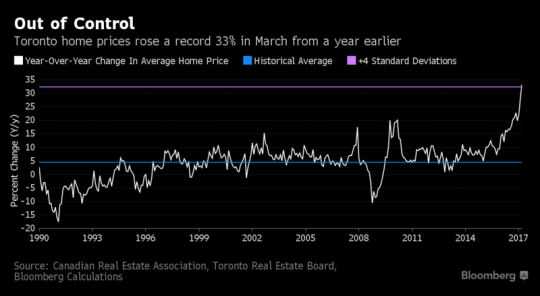
    Below is a chart from Bloomberg showing the year-over-year change in home prices in the Greater Toronto Area since 1990. It also shows the historical average (in blue) and how in March 2017 we hit 4 standard deviations above that. Home prices rose 33% in March compared to a year earlier.

    If I were a realtor, I’d probably tell you that the market is hot hot hot. Now is the time to sell because you’ll get some absurd number above your asking price and now is the time to buy because prices are going nowhere but up. Don’t miss out. 

    I would like to try and be a bit more nuanced than that. Here are 3 thoughts:

    1)

    There’s no question that low rates / cheap money is one of the root causes of the real estate valuations we are seeing today. But frankly I have no idea when or if that will change. There is an interesting argument out there that capital is no longer scarce. Our economy is going through a fundamental shift, which is why real estate is not the only asset class seeing these sorts of valuations and growth figures.

    2)

    There are a number of global factors which are helping to cement Toronto’s position as an alpha global city and destination for human capital. Think Trump, Brexit, and so on. I agree with Richard Florida’s argument that our real estate market will see more – not less – pressure going forward. Here is a snippet from a recent interview with Florida in Toronto Life:

    I think Toronto is going to get an even bigger influx of the creative class. With the rise of Trumpism, more and more people who might otherwise have gone to the United States are going to come to Canada. We’re going to see American tech companies invest more and more in Toronto. And if we think the housing affordability and economic divide we see today is bad, it’s going to grow ever more gaping. 

    3)

    I believe that there are always opportunities in the real estate space, but that you have to be disciplined, focused on fundamentals, and willing to do things that others won’t. What bothers me is when I hear people say things like: “Real estate only goes up. You can never go wrong.” I started my career pre-2008 and lived in both the United States and Ireland. I saw what down looks like.

  • Housing is a bitch

    I just discovered Steve Randy Waldman’s blog called Interfluidity and, more specifically, a post he wrote called: “Home is where the cartel is.” I am now following him.

    He starts off by saying that housing is a bitch, which is just him saying that urban housing is a difficult problem to solve. A truism for this audience.

    He doesn’t profess to have all of the answers, but he does write a thoughtful piece that covers, among other things: the “market urbanist” (supply-side) solution to solving housing affordability, the reasons why the “housing cartel” will never approve of this, and the inherent contradiction between housing as an investment and housing as a sustainably affordable good.

    He also offers up Singapore and Germany as examples of two very different housing markets. It reminded me of a tweet I retweeted this morning which shows Germany as having the 2nd lowest homeownership rate (45%) among OECD countries.

  • Supply down. Prices up. Unit sizes up.

    This morning BILD released its November new home data for the Greater Toronto Area. 

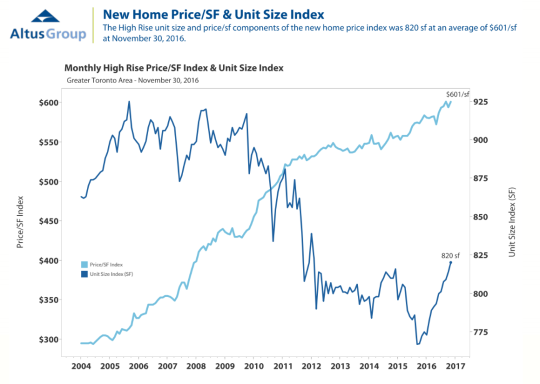
    The story is one we’ve been hearing for a while. Supply is trending downward. It’s becoming harder to build. And prices are up. The average new detached house in this region is now C$1,230,961 and the average new condo is now C$493,137 (~$601 psf). Overall, average pricing is up 20% for low-rise houses and up 10% for condos, compared to this time last year.

    One of the things that I find interesting about the data is how unit sizes have recently started trending upward on the high-rise (condo) side. Below is a chart from Altus Group that shows what I’m talking about. Look at the increase from the middle of 2015 to today. The average is now 820 sf, compared to what looks to be around 770 sf at its lowest point.

    image

    Now, there are a number of possible explanations for this. One is that boomers are starting to sell their houses and move into condos in larger numbers, and 500 sf just don’t do. The market is starting to cater to them. Another possible explanation is that low-rise pricing has become so out of reach for many people and families, that they are now looking to condos to fill that need.

    I see both scenarios playing out in new projects today. But this second scenario, in particular, is one that I’ve been thinking about for a few years now. It’s less obvious than the boomer play. But I think of it as the market maturing. I like seeing families living right in the city and I am sure we will see more of that in the future.