Daily insights for city builders, delivered every morning at 6 AM ET. I’m Brandon Donnelly — a Toronto-based real estate developer and founder of Globizen. I’ve been writing here since 2013.

Tag: housing market

  • Opendoor.com is so risky that it may just work

    image

    I have been writing about the startup Opendoor.com for over 2 years now. And I continue to believe that they are the most promising disruptor in the residential real estate space. 

    Here is the first post that I wrote back in July 2014 after they raised their first round of funding. Here is the second post that I wrote after they launched in Phoenix. And here is another post that I wrote 6 months ago where I argued, once again, that they are doing something worth paying attention to. (This last post explains how the platform works.)

    Well, about a week ago it was announced that they have raised another round of funding: a $210 million Series D. In all likelihood, the company’s valuation is now over $1 billion. Here’s the Techcrunch announcement where the message was: huge ass number; risky business model.

    In response to this, Ben Thompson wrote a terrific and widely shared blog post called, Opendoor: A Startup Worth Emulating. I love his post because he says what I have firmly believed and argued for many years: Zillow and Redfin are not disruptive real estate startups.

    This is what he says about Zillow:

    “And yet, the most successful real estate startup, Zillow (which acquired its largest competitor Trulia a couple of years ago), is little more than a glorified marketing tool: the company makes most of its revenue by getting real estate agents — the ones collecting 6% of fees, split between the buying and selling agents — to pay to advertise their houses on the site. Certainly a free tool that makes it easier to find houses in a more intuitive way is valuable — Zillow has acquired the sort of userbase that allow it to build an advertising business for a reason — but at the end of the day the company is a tax on a system that hasn’t really changed in decades.”

    And though very risky, he argues that Opendoor is far better positioned to shake up the status quo. 

    Here are two of his key points:

    “Sellers are uniquely disadvantaged under the current system, which is another way of saying they are an underserved market with unmet needs.” [Sellers are the side of the market that Opendoor is specifically targeting.]

    “Opendoor has a new business model: taking advantage of a theoretical arbitrage opportunity (earning fees on houses sold at a slight mark-up) by leveraging technology in pursuit of previously impossible scale that should, in theory, ameliorate risk.”

    And here’s what that could ultimately mean for the industry:

    “Opendoor has many more reasons why it might fail than Zillow or Redfin, but its potential upside is far greater as a result. First is the immediate opportunity: sellers who can’t wait. However, as Opendoor grows its seller base, especially geographically, its risk will start to decrease thanks to diversification and sheer size; that will allow it to lower its “market risk” charge which will lead to more sellers. More sellers means both less risk and an increasingly compelling product for buyers to access, first with a real estate agent and eventually directly. More buyers will mean lower marketing costs and faster sell-through, which will lower risk further and thus lower prices, pushing the cycle forward. It’s even possible to envision a future where Opendoor actually does uproot the anachronistic real estate agent system that is a relic of the pre-Internet era, and they will have done so with realtors not only not fighting them but, on the buying side, helping them.”

    I’m with Ben on this.
  • The yellowbelt

    We talk a lot about the greenbelt here in Toronto. Some argue that it’s squeezing the housing market and driving up prices.

    But what about the yellowbelt? (Credit to Gil Meslin for the term.)

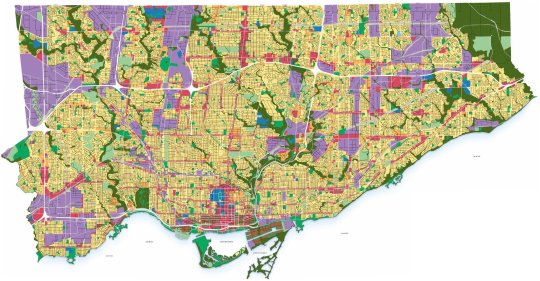
    Here is a land use map of Toronto:

    The yellow areas are “neighborhoods.” They, along with parks, ravines, watercourses, and valleys, make up ¾ of the city’s land area. The Official Plan describes these areas as being “stable” – meaning they will see little physical change. Supply cannot adjust to demand.

    I get why this is the way it is and I understand how difficult it would be change something like this. But let’s not ignore the impact that this land use constraint has and will continue to have on the housing market. 

    It’s the yellowbelt. Thank you Gil for letting me to steal the name.

  • Low-rise vs. high-rise

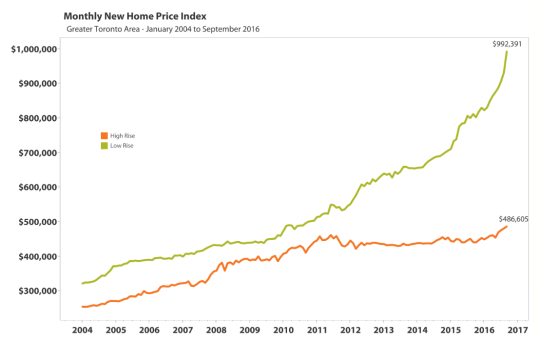
    Yesterday I sent out this tweet, which included this graph:

    The chart is from Altus Group and it is a monthly price index of new low-rise vs. high-rise housing in the Greater Toronto Area (GTA). I have posted similar charts in the past, but every time this chart gets updated the spread widens and the market looks even crazier.

    Some people responded on Twitter by saying that this is clearly an indication of a bubble. I don’t know if that is the case. 

    But, as I have said many times before, I do believe that it tells a vivid story around supply. Low-rise housing is severely supply constrained in the GTA and high-rise housing is less so. That has helped to stabilize pricing in the latter case.

    Now, you could look at this chart and say that the pace of low-rise price increases is simply unsustainable. The market must correct. 

    But you could also look at it and say that the market is going through a fundamental shift whereby more and more families will start living up, as opposed to out – which should then translate into high-rise pricing trending upwards as unit sizes increase. This is where I think we are headed. 

    What do you reckon is happening?

  • Tools for promoting healthy, responsive, affordable, high-opportunity housing markets

    This month the White House released a Housing Development Toolkit. The report starts by talking about the local barriers to building and makes this statement:

    “The growing severity of undersupplied housing markets is jeopardizing housing affordability for working families, increasing income inequality by reducing less-skilled workers’ access to high-wage labor markets, and stifling GDP growth by driving labor migration away from the most productive regions.”

    It then goes on to highlight a number of tools that American cities have adopted or should adopt “to promote healthy responsive, affordable, high-opportunity housing markets.” 

    They are:

    • Establishing by-right development
    • Taxing vacant land or donate it to non-profit developers
    • Streamlining or shortening permitting processes and timelines
    • Eliminate off-street parking requirements
    • Allowing accessory dwelling units
    • Establishing density bonuses
    • Enacting high-density and multifamily zoning
    • Employing inclusionary zoning
    • Establishing development tax or value capture incentives
    • Using property tax abatements

    None of this will be news to regulars of this blog. We have spoken about almost every single tool in the above list. 

    I’m not necessarily sold on all of them (good discussion to have), but I have gone on ad nauseam about eliminating parking minimums (off-street parking); the value of accessory dwelling units (commonly called laneway housing here in Toronto); and the negative impacts of barriers to building.

    The good news is that there’s growing alignment around a similar set of actions. Change takes time. There’s usually a heavy bias towards the status quo.

  • Sharing walls with strangers

    Barry Ritholtz recently published an article in Bloomberg View called: Still a Lot of Negativity on Housing

    He basically says that “many people” should go out and buy a home given the current state of the US housing market and the historically low interest rates. That’s a perfectly fine argument. But it’s not all that interesting.

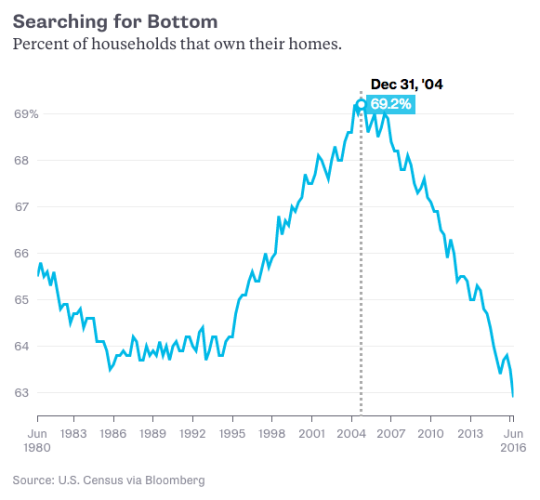
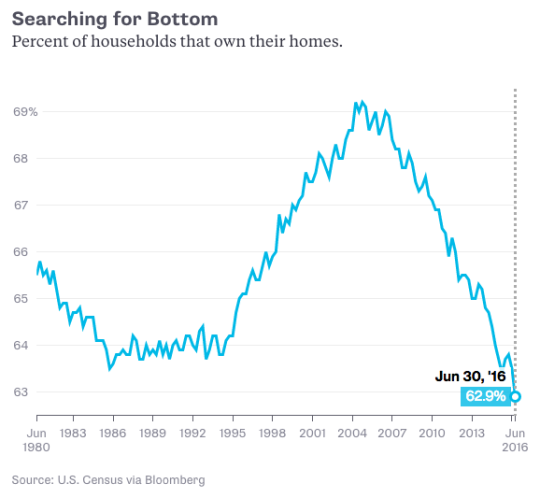
    The article does, however, have a moderately interactive chart showing the percentage of US households that own their homes.

    It shows the pre-2008 peak:

    image

    And it shows, somewhat surprisingly, the recent “search for bottom.” I knew there was a significant post-2008 decline, but I guess I thought it had stabilized. Instead, the US is hitting homeownership rates not seen since the mid-1960s.

    image

    Big cities tend to have a higher percentage of renters. Millennials are flooding into cities. The digital economy now encourages mobility, which contradicts traditional notions of homeownership. There are all kinds of potential hypotheses that could be extracted here.

    But the other interesting thing I noticed in the article, was this:

    However, at some point in life, you probably no longer want to have a landlord telling you what color your walls can be or become tired of having strangers share a wall with you. I am not a zealous believer that everyone should go out and buy a home. However, for many people, buying makes sense – especially with mortgage rates as low as they are (the current rate of about 3.45 percent for a 30-year fixed-rate mortgage is just 0.10 percent higher than the record low).

    I couldn’t help but notice the embedded cultural bias. The inference is that when you rent, you share walls. In other words, you live in some sort of multi-family apartment. 

    But when you finally go out and buy a home, you graduate from that. You no longer need to share walls with strangers. Because an owned home equals a single-family detached dwelling. That’s how you know you’ve made it.

    Well, I have shared walls in my owned home. I guess I’m not there yet. 🙂

  • Should we love bubbles?

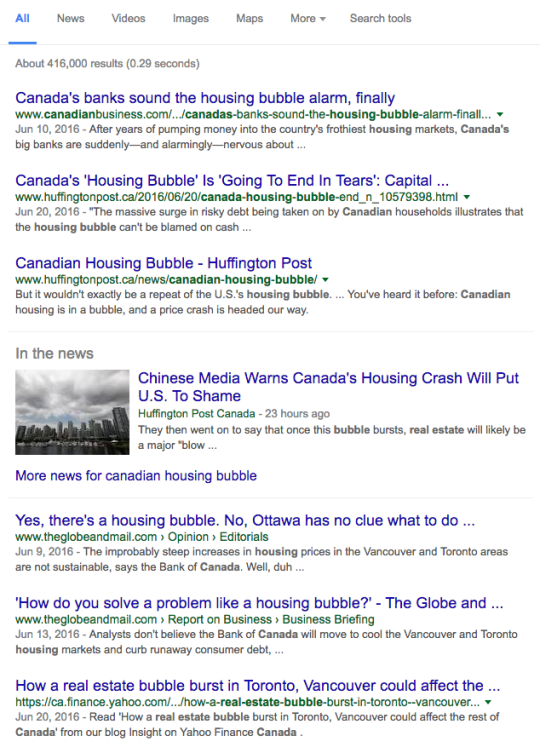
    There’s no shortage of talk about a Canadian housing bubble:

    image

    In Vancouver, the price of a single-family home (as of June of this year) increased 39% to C$1.6 million from the year prior. Does that constitute bubble territory?

    In an effort to stop prices from running away even further, I am sure you all know that the BC government has recently imposed an additional 15% transfer tax on Metro Vancouver homes purchased by foreign buyers (people who are not Canadian citizens or permanent residents).

    The data that I have seen (here and here) suggests that foreign buyers could make up somewhere around 5-10% of the market. Given that many will now get creative in terms of hiding their foreignness, I am not so sure this new tax will have a dramatic impact on affordability. But it certainly sounds nice if you’ve been grouchy about home prices and thinking “those damn foreigners.” We’ll have to see how it plays out.

    Having said all of this, if Vancouver is in fact in bubble territory, would that be so bad? Are we thinking about this the right way?

    Here’s an alternative viewpoint.

    I recently stumbled upon an old blog post by Tom Evslin (2005) called: Why we need bubbles. I discovered it via it Fred Wilson. Tom’s argument is that we need irrational exuberance because it provides the capital that allows for dramatic overbuilding. The overbuilding of things like rail infrastructure, internet infrastructure and – I’m adding this – housing infrastructure. And once this happens, it dethrones the incumbents and paves the way for future economic progress.

    Tom’s focus is on technology, but I couldn’t help but think of the parallels with city building. Is the proposed Rail Deck Park in Toronto so bold that it’s only possible during a period of irrational exuberance? Should Vancouver instead be working to dramatically expand its housing supply instead of trying to tax away a portion of demand? Is a period of irrational exuberance precisely the moment where we lay the ground work for our future successes?

    I’m not saying we’re in a bubble. I don’t believe in or know how to time markets. But I am asking whether the bubble headlines are missing the greater opportunity.

  • Home prices and negative interest rates

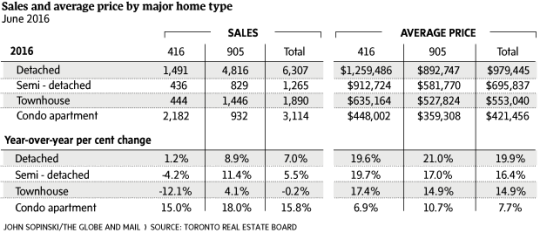
    This morning, I am looking at the following chart of average home prices in the Greater Toronto Area:

    It’s from this Globe and Mail article.

    These are staggering numbers. The average price of a detached home in the suburbs (905 area code) increased 21% year-over-year. In the city (416 area code), the increase was 19.6% YOY. These numbers are almost unbelievable.

    The article focuses on low supply (decrease in listings) and high demand. And that is certainly a big part of what’s going on here in this city, as well as in many others.

    But of course, the backdrop to all of this is our low / zero / negative interest rate environment.

    Larry Summers has a great post on his blog (which I discovered this morning via Fred Wilson) that talks about this “remarkable financial moment.” In some instances, real interest rates are actually negative! (You should read his post.)

    There are always people threatening that interests rates just have to go up. But Larry, as well as others, continue to argue that natural real interest rates are likely to remain close to zero going forward.

    Fred mentions Albert Wenger on his blog this morning and I have written about him before as well, here. In his book World After Capital, Albert argues that capital is no longer the scarce resource of our time. Instead, it has become attention.

    If you believe all of this to be true, then perhaps the numbers at the top of this post aren’t so unbelievable after all.

  • A money back guarantee on your next home

    image

    I’ve written about Opendoor.com a few times. As far as I can tell, they are the furthest ahead in terms of disrupting the residential real estate market. So I like to follow them quite closely.

    They’ve recently launched some new features, so I figured it would be a good time to check-in on what they’re up to. But first – for those of you might not be familiar with Opendoor – here’s what they do.

    Opendoor offers instant liquidity to homeowners by buying homes site unseen. The fee they charge seems to amount to less than 10% of the value of the home. 

    They also say that they typically offer prices that are about 1-3% less than the market value of the home 3 months into the future. (Apparently 3 months is the average time-on-market for the cities in which they operate.)

    Once they’ve bought the home, they then make improvements and put it back on the market. As of today, they are buying about 10 homes a day in the two markets in which they operate (Phoenix and Dallas). They are spending about $75 million a month buying homes.

    To mitigate their risk, they won’t buy a home built before 1960, a home that was pre-fabricated, a home with a solar lease, and so on. They also stick to values that are between $100,000 to $600,000. But apparently this covers off about 90% of homes in the United States. (You can read their full FAQ here.)

    To accomplish all of this, they have raised about $110 million in venture capital.

    What’s fascinating about all of this is that they are starting to create a seamless marketplace. As they continue to buy more homes (and aggregate supply), more buyers are starting to come to their marketplace. They also allow people to easily find local contractors.

    Over time as they gain scale and as their algorithms improve, one could imagine their pricing becoming more competitive, them taking more of the market, and them bearing much less market risk as homes quickly trade. 

    They liken their model to car trade-ins. Apparently 60% of people who buy a new car are trading in an old one. That’s an interesting comparison that I hadn’t thought about before.

    So what’s new?

    Two things

    First, they are offering a 30 day full refund on new home purchases. In other words, if you buy a home through their platform and, for whatever reason, you end up not liking it, they’ll buy it back (minus some transaction costs and so on).

    Second, they are providing a 180-point inspection report to buyers and if anything breaks in the first two years of ownership (presumably it is something that contravenes the inspection), they’ll come and fix it.

    These additions are helpful because it starts to target buyers, which will help them fill out the other side of their marketplace. It also promotes greater transparency because now they’re partially on the hook for the home’s performance.

    I like what they are doing and, again, I can’t think of any other company making such big bets in this space.

  • This U.S. housing boom is different

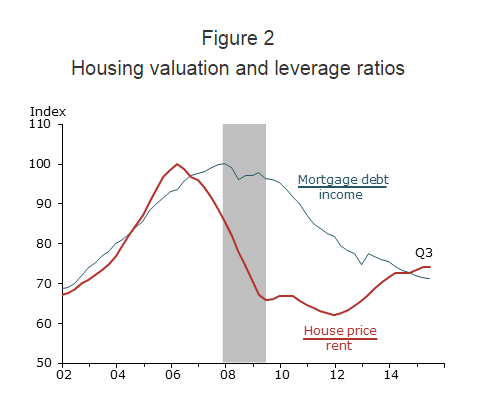
    Just a few days ago, The Federal Reserve Bank of San Francisco published an interesting research study where they argue that this U.S. housing boom is different than that of the early 2000s.

    During the last boom, U.S. home prices peaked in 2006 and then dropped about 30% in the wake of The Great Recession. Since then prices have rebounded – almost to their pre-recession levels. This has some people asking whether this story is headed towards the same ending.

    But the FRBSF is saying no:

    “We find that the increase in U.S. house prices since 2011 differs in significant ways from the mid-2000s housing boom. The prior episode can be described as a credit-fueled bubble in which housing valuation—as measured by the house price-to-rent ratio—and household leverage—as measured by the mortgage debt-to-income ratio—rose together in a self-reinforcing feedback loop. In contrast, the more recent episode exhibits a less-pronounced increase in housing valuation together with an outright decline in household leverage—a pattern that is not suggestive of a credit-fueled bubble.”

    And here’s the chart:

    Source: Flow of funds, Bureau of Economic Analysis (BEA), CoreLogic, and BLS. Data are seasonally adjusted and indexed to 100 at pre-recession peak.

  • The contradiction in American housing policy

    I really like this post by Daniel Hertz talking about the inherent tension in American housing policy.

    Here’s his conclusion:

    We are, in conclusion, profoundly conflicted as a nation when it comes to housing: we want it to be affordable, but we also want its prices to rise fast enough to be valuable as a financial investment. That’s a contradiction we need to acknowledge if our housing policy debate—and, ultimately, our housing policy—is going to be coherent and constructive.

    Of course, this situation isn’t unique to the US. Though the US does have homeownership subsidies – such as the mortgage interest tax deduction – that other similar countries, like Canada, do not have.

    Still, I feel a similar kind of contradiction here. We worry about excess supply and housing bubbles when the reality is that both of these things are desirable outcomes if, and only if, the primary objective is to maintain housing affordability.

    But I don’t think that is the primary objective in practice. At least in this part of the world, I think we worry first and foremost about making sure that home prices continue to go up and that wealth is being built. Then, we worry about providing affordable housing for those that are unable to participate.

    I’m not making a judgement call on whether or not that’s a good or bad thing. It just strikes me that this tension, and there certainly is a tension, is not an equal one.