Daily insights for city builders, delivered every morning at 6 AM ET. I’m Brandon Donnelly — a Toronto-based real estate developer and founder of Globizen. I’ve been writing here since 2013.

Tag: housing affordability

  • Attainable housing is in short supply

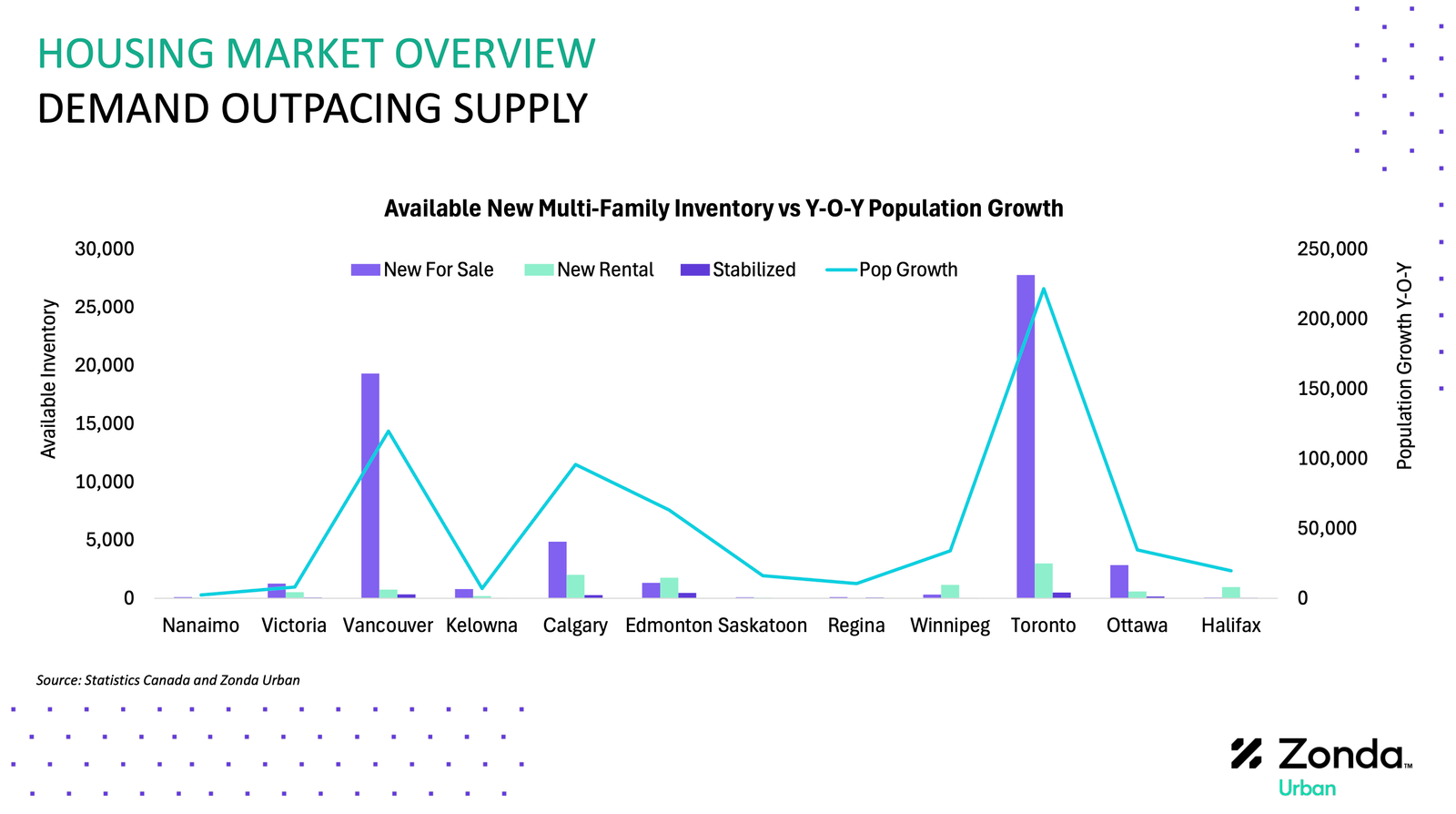
    Approximately 41% of the YTD population growth in Canada this year has been in Ontario. Here’s a slide from a recent presentation by Zonda Urban:

    So there’s an argument to be made that demand is still outpacing new housing supply in most of our major markets:

    Why then are new home sales continuing to slide? A reasonable answer would be that — by design — this new housing isn’t attainable to most:

    The result seems to be a long-term structural shift toward more rental housing:

  • Housing affordability in Canada

    By some measures, housing affordability is, in aggregate, the worst it has been in Canada going back to the 1980s. Below is a chart from RBC showing homeownership costs as a percentage of median household income.

    The previous spike came around the early 90s, but following that, we saw 3 decades of relative affordability. In fact, for a large portion of this timeline, condo apartments look to be hovering around 1/3 of median household income. This is a common rule of thumb for measuring affordability.

    Now obviously things changed pretty dramatically during the pandemic. But that time has ended and a reset is underway. New housing supply has slowed dramatically. Developers are sitting on record levels of inventory. And sellers of all shapes and sizes are clinging, as best they can, to yesterday’s prices.

    With so much uncertainty, it’s challenging, if not impossible, to know exactly how all of this will play out in the coming years. But I suspect that, as time goes on, the above chart is going to start to mirror what we saw in the early and mid-90’s. In other words, affordability is going to improve.

  • The global cities attracting talent, visitors, and investment

    Earlier this month, Resonance Consultancy published its 2024 World’s Best Cities ranking. Or, in their words: its definitive power ranking of the 100 global cities that it believes are shaping tomorrow.

    These are always fun to flip through, which is I guess why people do them and why people look at them; but I do think it’s important to look at the underlying methodologies. Otherwise, what does “world’s best” even really mean?

    In this case, they’re looking at global cities through the lens of three key categories: livability, lovability, and prosperity. More specifically though, the report looks at factors that are demonstrated to have moderate to strong correlations with attracting talent, visitors, and/or businesses.

    This makes it distinct from rankings that are more focused on things like livability. Because according to Resonance, factors such as commute times, crime, and housing affordability don’t tend to correlate strongly (at least in the short-term) with a city’s ability to attract talent, tourism, and investment.

    While this may seem a bit counterintuitive, it does also make sense. People don’t move to London because they’re looking for affordable housing and a reasonable commute. They move to London because they want to be in the center of the world.

    And yes, London tops their power ranking:

    The top of this ranking isn’t all that surprising. It’s the usual suspects. But I continue to be impressed by how quickly Dubai has transformed itself into a top global city. Also impressive is how Dublin punches above its weight of just over 500,000 people.

    I am medium surprised to see Hong Kong nowhere on this first page (there are another 65 cities not shown here). It usually features as a top global city. But presumably this is the result of Beijing meddling. People are looking elsewhere — like Singapore.

    For the full list of cities and to download a copy of the report, click here.

  • Toward the childless city

    There is a common narrative that, when it comes time to start a family and have kids, you should probably consider moving to the suburbs. Sure, you’ll have a painful commute, but you’ll get more space for your money, and maybe you’ll end up with better kids.

    I don’t know, obviously not everyone agrees with this. I certainly don’t.

    But it is something that commonly happens and, in many cities, it is now happening more often. Here is a map from the Centre for London showing the change in the proportion of households with at least one dependent child from 2001 to 2021:

    A darker borough means that it lost households with at least one child. And a lighter borough means that it gained more kids. Why this is concerning is that it means the trendline is toward more, and not less, childless cities. Here’s an excerpt from a recent FT article:

    A future with dwindling numbers of children is one many cities, including San Francisco, Seattle and Washington DC, are grappling with. In Hong Kong, for every adult over 65 there are, to put it crudely, 0.7 children, and in Tokyo it is even fewer (0.5).

    Of course, this is not a new phenomenon. And we know the main drivers:

    Randal Cremer is one of several planned primary school closures and mergers in inner London triggered by low birth rates, families moving away because of expensive childcare, Brexit, and parents re-evaluating their lives during the pandemic. The biggest factor, says Riley, is that “housing is just becoming unaffordable”. Philip Glanville, mayor of Hackney, calls it “the acute affordability crisis”.

    So how do we start to solve this? Here are a few ideas that we recently talked about on the blog, but it is by no means an exhaustive list. In my opinion, this is a problematic trend that deserves a lot more attention. Because cities are at their best when they work for everyone — from the young to the old.

  • Real estate investors are outbidding people who own strollers

    Here’s a potential scenario:

    “When you have investors competing with first-time buyers who walk in with a couple of [baby] strollers, typically the investor is going to win,” Mr. Pasalis says. “They are well capitalized. They can pay a higher price. And this is why our home ownership rate is declining, because more and more homes are actually going into the hands of investors who rent them out, and amplifying home and amplifying condo prices. We are seeing that.”

    But let’s break this down a little.

    Where are these first-time buyers walking into? Is it a resale home showing or is it a pre-construction showroom? If it’s the latter, then we know it’s going to be difficult / atypical for them to make a buy decision so far in advance. They already have multiple strollers in hand, do they want to wait 4-7 years for their pre-construction home to be ready?

    I would also add that in our current environment — where investor demand for pre-construction homes has waned significantly — the development industry has not seen a marked uptick in end-user demand. Why are they not stepping up now that they’re not being outbid by investors? In my opinion, it’s an ideal time to buy!

    One reason could be that people who own strollers still largely prefer low-rise housing. Maybe it’s for reasons of affordability, maybe it’s a cultural bias, or maybe it’s a genuine preference. Either way, let’s turn our attention to resale homes. In this scenario, who is likely to pay the most?

    If you’re an investor, then you are looking for a specific yield. And so in theory, it should be a mostly dispassionate decision: “Here’s the most that I can pay in order to meet my minimum returns. Do not exceed.” But the question is whether is this is going to be more or less than what a stroller-owning group of people would pay.

    The answer is probably that it depends. However, if the answer is that the investor wins and they then turn around and rent it to people who own strollers, is this actually a problem? And if this same investor happens to own 25 other rental homes and they’re all rented to people who own strollers, is this an even greater problem?

    I suppose it is a problem if you’re worried about Canada’s homeownership rate, which has in fact declined from about 69% (in 2011) to 66.5% (in 2021). But what does this even mean? Is a higher homeownership rate always better? Does Canada have a target number? As of February of this year, the homeownership rate in Switzerland was only about 36.3%. And the last time I checked, it was still a rich country.

    There is nothing wrong with renting. I know wealthy people who have opted to rent their entire life because they enjoyed the flexibility and/or had better places to put their money.

    All of this said, the argument in the above scenario is that, but for investors outbidding people with strollers, these homes would be more affordable and that would in turn increase the homeownership rate. It’s a similar argument to, but for foreign buyers or but for Airbnbs, these homes would be more affordable.

    But in a city like Toronto, we are building very little in the way of new low-rise houses. New supply is virtually non-existent. Similarly in Seattle, they are now building more accessory dwelling units than they are single-family houses. So it is any wonder that demand is constantly outstripping supply and that prices are being bid up?

    In my opinion, a better solution is to rethink how we build our low-rise neighborhoods. And here and here are two good places to start.

  • What we value the most

    One natural response to yesterday’s post about (housing) affordability vs. beauty is to think that I put forward a false dichotomy. Why can’t we have both? Why does it need to be a zero-sum game? Surely there’s a middle ground. Our cities should be both inclusive and beautiful. And of course, I don’t disagree.

    What I was trying to do with the post was force a thought exercise. There are lots of things that we do as city builders which serve to increase the cost/price of housing. Going to a design review panel adds time/cost. Deciding to use that really nice material from Europe adds cost (and maybe time). And even adding a simple building stepback adds time/cost.

    So in doing these things, we are in effect deciding that these are more important that just building cheaper and lowering the resulting rents/sales prices. We can certainly debate the right balance and how much should be spent on things like design and/or sustainability, but it doesn’t change the fact that, for better or for worse, we are saying, “it is important that we spend the money on this particular item.”

    Now, there is also a common counter argument that none of this really matters, because developers will always price new housing at whatever the market will bear (i.e. the maximum possible price). But as I have tried to argue many times before on this blog, this is not always true. Pushing prices too far increases risk and slows absorption.

    It also ignores the fact that in any given city there are going to be sites that are infeasible to develop with new housing. That is, when you look at all the costs and, yes, what the market will bear, the numbers just don’t work. And so what can happen when you reduce development costs is that you now unlock more sites for new housing, increasing overall supply.

    None of this is to say that our cities shouldn’t be beautiful or that we shouldn’t strive for creative design solutions. This is exactly what we should be doing! Instead, this post (and yesterday’s) is simply a reminder that time and things do cost money, and that the decisions we make are rarely benign. In fact, they usually speak to what we value the most.

  • Affordable vs. beautiful

    If you had to pick one, would you say that it’s more important for new housing to be affordable or to be beautiful? Many of you are probably thinking that it should be both. And while it is true that good and thoughtful design doesn’t always need to be more expensive, nice things do often cost money. And sometimes, doing as little as humanly possible costs even more money.

    Let’s consider two development scenarios. In scenario A, the developer has well-oiled machine that delivers relatively affordable, but identical rental housing all across the country. The buildings are functional and there’s virtually no vacancy, but the architecture is undoubtedly bland and it certainly doesn’t respond to its local context. Standardization and efficiency trumps all, including aesthetics.

    In scenario B, the developer is similarly building new rental housing, but she instead invests heavily in custom designs. Each building is unique. And each building goes through a “design review panel”, after which extensive changes are made in order to ensure that the design is truly beautiful and that it responds to its local context. As a result, there is a real price premium to these homes.

    These are perhaps extreme examples. Usually, the goal is some sort of balance between affordability and beauty. But I do think it speaks to some of the tensions that our industry faces. So if you had to choose one, which one would it be? What kind of new homes do our cities really need more of? And if your answer is scenario B, does it change after a certain premium?

  • What is the correlation between urban density and housing affordability?

    There’s lots of data out there to suggest that there is a correlation between urban density and housing unaffordability. Take Hong Kong. It is very dense, and also one of the most expensive housing markets in the world. But I think the real question is: does urban density actually cause housing unaffordability, or do the two simply tend to be correlated when you plot a country’s biggest cities?

    One the one hand, there are factors that do drive up home prices when you build more densely. Building a reinforced-concrete high-rise is always going to be more expensive on a per square foot basis than building a wood-framed bungalow. But of course, the former also uses land a lot more efficiently, which is what you need to do in big and supply-constrained cities.

    Michael Lewyn’s view (credit to Robert Wright for sending me the article) is that density is incorrectly used as a scapegoat to fight compact development. It does not actually cause higher rents. One counter example he gives is that of Manhattan, which went from 2.3 million people in 1910 to just under 1.7 million in 2020. In other words, it got less dense, while at the same time its rents grew exponentially.

    Like most important city matters, the answer is complicated. But this is an interesting topic that I think we should spend more time on here.

  • Which is the most important when it comes to new housing?

    If you can’t see the Twitter poll below, click here:

    At the time of writing this post, affordability was number one, followed by design and beauty, and then sustainability.

    Some of you were right to point out that these options are not always mutually exclusive. Affordability and sustainability, for instance, can be mutually reinforcing.

    Building in walkable and transit-rich neighborhoods where parking is not needed is both good for overall affordability (parking is usually a loss leader) and better for the environment.

    But in other cases, sustainability costs more. Triple-glazed windows might perform better than conventional double-glazed, but they’re also more expensive.

    Now, as a general rule, I believe in working hard to find the mutually reinforcing opportunities. How can we check all of the boxes and not have to compromise?

    But sometimes there’s no other option. So it is interesting to see how people answer the above question. Not surprisingly, affordability is top of mind.

    Which would you pick?

  • Zoning controls, sprawl, and housing affordability

    Maybe it’s confirmation bias, but I continue to feel like there is a groundswell of interest in trying to improve housing supply and overall affordability. The YIMBY movement continues to gain steam. Here are are few excerpts from a recent M. Nolan Gray article where he calls for an end to zoning as we know it today:

    In nearly every major U.S. city, apartments are banned in at least 70 percent of residential areas. San Jose prohibits apartments in 94 percent of its residential areas. The most a developer can build in these zones is a detached single-family home.

    The results speak for themselves. Houston builds housing at 14 times the rate of peers like San Jose. And it isn’t just sprawl: In 2019, Houston built roughly the same number of apartments as Los Angeles, despite being half its size. Since reforms to minimum-lot-size rules were put in place in 1998, more than 25,000 townhouses have been built, overwhelmingly in existing urban areas.

    To be clear, Houston has made its share of planning mistakes. But, free of zoning, the city can constantly remake itself. That Houston is now one of the most affordable and diverse cities in the country is no accident.

    The relationship between housing affordability and constraints on development is a well-documented one. If you want more affordable housing, you generally want fewer, rather than more, constraints on delivering new housing.

    But as I was reading through the article, I couldn’t help but think more specifically about the relationship between sprawl and affordability. Because it is also true that, for a variety of reasons, the former has tended to help the latter (or at least coincide with it), which is why Gray felt it was important to say “and it isn’t just sprawl” when talking about Houston.

    Part of this relationship has to do with the fact that expansionist development tends to be of the low-rise stick-built varietal, which is a relatively cost effective way to build. Whereas the higher density infill stuff tends to be built using more expensive materials like reinforced concrete. But of course there are many other factors at play, including lower land costs.

    So I think one really interesting question is this one here: To what extent could we break this relationship between sprawl and affordability with what Gray is advocating for? In other words, how cheap could we make new infill housing in our older cities if we were to greatly loosen zoning controls or possibly even remove them all together?

    I don’t know the exact answer, but I know that directionally it would be better.