Daily insights for city builders, delivered every morning at 6 AM ET. I’m Brandon Donnelly — a Toronto-based real estate developer and founder of Globizen. I’ve been writing here since 2013.

Tag: hong kong

  • Average living space per person in Hong Kong

    This recent NY Times article — which makes the case that the current protests in Hong Kong are at least partially a result of inequality — has a pair of interesting diagrams that speak to the city’s tight housing market.

    The first compares average living space per person in Hong Kong to Paris and New York City. New York City appears palatial compared to the illegally subdivided apartments that are discussed in the article.

    The second looks at housing affordability as a multiple of median household income. Hong Kong is over 20x. I am curious what median incomes were used for each of the cities. A small denominator makes the multiples look worse.

    In this chart, New York also includes the entire metropolitan area, which would help to improve its affordability ranking. So one could argue that this isn’t really a fair comparison.

    At the same time, none of this changes the fact that Hong Kong has some of, if not, the most expensive housing in the world.

    Images: NY Times

  • Hong Kong vs. Singapore

    There’s now evidence to suggest that the political crisis in Hong Kong may be having an impact on capital flows. Bloomberg, as well as others, reported today that wealth managers in Asia have been receiving a heightened number of requests to transfer assets out of the country — to places like Singapore — and to setup new overseas bank accounts so that they can be ready to transfer, should the situation gets worse.

    In fact, the Monetary Authority of Singapore (MAS) even asked the country’s financial institutions not to prey on the wealthy in Hong Kong during this period of uncertainty. They want to avoid the perception that Singapore is trying to capitalize on the situation. Of course, it remains to be seen how much all of this is here-say and how much of it will actually translate into a meaningful transfer of wealth.

    Hong Kong has a significantly larger private wealth base, with about 853 individuals worth more than $100 million. This is more than double the number in Singapore (figure from Credit Suisse). But the current demonstrations have people questioning what will happen to Hong Kong in 2047 when the constitutional article committing Hong Kong to a capitalist way of life is set to expire.

    The flows of capital can be fickle.

    Photo by Florian Wehde on Unsplash

  • Using AI to estimate crowd sizes

    This recent NY Times article about crowd estimates for Hong Kong’s annual pro-democracy protest is a good follow-up to my post about the number of people who, allegedly, showed up to last month’s NBA Championship parade here in Toronto.

    For years, Hong Kong has been seeing divergent estimates for its annual protest. Organizers typically overstate. And the police typically understate. This year, organizers claimed 550,000 people in attendance, whereas the police claimed only 190,000.

    The difference this year is that a local tech company has started using AI software (loaded up onto iPads) to help supplement the standard practice manual counts. This year they concluded — perhaps more definitively — that 265,000 people protested in the streets of Hong Kong.

    Image: NY Times

  • Architect I.M. Pei dies at 102

    Architect I.M. Pei died this week in New York City. He was 102. Being a centenarian is noteworthy enough. He was born in Hong Kong in 1917. I would love to join that club. Imagine how much change he experienced throughout his life. But, of course, Pei was also a celebrated Pritzker Prize winning architect.

    For those of you in Toronto, you can look to Commerce Court West to see an example of his work (Page & Steele was the local architect). Completed in 1972, it was the tallest building in Canada until 1976. But perhaps his most well known project is the Louvre Pyramid in Paris (pictured above).

    In reading some of his obituaries, I was intrigued — but in no way surprised — to learn that the Louvre Pyramid was deeply hated by Parisians at the time it was being proposed and built. Supposedly, for the first few years after completion, Pei couldn’t walk the streets of Paris without people berating him.

    However, if you surveyed Parisians today, I would bet you that the approval rating of the Pyramid would be extremely high. And I would also argue that it has since become one of Paris’ most globally recognizable symbols. (Parisians, please weigh in below in the comments.)

    All of this, once again, suggests to me that we’re often not very good at evaluating the merits of things that are new to us. Pei’s Pyramid, beyond being a new circulation strategy for the broader complex, was a radically different style of architecture.

    Appreciating that sometimes requires a bit of time.

    Photo by Uriel Soberanes on Unsplash

  • Architecture of density

    Photographer Michael Wolf died at his home in Hong Kong this week. He was 64. Even if you don’t recognize the name, I am sure that many of you have seen his work. Perhaps his most famous project was “Architecture of Density”, which had him documenting Hong Kong’s extreme urban density from 2003 to 2014. Here is a photo (taken from his website):

    Michael was born in Germany, but grew up in Canada (he went to school in midtown Toronto) and in the United States. He eventually settled in Hong Kong and Paris — both of which became muses for his work. Michael made a career out of documenting cities and the life that happens within them. If you aren’t familiar with his work, I would encourage you to check it out here.

    Photo: Michael Wolf

  • Marketing to Hong Kong

    A reader of this blog, who is based in Hong Kong, recently emailed me these photos:

    They are of a direct mailer that he received in his mailbox for a project here in Toronto.

    He sent them to me because he thought it was an interesting example of how projects are marketed to residents of Hong Kong.

    I don’t know what most of the text means, but it is clear that Canada is a brand and that the Toronto Reference Library is an important landmark.

  • Average January temperatures by global city

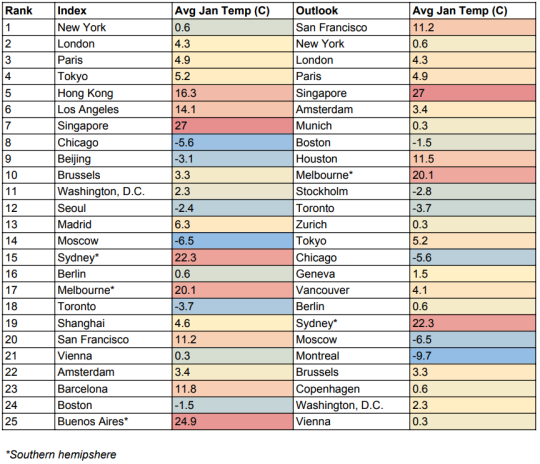
    In Edward Glaeser’s book, Triumph of the City, he argues that the average temperature in January is the single best variable to predict which U.S. cities have grown the most over the last century. Indeed, from July 2015 to July 2016, 10 of the 15 fastest growing large metro areas in the U.S. were in the south. Follow the sun and sprawl.

    Given this phenomenon, I thought it would be interesting to look at the world’s most influential cities (i.e. global cities) through this lens. Because let’s face it, New York and London aren’t all that warm in January. 

    Below are the top 25 global cities (taken from A.T. Kearney’s 2018 Global Cities Report), along with their average January temperature (taken from here). Note, there are two rankings. On the left is their global cities index. And on the right is their global cities outlook, which evaluates current potential. Cities that improved their economics & governance made the biggest leap on the right.

    image

    First of all, it’s interesting to see San Francisco jump so significantly in their outlook ranking. This has everything to do with tech and innovation. It’s also important to note that a handful of the above cities are located in the southern hemisphere, so “average January temperature” doesn’t mean the same thing (probably should have normalized to their winter).

    Montreal wins the award for the coldest city in this ranking. And there’s really only one city, Singapore, with a tropical climate. Though there are others, such as Hong Kong and Sydney, that would fall under subtropical. All of this isn’t enough for us to start inferring anything, but perhaps colder and more temperate climates aren’t such a bad thing for economic growth.

  • China has a lot of people

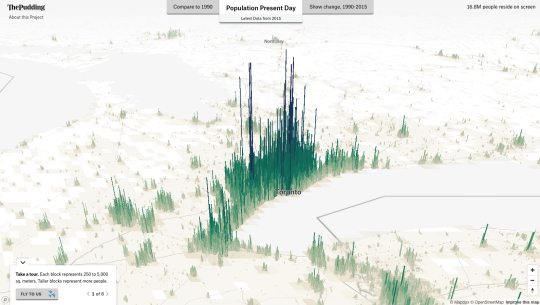
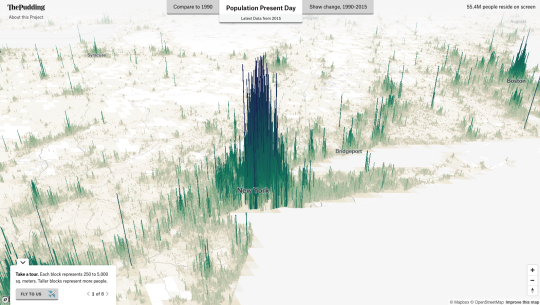
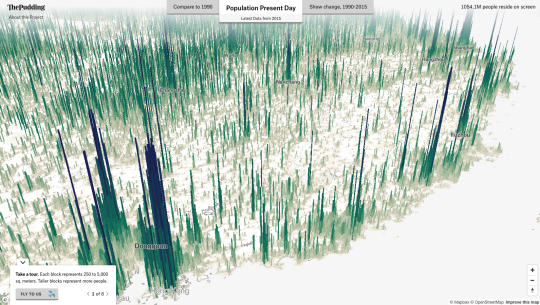
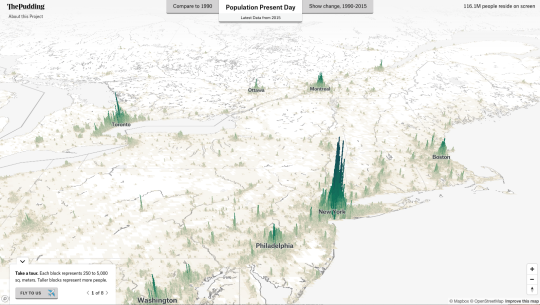
    Matt Daniels over at The Pudding recently visualized the world’s population in this spiky 3D map. You need to take a look. Better on desktop.

    The data is from 2015, but you can also compare it to and show the change from 1990.

    Here is the Greater Toronto and Hamilton region (16.8 million people reside in this screen grab):

    Here is the New York City region (55.4 million people reside in this screen grab):

    And here is China (1.054 billion people reside in this screen grab):

    I tried to capture both Shanghai and Hong Kong in this image. Guangzhou, Hong Kong, and Shenzhen are currently in the mist of forming a 40 million-person megalopolis.

    If we pan back over to the northeastern United States and Central Canada – keeping the same scale as the above image from China – it looks like this:

    These last two images say a lot. 

  • Long live the neon

    image

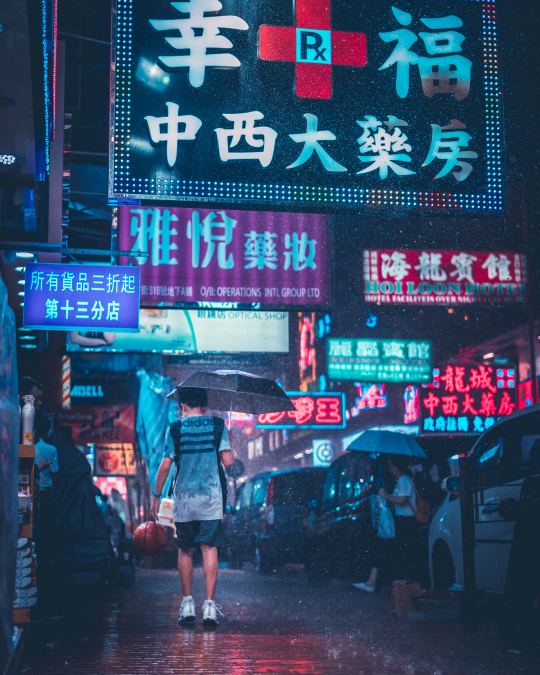
    I like this article and photo essay in the Guardian talking about “Hong Kong’s fight to save its neon shimmer.” Neon lights have been a ubiquitous feature of the Hong Kong nightscape since about the middle of the 20th century. They were an outcropping of increasing economic prosperity. And in many ways they really represent the culture of the city – a frenetic free market where entrepreneurs have no choice but to compete for attention. 

    But thanks to more restrictive sign ordinances and new technologies (though LED can be made to look pretty similar to neon), there’s growing concern that a fundamental part of Hong Kong’s urban landscape may be disappearing. The article mentions a newish (2017) advocacy group called the Hong Kong Neon Heritage Group, which is trying to raise awareness about the city’s remaining lights.

    Love live the neon.

    Photo by Sean Foley on Unsplash

  • The most expensive parking spot in the world

    I saw in the news recently that Hong Kong just set a new world record for the most expensive parking spot. I think it also held the previous record.

    Last month somebody paid HKD 6 million for a single stall in the Ultima apartment complex in Kowloon. That’s about USD 765,000 or CAD 1 million based on today’s rates. And the spot is 16.4 feet x 8.2 feet, so that works out to about CAD 7,436 per square foot. 

    What is clear is that supply is not keeping up with demand. Here is the stat from a recent Toronto Star article:

    The number of parking spaces grew just 9.5 per cent to 743,000 from 2006 through 2016 [in Hong Kong], while the private car population surged 49 per cent to 536,025, according to a report by the city’s Transport Department.

    There are a number market forces which are undoubtedly bringing down the ratio of parking stalls to housing units. That same phenomenon is also pretty clear here in Toronto. But it is interesting to note the continued growth in private cars.