Daily insights for city builders, delivered every morning at 6 AM ET. I’m Brandon Donnelly — a Toronto-based real estate developer and founder of Globizen. I’ve been writing here since 2013.

Tag: google

  • The neighborhood of the future (part 2)

    I have been traveling since the weekend and so I am behind on my reading. One of the benefits of writing this blog every day is that I am forced to read as much as I can. I have to be a sponge.

    Right now, I am still reeling in excitement over the Sidewalk Toronto announcement and getting caught up on that reading. 

    This week Sidewalk Labs published the entire vision section of their RFP response to Waterfront Toronto. This is the response that won them the Quayside partnership. It’s 196 pages and can be downloaded here.

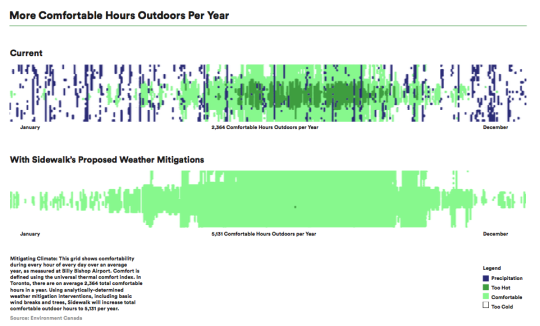
    I’m still making my way through the package, which I am obviously going to do, but I thought this was a great diagram:

    image

    As is stated in their RFP response, inclement weather affects pedestrians and cyclists more than drivers. Toronto’s most notable response has been our PATH system, which pulls both people and retail below grade, away from the elements.

    But Sidewalk’s research suggests that with the right wind, sun, and precipitation strategies, they may be able to 2x the number of comfortable outside hours per year here in Toronto. That’s what the above diagram shows.

    Of course, there is so much more in their RFP response. But I need more time to digest it all. I’ll be sure to report back to all of you once I have done that. If you don’t feel like going through all 196 pages yourself, you can watch this 4 minute YouTube video instead.

  • The neighborhood of the future

    image

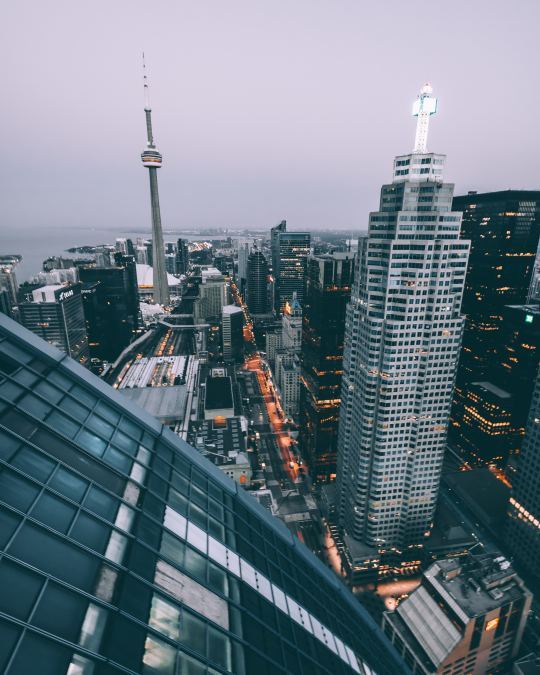
    Daniel Doctoroff (chairman and CEO of Sidewalk Labs and former deputy mayor of New York City) and Eric Schmidt (executive chairman of Alphabet and former CEO of Google) recently contributed a piece to the Globe and Mail about “why Toronto is the ideal place to build a neighborhood of the future.” 

    It’s about the partnership they working on with Waterfront Toronto. I wrote about that announcement, here.

    Here is an excerpt from the Globe article:

    “The eastern waterfront will be a place where residents, companies, startups and local organizations can advance new ideas for improving city life. It’s where a self-driving test shuttle will take its first steps toward becoming a next-generation transit system that’s cheaper, safer and more convenient than private car-ownership. It’s where new insights into advanced construction methods will start to reveal a path toward more affordable housing development. It’s where explorations into renewable energy and sustainable building designs will show promise toward becoming a climate-positive blueprint for cities around the world.”

    These are some of the first details that I have heard about their vision for Toronto’s eastern waterfront. 

    Some of you are probably worried – after reading the above excerpt – that by focusing on self-driving vehicles, we are setting ourselves up to repeat our previous mistakes. But if self-driving vehicles are destined to become a reality (and it certainly feels that way), it is critical that we understand their impact and how they might best dovetail with the public transit systems we already have in place.

    I am thrilled that all of this will be happening right here on our doorstep.

    Photo by Brxxto on Unsplash

  • 10x the scale

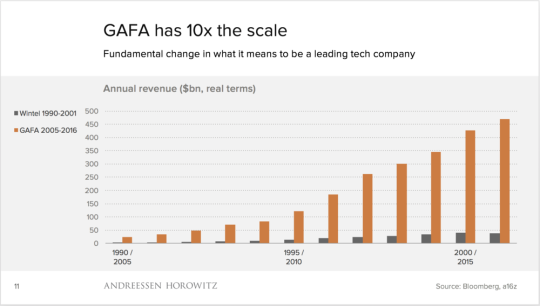
    Below is a chart from Benedict Evans comparing annual revenue from the Wintel era (Microsoft + Intel) to the current GAFA era (Google, Apple, Facebook, and Amazon). 

    His argument is that, today, “the scale of tech winners” is about 10x what it was during the previous cycle.

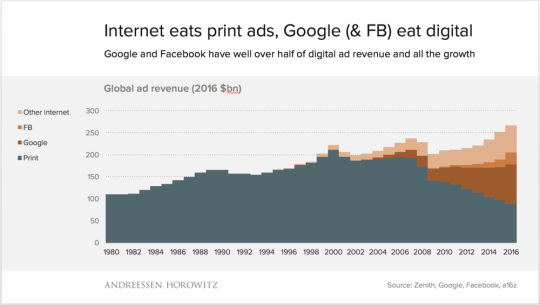
    And here is a chart, from that same post, showing how the internet ate print ads when it comes to global revenue:

    A lot of this has to do with the unprecedented growth of smartphones and the sheer number of people who came and are coming online. Mobile is 10x the PC market.

    But the other interesting narrative from the post is the argument that these companies (GAFA) have learned from previous generations just how aggressive you need to be to survive.

    The shift to mobile posed a structural threat to Facebook. At the time of its IPO, there were serious doubts as to whether the company would be able to pull off this transition.

    Which is why the founder went out and spent 10% of the company to acquire companies that would help with this transition and ensure its survival. That seems to have worked.

    In the words of Andrew Grove: “Only the paranoid survive.“ And in today’s tech world, the rewards for surviving are that much bigger.

  • Sidewalk Labs, Amazon HQ2, and the Milanese Leonardo

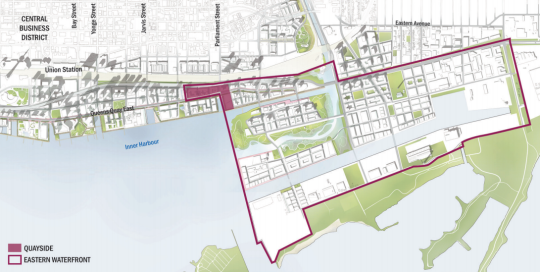
    Earlier this week the WSJ announced that Sidewalk Labs (Alphabet Inc.’s urban innovation organization) is close to a deal with Waterfront Toronto to develop a new 12-acre section of the eastern waterfront. Sidewalk Labs would be their innovation and funding partner. It’s not final yet and it’s still subject to board approval, but the sentiment is that it should go.

    There aren’t a lot of details about the project – other than the fact that it will be fairly big, up to 3 million square feet – but the overall intent is digital city building. It’s about imagining what a city could be if you built it today “from the internet up.” More info about Sidewalk Labs, here.

    I thought of this project as I read Seth Godin’s daily blog post this morning in bed. Here are two snippets from that post:

    When a new technology arrives, it’s often the nerds and the neophiliacs who embrace it. People who see themselves as busy and important often dismiss the new medium or tool as a bit of a gimmick and then “go back to work.”

    There’s never a guarantee that the next technology is going to be the one that moves to the center of the conversation. But it’s certain that a new technology will. It always has.

    Openness matters.

    I’m anxious to learn more details about the project, but this is obviously very exciting. It also creates momentum and strengthens the case for Amazon HQ2 in Toronto. The above 12-acre Quayside area is only the tip of the iceberg. There’s the rest of the eastern waterfront and also East Harbour.

    image

    Some people have been critical of this city’s push for Amazon HQ2. Anthony Lacavera, chairman of Globalive Capital, called this “the biggest Trojan Horse of all time.” His view is that Amazon would simply use HQ2 Toronto as a mechanism for cheaper labor (USD > CAD) and to siphon the best and brightest down to the US.

    Now, I agree that it would be more impactful to create the next Amazon then to simply lure in its second headquarters. Big entrepreneurial successes are what fuel the darwinian evolution of startup hubs. The founders, early employees and investors make boatloads of money and then they start reinvesting that back into the ecosystem by, among other things, backing the next generation of entrepreneurs.

    But does this necessarily mean that an Amazon HQ2 would be detrimental to Toronto by acting as a conduit to the US? Will it discourage entrepreneurship? Should we eschew all US firms out of fear that this may in fact happen? I don’t think so.

    There’s tremendous value in concentrating smart people in one place – ideas build on ideas. And I don’t think technology has been able to disrupt that, at least not yet. One example of this is a theory that Paul Graham calls the Milanese Leonardo:

    You can see how powerful cities are from something I wrote about earlier: the case of the Milanese Leonardo. Practically every fifteenth century Italian painter you’ve heard of was from Florence, even though Milan was just as big. People in Florence weren’t genetically different, so you have to assume there was someone born in Milan with as much natural ability as Leonardo. What happened to him?

    And his reasoning is as follows:

    Nothing is more powerful than a community of talented people working on related problems. Genes count for little by comparison: being a genetic Leonardo was not enough to compensate for having been born near Milan instead of Florence. Today we move around more, but great work still comes disproportionately from a few hotspots: the Bauhaus, the Manhattan Project, the New Yorker, Lockheed’s Skunk Works, Xerox Parc.

    Xerox Parc (Palo Alto Research Company) is a great example of the kind of positive externalities that can happen as a result of smart people being in close proximity to each other while they wrestle with similar problems. It has been well documented that it was Steve Jobs’ visit to Xerox Parc that inspired many of Apple’s early innovations.

    So my view: let’s increase Toronto’s urban metabolism and make it the Florence of 1450.

    Ed Clark – who is leading the charge for HQ2 in Toronto – has been clear that large taxpayer subsidies are not on the table for Amazon. That would not be fair to the existing companies in this city. If that is what it is going to take, then we are not going to win. We will win based on our city, our human capital, and our openness to the rest of the world. That feels right.

    Welcome Sidewalk Labs. Welcome Amazon. This city is open for business and to new ideas. 

    Image: Waterfront Toronto

  • What e-commerce may do to our streetscapes

    Sidewalk Labs recently ran a thought experiment where they came up with 5 possible scenarios for the future of retail and, more specifically, what they may mean for our streetscapes. You can read all about them here, but my mind lumps them into 3 broad categories.

    First, there’s the temporary/pop-up/independent scenario. This one is all about flexibility and speed. It’s about web-first retailers who don’t have, need or want permanent stores and about empowering small scale business owners. This makes sense. The internet has decentralizing forces.

    The second one takes retail in the opposite direction. It’s about going all in on physical stores; upsizing them and making them even more over the top and Instagram-able. This one also seems intuitive given that we’re already seeing this trend with malls. Many/most are dying and the surviving ones are trying to go as high end as possible.

    The last scenario takes vacant and underutilized retail on the fringe and turns them into “digital dispensaries.” This one is entirely utilitarian and void of any streetscape/urban considerations. It’s about autonomous electric vehicles picking up your goods through drive-thrus and on-demand drones dispatching your toilet paper after you hit that Amazon Dash Button.

    This feels like a good list. I think you could argue that the writing is on the wall for all of these scenarios.

    Photo by Lance Anderson on Unsplash

  • Why I write about tech on my city building blog

    I had a friend ask me this week about how I decide what to write on this blog. His comment was that I tend to write about a variety of different topics. He wondered: Isn’t it better to focus on one particular niche?

    The simple answer is that I write about what interests me. And secondary to that is any concern around what will get the most clicks. In fact, I try not to fall into the trap of worrying about the latter. Sometimes it can be paralyzing to fixate on what will appeal most to the tens of thousands of people who read this blog on a regular basis.

    The reality is that my interests are much broader than, say, just design and real estate; though these two topics are clearly central. 

    I learned a long time ago while studying architecture and art history that what we make as a society is generally a product of the cultural milieu at the time. In other words, the built environment doesn’t happen in a vacuum. It is the physical manifestation of what we believe to be true at a particular moment.

    Today, it’s pretty hard to ignore the importance of tech. Think of some of the most valuable companies in the world right now: Apple, Google, Amazon, Facebook, and so on. Now, technology has always shaped our cities, but what makes this moment different is the decisive shift toward software.

    It’s arguably no longer about who can build the best mousetrap. It’s about who can build the best software layer on top of that mousetrap.

    In 2011, venture capitalist Marc Andreessen (previously the co-founder of Netscape) published a widely shared essay called, “Why Software Is Eating the World.” And over the past 6 years he has been proven to be very right.

    The 3 main points he aimed to make with that essay are as follows:

    1. Every product or service that can become software will become software.
    2. Every company will have to become a software company.
    3. The winning companies will be the best software companies.

    Depending on your industry, this may sound ludicrous to you. Certainly in 2011 it probably seemed that way. 

    But a perfect example of this phenomenon is the iPhone. The phone itself is manufactured in China, albeit where a lot of great hardware innovation is taking place. 

    But at this point, phones have become fairly commoditized. The profits that Apple makes from the iPhone disproportionately come from the software layer and the app ecosystem it has developed.

    You could make a similar argument with Tesla. Autonomous navigation – which most of us can agree will have a profound impact on cities – is largely a software challenge. 

    And so if you believe that autonomous vehicles will be a fundamental part of the future of mobility, then it’s not that hard to believe in point number three: the winning car company will also have to be the best car software company.

    Some industries have been less touched by tech and software – real estate being one of them. But if Andreessen is right and it’s not a question of if, but a question of when, then it behooves all of us to think about the potential impacts.

    I love how Andreessen ends this podcast discussion with Barry Ritholtz of Bloomberg and so I’m going to repeat it here to close out this post. He says: “There are no bad ideas. There are only early ideas.” 

    And that’s why I write about tech on my city building blog.

    Photo by Michal Pechardo on Unsplash

  • Motivation and coordination

    Albert Wenger of Union Square Ventures recently gave a talk at the 2017 Blockstack Summit about “Decentralization and the Knowledge Age.”

    He starts by talking about motivation and coordination.

    The state, he argues, is good at coordination, but not so good at motivation. The market, on the other hand, is good at motivation, but not so good at coordination. Money and self-interest are powerful incentives.

    He then talks about how networks have improved the market, the firm, and the state. When the cost of sharing information drops, everything gets better.

    But there are downsides to networks. For one, they form monopolies. Consider Facebook in social. Google in search. Amazon in ecommerce.

    They also create environments ripe for censorship and “algorithmic abuse.” Everything you see in your feeds is optimized to make you respond and/or feel a certain way. The line between delivering you relevant content and deliberate manipulation is perhaps a fine one.

    So what’s the solution? Decentralized blockchain networks are one exciting possibility. But they also have their own limits and drawbacks. Albert touches on those in his talk.

    The video is about 24 minutes. If you can’t see it below, click here.

    [youtube https://www.youtube.com/watch?v=LgQT874KHuw?rel=0&w=560&h=315]

  • Zaha Hadid’s Miami condo is on the market for $4,350 psf

    Today, Google is celebrating the famed Iraqi-born British architect Zaha Hadid, who died last March (2016) in Miami of a sudden heart attack.

    She was the first woman ever to receive the Pritzker Architecture Prize, which is the prize of all prizes for architects.

    Here is Google’s front page:

    The building that is featured is the Heydar Aliyev Center in Baku, Azerbaijan. It’s an extraordinary piece of architecture. And in case you aren’t familiar with it, below is a Red Bull video of Maksim Kruglov skateboarding the building and its grounds. The building is just screaming to be skated. (Click here if you can’t see it below.)

    [youtube https://www.youtube.com/watch?v=J7lEGbAIU6M&w=560&h=315]

    I’m not exactly sure why Google chose today to feature Hadid. Initially I thought it might be the anniversary of her death, but she died in March. Whatever the case may be, a quick search revealed that her Miami condo was just listed for $10,000,000. That’s probably not what they are celebrating.

    It’s located at 2201 Collins Avenue (Unit 730) in the W Hotel Miami Beach. It’s 2,299 sf and features a totally separate guest apartment, which itself has one bedroom. The main suite was initially 2 units, but Zaha had them combined into a generous one bedroom.

    Only $4,350 per square foot.

    Below is a quick video prepared by the broker. You don’t need the sound on for this one. (Click here if you can’t see it below.)

    [youtube https://www.youtube.com/watch?v=9CD_xwYPbf8&w=560&h=315]

  • The Anti-Portfolio

    In the world of venture capital, it is not uncommon to make most of your money off only a small fraction of your investments. Here’s how Fred Wilson describes his firm’s “batting average”:

    “I’ve said many times on this blog that our target batting average is “1/3, 1/3, 1/3” which means that we expect to lose our entire investment on 1/3 of our investments, we expect to get our money back (or maybe make a small return) on 1/3 of our investments, and we expect to generate the bulk of our returns on 1/3 of our investments.”

    I’m guessing that this is one of the reasons why mistakes are more readily embraced – or even celebrated – in venture capital and in tech. It’s part of the DNA of the industry.

    A perfect example of this is something called the Anti-Portfolio. Venture capital firm, Bessemer Venture Partners, has a page up on their website dedicated to “honoring those we missed.” It is a list of phenomenally successful companies that for various reasons BVP decided not to invest in. That is, they had the opportunity but they decided to pass.

    Here’s a taste (copied verbatim from their site):

    • [Apple] BVP had the opportunity to invest in pre-IPO secondary stock in Apple at a $60M valuation. BVP’s Neill Brownstein called it “outrageously expensive.”
    • [Facebook] Jeremy Levine spent a weekend at a corporate retreat in the summer of 2004 dodging persistent Harvard undergrad Eduardo Saverin’s rabid pitch. Finally, cornered in a lunch line, Jeremy delivered some sage advice “Kid, haven’t you heard of Friendster? Move on. It’s over!”
    • [Google] Cowan’s college friend rented her garage to Sergey and Larry for their first year. In 1999 and 2000 she tried to introduce Cowan to “these two really smart Stanford students writing a search engine”. Students? A new search engine? In the most important moment ever for Bessemer’s anti-portfolio, Cowan asked her, “How can I get out of this house without going anywhere near your garage?”

    As I was going through BVP’s Anti-Portfolio, I immediately thought about how different this sensibility is compared to the real estate industry. I mean, could you imagine a developer celebrating all of the sites she or he passed on and all of the projects that lost or made no money?

    One of the reasons you do this is to learn from your mistakes. So perhaps we could all use some sort of “anti-portfolio.”

  • Tesla is winning the arms race

    “If we have data, let’s look at data. If all we have are opinions, let’s go with mine.” – Jim Barksdale, former Netscape CEO

    Fred Wilson wrote a post yesterday about Tesla’s data advantage in this self-driving car arms race that we are currently living through. (I found the above quote in the comment section of the post.)

    In their Q3 2016 update, Tesla claims to have logged more than 1.3 billion miles on its vehicles equipped with Autopilot hardware. This is important because the more data it collects – across diverse road and weather conditions – the better the vehicles get at driving without human intervention. As Fred Wilson put it: “more data is better than more software engineers.” So that places Tesla ahead of Google, Uber, GM, et al.

    I spent a lot of time driving over the past week, certainly more than usual, and I couldn’t help but think about how much better it would have been to instead sit in the backseat and read a book (or mindlessly scroll through Instagram).

    I always try and use cruise control on long drives, but unless the road is fairly empty, I find it doesn’t work very well. Everyone is driving at different speeds and so I usually end up having to reset it / adjust it every so often.

    The big question in my mind is still: How does the world look when driving longer distances doesn’t suck so much? What changes when you can get into your / a car (important distinction) at bedtime, fall asleep, and then wake up in a new place?

    A lot, I think.