Daily insights for city builders, delivered every morning at 6 AM ET. I’m Brandon Donnelly — a Toronto-based real estate developer and founder of Globizen. I’ve been writing here since 2013.
The Wall Street Journal’s recent piece about “Silicon Valley invading Toronto” is, in my view, describing a generally positive outcome.
We are one of the largest cities in North America (the exact ranking depends on where you draw the urban boundaries).
We have more enlightened views around foreign and high-skilled workers (I was given a short window in which to leave the US after I finished my first graduate degree there).
And we have a large and highly educated pool of tech talent (the salary differential discussed in the article looks to be, at least partially, a result of the weaker Canadian dollar).
US companies are gobbling up office space in Toronto. And presumably, this is one of the reasons why 139 new flights were added between Toronto and Francisco over the last two years. (Source: WSJ)
However, I do agree with the remarks from people like Jim Balsillie (Blackberry) and Harley Finkelstein (Shopify) that a better outcome would be the creation of more massively successful Canadian tech companies.
As Finkelstein points out, there’s a big difference between 100,000 square feet of space for the HQ of a new and growing Canadian tech company and 100,000 square feet for a new branch or satellite office.
The stats we read in the papers about the number of tech jobs being created in Toronto generally don’t speak to composition. Where in the value chain do these people sit? Where is the value accruing?
The intellectual capital is here. And we should be doing everything we can to foster and finance new homegrown ideas and businesses.
The below chart from this morning’s Wall Street Journal is perhaps a good example of our ongoing transformation from an industrial economy to an information economy. Just four stocks — namely Microsoft, Apple, Amazon, and Facebook — have accounted for 19% of the S&P 500’s total return this year. All of them are “tech.”
And this is not new to 2019. Similar contributions were made by tech last year and in 2018. I have been used to hearing about the 4 horsemen of tech. But apparently there’s even now something called the “FAANG stocks,” which refers to Facebook, Amazon, Apple, Netflix, and Google (Alphabet).
This shift is, of course, one of the reasons why every city is trying to establish a strong tech ecosystem. I saw that first-hand in Lisbon this past week. And frankly I think the city has many of the same characteristics that made Berlin a great place for tech. It’s affordable. It’s filled with young and smart people. And it’s a fun place to be.
There’s a reason that Lisbon now hosts the annual Web Summit, which is generally considered to be the largest tech conference in the world. (The North American offshoot, called Collision, relocated to Toronto this year in order to be in a more global city.)
Portugal only has a population of about 10 million people. There are some 3 million people in the metropolitan area of Lisbon. But that doesn’t really matter because most startups today are immediately targeting a global customer base.
I learned more about Portugal and Spain’s colonial pasts on this trip and I found it fascinating. In many ways, it was the start of globalization. But that was the Age of Discovery. Those centuries are over and done with. Our century is the Information Age. The above chart is part of that story.
Sidewalk Labs just released its draft Master Innovation and Development Plan (“MIDP”) for Toronto’s eastern waterfront. It’s called Toronto Tomorrow: A New Approach for Inclusive Growth, and it’s massive. Over 1,500 pages. It consists of an overview and 3 volumes, all of which can be downloaded here.
At a high-level, the objectives of the plan are twofold. They want to revitalize the eastern waterfront (it’s currently appalling) and they want to test new urban ideas that could benefit the broader city, as well as the rest of the world. Deploying new technologies at a larger scale is one of the ways the company intends to make money.
I am still working my way through the plan (I may never finish), but here’s a breakdown of the development program for the Quayside precinct:
If you’re looking for a quick overview of the plan, here are five things to know about the Sidewalk Toronto project and here is an overview of the public-private partnership that they are proposing. Of course, there’s also no shortage of criticism on Sidewalk’s plans for the waterfront. Some links here, here, and here (paywall).
Sidewalk Labs is trying to assuage public concerns through some of its open commitments. They have said that they will not seek special tax subsidies, control urban data, sell personal info and/or use it for ads, or develop the entire eastern waterfront themselves. But the plan remains highly controversial.
I think part of the issue is that, because so much of what they are proposing hasn’t been done before, there are a lot of unanswered questions and a great deal of uncertainty around the future. Many are interpreting this as the company hiding its true intentions. Maybe it is. Or maybe it isn’t.
But let’s not forget what Waterfront Toronto requested back in 2017 for these lands. It wanted an innovation and funding partner:
Waterfront Toronto is seeking a unique partner, one with invention ingrained in its culture, which can transform conventional business practices and help to establish a benchmark climate positive approach that will lead the world in city building practices.
There’s no question that what Sidewalk Toronto has put forward is bold. As I scanned through the plans today, I found myself hard pressed to think of any “conventional” developer that would be willing to come forward with a proposal as ambitious as this one.
As you all know, Sidewalk Labs’ parent company is called Alphabet. But I think it’s worth mentioning that “alpha” is a finance term that refers to the excess return of a strategy beyond that of a benchmark index. Put differently: How much better are you than the status quo?
The whole point of Alphabet is that they’re supposed to make “alpha bets” on ambitious projects. They are given the “resources, freedom, and focus” to try new things. Sometimes those projects will fail. But in other cases they will succeed in moving the world forward.
Every city today is trying to grow a thriving technology ecosystem. We want to be innovative. We want to transform conventional businesses practices. And we want to lead the world. Unfortunately, that rise to the top is almost never a smooth and linear one. There will be mistakes along the way.
This week, Google announced a $1 billion investment in housing across the San Francisco Bay Area. Here is the blog post announcement by CEO, Sundar Pichai. And here are a couple of paragraphs from the post explaining how this is expected to work:
First, over the next 10 years, we’ll repurpose at least $750 million of Google’s land, most of which is currently zoned for office or commercial space, as residential housing. This will enable us to support the development of at least 15,000 new homes at all income levels in the Bay Area, including housing options for middle and low-income families. (By way of comparison, 3,000 total homes were built in the South Bay in 2018). We hope this plays a role in addressing the chronic shortage of affordable housing options for long-time middle and low income residents.
Second, we’ll establish a $250 million investment fund so that we can provide incentives to enable developers to build at least 5,000 affordable housing units across the market.
In addition to the increased supply of affordable housing these investments will help create, we will give $50 million in grants through Google.org to nonprofits focused on the issues of homelessness and displacement. This builds on the $18 million in grants we’ve given to help address homelessness over the last five years, including $3 million we gave to the newly opened SF Navigation Center and $1.5 million to affordable housing for low income veterans and households in Mountain View.
Google is not alone in its efforts to improve housing supply in the Bay Area but, according to CityLab, this is “the single largest commitment by a private employer.”
There’s a lot of debate about the value of housing supply, alone. But in 2017, the Bay Area added 3.5x as many jobs as it did housing. I think most people would agree that’s a suboptimal, and potentially unsustainable, mismatch.
Also, if large companies such as Google and Microsoft are making these sorts of investments, it is likely that they’re worried about housing unaffordability impacting their ability to attract and retain top talent going forward.
Perhaps this is a signal for just how unsustainable this mismatch has gotten.
Last weekend I went by Sidewalk Toronto’s “experimental workspace” at 307 Lake Shore Blvd East. It is open to the public every Sunday from 11am to 5pm if you’d like to drop in.
This week they had their #BuildingRaincoat on display, which is an adjustable awning system designed to protect public sidewalks, mitigate the impacts of adverse weather, and improve outdoor comfort.
Also installed were a number of the paving systems that they are currently piloting. They’re working with over 20 different vendors to try and create the “holy grail” of street paving.
They define that as a system capable of the following four key features: modularity, heating, lighting, and permeability. Here’s an example of what one of them looked like (it was snowing at the time and, yes, Doc Martens):
With modularity, the goal is to make it possible for a single person to be able to pull up and replace one of the hexagonal slabs. This would dramatically change how we repair and patch our roads. Supposedly, they’re also more resistant to cracks, which means fewer potholes.
The key benefit of a heated paving system is an obvious one. When needed, their test system automatically heats the slabs to 2-4 degrees celsius in order to melt any snow and/or ice. That’s as warm as you need apparently.
They have two heating systems running at 307. The first is hydronic (fluid in pipes just below the pavement) and the second is conductive heating (thin conductive film in or under the pavement).
I’m sure many of you will be questioning the environmental and carbon impact of a heated public realm. And that is certainly a good question. But the status quo in this city involves about 131,000 tons of road salts per year. That’s a problem.
The lighting feature is pretty neat because there are a variety of different use cases beyond just demarcating space. One example that Sidewalk gives is that it could be used in a bike lane to tell you how fast you need to ride in order to hit all green lights.
Finally, permeability matters because it minimizes runoff and allows water to be absorbed in situ. The tradeoff is that it makes the slabs structurally weaker. So that is still being worked on.
I am thrilled to see this sort of urban innovation taking place right here in the city. If you haven’t already, I recommend checking out 307.
I have been using Google Translate a lot on this trip. Few people here in Rio de Janeiro speak English.
It is an incredible app that also works without cell service. You just download whatever language(s) you need to your phone.
There’s a conversation feature that allows you to go back and forth with someone in real time (almost).
There’s a camera feature that is invaluable for translating restaurant menus.
And there are a number of smaller features that I have also found really useful.
For example, if you rotate your phone into landscape mode, it will show you your translation in big text like a flash card.
It looks like this (trust me it is useful):
I also just learned that, since November 2016, the Translate app has been using a neural machine translation system developed by Google.
It is capable of understanding and translating complete sentences, and that has reduced translation errors by about 60% compared to the previous system.
Rather than translate word-by-word or phrase-by-phrase, Google’s NMT network encodes the “semantics of sentences.”
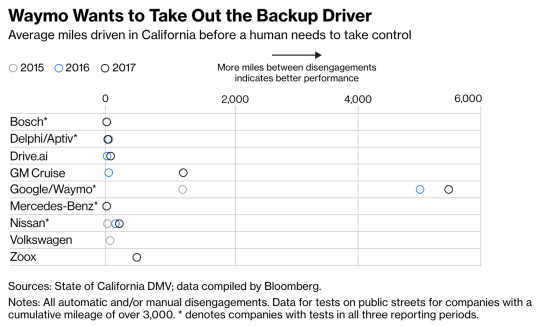
This is an interesting piece by Bloomberg summarizing the current state of autonomous vehicles and in particular the (supposed) dominance of Waymo (Alphabet’s self-driving vehicle arm). Many believe they will be the first real entrant into the market.
The company is currently running an “Early Rider” program in 25 cities. But its Phoenix trials are the furthest along, which isn’t at all surprising given the city’s car orientation and suburban fabric. Already Waymo has started offering passenger rides without a backup driver in the car.
Overall, the company has come forward with four main business priorities:
Ride hailing
Trucking
Personal vehicles
Public transit
But I still think that we’ll see a blurring of these priorities, if not outright cannibalization, as the cost per mile plummets. I mean, why own a personal vehicle if it is flat out easier and cheaper to just hail a robotaxi?
Here is an excerpt from the article talking about pricing:
Tasha Keeney, an analyst at ARK Invest, says that Waymo could choose to offer an autonomous ride-hailing service today at around 70 cents a mile—a quarter of the cost for Uber passengers in San Francisco. Over time, she says, robotaxis should get even cheaper—down to 35 cents a mile by 2020, especially if Waymo’s technology proves sturdy enough to need few human safety monitors overseeing the autonomous vehicles remotely. “You could see software-like margins,” Keeney says.
I can’t wait to be driven around for cents on the dollar. Click here to read the full article.
Politico Magazine recently published this article about Sidewalk Toronto. It’s called: Google Is Building a City of the Future in Toronto. Would Anyone Want to Live There?
If you’re familiar with what Sidewalk Toronto is up to, the first bit will likely cover things you already know. But later on it gets into an interesting discussion around data privacy, among other things.
One argument is that if you strip any personal identifiers from the data you collect, then you’ve effectively eliminated the issue of privacy.
But what about “collective privacy?”
What if you could, for example, identity signs of concentrated drug usage within certain districts, communities, or even buildings? Does that start to get a little too personal?
This is the great debate surrounding Quayside, the area that Sidewalk is focused on. The article also touches on what Quayside could mean for the future of Toronto.
Just about all players involved believe that if Sidewalk can be successful at Quayside, it has a shot at the adjoining 800-acre Port Lands, a swath of problem space big enough to become home to a dozen new neighborhoods in a growing metropolis. Townsend, the consultant, says of the Port Lands: “That’s a city they’re going to build there. This is just the warmup, this little piece.”
Full article, here. There’s also an audio version in case that’s your preferred consumption method. It’s about 40 minutes long if you do it that way (and don’t speed it up).
Sidewalk Toronto is currently looking for “12 smart, creative, and caring people who are interested in the future of Toronto’s waterfront and how we [Sidewalk Toronto] can responsibly incorporate technology to improve urban life.”
Each Fellow will complete a 2-day orientation session in Toronto; 6 days in Amsterdam and Copenhagen; 5 days in New York City and Boston; 3 days in Vancouver; and then do a final 2-day working session back in Toronto before presenting their takeaways.
This feels like a response to the criticism that Sidewalk Toronto wasn’t doing enough to listen to the community and that it simply wanted to build a tech-infused neighborhood that could serve us more ads – but it’s cool nonetheless.
If you’re between 19-24 years old and you live in Toronto, you can apply here. It sounds like a fun opportunity for young city builders. I know that I certainly would have been all over it when I was in that age bracket.
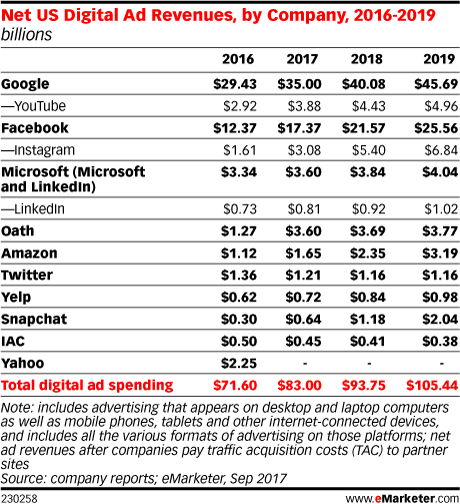
This morning Fred Wilson posted this chart on his blog:
What is clear is that when it comes to US digital ad revenue, it’s the Google and Facebook show, followed by everyone else. Microsoft/LinkedIn is a distant third. Fred calls it “the digital advertising duopoly.” And his view is that the tech industry needs to figure out new approaches to monetization that still allow free content to be consumed.
I’ve said this before, but Facebook buying Instagram for $1 billion seems like a bargain when you look at a chart like this and you see what they were able to do with the platform. Instagram’s 2018 revenues are projected to be bigger than every other company on the list minus Google but including YouTube.
Also notable are the flatlining of Twitter and the projected growth of Snapchat. 2017 was a rough year for $SNAP. But it appears that somebody believes they’ll be able to turn things around with their app redesign and reconstituted ad platform. Be that as it may, it’s still the Google and Facebook show – at least for the time being.