Daily insights for city builders, delivered every morning at 6 AM ET. I’m Brandon Donnelly — a Toronto-based real estate developer and founder of Globizen. I’ve been writing here since 2013.

Tag: google

  • The self-driving car arms race

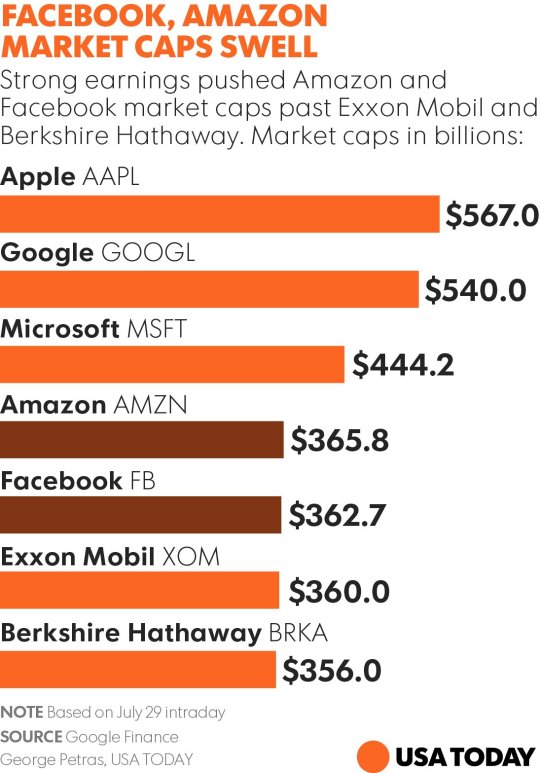
    Earlier this month, I came across the following chart from USA today. 
    image

    It was based on market caps as at July 29 and so the order wouldn’t look quite the same today. Still, here are the largest companies by market cap and the top 5 are US consumer-facing technology firms.

    Remember when it was a big deal that Apple had surpassed Exxon Mobil as the world’s most valuable company?

    We are living in a tech-driven world.

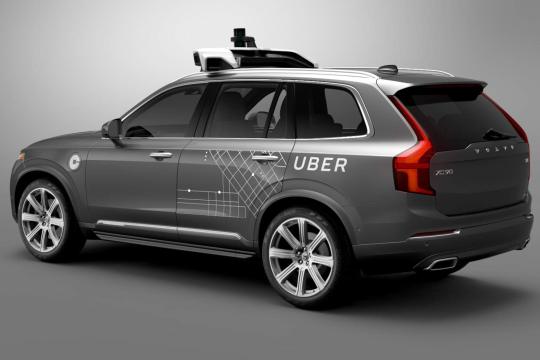
    Then yesterday, I was reading this New York Times article talking about Uber’s acquisition of Otto (a startup focused on self-driving truck technology) and its plans to allow riders in Pittsburgh to summon self-driving vehicles later this month.

    The vehicle will be a tricked out Volvo:
    image

    These two snippets from the NY Times stood out for me:

    Suddenly, it seems, both Silicon Valley and Detroit are doubling down on their bets for autonomous vehicles. And in what could emerge as a self-driving-car arms race, the players are investing in, or partnering with, or buying outright the specialty companies most focused on the requisite hardware, software and artificial intelligence capabilities.

    “There’s an urgency to our mission about being part of the future,” Travis Kalanick, Uber’s chief executive, said on Thursday in an interview. “This is not a side project. This is existential for us.

    The way it will work in Pittsburgh this summer is that the self-driving Volvos will still arrive with a driver, in addition to a sidekick in the passenger seat taking notes about how the vehicle is performing. But the goal is to start weaning us off of human drivers. These pilot rides will be free to start.

    This is quite possibly the start of a general change in terms of the way cities operate (quote from Bloomberg):

    In the long run, Kalanick says, prices will fall so low that the per-mile cost of travel, even for long trips in rural areas, will be cheaper in a driverless Uber than in a private car. “That could be seen as a threat,” says Volvo Cars CEO Hakan Samuelsson. “We see it as an opportunity.”

    Uber is currently logging about 100 million miles per day. Hopefully it is clear at this point that this is not as simple as ride sharing vs. traditional taxis. Cities who are thinking about it in this way are thinking short-term and missing the bigger picture.

    Companies such as Uber, Tesla, and Google are aiming for a fundamental rethink of urban mobility. There is an arms race going on that I believe will completely eradicate the need for human drivers.

  • Project Sidewalk

    One of Alphabet’s subsidiaries is a company by the name of Sidewalk Labs. Some of you, I’m sure, have been following it. The goal of the company is to leverage technology in order to solve some of our biggest urban challenges.

    Initially, they were fairly under the radar, but more recently they’ve become a lot more public with their projects and their mission. Here is a snippet from a recent blog post written by their CEO, Daniel L. Doctoroff

    “The world is poised for a fourth urban-tech revolution — an age of connectivity capable of reshaping cities as much as the steam engine, electricity, and automobile have in the past. New technologies will help citizens and elected officials tackle those intractable urban challenges that Larry outlined last summer, but making sure this age imposes fewer social costs than those previous shifts is critical.”

    Earlier this week it was also announced that the company is likely to enter the real estate development business and construct a new city precinct in order to pilot some of their ideas and projects. The initiative is called Project Sidewalk. 

    Here is an excerpt from the Wall Street Journal:

    “According to people familiar with Sidewalk’s plans, the division of Alphabet is putting the final touches on a proposal to get into the business of developing giant new districts of housing, offices and retail within existing cities.

    The company would seek cities with large swaths of land they want redeveloped—likely economically struggling municipalities grappling with decay—perhaps through a bidding process, the people said. Sidewalk would partner with one or more of those cities to build up the districts, which are envisioned to hold tens of thousands of residents and employees, and to be heavily integrated with technology.”

    When I read this, I immediately thought of the Port Lands area in Toronto. Not because Toronto is decaying – far from it – but because it’s a massive 880 acre site that is both adjacent to downtown and entirely underutilized. I can’t wait to see this area transformed into a thriving waterfront community.

    In any event, if or when Project Sidewalk gets off the ground, it will be very interesting to see what a Google-backed real estate development company looks like.

  • Lists, disciplines, and AI

    I have a bit of an obsession with my calendar, lists, and goals. On the home screen of my phone I have Wunderlist, Evernote, Google Drive, and 2 calendar apps (more on that in a second).

    This obsession is probably one of the reasons I write this blog. I like writing, drawing, and documenting things. It helps me sort through my thoughts. I have everything from a list of cities I want to visit to a list of billion dollar business ideas (yes it’s really called that).

    But the other reason I like to keep lists is because – as I said in this post – I’m trying to be cognizant about overcommitment. And when I write things down, it serves as a reminder of what I’m doing and what I’m allowed to focus on.

    One of the ways I do that is through repeatable goals (or disciplines). These are non-negotiable things that I’ve committed myself to and that I just have to grind out – such as writing on this blog every day. I can tell you that some blog posts come out a lot easier than others. But I’m a firm believer that there are few substitutes for just showing up every day and putting in the work.

    On that note, let me tell you why I have 2 calendar apps on my phone. I’ve been testing out the latest version of Google Calendar because of a new feature they rolled out this month called Goals.

    What it does is automatically schedule repeatable goals. So for instance, you could tell it that you want to work out 3 times a week for 1.5 hours each time and that you prefer to work out in the evenings. It will then go and find 3 times for you to do it every week for all of eternity. 

    If a conflict arises, that’s no problem. As soon as you enter another appointment, the app will automatically reshuffle your calendar goals to make sure that you still get your 3 workouts in. It’ll even learn your preferences as you make changes to these appointments over time. 

    So far I’ve been finding this feature really useful. I used to do this for myself manually, but now I have a computer that does it for me. Even better.

    It’s also a glimpse into the future that Sundar Pichai, CEO of Google, was talking about on a recent earnings call:

    “We’ve been investing in machine learning and AI [artificial intelligence] for years, but I think we’re at an exceptionally interesting tipping point where these technologies are really taking off,” he said. “That is very, very applicable to businesses as well. So thoughtfully doing that externally we view as a big differentiator we have over others.”

    “In the long run, I think we will evolve in computing from a mobile-first to an AI-first world,” Pichai said in closing. “And I do think we’re at the forefront of developments.”

    For the past 5 years, it’s been all about mobile. But now much of the tech community – including the CEO of a pretty big company – is saying that artificial intelligence is next. What do you think this will mean for cities?

  • Can starchitecture trump soul-crushing sprawl?

    Hunter Oatman-Stanford just published a longish read over on Collectors Weekly that talks about the history of suburban office complexes in America. That part alone makes it an interesting read.

    But he also makes the argument that innovative companies like Apple and Google are still stuck in a midcentury suburban mindset with their new mega headquarters:

    “I look at Apple’s Norman Foster building, and it’s 1952 all over again,” Mozingo says. “There’s nothing innovative about it. It’s a classic corporate estate from the 1950s, with a big block of parking. Meanwhile, Google is building another version of the office park with a swoopy roof and cool details—but it does nothing innovative.”

    Others have made this same argument. Back in 2013, Wired published an article talking about why Apple’s new Norman Foster spaceship could result in them losing the war for tech talent. 

    And if you read the piece in Collectors Weekly, you’ll see just how little, in some cases, the office environment has changed since the middle of the 20th century.

    Back then, we also had big name starchitects designing suburban head offices for innovative companies. Below is a photo from the GM Technical Center in Warren, Michigan. It was designed by Eero Saarinen and it opened in 1956.

    image

    There’s lots of research that suggests that, today, both entrepreneurs and capital are flocking to urban centers, instead of the suburbs. And I certainly don’t need to repeat that to this audience.

    But given this shift, I think we will increasingly view the suburban sprawl of places like Silicon Valley as a serious competitive disadvantage. I mean, I am sure these new buildings will be lovely, but I certainly wouldn’t want to work there. 

    Would you?

  • [Video] Gang of Four

    Scott Galloway, professor of Marketing and Brand Strategy at NYU Stern, recently delivered a presentation on the Gang of Four: Apple, Amazon, Facebook, and Google. These dominant companies are also often referred to as the “Four Horsemen.”

    The video is about 16 minutes long and I would highly recommend that you give it a watch.

    It’ll be like drinking from a firehose, but there are so many fascinating takeaways. You’ll also quickly discover how far reaching the societal impacts of these companies have been and will likely be in the future.

    If you can’t see the video below, click here.

    [youtube https://www.youtube.com/watch?v=jfjg0kGQFBY?rel=0&w=560&h=315]

  • Why Google is worried about being welcoming to employees who want to build new businesses

    Here on ATC, we’ve talked a lot about the changing nature of work and what that could mean for cities. 

    We talk (and debate) about the value of density and of being in close proximity to others so that ideas can percolate – whether that means open office floor plans or community coffee shops.

    But alongside all of this, there are some fascinating structural changes taking place within organizations. Below is an excerpt from a recent New York Times article called, How Larry Page’s Obsessions Became Google’s Business

    But corporate success means corporate sprawl, and recently Google has seen a number of engineers and others leave for younger rivals like Facebook and start-ups like Uber. Mr. Page has made personal appeals to some of them, and, at least in a few recent cases, has said he is worried that the company has become a difficult place for entrepreneurs, according to people who have met with him.

    Part of Mr. Page’s pitch included emphasizing how dedicated he was to “moonshots” like interplanetary travel, or offering employees time and money to pursue new projects of their own. By breaking Google into Alphabet, Mr. Page is hoping to make it a more welcoming home for employees to build new businesses, as well as for potential acquisition targets.

    What I find interesting about the statements I’ve bolded is that they represent a radically different approach to business and employment. Of course, it’s not really a new thing. Google has been encouraging its employees to work on personal projects since, I think, the very beginning. 

    But as you read the above article, you really get the sense that Page believes that this kind of organizational culture is fundamental to the long term competitiveness of the company. It’s something he is genuinely worried about.

    As counter intuitive as it might seem to encourage employees to work on other things besides the core business, one could argue that it’s almost essential in a world of rapid and constant innovation. Would you rather an employee or a competitor discover what’s next in your industry? If it’s the former, you have a chance of absorbing it into your current business. If it’s the latter, you’re already too late.

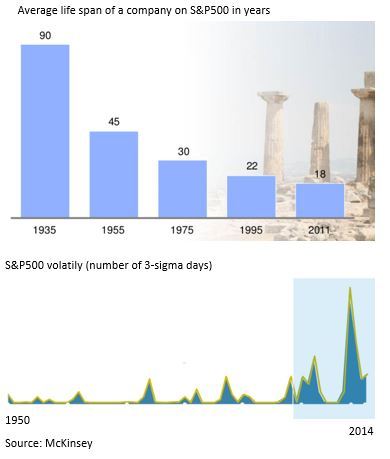
    If you go back to the article I posted earlier this week, you’ll see that creative destruction is happening a lot faster than it did in the past. The average life span of many, or most, companies seems to be decreasing.

    The tech sector seems to be ahead of most other industries with respect to this kind of thinking. But I believe that it will continue to percolate through the economy. And when it does, it will probably have many impacts on the kinds of spaces we design and build in our cities.

  • Fun Friday: ATC subscriber map

    When I was very young I went a Montessori school here in
    Toronto. If you’re not familiar with Montessori education, it’s basically a
    very open ended and independent form of learning. Students choose
    what they want to do.

    Because of this, many have argued that a Montessori
    education is actually great training to be an entrepreneur
    . Instead of being
    told what to do, you as a student need to figure it out on your own. See the
    parallel? Both Google founders went to Montessori school.

    When I was there (< grade 4), my absolute favorite thing
    to do was draw maps. I remember them having these large scale maps of the world where you could
    physically remove each country so that you could then trace it and create your
    own maps. I spent a lot of time doing exactly that.

    To this day, I still really love maps. And I remember many
    of my friends in architecture school being the same way. So perhaps it comes
    with the territory.

    In any case, I recently started playing around with a product
    called cartoDB. And one of the things you can easily do with it is connect it
    to Mailchimp (the service that manages the ATC email newsletter) and anonymously
    map the location of each subscriber. I couldn’t resist giving it a try.

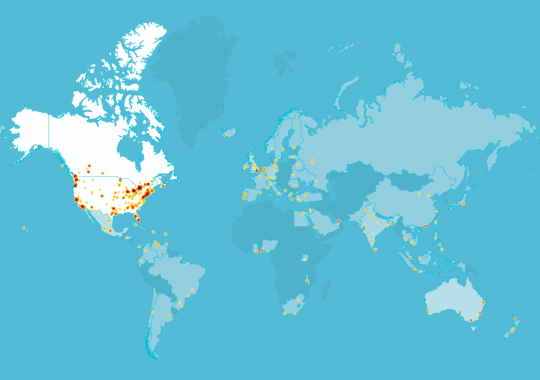
    Below is what that looks like. Not surprisingly, the highest
    concentrations of subscribers to this blog are in Canada and the US.

    image

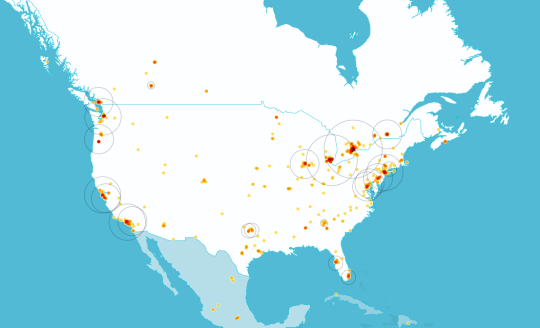
    So here’s a zoomed in version:

    image

    I’ve been trying to branch out from talking about Toronto
    all the time. And that seems to be working somewhat. But I could still do a better
    job of creating more global content. I’ll try harder.

  • Making alpha-bets

    GBike by Mohamed Yahya on 500px.com

    https://500px.com/embed.js

    On Monday, Google broke the internet when it announced that it was reorganizing itself into a holding company structure called Alphabet.

    That means that Google, Inc. will now become a subsidiary, along with many other companies, of Alphabet Inc. and all shares of Google will automatically convert into the same number of shares in Alphabet.

    This is huge, but also something that was likely inevitable given the passions of the founders. Apparently Larry Page has been thinking about this move for years.

    As it stands pre-Alphabet, Google (with its main internet products) is basically a cash cow funding all of Google’s other experiments. But this muddied the waters and made it difficult for investors to clearly see how much the main internet products were making and how much the founders were spending on self-driving cars, delivery drones (Project Wing), and other new ideas.

    Now everything will be separate.

    But what’s really exciting about the reorganization is that it sets the stage for Alphabet/Google – which is arguably already one of the most important companies in the world – to become even more impactful in a wide variety of industries and disciplines, some/many not traditionally associated with tech. Each wholly owned subsidiary will have their own CEO and the founders rightly believe, I think, that this overall structure will afford them more “management scale.”

    Within Google will remain search, advertising, maps, YouTube, and the Android mobile operating system. But already Alphabet is the parent company of the following other businesses:

    • Calico, an anti-aging life extension company
    • Sidewalk, a smart cities company whose mission is to improve life in cities
    • Nest, an “internet of things” company that makes connected devices for your home
    • Fiber, a company that offers super fast internet
    • Google Ventures (venture capital) & Google Capital (private equity)
    • Google X, which is the lab developing self-driving cars and delivery drones (Project Wing)

    If you can’t tell, I’m bullish on all of this. The approach really resonates with me and I can’t wait to see what Alphabet becomes. If you’d like to read the full and official blog post announcement, click here

    Cheers to trying new things and making big bets.

  • Driverless cars, urban mobility, and Toronto’s Gardiner Expressway

    image

    About a week ago I wrote a post questioning what driverless cars will mean for cities. I ended by saying that that it feels as if we’re going to see increasing tension between private and public transport.

    What I meant by that was simply that conventional notions around private car use are going to change. And ultimately that is going to mean that we need to rethink public transport and how that fits into a broader urban mobility framework.

    What do I mean by this?

    The International Transport Forum at the OECD recently published a fascinating report called, Urban Mobility System Upgrade: How shared self-driving cars could change city traffic. And it deals with exactly the sorts of things I am thinking about.

    The study looked of what might happen when all cars become self-driving in a mid-sized European city (specifically Lisbon, Portugal). They leveraged existing transportation data from the city, but replaced 100% of the human powered cars with two types of self-driving cars: TaxiBots and AutoVots.

    TaxiBots were driverless cars that would be shared with multiple people at the same time. In other words, they were a kind of pseudo-public transit. And AutoVots we’re your more conventional private taxi. They picked up one person at a time.

    So, what did they find?

    In the first scenario, they combined their TaxiBots and AutoVots with public transit (light rail) and discovered that the same number of people could be moved around with only 10% of the cars currently on the road. That’s a 90% reduction!

    They also found that the city needed 20% less on-street parking and 80% less off-street parking since driverless cars don’t need to sit idle waiting for a driver.

    In the second scenario, they removed mass transit from the equation. And in this instance they found that the city was still able to get around, but with an 80% reduction in the number of cars on the road. Remarkably, it also led to a 10% reduction in rush hour commute times.

    These are pretty profound changes. Reducing the number of cars on the road by 80-90% is a significant change. 

    But it’s also why I’ve been thinking about the tension between private and public transport. As we get better at optimizing “cars” (their definition will change), what becomes the role of true public transit?

    Ultimately, I think what will happen is a blurring of the two. In the example above, the TaxiBots served basically as small scale public transit. But that does not necessarily mean that true mass transit will become irrelevant. We’re just going to need to rethink how the entire mobility network fits together.

    I’d now like to bring this discussion back to Toronto for a minute.

    As many of you probably know from this blog, Toronto is on the cusp of deciding what to do with the eastern portion of the Gardiner Expressway (an elevated highway that runs across the downtown waterfront). It will go to City Council next month. 

    I firmly believe that we should remove it, but there many people who believe we shouldn’t. The main objection seems to be that the traffic projections indicate that removing it could make commuting into downtown – by car – 3 to 5 minutes longer by 2031

    By today’s standards, I believe this concern represents an outdated way of thinking about cities and urban mobility. Adding more lanes is like loosening your belt to deal with obesity. However, it gets even worse when you think about urban mobility in the context of this post.

    Given the profound transportation changes that are currently underway, I think there’s a strong likelihood that the Gardiner projections we have today will be completely wrong by 2031. I don’t know know for sure, but I’m guessing the models don’t account for the efficiencies being created by driverless cars and peer-to-peer networks.

    In other words, I am suggesting that those 3 to 5 minutes could prove to be a red herring. The relevant question should be: Which decision will allow Toronto to build the absolute best waterfront in the world? And in my opinion that leads to removing the Gardiner East.

    If you feel similarly, I would encourage you to write your local City Councillor.

  • Are we becoming more or less entrepreneurial?

    Aaron M. Renn of The Urbanophile, recently wrote an interesting article in Governing called, Where’s America’s Entrepreneurial Economy? In it, he argues that despite the fact that there’s a perception that entrepreneurship is on the rise, overall rates are actually declining.

    The Brookings Institution found that so-called “firm entry rates” have declined since the 1970s and that they suffered a steep fall post-2005. And though millennials are often seen as an entrepreneurial generation, The Wall Street Journal reports that business ownership among those under the age of 30 recently hit a 24-year low. Self-employment has seen a similar downward trend. A study by Economic Modeling Specialists International found that both the total number of self-employed and their share of jobs have fallen since 2006.

    His argument is that outside of tech — where yes, the barriers to entry have fallen significantly over the years — it has actually become harder to start a company in a lot of other cases. And he specifically mentions two industries where he believes that is very much the case: construction and real estate.

    Why is that?

    Well, he cites a number of possible factors, one of which is increased licensing requirements for many industries. But the two most interesting for me are slow disruption cycles and the presence of large dominant firms.

    Real estate has both of those. 

    It’s also a capital intensive industry. And it’s becoming harder for smaller private players to compete with larger institutions and pension funds who struggle with “moving the investment needle”, not with access to capital. Real estate is no longer the fringe asset class it once was.

    In contrast, you have the tech space with fast disruption cycles and low barriers to entry. Yes, you also have large dominant players (Apple, Google, Facebook, Amazon, and so on), but even they don’t have complete immunity in an environment where new ideas frequently trump access to capital.

    A culture of entrepreneurship across all industries is important for our society. I hope we never lose that.