Daily insights for city builders, delivered every morning at 6 AM ET. I’m Brandon Donnelly — a Toronto-based real estate developer and founder of Globizen. I’ve been writing here since 2013.

Tag: germany

  • Just put up a sign

    Back before the 2008 financial crisis, I did a short stint working for a real estate developer in Dublin, Ireland. 

    Most of our projects were in Ireland, but our consultant teams were sometimes from all over.

    One day we were having a meeting with our architect from Germany and we started talking about a particular project’s green space.

    But this wasn’t the sort of green space that was supposed to be actively used. It was a green space that, I guess, you were just supposed to look at and admire for its greenness. 

    So one of my Irish colleagues asked, while referencing the proposed design: “How are we going to keep people off the grass?”

    Our German friends didn’t immediately appreciate the concern and responded with: “What do you mean?”

    Irish: “How will we stop people from walking and hanging out on the grass?”

    German with serious face: “Oh. We will put up a sign.”

    At that point, every Irish person in the room just started laughing and more or less said: “Yeah, that’ll never work.”

    Cultural differences can be subtle.

  • German investment fund buys 1111 Lincoln in Miami Beach for $283M

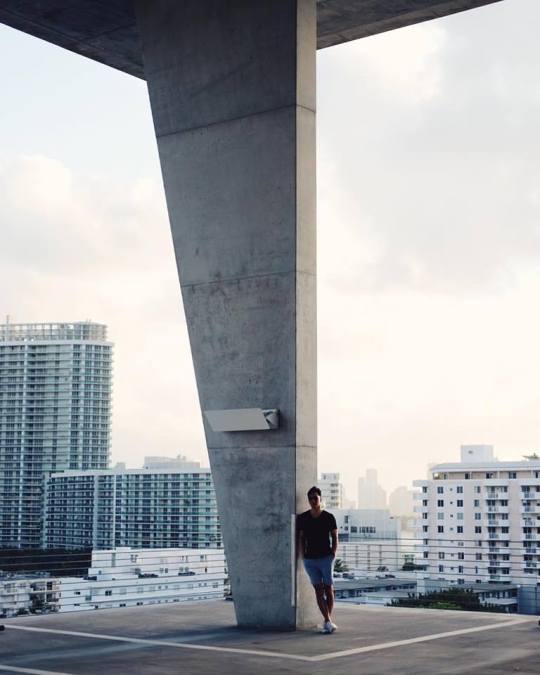
    The German investment fund Bayerische Versorgungskammer (BVK) has just closed on the Herzog & de Meuron-designed mixed-use parking garage / event space at 1111 Lincoln in Miami Beach

    They paid USD$283 million or $1,932 per square foot. It’s one of the biggest deals ever on Lincoln Road.

    The complex includes 94,488 square feet of office, 51,839 square feet of retail, and a 300 stall parking garage / event space (people get married in this garage). The sale also includes retail space at 1664-1664 Lenox Avenue, but excludes two new residential units according to The Real Deal. I’m assuming it is these two.

    The seller was developer Robert Wennett, who bought the site – existing office building + surface parking lot – in 2005 for $23.5 million. He then spent $65 million on the widely celebrated HdM garage and built himself a penthouse residence on top if it.

    I am very curious to know the cap rate. But it would also be interesting to try and figure out what sort of premium could attributed to the fact that this is a pretty famous complex designed by HdM.

    The Wall Street Journal once wrote that several hundred people walk into this parking garage every single day just to look around. I have been one of those humans on many many occasions. See above photo.

    For more photos of 1111 Lincoln, click here.

  • Lessons in transit success

    image

    Dylan Reid of Spacing was recently at the International Transport Forum in Leipzig, Germany and has been publishing some interesting posts related to transit. Here is one about what makes transit systems succeed and fail.

    I really like the point that we too often think about transit projects as culminating with a big opening, while overlooking the importance of operations. It’s a bit like focusing on the wedding ceremony and forgetting that the ceremony is only really there to (hopefully) mark the beginning of a lifelong union.

    One of the reasons why this is important is because, as Reid points out, “fares need to provide a strong and consistent proportion of the agency’s funding.” So you need bums in seats, which means you need to build the right transit in the right locations. In other words, a new subway line through a low density suburb will probably result in an abysmal farebox recovery ratio.

    At the same time:

    “…fares will rarely cover all of an agency’s costs. Hong Kong’s Kam noted that, to be truly autonomous, an operator needs an additional dedicated, independent source of revenue. This cannot be based on additional transit-related non-fare revenue (e.g. advertising) – such revenue is helpful but never significant. It needs to be an external source. In Hong Kong, it is based on the agency’s extensive property ownership, but in other cities it could be a congestion charge, a dedicated sales or income tax, or other mechanism. Only with such a source can the agency have the independence to make its own choices for reinvestment and improvements.”

    This is one of the reasons why I am such a strong supporter of road pricing.

    Another point that Reid makes is that transit agencies should always have a consistent pipeline of new projects, rather than erratic periods of expansion. This makes a lot of sense given what it takes to ramp up for a large infrastructure project. But it’s obviously contingent on having sustainable funding sources.

    Click here if you’d like to read the rest of Dylan Reid’s post.

  • E20_Private Residence

    The private residence below is located on a quiet street in the village of Pliezhausen – about 30 km south of Stuttgart. Designed by Steimle Architekten, the house is 376 square meters and sits on a 658 square meter property. Its insulated concrete shell is 50 cm thick. All photos by Brigida González.

  • Housing is a bitch

    I just discovered Steve Randy Waldman’s blog called Interfluidity and, more specifically, a post he wrote called: “Home is where the cartel is.” I am now following him.

    He starts off by saying that housing is a bitch, which is just him saying that urban housing is a difficult problem to solve. A truism for this audience.

    He doesn’t profess to have all of the answers, but he does write a thoughtful piece that covers, among other things: the “market urbanist” (supply-side) solution to solving housing affordability, the reasons why the “housing cartel” will never approve of this, and the inherent contradiction between housing as an investment and housing as a sustainably affordable good.

    He also offers up Singapore and Germany as examples of two very different housing markets. It reminded me of a tweet I retweeted this morning which shows Germany as having the 2nd lowest homeownership rate (45%) among OECD countries.

  • Drone fly through of Hamburg’s Elbphilharmonie

    It’s somewhere around 7 years behind schedule, but Hamburg’s Elbphilharmonie concert hall opened its doors this week for its first ever public performance. Designed by Herzog & de Meuron, it was initially scheduled to open in 2010 at a cost of €77m. Instead it cost €789m and its first performance was, well, this week. This is according to The Spaces.

    If by chance you didn’t attend the official opening ceremony (and even if you did), I recommend you check out this interactive drone fly through. It’s a neat (and potentially transformative) way to see the building, experience its architecture, and understand its setting on Hamburg’s harbor. Make sure you turn on your sound. It is a concert hall, after all.

    You can also watch the opening concert (January 11, 2017) here on YouTube.

  • What I’m doing next

    image

    A number of you have asked if I’m moving to New York. I can see why that was inferred from some of my posts, but that was actually not my intention. I am not moving to New York. (Sorry New York friends. I’ll visit soon.)

    Toronto is home base. I hope it’s clear how much I love this city. Sure, I’m a big fan of New York and Miami and Vancouver and Berlin and Tokyo and Jackson (to name some of the places I have on my phone’s weather app), but I made a deliberate choice to station myself here.

    Because unlike some of the other industries I write about on this blog, city building is hyper local. What I do involves the built environment. And that doesn’t generally happen via a laptop on a beach in Bali (at least not for extended periods of time).

    It happens by being on the ground, interfacing with local communities, meeting face-to-face with the city, and poring over drawings with smart people who know far more about their respective disciplines than I ever will. It is a collaborative and local effort. It’s about getting into the details.

    And so to be successful in this business, I think it helps to find a home and take long bets. I’m not saying that I will never work on projects in other cities (I have and I would), but I am saying that I’m not moving to New York right now and that home remains Toronto.

    On that note, here’s what I have to tell you. Later this year I’ll be joining Slate Asset Management as VP of Development.

    A bit about Slate:

    Slate is one of the most active acquirers, owners, and managers of real estate in Canada right now. Founded in 2005 by two brothers (Blair and Brady), Slate has over $3 billion of assets under management across over 16 million square feet and over 130 properties.

    All of this is done through four main investment vehicles: 

    1) The first is Slate Advisors. It acts on behalf of and alongside private institutional investors — such as Greystone.

    2) The second is Slate Office REIT (TSE:SOT.UN). It is a pure play Canadian office REIT focused on downtown and suburban properties all across the country.

    3) The third is Slate Retail REIT (TSX:SRT.U). It is a pure play REIT entirely focused on grocery-anchored U.S. retail properties. (Remember how many times I’ve written on this blog about how grocery has one of the lowest online shopping penetrations?)

    4) And the fourth: Slate is also starting a grocery-anchored retail platform in Germany. It is similar to #3, except that it’s in Germany.

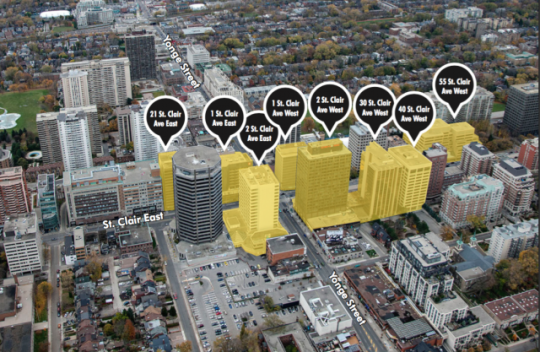
    Most recently, Slate has been in the news because of the position it has taken at Yonge + St Clair in midtown Toronto — a perfect example of “finding a home and taking long bets.” Slate, in partnership with Greystone, owns all 4 corners of the intersection and about 60% of the properties along the St. Clair corridor.

    Here’s a diagram of those Slate buildings:
    image

    In case you didn’t put two and two together, the 8-storey mural I wrote about two weeks ago is going up (right now) on the side of a Slate building (1 St Clair Avenue West — shown above). The British street artist known as Phlegm is doing it.

    Up until today, the focus of Slate has largely been on acquiring undervalued / overlooked real estate and creating value through re-leasing and overall repositioning. That will certainly continue. But given what I do, I am sure you can posit what’s also next.

    I’m genuinely excited to be joining such a talented group of real estate professionals. As I mentioned last week, I wasn’t in the market for anything new. I was heads down working on cool projects. But life happens. And Slate quickly demonstrated to me that the incredible success they have seen to date is precisely because of how progressive, nimble, and entrepreneurial they are.

    On that note, I have “one more thing” to share today.

    In parallel to all of this, and with the support of Slate, I am also starting a boutique city building company called Globizen. The name is derived from Global + Citizen.

    The objective is to build a company that embodies everything I write about on this blog. I want it to be lifestyle and design-driven. I want it to leverage technology to improve the way that cities and the building industry operate. And I want it to function as a vertically integrated real state + design firm, focused on sustainable urban infill development. Think of it as city building by and for the responsible global citizen.

    It’s still early days, but the thinking is that this new platform could compliment the larger Slate platform in some way. It’s too early to say how exactly, but everyone is open to having those discussions. And that’s what matters at this stage.

    I am going to end with a quote. It’s by Partner and Co-Founder, Blair Welch:

    “On all of our deals we have had people say ‘can’t’ to us. They say ‘Can’t be done, can’t do that, can’t raise money, etcetera.’ At Slate, we don’t do ‘can’t’ well.”

    I like that a lot. So here’s to finding a home, taking long bets, and not saying can’t. Onward my friends. 

  • Global home prices at the end of 2015

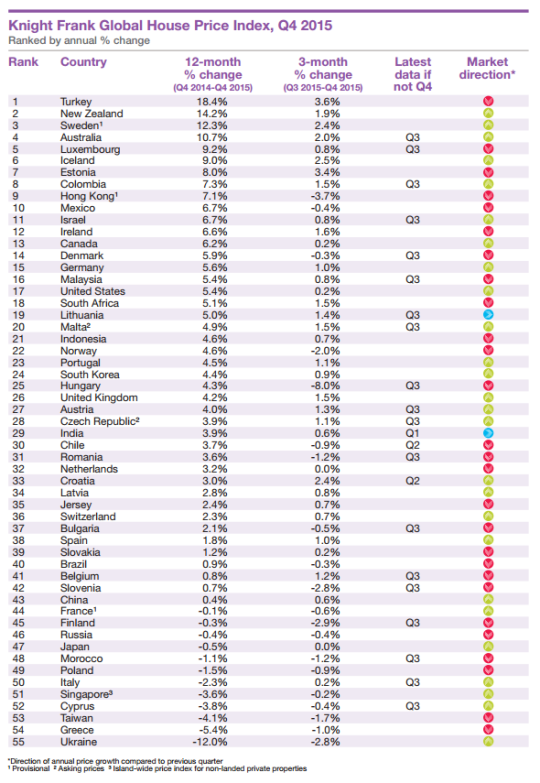
    Seeing how we’ve started looking at data from last year, I thought it would be interesting to look at global home prices as of Q4 2015. Here’s a chart from Knight Frank, which they refer to as their Global House Price Index:

    At the top of the list is Turkey, with an 18.4% increase from Q4 2014 to Q4 2015. (Supposedly this is because it has recently become easier for foreigners to buy property in the country.) Canada is 13th with a 6.2% increase (during this same time period) and the United States is 17th at 5.4%.

    This is obviously a high level analysis. There are lots of regional and local variations within each country. For instance in Canada right now, Calgary is a very different place than, say, Vancouver or Toronto.

    Nonetheless, it’s still valuable to see the relative performance of each country and see what their (Knight Frank’s) prediction is for 2016:

    “Our outlook for 2016 is muted. We expect the index’s overall rate of growth to be weaker in 2016 than 2015. The global economy is experiencing a potentially dangerous cocktail of low oil prices, a strong [US] dollar and a continued slowdown in China.”

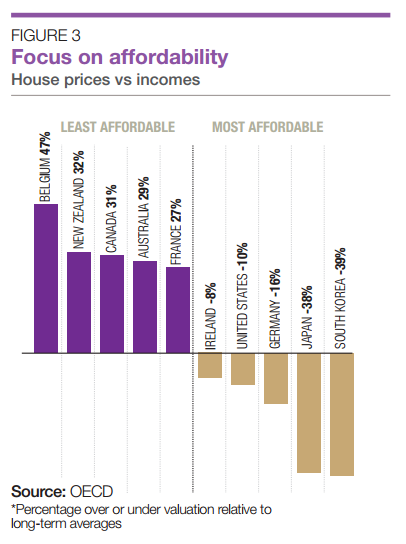
    It’s also interesting to see how the countries rank in terms of affordability:

    Once again, Canada ranks as being one of the least affordable countries in terms of home prices.

  • What technological deflation could be doing to the economy

    Earlier in the week, I came across this post (via Fred Wilson), arguing that rapid technological progress is causing systemic deflation in the broader economy.

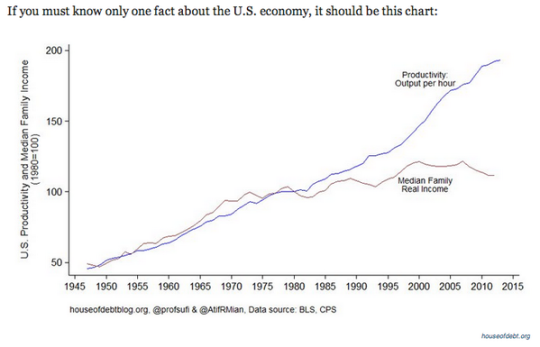
    Here’s a chart that illustrates the author’s point:

    What is happening here is that despite advances in technology and increases in productivity, real wages have been stagnant for decades. (This chart is for the US, but it likely applies to many other countries.)

    This is an interesting paradox. For a long time, increases in productivity were met with corresponding increases in income. So why the divergence?

    The author believes that it’s because the gains brought about by “extreme technological progress” are being unequally applied to the economy. In other words, they do not benefit the majority of people. He then goes on to argue that we could be entering an entirely new macroeconomic era: 

    “Economic growth may be over soon, at least in absolute terms. On the other hand that will be at least partially offset by the technological deflation. So instead of the decline of the innovation it will be just the opposite, the explosion of the innovation that will turn the economy to the decline. And moreover, it will not be a tragedy since we will be able to produce higher standard of living with fraction of the GDP today. Few adjustments needs to be done into our economic system to cope with the change for sure.”

    When you read things like this it makes the idea of a “basic income guarantee” seem far more palatable.

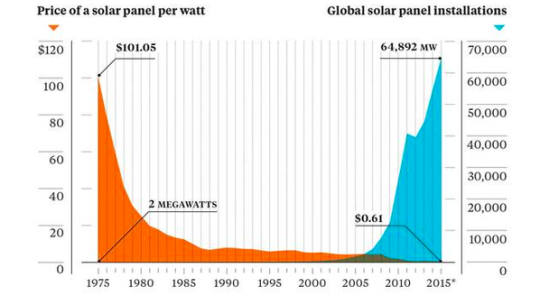
    The other chart that stood out to me was this one below, which shows the declining cost of solar panels and the rise of global solar panel installations. 

    It’s a great reminder that it’s only a matter of time before we wean ourselves off of oil. And, that we could be headed towards some sort of third industrial revolution where the marginal cost of energy is almost zero. Already about 25% of Germany’s electricity comes from renewables.

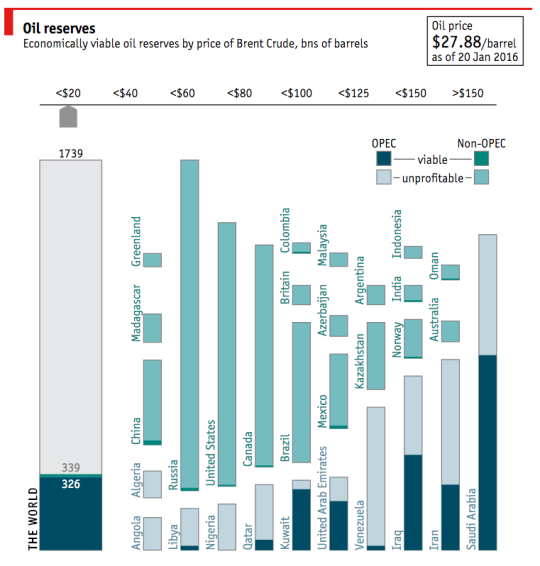
    On that note, I am going to end with a fantastic interactive chart from The Economist (screenshot below) that outlines oil reserves around the world by country. If you click through to their website, you can then toggle the price of oil (per barrel) to see how much of those reserves are actually viable.

    With the price of oil where it is today ($27.88 per barrel as of January 20, 2016), there are only a handful of countries with profitable oil. I am sure you could have guessed which ones.

    What will happen if, or should I say when, that oil is no longer needed? 

  • Last call at the bar

    Earlier this week I attended the CityAge conference here in Toronto and participated in a panel discussion about talent. 

    The questions were all about how cities can attract and retain talent, and how they can best leverage the talent they already have. These are questions that a lot of cities around the world are thinking about.

    In my responses I talked about things like transit connectivity, which is a problem that all of us in Toronto recognize we have. But I also focused a lot on quality of life, on sense of place, and on being a cool place to live. These are important factors.

    The example I then gave is Berlin. Some say Berlin is now over. But for many years Berlin has been dubbed one of coolest cities in the world. And I personally think a lot of that has to do with the arts, culture, and nightlife scene that emerged in the 90s. 

    But this wasn’t a government initiative to make Berlin a hub for talent. It was largely a grassroots movement that took hold for a myriad of reasons, one of which was simply empty buildings that people could colonize for parties. And it transformed the place into a city that later became known as “poor but sexy.”

    That brought me to another point, which is that Toronto’s 2AM last call at the bar is laughable by global city standards. And we know that. That’s why whenever we host an event of any sort of notoriety – such as the Toronto International Film Festival – we extend it to 4AM. The people coming here from all around the world expect that.

    This may seem like a small thing. And I am sure many of you here in the city would like things to stay just the way they are. But I think we need to loosen up.