Daily insights for city builders, delivered every morning at 6 AM ET. I’m Brandon Donnelly — a Toronto-based real estate developer and founder of Globizen. I’ve been writing here since 2013.

Tag: germany

  • The post-combustion era

    Over the winter I visited BMW World, and its neighboring museum, in Munich, Germany.

    I loved seeing how the company got its start and how far it has come since it helped to invent the automobile at the beginning of the 20th century. I think their first product was actually an airplane engine.

    But you and I both know that the paradigm is changing. The internal combustion engine (ICE) is going away and pretty soon we won’t be driving, so much as being driven around by our cars.

    Bloomberg recently published an interesting article about this shift and about BMW. Here is an excerpt:

    The fact that both combustion engines and electric motors find themselves inside the same 18,000-person complex in Dingolfing, BMW’s largest in Europe, makes it a microcosm of a shift overtaking automakers the world over. A visitor can see that 625-horsepower engine—more than twice as powerful as the original from 1985, a luxury product relentlessly branded as “the ultimate driving machine”—then walk around the corner and see its puny electric replacement. You start thinking the better slogan might be “the ultimate combustion engine.” As in: last of its kind.

    Electric motors are a hell of a lot simpler to manufacture (and service) than gasoline engines. BMW estimates that they take about 30% less time to make. So the impacts of this transformation span everything from supply chain to human capital.

    Today, about 10% of the work that goes on in Dingolfing is related to electric vehicles.

  • What’s in a roof?

    Over the weekend I stumbled upon this illustrated Medium post by Alfred Twu comparing sloped and flat roofs. The argument is that these two roof types are coded. In this part of the world, at least, sloped roofs signal low-rise “house” and flat roofs signal big city “high-rise.”

    I’m not yet convinced of this association with height, or of all the claims made in the article. Did New York City really make the flat roof commonplace in our cities? But the idea that a roofline can trigger certain associations — or even become divisive — is a fascinating one.

    Take, for example, Am Fischtal in Berlin. On one side of the street you have, still to this day, homes with flat roofs. And on the other side you have homes with sloped roofs. This clean divide is the result of a supposed “roof war” that took place during the Weimar Republic.

    At this moment in time in the suburbs of Berlin, the kind of roof you chose to live under was a proclamation of your political orientation. I’m not sure roofs have as much gravitas as they did in the 1920’s on Am Fischtal, but they still do say something.

    Image: Alfred Twu

  • A visit to BMW World

    Today we visited BMW Welt (World) and the BMW Museum in Munich.

    BMW Welt was designed by COOP HIMMELB(L)AU out of Vienna. It is the result of a design competition that the BMW Group held in 2001. Construction of the ~73,000 square meter facility was completed in 2007.

    The project is centered around a great hall and an elevated vehicle delivery area known as Premiere. It was designed — and this includes the HVAC system — to handle 40 car deliveries per hour, or 250 per day. I guess they don’t work a full 8 hours.

    Below are two photos that I took of the delivery area. The circles you see on the floor in the second picture are rotating platforms. This is where you want to pick up your new car.

    And here is a plan of the entire Welt space via COOP HIMMELB(L)AU:

    I also really enjoyed the BMW Museum, which is housed in a separate building adjacent to the BMW Tower (the one that looks like engine cylinders).

    The “art cars” were a lot of fun. I’m sure that many of you will be able to guess the artist behind this one:

    But what I enjoyed most were the classics like this one here:

    The least interesting cars for me were the ones that weren’t old enough to be “classic”, but also weren’t new and shiny. This can happen with architectural styles as well. Designs sometime need time to settle in.

    For more photos of BMW Welt and the BMW Museum, follow me on Instagram.

    Drawings/Isometrics: COOP HIMMELB(L)AU

  • 200 km/h on the Autobahn

    We drove on the Autobahn today. Our Ford remained as smooth as ever. They take their cars seriously here and force regular inspections.

    But this got me wondering about safety records and why more countries haven’t adopted similar approaches to highway driving.

    Here is Germany’s 2014 record from Wikipedia:

    It turns out that the injury and fatality rates on the Autobahn — measured per billion vehicle kilometers traveled — are actually relatively low compared to urban and rural road classes.

    It is also relatively low compared to international standards. Here is a 2012 comparison, also via Wikipedia:

    Europe as a whole does very well in this regard (not that this specifically addresses Autobahn safety). Generally, fatalities have declined significantly over the last few decades.

    Here is a chart from the World Health Organization:

    What is clear to me after seeing this data, though, is that the greater problem looks to exist outside of our highways and motorways.

  • Homes built in the past year

    I’m on a flight right now reading the latest issue of Monocle Magazine in a seat that barely accommodates the length of my femur. This month’s issue has their annual ranking of the top 25 cities in the world.

    Munich is first, which is not unusual for their ranking methodology. It generally scores well. Quality of life is high. Crime is low. The economy is strong. Beer gardens are fun. And you’re close to the Alps for snowboarding.

    One stat that caught my attention — and it’s not included for all of the cities — is the number of homes built in the past year. Presumably this is all housing units in the metro area — for sale, for rent, subsidized and so on.

    Here are their (clearly rounded) numbers. The order is as they appeared in the ranking, but again, not ever city included this stat.

    • Munich: 8,300
    • Tokyo: 150,000
    • Copenhagen: 5,000
    • Berlin: 11,000
    • Madrid: 1,600
    • Hamburg: 7,000
    • Melbourne: 5,100
    • Helsinki 4,400
    • Stockholm: 7,000 (18,000 in Greater Stockholm)
    • Sydney: 39,000
    • Hong Kong 17,000
    • Vancouver 22,600
    • Amsterdam 5,100
    • Kyoto 8,900
    • Dusseldorf 2,600
    • Barcelona 1,000

    Some of these numbers appear to stand out, such as the counts for Tokyo, Sydney and maybe Vancouver. But it’s hard to draw any conclusions around housing supply and housing affordability.

    Melbourne and Amsterdam allegedly have the same number of homes built over the past year, but according to Monocle the metro areas of Melbourne and Amsterdam have populations of 4.85 million and 2.4 million, respectively. This also says nothing about their growth rates.

    So which one is doing a better job of addressing housing demand? I’m not sure.

    But it was still interesting to see that Tokyo delivers somewhere around 150,000 homes a year. Tokyo is somewhat unique globally in that it’s a big city — one of the biggest — that somehow manages to gracefully balance both scale and quality of life.

    Photo by Elias Keilhauer on Unsplash

  • Chipperfield to build tallest building in Hamburg

    David Chipperfield Architects has just won a design competition for the tallest building in Hamburg. It is set to rise 230 meters and look something like this:

    image

    There’s a real elegance to its simplicity. It also feels like an appropriate pairing with the nearby Elbphilharmonie designed by Herzog & de Meuron.

    But the first thing I thought to myself when I saw the design was: “Must be office. There are no outdoor spaces.”

    And sure enough, the plan is for 104,000 sm of primarily office. There are also plans for restaurants, shops, exhibition areas, and a hotel and bar.

    Some architects begrudge having to incorporate balconies into their tower designs because they can break up the elevations, muddy the concept, and create thermal bridging concerns.

    This tower – called the Elbtower – is a good example of why that is the case.

    Image via Dezeen

  • Notes from the retail apocalypse

    A friend of mine was in Scottsdale last month for an ICSC conference where Garrick H. Brown (VP of Retail Research for the Americas at Cushman & Wakefield) delivered this retail presentation

    My friend flipped it to me this week and below are a couple of slides that stood out as I scanned through it.

    image

    Apparently over the last five years, a new dollar store has opened every four hours in the US. That’s how quickly this category is growing. A race to the bottom.

    image

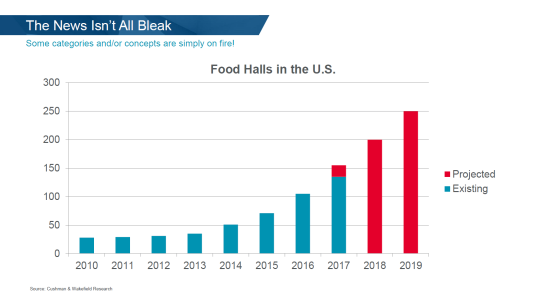
    Food halls are hot and not just in the US. Check out: “5 huge food halls opening soon in Toronto”.

    image

    This is similar to a chart I posted a few weeks ago that pegged online grocery shopping in South Korea at closer to 20%. I’m still fascinated by this market share number and want to better understand what’s driving it.

    image

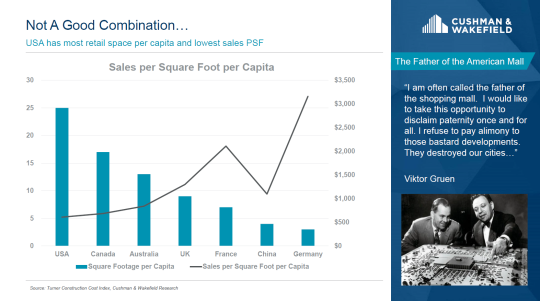
    This is an interesting chart that shows the relationship between retail square footage per capita and sales per square foot per capita. The US has lots of retail space per capita but low sales. Now look at Germany.

    image

    Finally, this is a chart that shows where household growth is expected to happen from 2016 to 2025. It follows a very clear historical trend of Americans moving from cold places to warmer/hot places.

    image

    For the full presentation, click here.

  • Strandkorb — a low tech solution to the elements

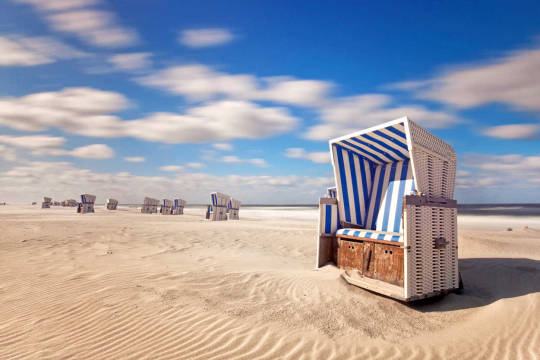
    I recently discovered this marvelous chair (image from here):

    image

    It’s called a strandkorb, which is a German word that translates into something along the lines of “hooded beach chair.” It was invented in the late 19th century by a basket maker looking for protection from the elements on the beach.

    Apparently they are fairly ubiquitous at resorts along the North Sea and Baltic Sea and are a bit of a cult object in Germany. They are a symbol of holiday fun, but also, to some, a symbol of German resiliency in the face of adverse weather.

    For me, the beauty of these beach chairs is that the “hood” blocks the wind. So if you orient yourself toward the sun, you could actually feel quite warm even when it may not be the perfect beach weather. They extend the season, which is paramount in cooler climates.

    I guess that’s why they have stuck around since the 1880′s. If you check out some of the (Google) photo spheres in beach towns in northern Germany, you will definitely find many a strandkorb.

  • Secrets of the German economy

    I just got off a flight where I spent an hour listening to this podcast: What Are the Secrets of the German Economy — and Should We Steal Them?

    One of the key themes is that Germany has a “stakeholder economy”, rather than a “shareholder economy”, which is one way to describe the Anglo-Saxon model.

    There’s also a lot of discussion around cities and spatial economics. 

    For instance, there’s an argument that WW2 forced a decentralization of the German economy. Germany is one of the rare examples where a country’s busiest airport (Frankfurt) is not located in the country’s biggest city (Berlin).

    Thanks Daniel for passing this podcast along. I enjoyed it.

  • Our bias toward homeownership

    We have a cultural bias toward homeownership in this country. Other countries have it too. We believe that homeownership is what you should aspire to.

    In 2011, Statistics Canada pegged the homeownership rate at 69%. 9.2 million households out of a total of 13.3 million. Other more recent data suggests that it’s probably a bit lower, though still higher than that of the US since the financial crisis.

    Regardless, more owners than renters.

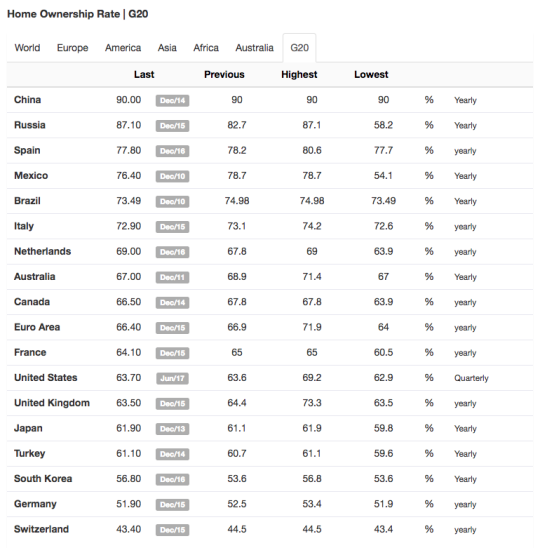
    I am not here to throw stones. I get it. I own my home. However, I do think it’s important to put this into perspective. Below is a chart from Trading Economics of homeownership rates in the G20:

    image

    At the bottom of the list – with the lowest homeownership rates – are Germany and Switzerland. Germany appears almost evenly split between owners and renters. And Switzerland is more renters than owners. 

    Both of these countries are wealthy. Both have a higher GDP per capita than that of Canada according to the World Bank and the International Monetary Fund. 

    Anecdotally, I can also say that some of the wealthiest people I know have made the decision to rent. They have simply decided to invest their capital elsewhere.

    I’m not trying to insinuate any sort of correlation with these statements, but I am trying to draw attention to a cultural bias.