Daily insights for city builders, delivered every morning at 6 AM ET. I’m Brandon Donnelly — a Toronto-based real estate developer and founder of Globizen. I’ve been writing here since 2013.

Tag: gentrification

  • The gentrification cycle — is it a natural outcome?

    image

    Here is the stereotypical gentrification narrative: Rundown neighborhood sees artists (or other cool gentrification catalyst) move in. Area becomes cooler. Other people start to move in. Developers start building. People start to complain about gentrification.

    I don’t mean for this to be pejorative in any way. I was just trying to be matter-of-fact about it.

    When I wrote yesterday’s post about the Drake Commissary and the changes that have and will continue to happen in West Queen West and in the Junction Triangle, I knew in my mind that people would be thinking about gentrification. 

    Sterling Road is home to many artists and creatives. What will happen to them as the area develops? I am sympathetic to concerns around displacement. We’ve also seen what can happen to a neighborhood when even the big brands and big money decide to leave.

    But let’s dig into this narrative a bit more.

    Virtually every private sector building ever built was done with a profit motivation behind it. When that old abandoned brick-and-beam warehouse was built, it made economic sense to do so – or at least somebody believed that to be the case.

    In many/most cases this ends up being true. So when the building eventually loses its utility, it is because something has changed in the world. Manufacturing has gone offshore. People are now shopping online. The city has gone bankrupt. Tastes have changed and nobody wants to lease the building. The list goes on.

    When groups rediscover and repurpose these spaces they are effectively kick-starting a new lifecycle for the building. And under the right circumstances, a new cycle for the neighborhood. These are the artists, the nightclubs (see Berlin club scene), the brewers, and so on. This is a hugely valuable phenomenon for cities because fresh ideas often require cheap space.

    Of course, it may also be the case that the buildings aren’t empty. But new energy is still introduced to the neighborhood and things start to visibly change. 

    Where I think many people take issue is when these early adopters and pioneers ultimately get displaced because of their own actions. They are the ones who made the area desirable again and there’s a sense of ownership: “Hey, I was here first.” I get that. 

    But what we often forget is that what is old was once new. Some developer presumably made money building that abandoned building and many people came before us to lay claim to its spaces. 

    The fact of the matter is that neighborhoods and cities naturally go through cycles. They also ideally grow. That’s why I like when people talk about cities as organisms with metabolic rates. Change is a constant, even if it may not seem that way.

    Take, for instance, the suburban neighborhood where I grew up. We moved in when it was basically a new subdivision and so the area was filled with young families. I had lots of kids my own age to play with. It was loads of fun. The streets were always filled with kids.

    But we’ve all grown up and most of us have moved on, meaning the neighborhood no longer has the same character, despite the fact that the built form has basically remained the same. When I go back to the area, I no longer see any kids playing in the streets. But that’s not to say it won’t happen again.

    This is a subtle example of one of the ways in which neighborhoods go through cycles – this one being a demographic one. Though it can obviously happen through more dramatic changes, such as new development or the abandonment and repurposing of older buildings.

    So if we are to assume that these sorts of natural cycles and changes are happening all around us, here are my honest questions. 

    Can and should gentrification (i.e. investment) be stopped? If so, are we saying that neighborhood cycles should be halted at one precise point in time, perhaps after the early-adopters take root? Or should we try and temper the pace of change? Is it simply a case of too much of a good thing?

    Let me give another example.

    I live in a condo building that is less than 5 years old. It’s 33 storeys, which is one of the higher buildings in the area. I’m sure it was contentious when it was initially proposed.  

    There are people who live and own in my building who today have real concerns about the other developments proposed and underway in the neighborhood. They worry that it will negatively impact the neighborhood, traffic, their views, and so on. But how does that work?

    To me, this is selfish. Because this is not a case of investment with displacement. And less than 5 years ago – before my building was built and occupied – we were the outsiders. I was the guy that current residents were worried about. Who am I to now turn around and say that nobody else is welcome now that I’m here?

    I say all of this not because I profess to have all of the answers. But because these are hot button issues and I think we’d be well-served by more precision in our discussions. Cities change and grow. That’s what makes them incredible and resilient places. Stasis is not an option. 

    So how should we ride the growth and the cycles?

  • Is radical rezoning the solution to gentrification and displacement?

    image

    “If I meet one more anti-gentrification activist who moved to Seattle ten minutes ago, I shall scream.” –Dan Savage

    So it’s not just developers who are frustrated by the many paradoxical desires that we have of cities. We are concerned about housing affordability and we want to minimize displacement, but we do things that restrict new supply and put increasing pressure on our existing housing stock. 

    Below is another excerpt from Dan Savage. It’s from an article called: Doing Something Real About Gentrification and Displacement. Dan writes a sex-advice column, but clearly also feels passionate about urban issues. When he talks about “this city” he’s talking about Seattle.

    “Housing scarcity—exacerbated by the ridiculous amount of this city zoned for single-family housing—deserves as much blame for the displacement crisis as gentrification. More. And unlike gentrification (“a once in a lifetime tectonic shift in consumer preferences”), scarcity and single-family zoning are two things we can actually do something about. Rezone huge swaths of the city. Build more units of affordable housing, borrow the social housing model discussed in the Rick Jacobus’ piece I quote from above (“Why We Must Build”), do away with parking requirements, and—yes—let developers develop. (This is the point where someone jumps into comments to point out that I live in a big house on Capitol Hill. It’s true! And my house is worth a lot of money—a lot more than what we paid for it a dozen years ago. But the value of my house is tied to its scarcity. Want to cut the value of my property in half? Great! Join me in calling for a radical rezone of all of Capitol Hill—every single block—for multi-family housing, apartment blocks and towers. That’ll show me!)”

    His overarching point is that lots of highly-educated people with money are choosing, today, to live in urban centers. And whether we like it or not, that is going to cause gentrification. We can’t stop that. But what we can do is try and alleviate housing scarcity. 

    His other solution involves building lots of transit to address geographic isolation. I agree with him on this point and I’ve argued it before on the blog. If we can all agree that one of the issues is land/housing scarcity, then transit is certainly another way to “pull in” new supply. Though I think we need to be realistic about the level of service required to make areas desirable.

    If you have a few minutes, check out Dan Savage’s article. It’s a good and entertaining read.

  • Site: Volume 6

    image

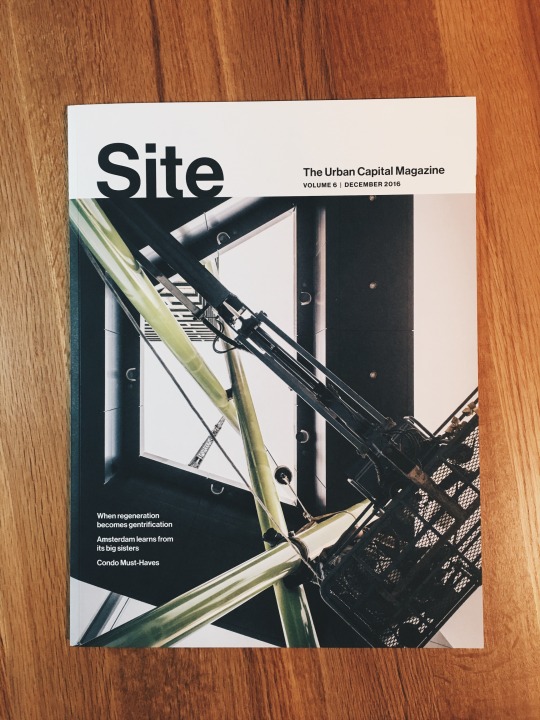
    Urban Capital just released Volume 6 of its annual publication called Site. (Sadly, I missed the party.)

    The cover, shown above, is a photo of Shayne Dark’s 90 foot public art installation at Tableau Condominiums. The piece is called NOVA and it’s located at the southeast corner of Peter Street and Richmond Street West in downtown Toronto. If you haven’t yet seen it, I would encourage you to go by. I love the scale that the art and architecture have brought to this stretch of Richmond.

    You can pick up a free copy of Site from any Urban Capital sales office. But in case you don’t end up doing that, I thought I would post a copy of the article I wrote for it. It’s called “Too Much of a Good Thing” and it’s a discussion about urban regeneration vs. gentrification.

    Some of you may also appreciate the Condo Development 101 feature that Urban Capital has been publishing alongside Site. The “how to” in this issue is on financing a development project.

    ———————————————————

    Too Much of a Good Thing

    Urban Capital is an urban regenerator. From its start in Toronto’s King-Spadina district in the late 1990s to Ottawa and Montreal in the early 2000s and Halifax, Winnipeg and Saskatoon today, it has tried to be at the vanguard of urban change. But there’s a flip side of this – “gentrification”, where people get displaced. When does too much of a good thing – regeneration – become a bad thing – gentrification? Brandon Donnelly looks for the answer, and asks what can be done to offset the negative impacts of urban regeneration.

    The 1960s through to the 1980s were not kind to many cities in North America, Europe and the UK. The economy was going through a process of industrial restructuring. Racial tensions were high, particularly in the US. And the lure of the suburb proved irresistible to an auto-oriented generation who saw cities as blighted and dangerous.

    In 1967, Detroit saw one of the most destructive riots in the history of the United States. It lasted five days and resulted in 43 deaths and the destruction of over 2,000 buildings. From 1960 to 1980 the city lost nearly 30% of its population – a decline that continued into the 21st century and has only recently been reversed.

    On October 16, 1975, New York City was less than 24 hours from declaring bankruptcy, as $350 million of debt was about to come due. The economic fallout from deindustrialization had hit the city hard and crime had risen dramatically. By the end of the decade the city would lose nearly a million people and then see the start of what became known as the “crack epidemic.” People avoided “the city” – the city being Manhattan. It was simply too dangerous.

    Cities, it would seem, were dying.

    Yet despite this dire urban backdrop, concerns over gentrification were not non-existent. New York neighbourhoods such as the South Houston Industrial District (today’s SoHo) and the Lower East Side were embroiled in fights over highways, displacement, and gentrification throughout the 1960s, 70s, and 80s.

    Indeed, the term “gentrification” can be traced back to 1964, when it was coined by the German-born British sociologist Ruth Glass. She described it as a rapid process where modest mews, cottages, and previously subdivided Victorian houses were upgraded to elegant and expensive houses – ultimately upsetting the whole social order of the district.

    Baron Haussmann – the original gentrifier

    Even before the term had been coined, “gentrification” as an urban phenomenon had long entered the mind of city dwellers. From the 1850s to the 1870s, during Baron Haussmann’s complete destruction of working-class medieval Paris, the French poet Charles Baudelaire wrote about the estrangement he felt with this newer and richer Paris. This was 19th century gentrification at work.

    But is gentrification always a bad thing? As Detroit bled people in the post-war years, would anyone have opposed a new “luxury” condo tower, assuming it could have been built? Should Haussmann and Emperor Napoléon III have left Paris the way it was? The generation that was displaced wasn’t all that thrilled, but today Paris is one of the most admired and visited cities in the world. So was it worth it?

    De-gentrification is not a great alternative

    Another way to look at gentrification is that it by definition requires capital investment. To renovate and regenerate a neighbourhood is to invest money and make new things. Therefore, the opposite of gentrification – let’s call it de-gentrification – would be disinvestment. This is where capital investments are not made. Things are left to age, because let’s keep in mind that all built form depreciates over time. Nothing is static.

    Most people would probably agree that disinvestment is not an optimal outcome for communities. And you don’t have to look hard to find examples of it. In 1970, the United States had 1,100 urban Census tracts that could be classified as “high poverty.” By 2010, 40 years later, that number had climbed to 3,165. This is disinvestment. This is the lack of gentrification, which doesn’t always get talked about.

    Developers such as Urban Capital have positioned themselves as urban regenerators. What started with a late 1990s boutique loft project – Camden Lofts – in Toronto’s hollowed out Fashion District has grown into a firm philosophy around investing in and regenerating neglected urban areas. In 2013 the company completed the first phase of its four-phase River City development. It was the first building in Toronto’s emerging West Don Lands district, previously a derelict area completely outside the consciousness of Torontonians.

    Earlier, with its East Market development in 2001, Urban Capital kick started what ultimately grew into quite a condo boom in Ottawa. East Market was at the scruffy end of the city’s Byward Market, a one-acre empty parking lot adjacent to a Salvation Army hostel. It was the first major condominium development proposed in the city’s central district in over ten years.

    And today, with the completion of its Glasshouse development in Winnipeg, Urban Capital is delivering 200 new residential units in a downtown bereft of permanent residents.

    Wake up and smell the gentrification

    But at what point does urban regeneration become unwanted gentrification?

    In 2012, on the heels of its successful East Market and then Mondrian developments, Urban Capital returned to Ottawa to launch an infill project in an area of that city that they felt represented an urban void between the downtown core and the trendy Glebe neighbourhood. Their objective was to re-energize a stretch of blocks that, at the time, was characterized by a mostly surface parking lots.

    However, instead of being welcomed as an urban regenerator, as it had been with East Market and other projects, the company was seen as an intruder coming in to build luxury condos for the wealthy. An anti-gentrification campaign quickly emerged with flyers screaming: “Wake Up and Smell the Gentrification!” The gist of their strongly rhetorical message: Don’t get pushed out by the rich developers.

    Of course, this is not unique to Urban Capital in Ottawa. Gentrification battles and fears of displacement dominate headlines around the world. In many ways it is symptomatic of a larger socioeconomic shift: income inequality is rising and the middle class is being squeezed out. The results of this now play out on our streets with every new condo development and hipster coffee shop.

    Good at the beginning; not so good later

    Perhaps the main difference between welcome regeneration and unwanted gentrification is that the revitalization of neglected urban areas – the “welcome regeneration” – often does not directly impact that many people. There’s nobody there to oppose change at the beginning. Things are just getting starting.

    For instance, no one lived in Toronto’s Fashion District in the 1990s, and most people did not believe that this de-industrialized part of the city would one day be transformed into the thriving mixed-use community that it is today. So urban regeneration was not only not opposed, it was actively encouraged.

    But as communities mature and people begin to fear that additional investment will translate into displacement and/or a reduction (or even change) in their quality of life, NIMBYism takes root. Urban Capital has projects from the Maritimes to the Prairies, and partner David Wex describes the evolution this way: “I’m usually pretty popular at the start of a city’s upswing, and then disdained (at best) later on.”

    It would seem that cities only have two states: they’re either on the brink of death or they’re being gentrified and over-developed by nasty developers.

    Inclusive Urbanism

    It is short-sighted to think that as cities and neighbourhoods cross the chasm from under-the-radar regeneration to unwanted gentrification, simply stopping change will preserve the status quo. Instead, we must find the right balance between growth and preservation. And we need to get better at creating inclusive urbanism.

    Earlier this year, at the 24th Annual Congress for the New Urbanism in Detroit, Carol Coletta of the Kresge Foundation’s American Cities practice delivered a keynote speech where she spoke about the transforming city and the battles of gentrification. She urged everyone to consider the value of mixed-income communities, and gentrification – without displacement. She ended by saying: “Equity does not sit in opposition to a thriving, appealing city. It is central to it.”

    Since the very beginning, people have moved to cities in search of social interaction and wealth creation. So it strikes me that the concern may not necessarily be that neighbourhoods could be becoming wealthier (gentrified), but rather that the investments being made and the benefits being created are not being broadly shared. And that some people are not only being left out, but are in fact getting pushed out.

    So what should we do?

    First, we shouldn’t assume that this is entirely a design, real estate and city planning problem. Exponential technological growth has caused rapid structural changes in our economy, manifesting itself in an economic “decoupling”. This has been well documented. A 2012 study by Andrew McAfee, a research scientist at MIT, found that while U.S. productivity and GDP have continued to grow since the early 1980s, median household income has in fact decreased. This is the hollowing out of the middle class that is driving the populism – in Europe as well as the U.S. – that we are seeing today. Sadly, this is not a problem that architects and real estate developers, alone, can solve.

    Second, we – meaning everyone involved in the built environment – need to do more to create inclusive urbanism. This means mixed-income and mixed-use communities that minimize displacement and ensure that residents are well connected to jobs, education, and other services. Already, cities such as Toronto have by-laws in place to preserve affordable and mid-range rental housing in the face of new development. Residential rents are also controlled, with maximum annual rent increases set by the government. You could call these anti-displacement policies.

    Third, there has been much debate about the connection between new housing supply and affordability. On one side you have Harvard economist Edward Glaeser, who touts the affordability success of cities such as Houston, a sprawling metropolis with few land use controls. And on the other you have people like urbanist Richard Florida, who have become frustrated with this proposed solution to inclusivity.

    It is unlikely that supply alone will solve the urban affordability crisis, but there is a clear connection. Heavily supply constrained cities – Vancouver because of its hemmed-in geography, and Toronto (arguably) because of its greenbelt – have seen prices increase faster than more elastic markets. That’s because the rich will always outbid the poor for housing – particularly when supply is fixed. So stopping new supply does not guarantee that displacement will not happen. In fact, it may even exacerbate it. Without new supply, the wealthy will simply look to gentrify the existing housing stock.

    Vital cities evolve.

    As counterintuitive as some of this may seem at first, investment in cities is a sign of vitality. Every construction crane or sidewalk repair is money being spent to maintain and, hopefully, improve the environment in which we live. When cities and neighbourhoods fall into neglect, we seem to be able to recognize the value of change. That’s when we invite urban regeneration. That’s when we want to see that crane up in the sky. But at some point there’s a feeling – and it’s not a new feeling, as evidenced by the “Haussmannization” of Paris – that it’s simply too much of a good thing. Enough is enough.

    Not all development is good development, but we must find a balance. Cites are incredibly powerful and resilient organisms. They welcome us in. They allow us to live our lives with our families and friends. And they empower us to generate wealth. But in order for them to do that best, they need to be allowed to adjust, evolve, and grow.

    Rather than try and stop urban change, a more productive set of questions would be: Are we using this opportunity to improve the built environment and create inclusive urbanism? And how can we ensure that the benefits will be more broadly shared? These are the great challenges facing our cities today. And if we don’t address these issues head-on, the gentrification battles will only get nastier.

  • Preserving place

    I was recently asked: How do you go into a neighborhood, build new, and not erase and/or sterilize what makes that neighborhood interesting in the first place? 

    Gentrification is a controversial topic in city building. Too often I think we ignore what happens when we don’t invest in communities, but that doesn’t mean we shouldn’t be deliberate when we do make investments.

    Development is filled with tensions. We are constantly trying to navigate through constraints and balance out the wants of each and every stakeholder. It becomes an art. It doesn’t always work out as planned.

    To state the obvious, I would say that it starts with caring. If you’re not interested in community and city building, then the default response will be to simply replicate what worked on the last project.

    But every place has a local culture. And if city builders are to have any hope of preserving and building upon what makes that place unique, we have to first understand it. What made it successful in the first place? What is its DNA?

    Because then you’re in a position to think about both built form and programming in a way that is culturally sensitive.

    One example that comes to mind is the proposed redevelopment of Honest Ed’s / Mirvish Village here in Toronto. 

    The “micro tower” design is intended to create the sense that the area was built up organically over time. And the fine grain retail (50-60 individual retail spaces) is intended to house local retailers, micro retail startups, and pop-up shops. To me, both of these elements speak to the history and fabric of the area.

    Adopting a unique approach can also sometimes mean rethinking how you measure ROI. If all you care about is who will pay you the highest rent – right now – then you’re going to make a decision based on that metric.

    Maximizing revenue is not a bad thing. That’s what businesses are supposed to do. But sometimes there is or should be a larger vision at play. And sometimes you need to take a longer view.

    In Toronto’s Distillery District, the developers made the decision to eschew large chains and franchises (in favor of more local retailers) so that they could create a very particular place. Ultimately that particular place became a great place to sell condos, but they suffered early on for it.

    I like how Gary Vaynerchuk put it when he asked: What is the ROI of your mother? Sometimes you may not be able to measure it, but that doesn’t mean the ROI isn’t there.

    Any other suggestions?

  • The Lofts at SoDoSoPa

    Introducing The Lofts at SoDoSoPa and The Residences at The Lofts at SoDoSoPa (South of Downtown South Park).

    The following South Park video is a great parody of every real estate marketing video you’ve ever seen. Real estate marketing can be so terrible.

    [youtube https://www.youtube.com/watch?v=pAPmjcBnxIs?rel=0&w=560&h=315]

    This video is probably old news, but I never watch TV and so it’s the first time I’m seeing it.

    If you can’t see the embedded video, click here.

  • Within-city house price gradients

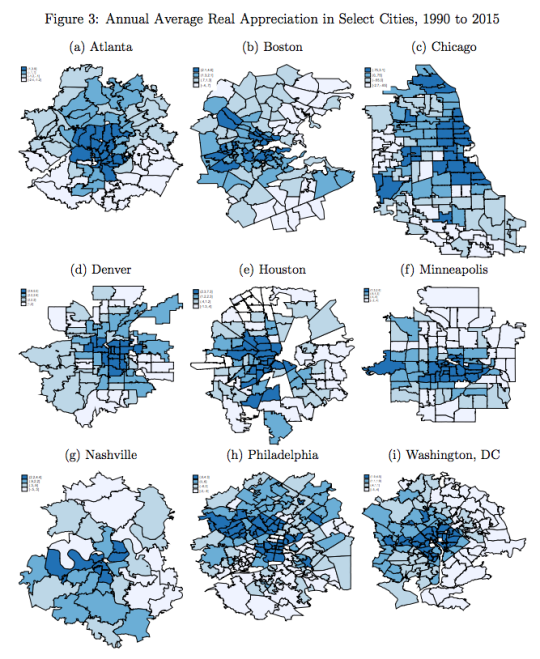
    The Federal Housing Finance Agency recently published a working paper where they looked at within-city house price gradients for a selection of US cities over a 40 year period. The goal of the study was to address what they call a “persistent blind spot” in local house price measurements.

    Here is their diagram showing annual average real appreciation from 1990 to 2015 for 9 US cities: 

    The darker areas indicate more appreciation. They are generally clustered around each city’s CBD.

    And here is an excerpt from the paper’s conclusion:

    “In an area with a highly elastic housing supply, a permanent housing demand shock is first capitalized into prices, but over time as quantities adjust, prices return to pre-shock levels (see Glaeser, Gyourko, Morales,
    and Nathanson, 2014). In contrast, near the CBD, where buildable sites are less available and regulation is presumably more onerous, a permanent demand shock can outpace supply responses, leading to permanent price increases.

    What stood out for me was this last sentence. It’s a reminder of the perfect storm that many cities now find themselves in.

    When everyone wanted to live in the suburbs, it was fairly easy to just build more homes. Supply was relatively elastic. And this kept prices in check.

    However, the same is not true for city centers. Supply is relatively inelastic, meaning it’s much harder to build more homes when demand increases. And demand has been increasing.

    So what we have today is a situation where many central cities are operating with basically a perpetual supply deficit. Hence the the comment about “permanent price increases.”

    I don’t want to oversimplify the situation, the potential solutions, and/or the well-documented mistakes, but there was arguably a middle class price benefit to mass produced sprawl.

    What should we be doing today to address housing affordability concerns?

  • Lessons on the transforming city

    image

    Last week, Detroit hosted the 24th annual Congress for the New Urbanism. The theme was: The Transforming City. 

    I wasn’t there, but I would have loved to attend. So many interesting things going on, but so little time. Attention is scarce.

    For those of you who also did not attend, below is a copy of a speech that was delivered by Carol Coletta – senior fellow at the Kresge Foundation’s American Cities Practice. I found it on City Observatory

    The speech does a great job of addressing many of the common misconceptions that people have about cities. I can tell you that I heard many of them just this past weekend.

    Also, if you aren’t familiar with The Kresge Foundation, they are a large private philanthropic foundation based in Troy, just outside of Detroit. You might not recognize the name, but Kresge is the K in Kmart.

    And now Carol Coletta…

    ———————————————————

    Could there be a more apt place to observe “The Transforming City” than Detroit?

    On behalf of Rip Rapson and my colleagues at the Kresge Foundation, welcome to Detroit. If you travel to Detroit regularly, as I have over the past 15 years, you see that Detroit changes quickly.

    The speed of change here sometimes takes your breath away.

    How many of you have walked the Detroit Riverfront or ridden the Dequindre Cut?

    Visited the expanding Eastern Market?

    Seen the Q Line construction on Woodward?

    Eaten a meal at Selden Standard or Wright & Company, one of those meals so special that it deserves its own social media channel?

    Walked the streets of downtown or Midtown and discovered Great Lakes Coffee, City Bird, or the El-Moore Lodge?

    Or met Claire Nelson at the Urban Consulate, or any one of Detroit’s arts and civic innovators responsible for some of the most exciting urban work in the country?

    This is the Detroit you can see right outside this theatre.

    But there is another Detroit, one that is harder to see. It’s the Detroit that feels threatened by the pace of change in the city, suspicious of newcomers eager to be part of the change, and wondering when their loyalty to Detroit will be rewarded.

    Such feelings are not unique to Detroit. Every morning my Google Alerts brings a new batch of headlines from around the country detailing the gentrification battles.

    Because “new urbanism” is the butt of some of this criticism, I want to spend the next few minutes unpacking the myths and the realities of gentrification and what those of us who care about great places can do about it.

    First, let me share some numbers.

    In 1970, about eleven hundred urban Census tracts were classified as high poverty.

    By 2010—40 years later—the number of high poverty Census tracts in urban America had increased from 1100 to more than 3,000. (3165)

    The number of people living in those high poverty Census tracts had increased from 5 million to almost 11 million. And the number of poor people in high poverty Census tracts had increased from 2 million to more than 4 million.

    So over a 40-year period, the number of high poverty Census tracts in America’s core cities had tripled, their population had doubled, and the number of poor people in those neighborhoods had doubled.

    Given that record, I’ll bet a lot of people are hoping for a little gentrification– if gentrification means new investment, new housing, new shops without displacement.

    The idea that places might benefit from gentrification runs against the popular narrative. But here’s the really startling fact: only 105 of the eleven hundred Census tracts that were high poverty in 1970 had rebounded to below poverty status by 2010. That’s only ten percent! Over 40 years!

    A similar study of Philadelphia by Pew found almost exactly the same result in that city’s neighborhoods. There, ten times as many poor neighborhoods (164) experienced real declines in income as experienced gentrification since 2000.

    It is the lack of gentrification that we rarely count and never see. The deterioration happens too slowly for us to notice. But it doesn’t mean the deterioration isn’t devastating. In fact, the high poverty neighborhoods of 1970 lost 40 percent of their population in 40 years.

    You could make the case that poor people are displaced from poor neighborhoods because of their poor schools, their lack of jobs, their more chaotic public spaces, their lack of opportunity.

    Understand, this is not the fault of the people who live there. This is a public policy failure.

    But… when a combination of government intervention, philanthropic support, community development, and market forces combine to change a place as quickly as Detroit—even when that change means new residents, new jobs, and new places to live—it also rightfully generates concern.

    See, we are conflicted about change. Many of us wish we could fix place in time.

    But neighborhoods do change. You know that. You change them. And when change results in mixed income neighborhoods—in other words, when we achieve investment without displacement — it’s good for everybody.

    The research on this is quite clear: The ability of people to improve their economic status from one generation to the next is strongly correlated with mixed-income neighborhoods.

    Many of the public policy interventions to achieve economically integrated neighborhoods have supported poor people moving to wealthier neighborhoods. But that is an expensive, slow political slog that is hard to scale.

    But what if we flipped that script? What if… we could lure people with financial options about where they live to disinvested neighborhoods—resulting in the kinds of places that enable opportunity?

    And what if we also made a special effort to insure that the people remaining in low-income neighborhoods—people without options about where they live—what if an extra effort were made to insure they benefited from new people and new investment in their neighborhoods?

    The research tells us that mixed-income neighborhoods benefit poor people naturally. But can we double down to accelerate those benefits?

    Think of it this way: Can we get gentrification with broadly-shared benefits.

    I think so. But it’s not easy. Remember: Only 10 percent of high poverty neighborhoods “gentrified” over the past 40 years. And today we have triple the number of high poverty neighborhoods than we had 40 years ago.

    Clearly, mixed income neighborhoods won’t happen if we don’t work at it.

    So how can we do that?

    First, let’s acknowledge that, for the first time in 50 years, the market is moving in our favor. People (and jobs) are moving to cities. We need to see that as the opportunity it is to get mixed-income neighborhoods and not fear good, thoughtful development.

    That means we can’t let NIMBYs win the day. The same people who complain about high prices also complain when developers show up to build more supply. We have to make the connection between supply and demand for the protesters and the press.

    But attention must be paid to creating more mixed income housing. Our success on this has been mixed, and I’m struck by the comparison on methods used in NYC and in Portland, Oregon’s Pearl District to create more affordable housing in mixed income settings.

    As City Observatory reported today, The City of New York, one of the nation’s hottest housing markets, has had inclusionary zoning for the past 10 years. And over that time, the city has produced an average of 280 units per year for a total of 2800 units.

    In contrast, Portland took a very different approach. Portland used additional property tax revenue from construction in one neighborhood to subsidize affordable housing. Using just a third of such revenues from The Pearl District (along with Low Income Housing Tax Credits), Portland has built more than 2300 units of affordable housing—almost as many units as the much larger New York.

    Portland’s Pearl District is an example of a desirable neighborhood. The cost of desirable neighborhoods goes up. And it is the fear of rising costs, new investment, (and sometimes a changing demographics) that spawned the “just green enough” movement.

    Think about that: Disinvested neighborhoods lack access to parks and quality public space. But wait! Let’s not make it too nice for fear it will attract new investment. That’s craziness born out of legitimate frustration when prices start going up.

    The fact that buyers and renters are willing to pay more for quality neighborhoods means we need to build more of them, not fewer of them.

    How do we do that at scale?

    When Paul Krugman or—the American electorate willing—the next president calls for new investments in infrastructure to stimulate the economy, will we be ready with a plan that defines infrastructure as something more than roads and bridges?

    Why can’t “infrastructure” include new and redesigned parks and libraries, neighborhood community and cultural centers, trails and gardens—a reimagined civic commons? That’s the defining line I want to hear from our next president. I want so many desirable neighborhoods that people will have good choices at all price points.

    The way we live today is changing so fast. We are decoupling and recoupling. We have mothers raising kids alone, and people delaying childbearing—some forever—who want to help. We are sharing jobs, cars and homes. We are retiring later and living longer. And our lives, increasingly, are lived in public.

    We need to ready our cities for these changes. We need to figure out how to revalue what exists and give new life to the material, the buildings, the neighborhoods, the cities and the people we too often discard and write off.

    Equity does not sit in opposition to a thriving, appealing city. It is central to it.

    This is the work of CNU. This is your work. And that’s why I’m happy to be with you here in Detroit to celebrate and learn alongside you this week. Thank you for inviting me.

  • Lisbon creates 24-hour district

    About a year ago I wrote a post called, Lisbon is the new Berlin. The timing of the post happened to coincide with Monocle’s first ever Quality of Life Conference, which was held in the city.

    Since then, I’ve been keeping an eye out for all things Lisbon and the city has quickly jumped to the top of my list of places I want to visit. I am obsessed with understanding the triggers that catalyze change within a community and/or city.

    On a related note, Lisbon has recently put in place new regulations to control nightlife in the city. Bars in certain areas must now close at 2am on the weekdays and 3am on the weekends. Outdoor patios must close at midnight. If you have the right kind of soundproofing though, your bar can remain open until 4am. The impetus for these changes was to address nightlife noise complaints – a perennial problem in many cities.

    However, Lisbon has also created a 24-hour district along a supposedly underdeveloped area of the waterfront. This means that bars and clubs in this area will have the option of staying open 24/7. At the same time though, investments are being made (Portuguese article) to transform the area into something more than just a place for drinking and dancing.

    I am noticing a real trend in European cities around using nightlife as a strategic lever to attract talent and revitalize neighborhoods. Oftentimes the knee jerk reaction is to simply focus on the negative externalities associated with nightlife. But there are strategic benefits. Many cities today recognize that.

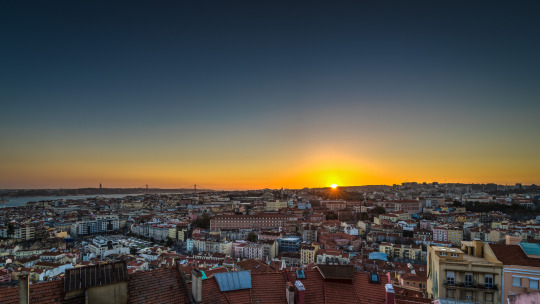
    Image: Mhx on Flickr

  • Coffee shops vs. fried chicken

    When it comes to a real estate market, there are always the typical metrics: sale prices, rents, vacancy and so on. But I’m always interested when somebody looks at the market in a different way and comes up with other kinds of metrics.

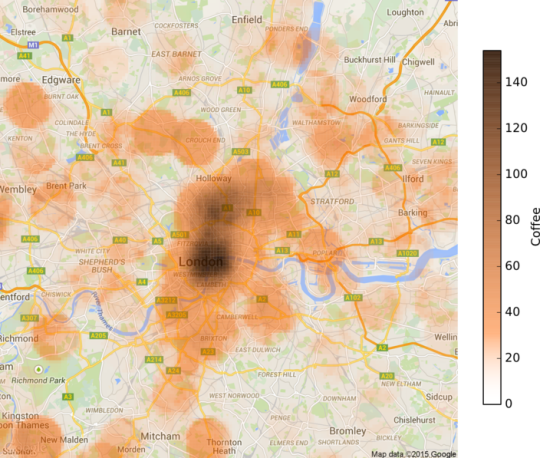
    That’s why I was intrigued when I stumbled upon this post by Sam Floy, where he looks at the concentration of coffee shops and friend chicken shops across London in order to determine which neighborhoods are in fact “up and coming.”

    To give you a taste, here’s his coffee shop map:

    His thinking was that if a neighborhood had a high density of coffee shops, a low density of fried chicken shops, and relatively low house prices, then it could probably be thought of as up and coming. 

    Coffee shops are often considered to be leading indicators of urban change (i.e. gentrification), and, well, friend chicken places I guess speak to a different kind of neighborhood.

    These sorts of playful studies aren’t going to tell you exactly which numbers you should be plugging into your development pro forma. But I think unconventional analyses can sometimes tell you a bit more of the story behind the numbers.

  • How should cities manage their own awesomeness?

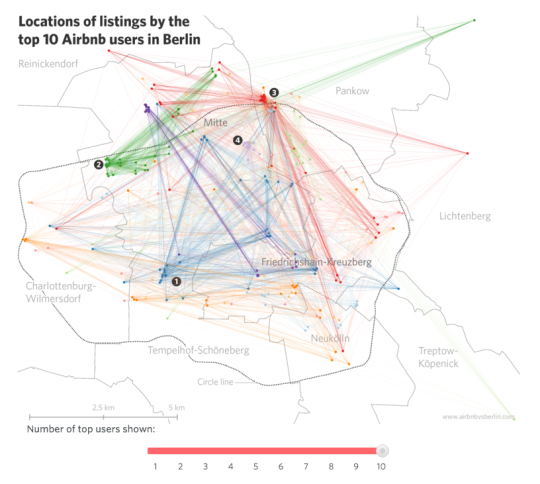
    Conor Maguire introduced me to an interesting site today called Airbnb vs. Berlin. The site does a deep dive into Berlin’s Airbnb market with the hope of answering the question: Is Airbnb contributing to a shortage in affordable housing?

    The site is very well done. It’s filled with lots of great market stats and diagrams such as this one here: 

    Of course, the impetus for a site like this is that cities all around the world, from San Francisco to Berlin, are grappling with rising home prices. If you happen to live in a successful, growing city, that’s probably what is happening.

    But when this happens, we seem to want to look for something or someone to blame. In San Francisco it’s the tech workers. They’re the ones driving up homes prices. In Vancouver, it’s the foreign Chinese buyers. And in Berlin, it’s those Airbnb users who are just out to make a profit. In all of these cases, we like to tell ourselves that if we could just get rid of “X”, everything would be much better. 

    But I think sometimes we forget that this is also the result of doing many things right.

    If Berlin wasn’t a brilliantly cool place to visit, then tourists wouldn’t come. And if tourists didn’t come, then Berlin wouldn’t have, by far, the largest Airbnb market in Germany. If Vancouver wasn’t one of the most enjoyable places in the world to live, you wouldn’t have the same attention from overseas buyers looking to snatch up properties. 

    So in a way, we should be asking ourselves: How do we, as a city, manage our own awesomeness?

    The other thing that Airbnb vs. Berlin reminded me of is the viewpoint that profits are some dirty little secret. I hear it all the time in the real estate development business. People will say: “That developer is just out to make money.” Of course she/he is! They operate a business. And like all for-profit businesses, one of the objectives – it may not be the only one – is to make money.

    I say all this not as a direct response to the website. They remained fairly neutral in their analysis. Instead, I raise it as an alternate viewpoint in the seemingly universal battle against “X.”

    In case you’re wondering about Berlin’s Airbnb market, the site estimates that there are roughly 11,701 Airbnb listings in the city out of a total of about 1.9 million flats. Of these listings, it is estimated that somewhere around 30% are by “professional users” who are only out to make a profit and are not participating in the “sharing economy” in its purest sense. That equates to about 0.18% of all Berlin flats.

    Based on this number, I’d say that Berlin’s cool factor probably has a lot more to do with the city’s rising rents than do the profit seeking Airbnb users.