Daily insights for city builders, delivered every morning at 6 AM ET. I’m Brandon Donnelly — a Toronto-based real estate developer and founder of Globizen. I’ve been writing here since 2013.

Tag: entrepreneurship

  • The advantages of disadvantages in business and entrepreneurship

    This morning I stumbled upon an interesting book by Claudia Kalb called Andy Warhol Was a Hoarder: Inside the Minds of History’s Great Personalities

    I obviously haven’t read it yet, but I like the premise. The book examines 12 famous figures and makes the argument that each of them had some sort of mental health condition that aided them in their success. 

    Here is an excerpt from a recent Harvard Business Review interview with the author:

    “The most common one may be narcissism. Frank Lloyd Wright is a good example. He had classic narcissistic qualities — a sense of grandiosity, superiority, a huge and complete belief in his aesthetic sensibility, and disregard for architecture that did not live up to his standard. Narcissists also have an ability to be charming, and to lure people into their orbit. That’s obviously useful for an entrepreneur. The issue is that while these qualities may make you a good leader, they may not make you a winning boss. Employees often feel that narcissistic bosses are ruthless or lacking in empathy. Also, unlike people with depression or anxiety disorders, narcissists don’t suffer as much personally from their condition — but the way they behave can be much harder on the people around them.”

    Related to this topic is an emergent body of research that, more specifically, looks at the relationship between mental illness and entrepreneurship. And according to work done by professor Michael A. Freeman of UC-San Francisco and professor Sheri Johnson of Berkeley, there’s a significant relationship. 

    Below are two excerpts from a Washington Post article published last year.

    “Forty-nine percent of entrepreneurs surveyed reported at least one mental health condition. Nearly a third reported having two or more mental health issues, such as ADHD, bipolar disorder, depression, anxiety or substance use conditions. And half of the entrepreneurs who reported no mental-health conditions identified themselves as coming from families with a history of mental illness.”

    Why would these conditions be of any benefit to entrepreneurs?

    “For all of its ills, depression also brings empathy and creativity. Martin Luther King Jr. and Mahatma Gandhi attempted suicide as teenagers. Uncommon levels of empathy can allow a businessman to better understand a customer’s need. And a creative mind won’t be satisfied on the corporate ladder, but instead in a fast-moving start-up where he or she can unfurl ideas and dreams.

    Individuals with ADHD naturally make decisions faster, are comfortable working independently and are more creative, necessary skills at a start-up. They’re likely to be bored working for someone else.”

    From a city building standpoint, all of this is quite relevant. Because for all of the focus on promoting innovation and entrepreneurship, we don’t seem to be talking about healthcare and mental health systems. And there’s clearly an argument to be made that the two are connected.

  • Top 20 cities for venture capital investment

    The Martin Prosperity Institute here in Toronto recently published a new report that looks at worldwide venture capital investment by city. The report is called Rise of the Global Startup City.

    The data is from 2012, because that’s what was available from Thomson Reuters, so keep in mind that there might be some variation in the rankings if we were to look at more recent data. Some of the cities sit fairly close.

    Nonetheless, here are a few of the broader takeaways (from the report page):

    “The United States accounts for nearly 70 percent (68.6 percent) of total global venture capital, followed by Asia (14.4 percent) and Europe (13.5 percent).”

    “Just two broad regions — the San Francisco Bay Area and the Boston-New York-Washington Corridor — account for more than 40 percent of global venture investment.”

    “Global venture investment is highly uneven and spiky — it is concentrated in a small number of large cities and metros around the world.”

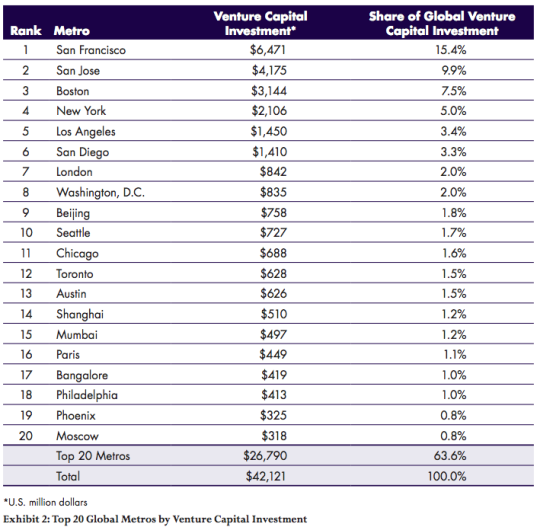
    Here are the top 20 cities by total venture capital investment (in USD millions):

    image

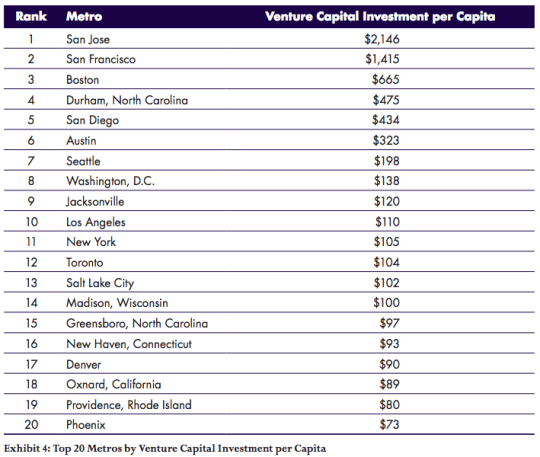
    And here are the top 20 cities according to venture capital investment per capita:

    image

    Given the variation in these two lists, you realize that some cities are largely benefitting from sheer size. London, for example, drops off the list when you look at venture capital investment per capita. 

    In fact, in this second list, 19 of the 20 cities are in the United States. The only non-American city that remains is Toronto.

  • Why Google is worried about being welcoming to employees who want to build new businesses

    Here on ATC, we’ve talked a lot about the changing nature of work and what that could mean for cities. 

    We talk (and debate) about the value of density and of being in close proximity to others so that ideas can percolate – whether that means open office floor plans or community coffee shops.

    But alongside all of this, there are some fascinating structural changes taking place within organizations. Below is an excerpt from a recent New York Times article called, How Larry Page’s Obsessions Became Google’s Business

    But corporate success means corporate sprawl, and recently Google has seen a number of engineers and others leave for younger rivals like Facebook and start-ups like Uber. Mr. Page has made personal appeals to some of them, and, at least in a few recent cases, has said he is worried that the company has become a difficult place for entrepreneurs, according to people who have met with him.

    Part of Mr. Page’s pitch included emphasizing how dedicated he was to “moonshots” like interplanetary travel, or offering employees time and money to pursue new projects of their own. By breaking Google into Alphabet, Mr. Page is hoping to make it a more welcoming home for employees to build new businesses, as well as for potential acquisition targets.

    What I find interesting about the statements I’ve bolded is that they represent a radically different approach to business and employment. Of course, it’s not really a new thing. Google has been encouraging its employees to work on personal projects since, I think, the very beginning. 

    But as you read the above article, you really get the sense that Page believes that this kind of organizational culture is fundamental to the long term competitiveness of the company. It’s something he is genuinely worried about.

    As counter intuitive as it might seem to encourage employees to work on other things besides the core business, one could argue that it’s almost essential in a world of rapid and constant innovation. Would you rather an employee or a competitor discover what’s next in your industry? If it’s the former, you have a chance of absorbing it into your current business. If it’s the latter, you’re already too late.

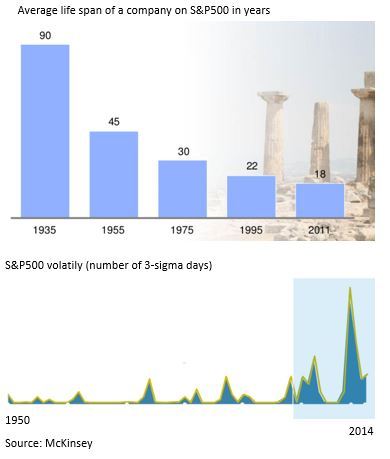
    If you go back to the article I posted earlier this week, you’ll see that creative destruction is happening a lot faster than it did in the past. The average life span of many, or most, companies seems to be decreasing.

    The tech sector seems to be ahead of most other industries with respect to this kind of thinking. But I believe that it will continue to percolate through the economy. And when it does, it will probably have many impacts on the kinds of spaces we design and build in our cities.

  • The value of absurdity for innovation (and a story about tacos)

    Vegan tacos by Karolina Wiercigroch on 500px.com

    https://500px.com/embed.js

    “Great ideas alter the power balance in relationships. That’s why great ideas are initially resisted.” –Hugh Macleod

    I have been following the work and writing of designer Tobias van Scheider for quite some time now. If you don’t subscribe to his newsletter and you end up liking this post, you should consider signing up.

    Recently I stumbled upon something he published back in October called “Ignore Everybody”, where he argues that when you’re exploring something new – that could potentially fail – one of the best things you can do is ignore everybody. 

    And that’s because:

    “We have to understand that ideas are by nature very fragile. They’re like little naked babies, unable to protect themselves. If we really believe in a new idea, we have to protect her with great effort. This is difficult, because oftentimes the greatest ideas get killed by the people around us. Executing on a great idea is by nature a lonely path. If everyone would agree with you, the idea is probably not that great anyway.”

    I am incredibly interested in how new things get started and how new ideas thrive. Fostering innovation has become a critical component of city building in today’s world. But sometimes I feel as if we’re thinking too top-down, as opposed to bottom-up. 

    As Tobias rightly points out in his article, lots of great ideas started as stupid little projects. Who would have thought that a teen sexting app with disappearing messages (Snapchat) would become a company worth many billions of dollars?

    It’s for this same reason that Sam Altman of Y Combinator recently wrote that sometimes its better to call your new company a project, rather than a business. When you call it a business you impose all kinds of biases onto it in terms of viable business models, and so on. But when you keep it a “project”, it becomes more acceptable to be experimental.

    As an example of all this, I was fascinated to learn this past weekend about a Toronto-based ad agency called OneMethod. Because as part of their agency they have a division called the MethLab, where the goal is to simply experiment with “absurd ideas.”

    One of those absurd ideas was a social media campaign slash pop-up taco restaurant – remember, they are an ad agency not restauranteurs. It was so grassroots that they ended up having to sell original art work that happened to come with a “free” taco in order to get around all the legal requirements for serving food. Brilliant.

    The idea was so well received that it has grown into a fully fledged restaurant called La Carnita, which today operates across 3 permanent locations and happens to be one of the most popular taco restaurants in Toronto.

    But let me ask you this, if they had instead gone out to investors – as an ad agency wanting to get into the taco business – would they have been able to raise the money for their first physical restaurant? I can imagine this being a lot more difficult.

    On a larger scale, this is exactly what Google is doing with Alphabet. The company was reorganized and rebranded so that they could continue to work on absurd ideas outside of the Google cash cow. If the idea/project takes off, then it becomes a fully fledged company. If it doesn’t, then it gets shut down and something else is tried.

    This is what people and companies are doing today to stay relevant in the innovation race. 

    But in some ways it feels like a battle to allow the absurd to survive. That’s why the best approach might be to just ignore everybody. There’s value in the absurd but maybe you’re the only one who sees it right now.

  • The Entrepreneurs, Barcelona

    Last week Monocle published their latest edition of “The Entrepreneurs” series. In this episode they look at Barcelona and a handful of entrepreneurs that are helping to grow the city. The video is only about 7 minutes long.

    I enjoy Monocle’s short films and I’ve always been impressed by Barcelona as a city. So here’s the video:

    [youtube https://www.youtube.com/watch?v=Q1wLBjlecac?rel=0&w=560&h=315]

  • Enabling innovation by lowering the barriers to entry

    Yesterday afternoon Sam Altman of Y Combinator published a blog post talking about a new YC Fellowship program for even earlier stage companies. 

    For those of you who aren’t familiar with Y Combinator, they are a super successful funding platform for early stage startups. They are located in Mountain View, California.

    What’s unique about their approach is that they invest a relatively small amount of money ($120,000 for 7% of your company) in a relatively large number of companies. Their most recent cohort was around 85 companies and they do that twice a year.

    The rationale behind this approach is that it can be incredibly hard to predict which people and ideas will produce the next great company. Oftentimes the best ideas appear really shitty at first. (Here’s a post by one of the cofounders of Airbnb talking about the company’s early rejections.)

    So instead of putting all of their eggs in one basket, YC invests smaller amounts in more companies.

    But beyond this being beneficial to them, it’s also a model that I think helps to reduce the barriers to people starting a company. It gives more people the chance to prove that their company has the potential to be something great. 

    And that’s precisely what makes this new YC Fellow program/experiment so interesting to me.

    Instead of $120,000, YC fellows will receive $12,000 and they won’t have to move to the Bay Area (although it’ll be encouraged). They’ll still get mentorship and advice like the regular YC program, but it’ll be a kind of light version. 

    Though this is almost certainly just the beginning. Here’s how Sam ended his announcement post:

    “Someday if it works, we’d love to fund 1,000 companies per year like this.”

    Now all of a sudden that’s some scale.

    What’s exciting about this is that I believe our cities have the potential to be far more innovative than they are today. Every city is trying to be the next Silicon Valley, but every city is not the next Silicon Valley.

    I saw a great tweet the other day that went something like this (I wish I could remember who the author was):

    “Entrepreneurs aren’t risk takers. They’re just rich kids with big safety nets.”

    It’s a bit of a tongue-in-cheek generalization. But to unlock the full potential of our cities, we should be figuring out how to get everyone participating and building their ideas, not just those with a head start. 

    I think there are a lot of people around the world who could be doing great things, but they just haven’t been able to take that first step for one reason or another.

    Hopefully organizations like Y Combinator will be able to help them take it.

  • Formula for life

    https://500px.com/embed.js

    Earlier this week I somehow stumbled on an old (2012) Medium story by Ev Williams, called, Formula for Entrepreneurial Success. (Ev is the cofounder of Medium, Twitter, and Blogger. He basically invented blogging.)

    His post includes 5 short recommendations, and is obviously aimed at entrepreneurs, but I think the lessons also apply more broadly to life in general. They resonated with me, so I thought they might also resonate with you.

    So whether you’re starting a company, developing a new building, or just living life, here are Ev’s 5 points:

    1. Work with amazing people. Don’t compromise on who you choose to found your company with and hire. Do not put up with ego-centric personalities or downer attitudes.

    2. Take on big challenges. It’s pretty simple: Hard things are valuable; easy things are not so valuable. Reaching the mountaintop is rewarding because it is hard. If it was easy, everybody would do it.

    3. Focus. Say no to most things: Features. People. Partnerships. “Coffees.” Projects. Only a few of them really matter. (Yes, it’s hard to know which.) Don’t get distracted.

    4. Take care of yourself. When you don’t sleep, eat crap, don’t exercise, and are living off adrenaline for too long, your performance suffers. Your decisions suffer. Your company suffers.

    5. Love those close to you. Failure of your company is not failure in life. Failure in your relationships is.

    If I had to pick one of the items from this list, I’d say I struggle the most with focus. It’s not that I can’t focus and complete tasks, it’s that I’m the kind of person who wants to fill every second of the day with something meaningful. And when people email me wanting to go for coffee or help with something, I want to do it.

    But unfortunately, time is a hugely valuable commodity and you have to be selective.

    So surround yourself with amazing people. Don’t be afraid of big challenges and risks. Focus. Eat well and lift weights (my preference). And love the important people in your life.

  • An interview with Archipreneur magazine

    I was recently interviewed by a Berlin-based online magazine called Archipreneur. You can read that interview by clicking here.

    If you haven’t yet heard of Archipreneur, you should definitely check it out. It’s a great read. The magazine is dedicated to the intersection of architecture and entrepreneurship. They cover a lot of the same topics that I cover here on Architect This City – such as design, real estate development, technology, and so on. But they are generally more focused on architects (or people trained as architects, in my case) who are doing interesting things other than traditional practice.

    In my case, it’s real estate development and this blog. Check out the interview here.

  • Bloomberg Risk Takers: Elon Musk

    Elon Musk is one hell of an entrepreneur. I just finished watching this “Bloomberg Risk Takers” video. 

    [youtube https://www.youtube.com/watch?v=mh45igK4Esw?rel=0&w=560&h=315]

    It’s about 45 minutes long, but well worth it. What’s astounding is both is willingness to go all-in and his commitment to solving big, meaningful problems. Click here if you can’t see the video above.

    Once you’re done watching, you should then read this Quora answer from his first wife talking about what it takes to be that great.

  • Lisbon is the new Berlin

    Photograph Tramway à Lisbonne by yannick le goff on 500px

    Tramway à Lisbonne by yannick le goff on 500px

    This morning I stumbled upon a blog post by a Berlin-based venture capitalist (Ciarán O’Leary) talking about how Lisbon feels like the next Berlin. In other words, it feels like the next great European startup hub.

    Here’s his reasoning:

    • The tech scene is organic – it happened on its own, came out of nowhere. That is much more fun and sustainable than any kind of political or targeted economic strategy.
    • There are a ton of constraints (funding, local talent base, etc.) so entrepreneurs need to hustle to make things happen. Hustle is good.
    • Berlin was an economic void, Portugal had a massive economic crisis and Lisbon sure isn’t letting that crisis go to waste.
    • Entrepreneurship has the real chance to be a center stage act, not a side gig. It’s everywhere.
    • The city is very, very cool. You just want to be here.
    • You can have a great life on a startup salary.
    • Everyone speaks english; everyone is welcoming and open. That matters a lot when you want to attract international talent and funding.

    Of course, he’s not the only one calling Lisbon the next Berlin. The EU also named Lisbon “the most entrepreneurial region in Europe in 2015.” Isn’t it interesting what can grow out of economic crisis? See PIGS.

    I also don’t think it’s a coincidence that Monocle held its first ever Quality of Life Conference in Lisbon. It’s a testament to O’Leary’s point above that, “You just want to be here.”

    And while being “very, very cool” may not seem immediately relevant to creating a robust startup environment, it really is. It may be the most important point. It makes the city a magnet for talent. 

    Just the other day I was trying to explain Berlin to someone and I used a similar lexicon. I said: “It’s an unbelievably cool city. It bleeds hipness. You will love it.”

    If you’re a city, that’s a great thing to be.