Daily insights for city builders, delivered every morning at 6 AM ET. I’m Brandon Donnelly — a Toronto-based real estate developer and founder of Globizen. I’ve been writing here since 2013.

Tag: entrepreneurship

  • The cost of failure

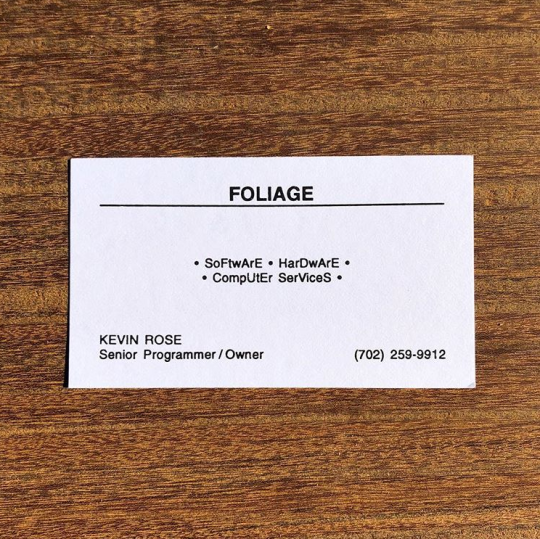
    Kevin Rose is an internet entrepreneur. He has built a number of consumer products, including Digg in 2004. Previously he was a venture capitalist with Google Ventures, but now he’s doing that with True Ventures. He also hosts a podcast.

    This past weekend he posted the following photo to his Instagram:

    image

    Here’s the story. 

    After begging his mom to take him to the printers, he got this business card made when he was 13 years old. Foliage Software wasn’t a real company, of course. But it had business cards and he was not only a Programmer and the Owner, but a Senior Programmer and the Owner.

    I laughed as soon as I saw this post because it is exactly the sort of thing that the 13 year old version of me would have done and probably did. (The combination of upper and lower case letters on the card also helped with the humor.) I’m sure if I dug around my mother’s house I would find a trail of my failed business schemes and project ideas.

    But that’s entirely the point he is trying to make. Try. Fail. Learn. Refine. All of these actions will increase your odds of success at the next go around. Nobody will remember the failures anyways.

    Seth Godin perhaps said it best with: “The tiny cost of failure is dwarfed by the huge cost of not trying.”

  • How to act like an entrepreneur

    I really like the post that Seth Godin wrote on his blog today called: The four elements of entrepreneurship.

    He defines entrepreneurs through their actions and behaviors. In his view, this is what they do:

    1. They make decisions.

    2. They invest in activities and assets that aren’t a sure thing.

    3. They persuade others to support a mission with a non-guaranteed outcome.

    4. This one is the most amorphous, the most difficult to pin down and thus the juiciest: They embrace (instead of run from) the work of doing things that might not work.

    As far as I can tell, that’s it. Everything else you can hire.

    He then goes on to say:

    All four of these elements are unnatural to most folks. Particularly if you were good at school, you’re not good at this. No right answers, no multiple choice, no findable bounds.

    Perhaps this is why many VCs seem to favor young founders. They’re not old enough to think they know what will work and what will not work.

  • Empowering food truck entrepreneurs

    When I lived in Philadelphia I survived on food truck food. My go-tos were an egg and cheese breakfast sandwich for $2.50, a bowl of spaghetti for $4.50, and a pretty substantial chicken burrito for somewhere around $5 or $6. The food was good. It was filling. And it was all priced perfectly for a poor student, which I was at the time.

    I still remember when Renzo Piano came to the University to talk about potentially renovating the design school. Somebody stood up and asked if he had considered the placement of food trucks in his plans. Piano responded by saying: “I am Italian. Don’t worry. I will provide for the food.” This is how ingrained food trucks were and are in the culture of the city.

    The other great thing about these food trucks is that they are a low-cost way of starting your own culinary business. Many were run by immigrants. And some of these “trucks” were so small that I used to have to duck in order to make my way to the concession window. There was nothing fancy about them. But they worked.

    These days I don’t really eat at food trucks anymore. They are not as widespread here in Toronto as they are in Philly. I also find them expensive and the portions are usually so small that you have to order 2 or 3 things. They feel like the anti-food truck.

    I appreciate that there’s a growing market for trendy and “gourmet.” But there’s value in low-cost options and in lowering the barriers to entry for aspiring food entrepreneurs. There are numerous examples of humble food trucks growing into full fledged restaurants. Let’s encourage more of that.

  • Contentment as vice

    “Contentment used to be a virtue. Now it’s a vice.”

    I came across this line on Brad Feld’s blog

    For those of you who aren’t familiar with Brad, he is a successful entrepreneur and early stage VC investor. He cofounded the Foundry Group, Mobius Venture Capital, Intensity Ventures and Techstars, and sold his first company back in 1993. 

    But Brad has also struggled with depression over the years and so you’ll find that a number of his blog posts are also quite contemplative.

    This particular post – where the above line comes from – is about a societal norm that I am sure many of you can relate to. I know I can. Here’s another snippet from the post:

    “We talked for a few minutes about the overall, dominant American culture of achievement. The endless striving. The need to feel busy, important, and successful. The deep cultural norms around ambition.”

    Whether it’s because we’re all deeply insecure or because we just need to fulfill our egos, this has become our modus operandi. It has become all about “the hustle” and about “crushing it 24/7.”

    Just this evening I was at a friend’s birthday party and I couldn’t tell you how many times I said “busy.”

    “Hey Brandon, how are things?”

    “Busy!”

    This is an absolutely terrible response. I know that. And I’ve started introducing other responses into my small talk repertoire. But busy is so ingrained in our culture. Being busy makes us feel important. It means we are in demand. We do things. We create value.

    But is the reverse – not being busy – now a vice?

    Regardless of your position on the appropriate balance between contentment (being ok with what you’ve got) and work (striving for more than what you’ve got), I think the first line of this post is an incredibly poignant commentary on the life that many of us live today.

  • We are all biased against creativity

    image

    I would like to do a follow-up to yesterday’s post about innovators and creators, because I recently stumbled up the following quote:

    “We think of creative people in a heroic manner, and we celebrate them, but the thing we celebrate is the after-effect,” says Barry Staw, a researcher at the University of California–Berkeley business school who specializes in creativity.

    It is taken from a Slate article called: Inside the Box – People don’t actually like creativity. And it’s supported by a bunch of research, including a 2010 study conducted by professors at Cornell University, the University of Pennsylvania, and the University of North Carolina.

    The key finding was that people generally hold a bias against creativity, and it’s activated when we become motivated to reduce uncertainty. This might be because we fear rejection or because we’ve come to learn that reducing uncertainty and promoting the status quo is often better for career advancement. 

    There’s less perceived risk.

    But here’s the thing: celebrating creativity after the fact is meaningless. There’s no genius in that. Everyone now knows this truth. The heroics come into play when you’re both willing to be misunderstood and willing to be dead wrong.

    Of course, talk is cheap. 

    Here are 5 suggestions for promoting greater creativity at your company taken from Tom Tunguz’s blog, who himself is borrowing from Barry Staw (author quoted above):

    1. Hire people who’s skills aren’t precise matches for the needs of the company.
    2. Encourage employees not to listen blindly to corporate policy and conventional wisdom; not all to speak with the same voice.
    3. Those in power should go as far as possible to encourage active opposition to ideas. (Similar to Drucker’s obligation to dissent).
    4. Optimize for adaptiveness. Have extra labor capacity and explore side projects. (How many creative companies started or were reinvigorated by side projects? Twitter and Slack are two that immediately come to mind).
    5. Lead rather than follow. Take risks.

  • How I built this

    My friend Dan just introduced me to a terrific podcast called, How I Built This. It’s all about “innovators, entrepreneurs, and idealists, and the stories behind the movements they built.” As soon as he told me about it I immediately pulled out my phone and hit subscribe.

    You will recognize many of the brands and entrepreneurs featured on this podcast. The companies span everything from Whole Foods and the Corcoran Group (real estate) to Kate Spade and Instagram.

    I’m not that up on podcasts. I think it’s because I don’t really drive that often and I don’t have much of a commute. Podcasts are great when you’re sitting in traffic, which is something people here in LA obviously do a lot of.

    But I’m going to make time to listen to this one. I have so much respect for anyone who has built something from nothing. Building and creating is what moves us forward.

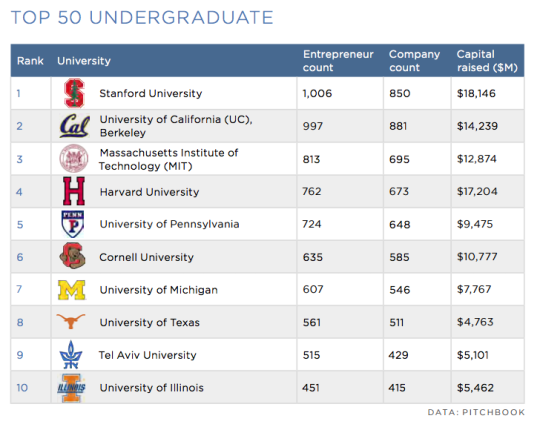
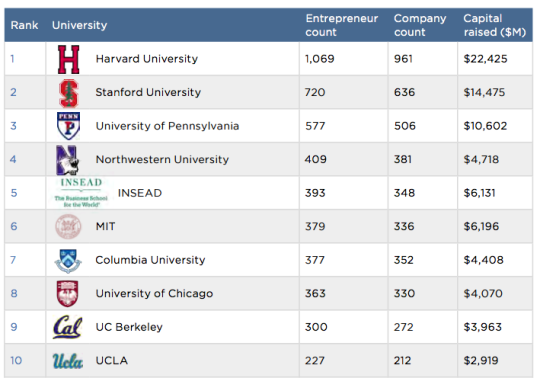
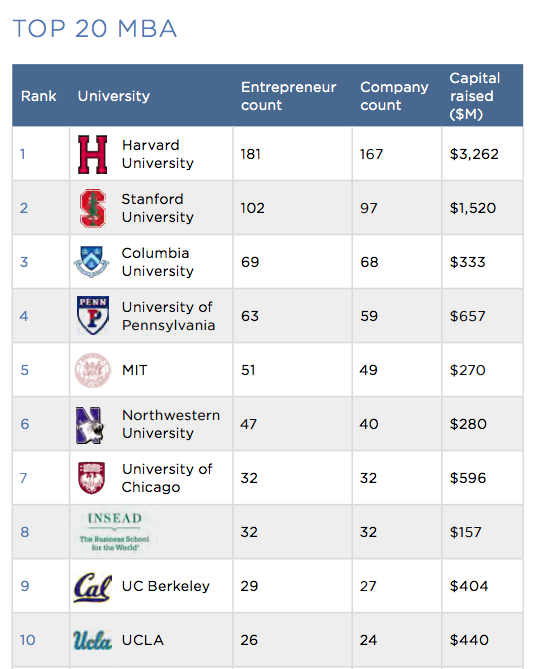
  • The universities that produce the most funded founders

    PitchBook recently published a report looking at which universities produce the most funded founders.

    What they did was track founders of companies that received a first round of venture funding between January 1, 2006 and August 15, 2016. They then looked at which school they graduated from and sliced the data to find companies valued over $1B (”unicorns”), big exits, Ivy vs. non-Ivy league alumni, and so on.

    The full report can be downloaded here for free. However, you’ll need to enter your email. Below are some of the key highlights.

    Top 10 MBA:

    Top 10 MBA by female founders:

    For all of you Canadian readers, the top undergraduate schools include:

    • University of Waterloo (#20)
    • McGill University (#32)
    • University of Toronto (#33)
    • University of British Columbia (#49)

    McGill does quite well in the unicorn department, placing in the top 10. However, it is clear that Canadian universities need to step up their game.

    Of course, the question remains: what is it that is holding us back? How much of it is the school itself and how much of it is external and perhaps cultural?

  • The institutionalization of development

    Jones Lang LaSalle recently asked: Is there still room for the buccaneer property developer?

    But in the contemporary world of real-estate – corporatized, institutionalized and massively capitalized – is there any longer room for the swashbuckling “merchant developers” or are they doomed to go the way of the wildly-gesticulating floor traders in colourful blazers that once symbolized financial markets?

    “There is always room for the entrepreneur,” says Richard Bloxam, JLL’s head of capital markets, Europe, the Middle East and Africa. “It is, however, fair to say that real estate has been on a journey away from total reliance on the entrepreneurial model.”

    I’ve written about the institutionalization of the business before. And it’s something I’ve been asking developers that I interview for my BARED blog series. Are the days of the eccentric and larger than life developer behind us?

    The consensus appears to be no. 

    All that has changed is the capital source / stack. The skills that make for a successful developer haven’t changed. You still need to be creative and look for opportunities that others don’t see. You still have to navigate through all of the various constraints – of which there is probably more of today. You still need to be entrepreneurial in spirit.

    What I wonder though is if this change hasn’t undemocratized the business to a certain extent. It seems to me that it’s harder, today, to fly by the seat of your pants with just an idea (and no capital). The barriers to entry feel more significant. But as Richard says, “there is always room for the entrepreneur.” And I believe that.

    I would be curious to hear your thoughts. 

    Also, the next BARED post will be up shortly. Stay tuned.

  • Rinse and repeat

    image

    Venture capitalist Matt Turck has a post up on his blog that is packed full of information about the New York City tech ecosystem. (He has also written similar posts about Berlin and Paris.)

    His overall thesis is that New York – as a startup/tech hub – is only now starting to catch up to the hype of 4 or 5 years ago. He now refers to NYC as the de facto Number 2 after the Bay Area.

    If you’re interested in all of this, you can go read his full post. But I would like to pull out 2 points. The first is about the “rinse and repeat” cycle that happens over time that allows cities to become substantive startup hubs:

    As any student of emerging tech ecosystems knows, the key dynamic to success is the “rinse and repeat” cycle. You need several waves of successful tech companies to go through the whole cycle of founding, financing, scaling and significant exit.   Post-exit, the hope is that successful founders, employees and investors then contribute back both money and expertise to the next generation of tech startups, a few of which eventually become highly successful themselves and then provide money and expertise to the following generation.

    The trouble is, each successive cycle takes years, because the average successful startup takes 5 to 10 years to get to a large exit.

    One key reason the Silicon Valley has become such a powerful network is that this “rinse and repeat” cycle has been happening there for decades, at least since the 1940s and 1950s (Hewlett Packard), with a real acceleration in the 1970s and 1980s (Apple IPO, founding of Kleiner Perkins, etc).

    I’ve written about this idea before, but didn’t refer to it as “rinse and repeat.” I’m thinking about adopting that terminology going forward.

    The second is a list of New York-based startups. Matt uses it as an example of how entrepreneurial activity in New York is operating across a broad cross-section of different industries. That’s an important characteristic to identify.

    However, I also thought you might find it valuable to see what startups are out there, particularly if you happen to work in one of the below verticals/horizontals. I certainly went right to the real estate line.

    Fintech: Betterment, IEX, Fundera, Bond, Orchard, Bread
    Health: Oscar, Flatiron Health, ZocDoc, Hometeam, Recombine, Celmatix, BioDigital, ZipDrug
    Education: General Assembly, Schoology, Knewton, Skillshare, Flatiron School, Codecademy
    Real estate: WeWork, HighTower, VTS, Compass, Common, Reonomy
    Enterprise SaaS: InVision, NewsCred, Sprinklr, Namely, JustWorks, Greenhouse, Percolate, Mark43, Movable Ink
    Commerce infrastructure: Bluecore, Custora, Welcome Commerce
    Marketplaces: Kickstarter, Vroom, 1stdibs
    On Demand: Handy, Via, Managed by Q, Hello Alfred
    Food: Blue Apron, Plated, Maple
    IoT/Hardware: littleBits, Canary, Peloton, Shapeways, SOLS, Estimote, Dash, GoTenna, Raden, Ringly, Augury, Drone Racing League
    AR/VR/3D: Sketchfab, Floored

    I was happy to see my friends at Floored in the above list. They are under AR/VR/3D, but they service the real estate industry.

  • The war on work

    Air Canada bumped me from my flight this morning and so I am spending the day hanging out at Toronto Pearson Airport. I can think of more enjoyable ways to spend Canada Day, but at least there’s a nice seating area in Terminal 1 with free wifi and lots of plugs.

    I just finished watching the below talk by Harvard economist Ed Glaeser at the Manhattan Institute. His overall thesis is that unemployment is a far worse problem than income stagnation and that the US needs to stop creating incentives for people not to work. He refers to it as a war on work.

    He addresses a few topics that we’ve talked about here on this blog, such as guaranteed basic incomes, as well as others that we haven’t talked about, such as raising the minimum wage. To give you one spoiler: He argues that a higher minimum wage has been shown to cause an overall drop in employment, which he, again, believes is a deeper problem.

    Glaeser delivers a passionate performance. So if you have 30 minutes to spare – perhaps you’re stuck in an airport somewhere – I recommend you give it a watch. If you can’t see the video below, click here.

    [youtube https://www.youtube.com/watch?v=8xaNV_6wgak?rel=0&w=560&h=315]