Daily insights for city builders, delivered every morning at 6 AM ET. I’m Brandon Donnelly — a Toronto-based real estate developer and founder of Globizen. I’ve been writing here since 2013.

Tag: entrepreneurship

  • Are we becoming more or less entrepreneurial?

    Aaron M. Renn of The Urbanophile, recently wrote an interesting article in Governing called, Where’s America’s Entrepreneurial Economy? In it, he argues that despite the fact that there’s a perception that entrepreneurship is on the rise, overall rates are actually declining.

    The Brookings Institution found that so-called “firm entry rates” have declined since the 1970s and that they suffered a steep fall post-2005. And though millennials are often seen as an entrepreneurial generation, The Wall Street Journal reports that business ownership among those under the age of 30 recently hit a 24-year low. Self-employment has seen a similar downward trend. A study by Economic Modeling Specialists International found that both the total number of self-employed and their share of jobs have fallen since 2006.

    His argument is that outside of tech — where yes, the barriers to entry have fallen significantly over the years — it has actually become harder to start a company in a lot of other cases. And he specifically mentions two industries where he believes that is very much the case: construction and real estate.

    Why is that?

    Well, he cites a number of possible factors, one of which is increased licensing requirements for many industries. But the two most interesting for me are slow disruption cycles and the presence of large dominant firms.

    Real estate has both of those. 

    It’s also a capital intensive industry. And it’s becoming harder for smaller private players to compete with larger institutions and pension funds who struggle with “moving the investment needle”, not with access to capital. Real estate is no longer the fringe asset class it once was.

    In contrast, you have the tech space with fast disruption cycles and low barriers to entry. Yes, you also have large dominant players (Apple, Google, Facebook, Amazon, and so on), but even they don’t have complete immunity in an environment where new ideas frequently trump access to capital.

    A culture of entrepreneurship across all industries is important for our society. I hope we never lose that.

  • Why Revelstoke could become the next…

    Photograph Mackenzie Avenue, Revelstoke by Ian Houghton on 500px

    Mackenzie Avenue, Revelstoke by Ian Houghton on 500px

    Despite being rainy and unusually warm, I had a great time in Revelstoke, BC. I first heard about the city a few years ago when I told a close friend of mine (who is an avid snowboarder) that I was going to Whistler. He told me: “Forget Whistler. Go to Revelstoke.”

    Revelstoke has been on the map for skiers and snowboarders for decades. Some consider it to be the helicopter skiing capital of the world. But there are only so many people who can afford $1,000+ per day skiing, so it wasn’t until 2007 when the first gondola opened up on Mount Mackenzie that people started calling Revelstoke the next Whistler, the next Jackson Hole, the next Zermatt, and so on.

    As both a snowboarder and a real estate developer, this is of course exciting. Everybody wants to be a part of the next big thing and they want to call it before anyone else. That’s how you make money – by being right about things before the masses catch on and/or when everyone else thinks you’re wrong.

    But 2007 happens to come before 2008. And 2008 wasn’t a kind year to the real estate community. Revelstoke was no exception.

    The condos at the base of the mountain weren’t selling (about half of the ones that did sell were sold to Canadians I was told). Expansion plans to become the largest ski resort in the world were scaled back. And the resort teetered on the brink of bankruptcy. But since then, new ownership has taken over the resort and the sentiment on the ground seems to be that Revelstoke – as a real estate play – is somewhere near the bottom.

    But something even more interesting is happening in Revelstoke, beyond just luxury condos at the base of a mountain. And since I was on the disabled list for the second half of my vacation, I had time to explore.

    I was fortunate enough to meet a local entrepreneur (who happened to also be from Toronto) and his message to me was clear: Ontario is moving in. Both talent and capital from Ontario are starting to flock to this small mountain town of almost 8,000 full-time residents (it’s technically classified as a city). And from my experience at the bars and restaurants in town, he appears to be right.

    Now, you might be thinking these people are just ski bums looking for an excuse to live in a mountain town. But is that such a unique and bad thing? Today’s up and coming generation is looking for lifestyle + career. And so if your city or community can offer both, you have a competitive advantage when it comes to attracting talent.

    Revelstoke knows they have the outdoor amenities and the “epic pow”, so now all they need to do is bring the businesses. And that’s exactly what Revelstoke wants to do. If you’re an entrepreneur or business owner, Revelstoke wants you to move there. I’m serious. The vision is to create a sustainable live, work, and play mountain community in the BC interior.

    I hope that happens.

    Drop me a line if you want to talk mountains and business.

    Post Update: The beautiful photo of Revelstoke at the top of this post was taken by Ian Houghton out of BC. This is his business website and this is his Facebook page

  • 21 largest venture capital investments in Canada

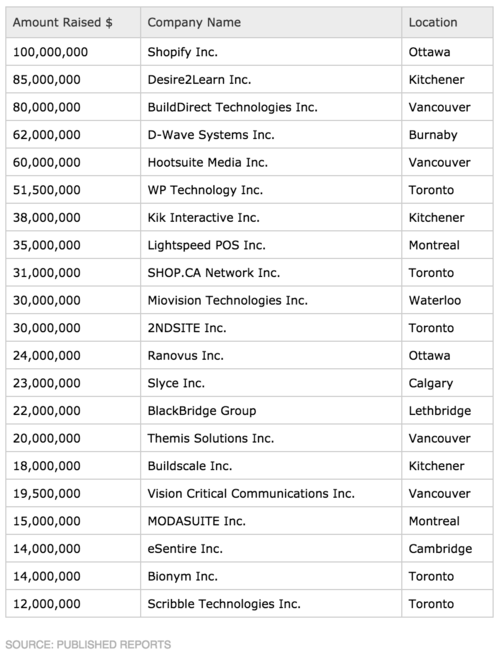
    The Globe and Mail published an interesting article this evening looking at the 21 largest venture capital investments in Canadian tech over the last 18 months. It’s called: Who needs Silicon Valley? Canadian startups scoring bigger deals.

    To put things into perspective, total venture dollars invested in Canada last year (2014) was around $1.9 billion. In the US, that number is estimated to be somewhere around $48 billion. So there’s a big spread here. But the Globe is arguing that there’s a shift towards medium-sized Canadian tech companies raising larger and larger rounds.

    Here are the top 21 largest venture capital investments made in Canada over the last 18 months:

    image

    At the same time, there’s also an attitude change that seems to be taking place. Confidence is growing. Here’s a quote from Mike McDerment of Freshbooks from the same article:

    “Our goal is to be an anchor tenant in Toronto. At Freshbooks, we want to build a global company that really contributes in some meaningful way to the city,” Mr. McDerment said. He touts the local schools and talent pool and downplays the Valley’s head start.

    “The money is shameless – it’ll just go wherever. It wants the opportunities,” Mr. McDerment said. “I don’t see why Toronto can’t beat Silicon Valley.”

    All of this is important because the medium-sized companies of today will hopefully become the large-sized companies of tomorrow. And that’s what you need to build a thriving startup hub. You need big successes. You need those companies going public and generating wealth for their employees and communities.

    Thankfully, that seems to be where we’re headed. The first company on the list above – Shopify – is already preparing for a dual US-Canada IPO.

  • Weird as a competitive advantage

    image

    Joe Cortright of City Observatory recently reposted an article that he wrote back in 2010 called, Keeping it Weird: The Secret to Portland’s Economic Success.

    In it he talks about a “weirdness index” that he developed for CEOs for Cities that measured and ranked 50 American cities across 60 different behavioural indicators. San Francisco and Salt Lake City come out as the weirdest, and Portland ranked 11th out of 50. The most “normal” part of the US was the Midwest. Normal meaning behaviours that are most similar to the national average.

    He then goes on to talk about weird as a competitive advantage. Here are a few snippets:

    When it comes to economic success in today’s economy, the key is to differentiate yourself from your competitors. Harvard Business School’s Michael Porter counsels businesses that “competitive strategy is about being different.” And the late, great urbanist Jane Jacobs told us, “The greatest asset that a city can have is something that’s different from every other place.”


    True entrepreneurship is about deviant behavior: starting a business that makes a product that no one else has thought of or thinks there’s a market for. Entrepreneurs and open-minded, experimental customers go hand-in-hand.


    We shouldn’t do things just to be different, but we should never be dissuaded from trying something simply because it is different or would make us different from other places.

    What this all comes down to is the simple fact that what is weird today, might very well become the norm tomorrow. But you need to be open enough to allow that to happen if you want to be the place that generates those news ideas.

    Could you have imagined that selfies would become as ubiquitous as they have? That would have been pretty hard to predict. It used to be the case that people were afraid to use their real name on the internet. Now we share our entire life online, including our faces.

    Image: Flickr

  • How open are you to experiences?

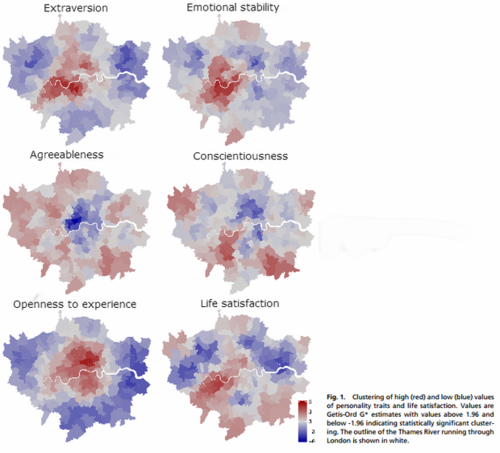
    This morning Richard Florida published an interesting CityLab article that talks about how different personality types cluster within cities. The study he references was done by a team of psychologists that surveyed 56,000 people in the London metro area.

    Here is a summary of what they found (darker red indicates higher concentration of each personality trait):

    image

    Probably the most interesting personality trait is the “openness to experience” one, as there appears to be a clear divide between people who live in the center of London and people who live in the suburbs.

    Here’s how Florida describes it:

    The most clustered personality trait the researchers found was “openness to experience” (bottom left map), which is concentrated in the center of London. Openness to experience, according to a wide body of psychological studies, is associated with creativity, innovation and entrepreneurship. This type is concentrated in higher density neighborhoods, with higher housing prices, more ethnic and religious diversity and higher crime ratesMeanwhile, the blue concentrations at the periphery indicate that there are fewer people open to experience in metro London’s suburbs.

    It’s fascinating to think about the role of psychology in city building. It’s not something we often talk about, but it’s there.

    I live downtown and I would definitely classify myself as extraverted and open to experiences. How would you classify yourself?

    Maps via CityLab

  • I’m back from Startup Weekend

    image

    I usually write on Architect This City every day. But this past weekend I skipped both Saturday and Sunday, which is something I haven’t done in the 15 months that I’ve been writing this blog. I hate missing days. I really do. But I had no choice. I was at Startup Weekend here in Toronto.

    For those of you unfamiliar with the global Startup Weekend initiative, let me tell you how it works.

    Last Friday night, hundreds of people from Toronto’s startup community convened at the MakeWorks coworking space in Toronto’s west end to pitch and hear new business ideas. The floor is always open to anyone who would like to pitch, but you only have 60 seconds (hard stop) to convince the crowd that your idea is worth pursuing. This past weekend there were about 40 pitches.

    Following the pitches, the crowd then gets to vote on their favorite ideas. The top pitches – there were 13 selected this past weekend – get to move on and the people who delivered those pitches become team leaders. They are then asked to get up one more time to tell the crowd who they need to develop their idea over the weekend. Once that happens, everyone starts scrambling around to try and put together a team. It’s all about hustle.

    Immediately after the teams are formed, the work starts.

    By Sunday at 5pm, you’re expected to have validated your idea and problem in front of real people, executed on some sort of minimum viable product (the solution), and ideally brought in some of your initial customers. Because at the end of the weekend, all the teams get up and deliver a 5 minute pitch in front of a panel of judges who assess you on how well you did against those 3 objectives.

    It’s a weekend of raw adrenaline. I wouldn’t be surprised if I lost about 5-10 pounds as a result of how little food I ate and how much coffee I consumed.

    I pitched a real estate related idea – just like I did 2 years ago at the last Startup Weekend I attended – and I was fortunate enough to win the top pitch on Friday night. I think it may have been because I said fuck in my pitch. Although, a lot of people also remembered me from the previous Startup Weekend and started calling me “Mr. Real Estate.”

    //platform.twitter.com/widgets.js

    Our team ultimately didn’t place – which may have been because it was an Internet of Things themed Startup Weekend and we weren’t that – but I think we developed a super solid business idea.

    Either way, I had a blast. We knocked on people’s doors to validate our idea. We got a ton of positive feedback on what we were trying to do. And I was fortunate enough to meet a bunch of smart and ambitious people. I was so impressed by what our team accomplished.

    But what I also love about events like Startup Weekend is that it shows you how vibrant the startup ecosystem really is in Toronto. There is no shortage of passionate entrepreneurs in this city fighting to change the world. And what’s great about this community is that they all know how hard it is to start something from nothing, and so they’re incredibly supportive. 

    If you have any interest, I would encourage you to check out events like Startup Weekend. They’re a lot of fun and they all contribute to the greatness of this city.

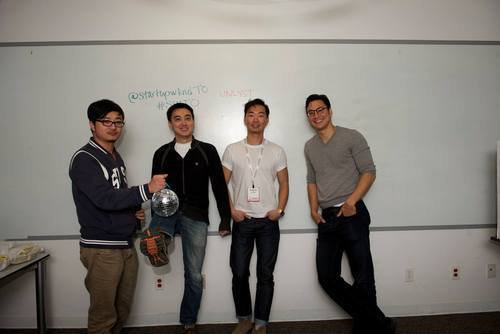
    Image: The Unlyst Team at Startup Weekend TO 2014 (Jerry, Louis, Landon, and me)

  • Doing new things

    image

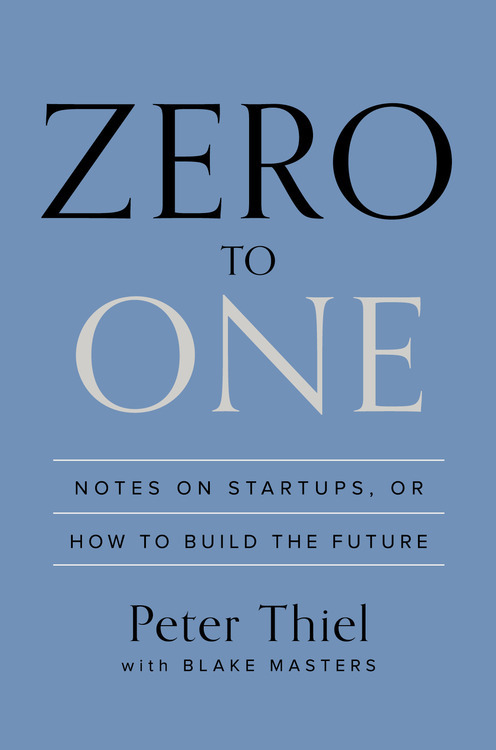
    I just finished reading Peter Thiel’s new book, Zero to One: Notes on Startups, or How to Build the Future. For those of you who may not be well-versed in the world of technology geeks, Peter Thiel is an entrepreneur and investor. He was one of the founders of PayPal back in 1998 and was the first outside investor in Facebook in 2004. He invested $500,000 for a 10.2% stake in the company!

    While the focus of the book is obviously on technology startups, it’s less about “here’s how you build a startup” (there is no formula) and more about “here’s how to think about the world, humanity, and the future of our civilization.” So even if you’re not a founder, or startup and technology enthusiast, I think you’d still find it really interesting.

    As one example, Thiel makes the distinction early on in the book between what he calls “vertical or intensive progress” and “horizontal or extensive progress.” The specific example he gives is of typewriters and word processors. If you take one typewriter and figure out how to make 100 of them, you’ve made horizontal progress. However, if you’ve just replaced typewriters with word processors, you’ve made vertical progress.

    In other words, vertical progress is doing new things and horizontal progress is just copying things that we know already work. In the grand scheme of the world, he argues that globalization is really just a form of horizontal progress. The rise of China is a result of them copying what has already worked in developed countries. But the true way to advance our economy and civilization is to not just copy – that’s easy – it’s to do, new, things.

    That, of course, is a lot harder to do. But to build the future, you need to build things and do things that haven’t been done before.

    Which is why Thiel actually gives $100,000 to a handful of college students every year so that they can drop-out and pursue a startup. In his mind, our education system is just perpetuating the status quo. MBAs move money around without creating anything new. Lawyers just preserve value and mitigate risk, also without creating anything new (Thiel is trained as a lawyer). And so he doesn’t believe that is the best way forward.

    This may not sit right with many of you, but questioning the status quo is a prerequisite if you’re trying to do new things.

  • Toronto’s “Instagram for doctors” raises $4 million

    image

    Earlier this week it was announced that Fred Wilson and his firm Union Square Ventures have just led a $4M Series A round of venture funding in the Toronto-based startup Figure1. Figure1 is essentially “Instagram for doctors.” Here’s how it works (via WSJ):

    Today, more than 125,000 health-care professionals use Figure 1 to view or share free medical imagery, including photos of patients with personally identifiable details blurred out or excluded; x-rays; charts; and still images taken from MRI or CAT scans, for example.

    The app’s users include board-certified doctors, registered nurses, medical and nursing students, physicians’ assistants, and others who use the app and share images for teaching and studying purposes, or even to request community feedback about a possible diagnosis.

    With this round, USV is now up to 3 investments in the Toronto/Waterloo region (I think of us as one center). The other 2 are Kik (out of Waterloo) and Wattpad, which is actually headquartered here in the St. Lawrence Market.

    What’s exciting to me about all of this is that it’s further evidence of a growing and thriving Toronto/Waterloo startup ecosystem. And while to some it may not seem like a big deal for yet another mobile app to receive funding, it’s actually great news.

    Because as these companies grow and become successful, they’ll not only create new jobs in the region, but also create a tremendous amount of wealth and expertise. And when this wealth and expertise gets reinvested into future startups, you end up with a powerful snowball effect. That’s how startup ecosystems are built.

    It’s also great to see companies staying put, because the pull towards more established startup hubs can be significant. When my friend Evgeny raised a Series A round from Andreessen Horowitz last year, he told me that they asked him to move 500px down to California. As is the case with a lot of VCs, they like their portfolio companies to be nearby.

    But ultimately 500px decided to stay headquartered here in downtown Toronto. And they did that for a few reasons: There’s lots of great engineering talent here and it usually comes at a discount relative to California (5-15%). He also finds that employees here are more loyal. There’s less turnover. In California, everyone is looking for that next best startup to join. Here 500px gets to be that big fish in a small pond.

    Anyways, a big congratulations to the Figure1 team. I hope they continue crushing it and that they stay put in Toronto. If you’re a healthcare professional, you can click here to download the app.

  • What are the most compelling reasons for someone to become an architect now?

    Since I’ve talked a lot before about the profession of architecture and the future of it, I thought I would share this recent interview with Mark Wigley from Surface Magazine (May 2014). Since 2004, Wigley was the Dean of Columbia University’s Graduate School of Architecture, Planning and Preservation. But he’s now stepping down and this was his exit interview.

    The first question he was asked was: 

    What are the most compelling reasons for someone to become an architect now?

    I actually think that there’s never a compelling reason to be an architect. The decision is irrational, and that irrationality is an enormous and precious asset. Architecture is full of romantics who think that even relatively small changes to the built environment create the aspiration for a better society. It sounds hokey, but there is in every architect the thought that things could be better. This is a kind of professional optimism. And that leads to an expertise in entering situations in which the dynamics are unclear. Architects are only ever called into a situation when it’s impossible. If it’s possible, you invite somebody with a toolbox who can give answers. You call the architect in when it’s not clear what the question even is. 

    The line I really like is the one I highlighted in bold above: “…there is in every architect the thought that things could be better.”

    Wigley is talking about it in a kind of romantic and idealistic way, but I don’t think it necessarily needs to be that way. The optimistic belief that things could be better, that things could be improved, is a powerful notion. In my view, it’s what drives entrepreneurship and that happens to be our most powerful economic engine.

    I actually think there are a number of parallels between architecture and entrepreneurship. In school, architects are indeed taught to enter into situations where “the dynamics are unclear.” It’s about taking an idea, developing it, and trying to figure out what it could become.

    Then, once you’ve poured your heart and soul into that idea, you get up in front of everyone and you pitch it. It’s your job to convince everyone that, yes, the way you’ve developed your idea is in fact the right way. Sometimes you get shot down. And other times you don’t. But you just have to take the risk.

    Click here to download the full PDF of Mark Wigley’s interview.

  • Tech and the City

    image

    I’m reading a great book right now called Tech and the City. I’m only 31% of the way through it (according to my Kindle app), but already it’s been an interesting read. It’s about the making and rise of New York City as a technology and startup hub – which, is fairly recent phenomenon. There aren’t too many cases where New York plays second or third city, but tech is one of those instances. Silicon Valley dominates.

    The book talks about the deliberate efforts that were made, by the Bloomberg administration as well by many others, to diversify New York’s economy away from financial services and towards technology, startups, and entrepreneurship. It gives you all the backstory about the rise of Silicon Alley in the 90s, its subsequent crash in the dot com era, and all the players involved. And yes the reference to Sex and the City is both on purpose and explicit throughout the book.

    But at a time where cities all around the world are trying to replicate the success of Silicon Valley, the takeaways from this book are perhaps universally applicable. It certainly got me wondering if, here in Toronto, we’re doing enough to prepare our city to dominate in the 21st century.

    Image: Stephen Wilkes