Daily insights for city builders, delivered every morning at 6 AM ET. I’m Brandon Donnelly — a Toronto-based real estate developer and founder of Globizen. I’ve been writing here since 2013.

Tag: education

  • Unlearning our biases

    I had coffee this morning with an engineer who is going back to business school in order to segue into real estate development. This is a fairly typical journey. Lots of people come into development from a related discipline. In my case, it was architecture (even though I never practiced architecture). It was also the case when I went to Rotman that something like a third of the class had a background in some sort of science or engineering field.

    However, one thing I did mention this morning was that he will likely find that he will need to unlearn certain things as he moves forward. Every discipline tends to indoctrinate us with a certain way of thinking about the world. Lawyers tend to be a certain way. Engineers tend to be a certain way. And architects tend to be a certain way.

    In my case, I found that architecture school taught me to be, among other things, an intense perfectionist. The modus operandi in design studios is that your project is never ever complete. The more you work on it, the better it will become. And as a result, you should feel a deep onus to work on it as much as humanly possible. But in business, this isn’t practical. In the vast majority of cases, speed over perfection will serve you better.

    I believe wholeheartedly in multi-disciplinary backgrounds, and maybe this is one of the reasons why. It shows you what you should unlearn. What would you say your biases are?

  • Harvard announces new Master in Real Estate degree

    The Harvard Graduate School of Design (GSD) just announced a new 12-month degree called the Master in Real Estate (MRE). Here’s a short excerpt about the program:

    The MRE program is designed to train future practitioners to address new and urgent realities facing the built environment and cities today. Whether undertaken by for-profit businesses, not-for-profit organizations, or public entities, real estate occupies a pivotal role in determining how the places where we live, work, and play are equitable, environmentally sustainable, and appealing, in addition to being productive for the economy.

    The key takeaways are that this is a graduate program being designed for aspiring real estate entrepreneurs and that it will live within Harvard’s Graduate School of Design. So there is an implicit recognition that the world of real estate doesn’t need to run counter to the pedagogical goals of a design school.

    Anyone who went to architecture school will tell you that real estate is often viewed as the “dark side.” Either you commit yourself to the pure world of architecture and design, or you sell out and seek profits in the world of real estate. But I have always considered this to be a false dichotomy.

    Real estate is a fundamental component of how we shape our built environment. And so if one’s ambitions are to improve the built environment — which is something that architecture schools do teach you — why should the delivery vehicle matter? Shouldn’t we be encouraging people to optimize for maximum benefit?

    I completed my undergraduate degree in architecture. But very early on I had the feeling that I was only getting one piece of a larger picture. And so I went to the University of Pennsylvania for graduate school and completed a degree that combined both architecture and real estate. My goal was to figure out a way to combine both passions. Maybe I’d become the next Jonathan Segal.

    Penn was very open to cross-disciplinary studies at the time (this was the mid-2000s), but there was still a gaping divide between the school of design and the business school. Walking across campus meant taking off one hat and putting on another. There wasn’t a lot of overlap.

    After school, I returned to Toronto and started working in development. I then decided to pursue my MBA part-time, which really wasn’t necessary for my career, but was probably driven by some sort of insecurity I felt at Penn. I was the outsider design student (with funny glasses I might add) trying to keep up with Wharton MBAs.

    I went back to the University of Toronto for my MBA and thoroughly enjoyed it. But I still couldn’t understand why there was such little overlap between the design school and the business school when it came to matters of the built environment. The real estate courses at Rotman were also extremely limited at the time.

    So I started talking to faculty members: What would it took to create a joint real estate program that lived somewhere between the design school and the business school? I offered to help and I tried to press upon everyone that this was a gaping void and a huge opportunity. Canada was falling behind in terms of real estate education. It was time to step up.

    The answer I got was generally always twofold: (1) Rotman’s real estate courses were already good enough and (2) it’s pretty hard to start a new program at the University. You have to do a bunch of things, one of which includes finding money. So, sorry.

    Harvard’s new Master in Real Estate degree is the kind of program I had in mind. So I’m happy to see others taking action. And I ultimately think it will be a good thing for our cities.

    If you’d like to apply, you can do that starting this fall.

  • Pay and performance for graduates of elite universities

    We know that educational attainment is probably the single biggest determinant of urban economic success. If you’re hoping to predict average household incomes, looking at the percentage of the population with a 4-year college degree is a pretty good place to start. But let’s take this a step further: to what extent does graduating from an elite university affect both pay and performance?

    It turns out, according to this recent study, that the pedigree of one’s university isn’t all that good at predicting motivation and talent. It does, however, impact pay. Average early career salaries for graduates of the top 10 colleges in the US are almost 50% higher than those with degrees from the ten colleges within the City University New York school system. This is according to data from Payscale and the US Department of Education.

    But this pay delta doesn’t necessarily match the performance delta that you might expect. The study found that for every 1,000 positions that you move in Webometrics’ global university ranking (which is what they used for their research), overall performance only changes by about 1.9%. In other words, a graduate from the alleged number one university is only going to perform, on average, about 1.9% better than someone from the 1,000th best school.

    I’m not exactly sure how to practically interpret a 1.9% improvement in performance. But 2% compounding on 2% each year should get you somewhere. Regardless, graduates from top universities do generally score higher on competency examinations. The reasoning behind this is thought to be at least twofold: 1) more selective admissions create a better pool of students and 2) top universities should provide better training.

    Whether that’s enough to justify the higher pay is a separate discussion. But if you’re looking to measure urban economic success, the data does suggest that elite universities should lead to overall higher average incomes.

  • Human Development Index

    The Human Development Index (HDI) is a composite index that ranks countries based on four key indicators (3 dimensions):

    • Life expectancy in years (health)
    • Expected years of schooling (education)
    • Mean years of schooling (education)
    • Gross national income per capita (standard of living)

    Equal weighting (1/3) is given to each of the above dimensions: (1) health, (2) education, and (3) standard of living.

    And the resulting index value is a normalized number between 0 and 1, with the latter number representing the maximum possible value.

    Generally speaking, a country is thought to be developed or advanced when it has an HDI greater than 0.8.

    The way you calculate each dimension’s index value is by using the minimum and maximum limits set out by the United Nations.

    To give you an example, for gross national income per capita (standard of living), the minimum is $100 and the maximum is $75,000. (Logic behind these numbers, here.)

    Once you know the boundaries, you then use this formula for each dimension:

    Dimension Index = (Actual Value – Minimum Value) / (Maximum Value – Minimum Value)

    Each of the individual dimension indices are then aggregated together to create that country’s HDI.

    In 2017, the country with the highest HDI was Norway at 0.953. Brazil, which is what got me started thinking about this, was at 0.759. So not quite developed.

    Canada and the US were on top of each other at 0.926 and 0.924, respectively.

  • City building reading list (and an event)

    Today’s post is going to be about a handful of things that have caught my attention.

    – Gary Hack, who is the former dean of the University of Pennsylvania School of Design, recently published a book called Site Planning: International Practice. It is a textbookish guide to planning processes, new technologies, and sustainability, with an emphasis on rapidly urbanizing countries. Thank you to my friend Michael Geller for bringing this to my attention.

    – Sidewalk Labs Toronto is opening a new experimental workspace here in Toronto at 307 Lake Shore Boulevard East (Queens Quay & Parliament) on Saturday, June 16th from 12 – 6pm. It’s an old fish processing plant that they have turned into their office. The team will work there during the week and on the weekends they will open to the public to showcase what they’re up to. Register for the June 16th event, here. I just did.

    – Alexandra Lange has a recent piece in the New Yorker called, The Hidden Women of Architecture and Design. It’s about the important role that women have played in the “design of childhood”, which is the title of a book by Lange. There’s also a short but interesting story about Detroit’s Lafayette Park (Mies van der Rohe) at the beginning of the article.

    – Finally, here is a blog post by Witold Rybczynski where he talks about the shortcomings of architectural education. Obscure theories. Technical or made-up jargon. And no concern for budgets and schedules. I have always shared a similar view and have long felt that there needs to be more business school in architecture school.

    Hopefully there’s something in here that is of interest to you.

  • New School of Cities

    The University of Toronto just announced a new School of Cities. It will begin operations on July 1 of this year (2018) and bring together researchers from various disciplines to address the world’s most critical urban challenges. 

    Insert stat here about the percentage of the population that will live in an urban area by 2050.

    There are more than 220 faculty members across 40 different academic divisions at the University of Toronto who are doing urban-focused work. The School of Cities is intended to bring those minds together.

    So far there are plans for a “global cities summit” and an “urban lab” that will also bring students, faculty, industry, and government together. The intent is for the School to act as a city builder both locally (Greater Toronto Area) and globally.

    This once again goes to show just how important we are all taking urban issues today. But I am sure this blog audience didn’t need to be reminded of that.

    If you would like to sign up for updates from the School of Cities, you can do that here.

    Photo by Jorge Vasconez on Unsplash

  • Where the young and educated are moving to in the US

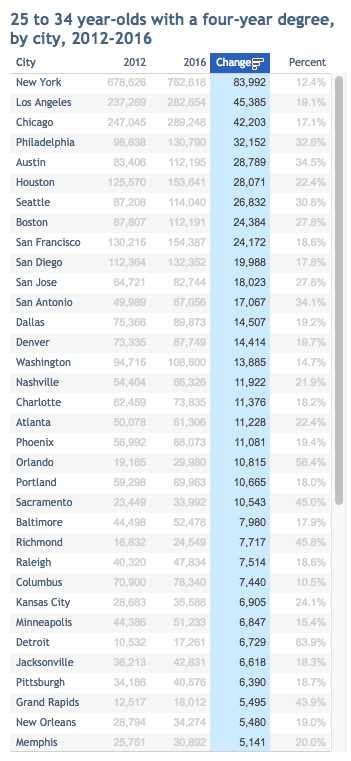
    City Observatory tracks something that they call “The Young and Restless.” It refers to the segment of the US population that is between 25-34 years old and has a bachelor’s degree or higher.

    We know that people in this age bracket tend to be relatively mobile and that the likelihood of moving decreases as people age. So it’s a potential leading indicator for the city regions of the future. It also adds a bit more nuance to the urban vs. suburban growth debate. 

    According to City Observatory, between 2012 and 2016 the number of 25 to 34 year olds with a 4-year degree living in one of the 53 largest largest cities in the US increased by 19%. This is compared to a 4% increase in the overall population in these cities.

    This increase in young well-educated adults is also happening 50% faster in the largest cities. So the young and educated still seem to be demanding city living, even if the world is arguably still suburbanizing.

    Below is a snapshot of City Observatory’s latest data. I’ve sorted the list by total change in population (2012 to 2016). Happy to see Philadelphia near the top. If you do it based on percentage, Detroit wins with a 64% increase.

    For the full list of cities, check out City Observatory.

  • Educational attainment and urban success

    We know that educational attainment matters a great deal for the economic success of our cities. In fact, by some measures, it is the single most important factor.

    City Observatory found that 60% of the variation in per capita income across large U.S. metro areas could be explained simply by the percentage of the population with a 4-year college degree.

    So education matters a lot.

    Many of you have probably seen this entertaining TED talk by Sir Ken Robinson called: Do schools kill creativity? It has almost 47 million views at this point. 

    Well, he was recently interviewed by Ingrid Peritz of the Globe and Mail and I have to share the following quote, because I think it’s terrific (particularly the part in bold):

    “We need to recognize that children have a huge range of natural abilities and they all have them differently. Our education systems are designed to focus on a small band of those. If you have a narrow conception of ability, you end up with a very big conception of disability or inability.”

    More people with a college degree seems to be a pretty good thing. But the solution doesn’t start there. Logically, it starts much earlier – with children. 

    All of this matters not just because people with a degree should, on average, make more money and have a higher quality of life. 

    But because it’s heartbreaking to think that some young child with incredible talents might be being mislabeled as inept simply because we have a system that is, well, inept.

    I recommend you read the interview with Ken.

    Photo by Christian Fregnan on Unsplash

  • Big cities, small cities, and automation

    It’s fine to talk about the importance of big cities in today’s world, but there’s another side of this coin to consider. What happens to the towns and smaller cities who aren’t guiding the global economy?

    Here is an interesting snippet from the NY Times that recently caught my attention:

    As one of my college professors recently told me about higher education, “The sociological role we play is to suck talent out of small towns and redistribute it to big cities.” There have always been regional and class inequalities in our society, but the data tells us that we’re living through a unique period of segregation.

    If you combine the above with the fact that a significant number of jobs are likely to be automated in the near term, one has to wonder what the world is going to look like assuming the status quo continues.

  • Has there been a “great inversion?”

    Urbanist Richard Florida has spoken a lot about a “great inversion.” This is about poverty moving to the suburbs and the core of cities becoming a kind of “gated suburb.” (i.e. wealthy)

    In response to this narrative, City Observatory recently published a post where they call this a new mythology. Joe Cortright argues that it is simply an exaggeration that sounds good in media headlines. And indeed, if you look at some accounts of poverty, the swings haven’t been that dramatic.

    However, if you dig into this study by Luke Juday at the University of Virginia (cited in the City Observatory article), there have been some interesting changes. 

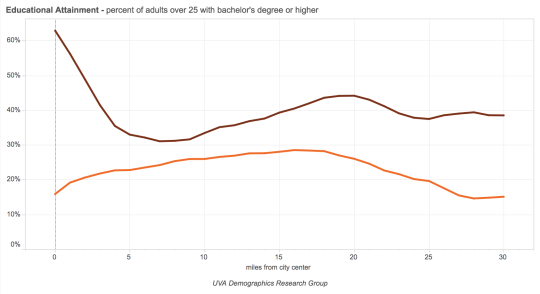
    Below is a chart that shows the percentage of adults (over 25) with a bachelor’s degree (or higher) sorted by distance from the city center. This particular chart is a composite of 7 northeastern (US) cities. The brown line is 2012 and the orange line is 1990.

    As you can see, there has been a huge spike in educated people living in city centers – at least in the northeast.

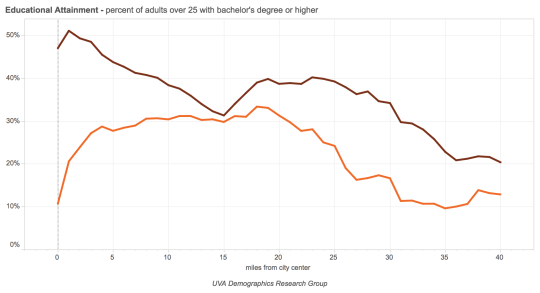
    Here is that same chart for Atlanta:

    New York:

    In the case of New York, it looks like the entire city just became more educated.

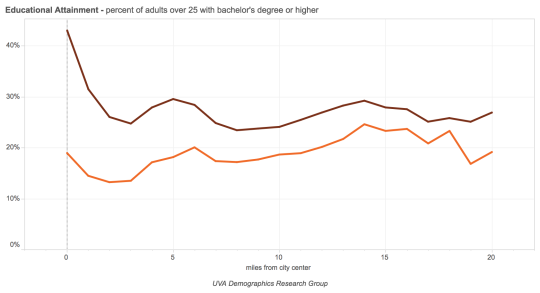
    Miami:

    Educational attainment is often the single biggest determinant of income. So there is something to be said about highly educated people concentrating themselves in city centers. We may not want to call it an inversion of great proportions, but it’s a meaningful shift.