Daily insights for city builders, delivered every morning at 6 AM ET. I’m Brandon Donnelly — a Toronto-based real estate developer and founder of Globizen. I’ve been writing here since 2013.
Earlier this month, The Atlantic published an article called: The Free-Time Paradox in America. The gist of the article was that the wealthy are increasingly starved for time, whereas the exact opposite is happening to the poor.
The article throws out this stat: “In 2015, 22 percent of lower-skilled men [those without a college degree] aged 21 to 30 had not worked at all during the prior twelve months.”
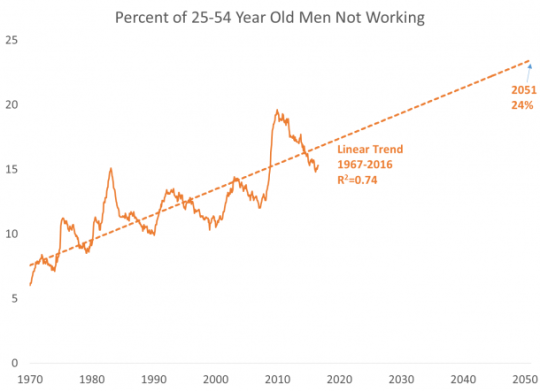
More recently, Larry Summers published the following graph on his blog, along with the prediction that by the middle of the 21st century over a third of men between 25 and 54 will no longer be working in America.
He cites technology and declining marriage rates as two possible explanations. Supposedly unmarried men are more likely to be out of work.
If you’re interested in this topic, Nicholas Eberstadt has a new book called Men Without Work. The focus is on a new class of men who are neither (1) employed nor (2) unemployed and looking for work. Instead they voluntarily electing not to participate in the US labor force. Similar to Ed Glaeser, part of his argument is that the incentives not to work (welfare) are simply too great.
This drop in labor force participation is largely concentrated among those without a college education. The problem seems to be that we are no longer creating enough good paying jobs for the less well educated. So the way I see it is that we have two options: we figure out how to do that (again) or we focus ourselves on education and training.
Richard Florida has written a lot about elevating service and retail jobs to fill this gap. But I have never understand how that works. I think it comes down to figuring out how to better elevate people.
The Center City District and Central Philadelphia Development Corporation recently published a report called: State of Center City 2016. The objective was to measure the progress being made in Philadelphia’s downtown.
I moved out of Center City (Rittenhouse Square) in 2009, but I still like to follow what’s happening. I really enjoyed my time in Philly. In fact, I remember missing its immensely walkable downtown after I returned to Toronto and touched down in the suburbs briefly before moving back downtown.
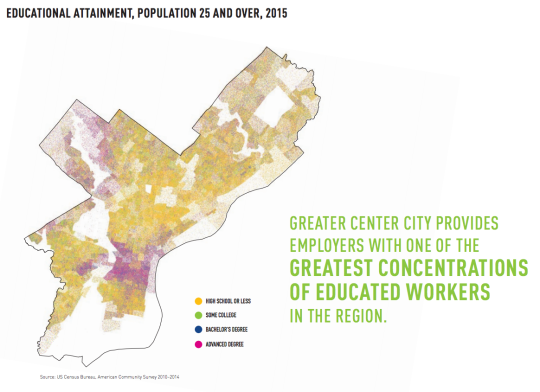
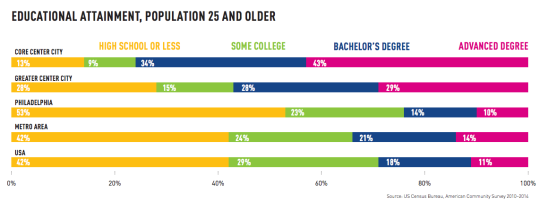
If you take a look at the report, one of the first things you’ll probably notice is the concentration of jobs and the concentration of knowledge works (with advanced degrees) in the Center City area. We are seeing this shift in so many cities around the world.
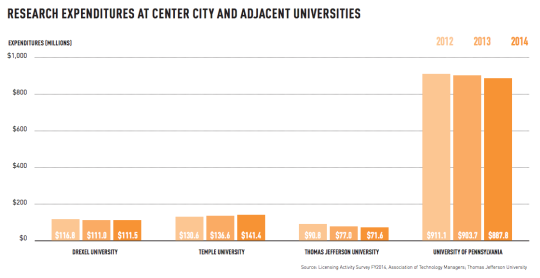
Here are a few graphics (all of which are from the report):
Part of the reason for this is that Center City is anchored by a number of fantastic Universities. This is critical for cities, today.
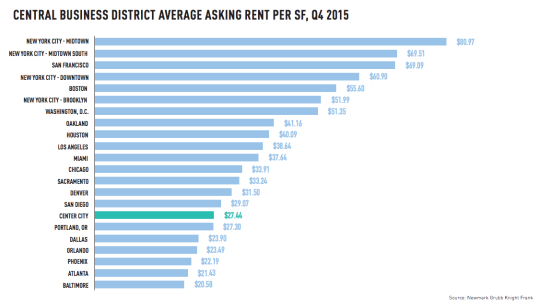
To end this post, I thought I would post the below comparison of average office rents in major CBDs across the US. I always find these charts interesting, even though the usual suspects are up at the top.
I’ve been getting a lot of (email) questions lately about what to study in order to become a real estate developer. So I thought I would reblog this post that talks about exactly that. I wrote it over a year ago and I almost forgot it existed.
At the same time, I’m reminded of something: I think these questions really speak to the fact that there’s a significant opportunity (particularly in Canada) in terms of real estate development education.
Oftentimes when I get these questions, I end up recommending the Master of Science in Real Estate Development (MSRED) at Columbia, MIT, and USC. Why don’t we have something similar (and better) in Canada? We are falling behind.
I have raised this with some Universities here in Toronto, but the response I got was that they felt the real estate courses being offered as part of their existing MBA programs were more than sufficient. I think we can do a lot better.
One professor suggested that I line up a big donor and work with them to spearhead the creation of the (Insert Donor Name Here) School of Real Estate. I think that’s a great idea, but not something I have the capacity for right now.
Hopefully somebody else out there is of the same mind.
Now I would love to see the University of Toronto and Ryerson University (as well as others) step up and leverage their respective architecture schools. Schulich is already out of the gate on this one.
Venture capitalist Fred Wilson is the poster boy for the New York tech industry. And this morning he posted an interesting video on his blog of a recent talk he did at Google NYC.
At the 4:50 mark he begins talking about the evolution of the tech sector in New York and how it became what is probably the second most active startup hub in the United States.
Given yesterday’s post on talent and the recent CityAge conference I participated in, I thought this video would make a great follow-up. There’s talk of lifestyle, diversity, gender equality, and talent within cities.
Fred is heavily involved in growing and improving computer science education in New York, which is a perfect example of how cities can better leverage the people and talent they already have – as opposed to just focusing on bringing in new talent. Coding is a valuable skill to possess.
I also found it interesting that Fred ended up in New York precisely because his wife wanted to live in New York. And that had a lot to do with all of the things you can do in the city, outside of work.
One of the things I did when I was in graduate school studying real estate and early on in my career was take a bunch of ARGUS and Excel modeling classes. Some of them I took through the University of Pennsylvania. Some of them I took through work. And some of them I just took on my own.
Regardless, I always found them incredibly helpful. Because at the end of the day, you’re not just learning the software; you’re also learning the real estate business. You can’t build a financial model if you don’t understand the business. And I mean really understand it.
So if you’re looking to get into real estate development or you just want to brush up on your skills, I would encourage you to consider taking a financial modeling course. I plan to do a refresher later this year.
The last one I completed was through a company called REFM (Real Estate Financial Modeling). The founder is a Penn (Wharton) alum – so it must be good, right? 😉 There are a lot of self-study options if you just want to take them online from home and all of them include prebuilt Excel models that you can then use (and customize) going forward.
One of the most common questions I receive from readers is about what to study in school in order to become a real estate developer. Here’s one of those questions:
“Thank you so much for your insight into the real estate development process! I was wondering if you could do a post on what educational degrees you think would best prepare someone for a career in real estate development?”
I’m not surprised that a lot of aspiring real estate developers have this question on their mind. Compared to many other career options, the path to real estate development has traditionally been pretty informal. It’s much less structured compared to other professions such as law or medicine.
But as the real estate industry continues to institutionalize (transition from rich families to institutions), I’m sure we’ll see recruitment become more structured as well.
Already the MBA and Master in Real Estate Development (or some other permutation of that degree) have become — for many large real estate organizations — the prerequisite to getting in the door. So if you’re looking for a simple and safe answer, just get one of these degrees.
To more fully answer this question though, I thought I would just share my own strategy for getting into real estate development. Because at the end of the day, there’s no one way to become a developer. Lots of people start out in other industries, only to fall into real estate later on.
The way I started was by first identifying the skills that I thought I would need as a real estate developer and that I felt employers would be looking for. And I assembled this list by going on lots of informational coffee meetings with developers to make sure I was headed in the right direction with my assumptions.
In the end, this is more or less what I decided I needed to know:
Planning: An understanding of local planning policies, zoning, and so on. For this one, it’ll help if you can pick a particular place and commit to learning it (which is what I did with Toronto). There are a lot of local particularities that you’ll need to grasp. Real estate is very much a local business.
Finance & Economics: The ability to understand markets, build models, and crunch numbers just like a banker. That was my goal before I got an MBA. This includes discounted cash flow analyses, net present value calculations, internal rates of return, and so on.
Sales & Leasing: There are a lot of people who think that this is the best way to start in real estate (particularly on the commercial side). Learn the nitty gritty of leases and deal negotiations and then figure out where you want to be in real estate. Because at the end of the day, development projects are only viable when you have sales and/or signed leases in place.
Design & Construction: This was the easy one for me because I was coming from an architecture background. I could “read plans” and I didn’t need to convince people that I understood how buildings worked and how they were built. Instead, I needed to convince people that I had all the other skills.
And I knew this because that was the feedback I received my informational coffee meetings while I was in architecture school. One CEO (of a large publicly traded REIT in the US) told me flat out: “I need to feel comfortable that you can negotiate and that you won’t fuck up the numbers.”
And that stuck with me. I realized that I had an image to shed.
To round out my skill set, I decided to specialize in real estate in my first masters and then get an MBA. And given the chance, I would do it the same all over again. But even if you don’t have the opportunity or inclination to do that, there are a lot of other things you can do to shore up your knowledge base.
I took a number of ARGUS and Excel classes to learn how to build robust real estate models. You might be surprised at how much you end up learning about the real estate business by doing that. I also became involved in organizations like the Urban Land Institute and started going to every real estate panel I could find. And before committing to doing an MBA, I even thought about taking some accounting classes at a local College.
So my point is that I think you should identify the skills and strengths that you have today and then figure out some way to acquire the missing ones. Go buy a real estate textbook. Take an online class. Go to industry events. Do whatever it takes to round out your skill set so that you can sit in front a prospective employer (developer) and tell them that you’re able to create value for them and their organization across every facet of the development process. That was my goal when I was trying to get in.
Of course, those aren’t your only options.
You could also just work your way up by taking any job with a real estate developer. One of my closest friends did exactly that and today is doing incredibly well with no formal training in real estate or even a related field. You could also just go out and buy your first property and have a go at it. Many great fortunes have been created by doing exactly that.
Either way, real estate development is an exciting business to be in. It can often be hard to get your foot in the door given the size of most development teams, but if it’s truly what you want to do and you work on acquiring the skills, I think you’ll eventually find your path.
The following chart is from City Observatory. It compares per capita income against the college attainment rate for the largest US metropolitan areas. If you hover over a circle it’ll tell you the metro area and what the precise numbers are. If you can’t see the chart below, click here.
What they found from this data set is that educational attainment – the percentage of the population with a 4-year college degree – is the single most important factor when it comes to urban economic success. In fact, according to City Observatory, it accounts for 60% of the variation in per capita income across the metro areas listed above. That’s huge.
As a recent graduate of Rotman’s Morning MBA program (and presumably because somebody over there reads Architect This City), I was asked to write a guest post for their MBA blog. More specifically, I was asked to share my thoughts on the real estate industry and on my time at Rotman. And since I haven’t really done a post like this before, I thought it would be worthwhile to do.
But before I begin, I think it’s important to explain a bit about my background and my motivations for doing an MBA in the first place. Before going to Rotman, my first master’s degree was in architecture and real estate from the University of Pennsylvania. Basically it was a Master of Architecture combined with their MBA real estate concentration. So it included everything from real estate finance to real estate development.
Having already done this 3-year program, there were a couple of things I wanted out of an MBA program. First of all, I wasn’t prepared to go full-time. Five years out of the workforce was simply too high of an opportunity cost for me and so part-time was all I considered. I also only applied to Rotman because I didn’t want to waste any time traveling outside of the city (or to other parts of the city). I also saw Rotman as a rising star and one of, if not the, best option in Canada.
At the same time, I didn’t give much thought to the real estate curriculum being offered even though I fully planned to stay working in the real estate industry. I felt like I already had that sort of formal training and so, unlike some of my classmates who were looking to switch into real estate, I was after something else. I ended up majoring in Innovation & Entrepreneurship.
What I was trying to do was really round out my skillset and fill in some of the missing holes: accounting, marketing, and so on. But even more importantly, I had drunk the kool-aid around Rotman’s focus on integrative thinking (renamed “business problem solving”) and “design thinking”. And since there will always be a part of me that thinks of itself as a designer, it seemed like the perfect program for me.
Because at the end of the day, it’s not that hard to learn how to create a real estate development pro forma or calculate your expected exit cap rate on some piece of real estate. That stuff is all fairly mechanical. It might seem quite mythical when you don’t know how to do it, but once you do, you quickly realize that a financial model is only as good as the assumptions you put in. As we’re told in school, garbage in = garbage out.
The real value gets created in the assumptions. It’s created in the way you think about the market, your product, and your customers. And a lot of the time, the most value is created when you know or believe something that nobody else believes to be true. If you’re a lemming, you’re going to get lemming like returns and outcomes. So in a lot of ways, I went to Rotman to help me think better and think differently.
In some industries, resting on your laurels can kill you in a relatively short period of time. See Blackberry. Real estate, on the other hand, is generally a bit slower moving. But that doesn’t mean that change doesn’t happen and that there isn’t room for loads of innovation.
Just look at the Toronto of today versus the Toronto of 10-15 years ago. We’ve transformed ourselves into a city of high-rises where more and more people now want to live in the core of the city. This has brought commercial landlords back to the city center so that employers have downtown office space to attract the best human capital (see South Core) and it’s brought suburban retailers into the core to sell to these same urbanites. We’re seeing a complete reversal of the trends experienced with the last generation.
Amidst all of this, I’ve been noticing a growing awareness and passion around cities. My blog Architect This City started as a forum for architects, planners, and developers, but it has grown into a community of thousands of people who simply love cities. They’re passionate about everything from architecture to grade-separated bike lanes (as geeky as that probably sounds).
So I think that it’s not only the real estate market that’s changing, but also the professions involved with it. I’ve written a lot about the future of the architecture profession because I think we’re starting to see the emergence of new business models. Architects are becoming developers and developers are starting to become much more heavily involved in the shaping of the communities in which they build. Which is why in many ways, I think of my self as a city builder more than anything else.
Finally, to make matters even more complicated, technology is starting to have a huge impact on the business. Zillow.com just bought Trulia.com for $3.5 billion to form a portal that will now serve around ¼ of the online US residential market. And Opendoor.com is getting ready to launch a product that seems entirely poised to disrupt the way homes are bought and sold in America.
So what I’m getting at is that there’s absolutely no guarantee that the way we used to do something, is the way we’re going to continue doing it. In fact, I operate under the assumption that everything can and will be changed by somebody at some point. And if this is the way you approach things, then it should become abundantly clear to you that being able think critically is going to be one of your most important assets.
When I was just starting at Rotman, I met for lunch with an upper year classmate who told me that one of the best things he’s taken away from the program is the ability to think about the way he thinks. That may sound silly to some, but in our uncertain world, it’s actually a great skill to have.
Each year Monocle publishes a ranking of the top 25 cities around the world in terms of quality of life. Different than most city rankings, the survey goes beyond the more typical metrics around crime, education and so on, and also looks at some of the softer aspects of quality of life. Metrics such as: Can I get a good glass of wine at 1am? What they’re after is a more truthful ranking of the cities that people actually want to live in.
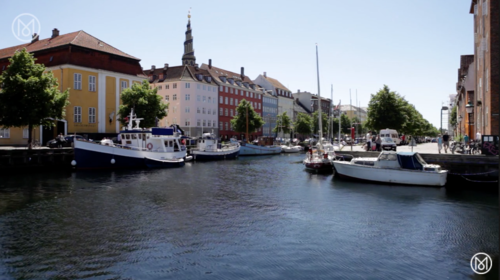
This year Copenhagen took the number one spot. Vancouver took first in North America. And Tokyo took first in Asia. All 3 cities have scored well since they began the survey. Monocle also released a short video that looks at these 3 cities and explains a bit about their ranking methodology. Click here to watch the video. It’s only about 7 minutes long, but it’ll probably make you want to visit all 3 cities. I’ve never been to Copenhagen, but it’s certainly on my list.
If you’re looking for the petition to Prime Minister Stephen Harper, click here.
Last Monday the Premier of the Turks and Caicos Islands, Rufus Ewing, was in Canada visiting with Prime Minister Stephen Harper. The purpose of the trip was to “boost ties” between the two countries. It was about trade, which most people would agree is a fairly typical kind of meeting.
However, this meeting struck a different headline in the media. And that’s because–for almost a century–there have been discussions and proposals put forward in this country to annex the Turks and Caicos Islands. The earliest record appears to be from 1917 when Prime Minister Robert Borden first suggested it.
Since then, the idea has been raised on many other occasions. In fact, both Nova Scotia and Saskatchewan have actually stepped forward and formally invited the Turks and Caicos to join their provinces. Here’s what Saskatchewan Premier Brad Wall had to say during this most recent visit:
“I think we want to be constructive in Saskatchewan. If the Prime Minister’s looking for a way to make this happen and doesn’t want to go through the challenge of creating a province or territory, and Turks and Caicos want to make this happen, just, you know, we’d like a tropical island.“
Presumably this approach would be easier than creating an 11th province or 4th territory. But despite these offers and efforts over the years, the idea has always been ultimately rejected. Following this week’s meeting, Foreign Affairs Minister John Baird stepped forward and also firmly rejected the idea:
"We’re not in the business of annexing islands in the Caribbean to be part of Canada. So that’s not something that we’re exploring. We’re not looking at any sort of formal association with the islands.”
But before I dive in, here’s a bit of background on the Turks and Caicos. The country is a collection of approximately 40 islands–most of which are uninhabited. They are a British Overseas Territory, but are self governing. However, from August 2009 to November 2012 the UK temporarily suspended its ability to self govern following allegations of corruption and fiscal mismanagement.
The land area of the country is approximately 613 square kilometres, which results in a population density of 51 people per square kilometre. For comparison, the land area of the City of Toronto alone (not the Greater Toronto Area) is almost equal at roughly 630 square kilometres. The population density averages around 4,150 people per square kilometre.
Now, onto why I believe we should be looking at a union. Here are 5 reasons.
1. They are open to the idea
Canada is not globally known as an imperialistic country and I’m not suggesting we change that. But here we have a case where the Turks and Caicos appears clearly open to the idea of some form of union. Why would we not consider it? And as long as they remain open to the idea, travellers will be able to continue placing the Canadian flag on their backpacks as a way to win friends overseas.
2. We’re aligned
Given that the Turks and Caicos is a British Overseas Territory, the country uses the common law system and the official language is English. (They’re missing French, but I’m sure that could be worked out.) We even share the same monarch. (Although, deep down inside I wish Canada was a republic.) These commonalities would make a proposed union all that much easier.
3. Vacationing and retirement
This is the obvious one that is getting most of the attention in the press. Canada is cold and we spend a lot of money traveling to warmer places. But if Canada had a province that was blessed with the weather of a place like the Turks and Caicos, I’d wager that it would receive a disproportionate amount of our travel and retirement dollars. All of a sudden you eliminate currency risk and the fear of foreign health care, which are both particularly important for retirees. This means that a lot more money would be kept within the Canadian economy. Sorry, Florida.
4. Access to education
53% of the labour force in the Turks and Caicos is made up of unskilled and manual labour. If they are serious about developing their economy beyond tourism, then I believe that education needs to become a significant part of their economic development platform. Thankfully, a union between our country and theirs would open up Canadian universities to the roughly 36,000 people who live in the Turks and Caicos Islands. Our universities are some of the most highly ranked in the world.
5. Economic development
Finally, let’s talk economic development.
Canada is one of the wealthiest countries in the world. And we consistently rank amongt the highest in the world in terms of education, transparency, quality of life and economic opportunities. It’s for these reasons that we’re perceived as a great place to live and invest. About one of the only things we don’t typically offer is great weather.
A union with the Turks and Caicos would obviously change that. But beyond just weather, it would also give Canada a foothold in an important region of the world and provide a stable locale for foreign investment. Similar to the way in which Miami has become the “Capital of Latin America”, the Turks and Caicos could become a meaningful center for trade and investment backed by Canadian stability.
This would benefit not only Canada, but also the Turks and Caicos, who have struggled over the years with fiscal mismanagement and corruption. In fact, the biggest challenge, I think, would be managing overdevelopment and ensuring that the growth and development happens in the most environmentally sustainable way possible.
Petitioning Stephen Harper
So there you have it, 5 reasons for why Canada should seriously consider a union and/or the potential annexation of the Turks and Caicos Islands. If you have any other ideas, or if you completely disagree with everything I said, I would love to hear from you in the comment section below.