Daily insights for city builders, delivered every morning at 6 AM ET. I’m Brandon Donnelly — a Toronto-based real estate developer and founder of Globizen. I’ve been writing here since 2013.

Tag: dublin

  • Roncesvalles is a great, single-sided, street

    Roncesvalles Avenue is a successful north-south main street in the west end of Toronto. I say successful, because it is truly a great street. It has transit, bike lanes, a fine-grained built form, and lots of interesting retail:

    But it is somewhat unique in that a large section of it is a one-sided retail street. Meaning, it looks like this:

    This obviously isn’t a fatal flaw. It remains a wonderful street. And there are lots of examples of thriving one-sided retail streets. Ocean Drive in Miami Beach immediately comes to mind (notwithstanding the fact that locals tend not to go to it).

    But conventional retail wisdom does dictate that two sides are better than one. Consider this 2023 report by Cushman & Wakefield ranking the top global main streets across the world. All of the streets that I have been to before are two-sided:

    • 5th Avenue in New York between 49th and 60th (above 60th is, incidentally, when the street converts to single-sided because of Central Park)
    • Montenapoleone in Milan
    • The main street of Tsim Sha Tsui in Hong Kong
    • New Bond Street in London
    • Avenues des Champs-Élysées in Paris
    • Grafton Street in in Dublin
    • Passeig de Gracia in Barcelona
    • Bloor Street in Toronto

    These are all two-sided retail streets.

    None of this is to say that the west side of Roncesvalles has nothing going on. It has a diverse mixture of uses, including churches, libraries, apartments, and many other things. But I think there is still an argument to be made that it has been hamstrung by restrictive zoning.

    That said, Roncevalles is defined as a “major street” in Toronto’s Official Plan and so it does fall under the city’s new Major Street Study. Maybe that changes things.

  • Dublin wants to reduce car traffic in its city centre by about 41%

    These are the current (well, 2019) and targeted (2028) mode share splits for Dublin city centre (sourced from here):

    The biggest planned change is a ~41% reduction in cars, taxis & goods entering the city centre. More specifically though, the plan contemplates a reduction in the number of cars in the core. The number of taxis and goods being moved around are both expected to increase.

    To achieve this, the city is targeting drivers that pass through rather than stop in the city centre. Supposedly, about two out of every three drivers are currently doing this, and so the goal will be to redirect them.

    Though, to be clear, this is not a plan to stop people from driving into the city centre. It is rightly about reducing the amount of road space allocated to private vehicles, prioritizing other modes of transport, and creating more “traffic-free civic spaces” for Dubliners and visitors.

    Of course, this is what many cities around the world are trying to do. So perhaps the most noteworthy aspect of this plan is that most Dubliners actually support it.

    According to The Irish Times, the plan received more than 3,500 public submissions, and 81% supported “reducing road space for private vehicles to facilitate a more efficient public transport system.” Further, 82% said they wanted more pedestrianized public spaces.

    There were, however, some concerns expressed. The carpark operators in the city centre are naturally worried about the impact to their businesses. This is expected and self-serving.

    Guinness (owned by Diageo) is also asking about how its delivery trucks will get to and from their brewery. This is obviously a crucial consideration. But I’m confident in saying that, whatever gets implemented, I’m sure that nobody is going to mess with the operations of St. James’s Gate Brewery.

    In fact, I’d be surprised if this weren’t written into the Constitution of Ireland somewhere.

  • The global cities attracting talent, visitors, and investment

    Earlier this month, Resonance Consultancy published its 2024 World’s Best Cities ranking. Or, in their words: its definitive power ranking of the 100 global cities that it believes are shaping tomorrow.

    These are always fun to flip through, which is I guess why people do them and why people look at them; but I do think it’s important to look at the underlying methodologies. Otherwise, what does “world’s best” even really mean?

    In this case, they’re looking at global cities through the lens of three key categories: livability, lovability, and prosperity. More specifically though, the report looks at factors that are demonstrated to have moderate to strong correlations with attracting talent, visitors, and/or businesses.

    This makes it distinct from rankings that are more focused on things like livability. Because according to Resonance, factors such as commute times, crime, and housing affordability don’t tend to correlate strongly (at least in the short-term) with a city’s ability to attract talent, tourism, and investment.

    While this may seem a bit counterintuitive, it does also make sense. People don’t move to London because they’re looking for affordable housing and a reasonable commute. They move to London because they want to be in the center of the world.

    And yes, London tops their power ranking:

    The top of this ranking isn’t all that surprising. It’s the usual suspects. But I continue to be impressed by how quickly Dubai has transformed itself into a top global city. Also impressive is how Dublin punches above its weight of just over 500,000 people.

    I am medium surprised to see Hong Kong nowhere on this first page (there are another 65 cities not shown here). It usually features as a top global city. But presumably this is the result of Beijing meddling. People are looking elsewhere — like Singapore.

    For the full list of cities and to download a copy of the report, click here.

  • Warren Buffet doesn’t like crypto and streetcars

    I have a great deal of respect for Warren Buffet. Much of what I know (or think I know) about investing has come from listening to and watching him and his partner Charlie Munger. Surely they have got to be the most successful investors living today.

    But there are some things that I don’t always agree with them on. The first and most obvious one is crypto. Warren thinks it is speculative rat poison and I think it is the future of the internet. I understand where he is coming from in that it does not produce cash in the same way as say a farm or an apartment building. But that doesn’t mean it won’t have value.

    The second one, as I have learned today, is maybe streetcars. As a rule, Warren doesn’t typically engage in local politics. But he recently decided to break that rule through a letter he wrote to the editor of the Omaha World-Herald, lobbying against a new $306 million project that I believe is going ahead regardless.

    Here’s an excerpt from the letter:

    “Residents can be far better served by extended or more intensive service by the bus system,” Buffett wrote. “As population, commerce and desired destinations shift, a bus system can be re-engineered. Streetcars keep mindlessly rolling on, fuelled by large public subsidies. Mistakes are literally cast in cement.”

    I should, however, be clear that (1) I know nothing about Omaha and this streetcar project, and (2) “streetcars” can be nuanced. There are streetcars that compete with car traffic and have short station spacing, and there is light rail transit on its own dedicated tracks and with farther station spacing. One size does not fit all.

    Here in Toronto, we have lots of the former and they generally move you around at the slowest possible speeds. Sometimes it is faster to just walk. But we are also getting a new light rail line next year and that should move much faster. I can also tell you that when I worked in Dublin many years ago, I took their Luas to the office every day and loved it.

    Again, I don’t know the specifics of Omaha’s streetcar project. Maybe Warren is right or maybe he is wrong. And that’s why I was careful to say “maybe” above. But I do know that in the right urban contexts and when done well, I am a fan of light rail transit.

  • Influencers in the wild

    Okay, so this is creepy, but perhaps not all that shocking:

    What artist Dries Depoorter has done is the following:

    • He recorded videos from open cameras located in cities around the world (the one in the embedded tweet above is from Temple Bar in Dublin)
    • He scraped all Instagram photos tagged with the same general location
    • And then he used AI software to help compare the Instagram photos against behind-the-scenes footage of the photos actually being taken

    I don’t have a problem with people posing and making numerous attempts to capture the right photo. You should see me before every meal and when I go to the gym. I think the creepy part is that many, or perhaps most, probably don’t realize just how ubiquitous video surveillance is within our cities. But the reality is that there are cameras everywhere.

    I guess I’ll never be able to run for Prime Minister.

  • London to pedestrianize Oxford Circus

    I was just reading about London’s plans to pedestrianize Oxford Circus with two new semi-circular pedestrian piazzas (pictured above). And it reminded of two things.

    One, there are silver linings to this pandemic. And one of them is that it has forced us to rethink how we allocate public space and how we engage with it. It is incredible seeing Toronto right now with so many outdoor patios in full swing. Why eat inside when you can eat outside? We should have been doing this all along.

    Two, the transformation of Toronto’s Yonge Street cannot happen fast enough. We are sorely missing a pedestrianized spine through the middle of our downtown. This portion of Yonge Street currently looks like shit and I know that we can do much better.

    Think La Rambla in Barcelona. Grafton Street in Dublin. Lincoln Road in Miami Beach. These are the streets that seem to always draw you in. They are places where public life can play out. I’m pretty sure that I have never once visited any of these cities and not walked these streets.

    Thankfully Yonge Street’s transformation is underway. So let’s make it truly remarkable and one of the most beautiful streets in the world. That should be the bar we set for ourselves.

    Image: Westminster City Council

  • City guides in the pre-smartphone era

    I came across this stack of old Wallpaper city guides while reorganizing a few things over the weekend (because that’s what happens on the weekends now). They are pretty beat up and color faded from travel. It looks like these guides are still being published by Phaidon (along with an app), but it’s been well over a decade since I bought one.

    I know the exact time period of the above books because I used to do really nerdy things like date and location stamp them when I got them. The Rome book was July 2007 and I picked it up in Dublin, while I was there working for a real estate developer before the global financial crisis. I also discovered old phone numbers and email addresses written inside of them. Usually it was a Hotmail address.

    What I liked about these guides is that they were fairly condensed — good for a long weekend — and they were generally design-focused — perfect for architecture nerds like me. Their restaurant, bar, and club selections were also just fine as a jumping off point. After that it was up to you to make your own adventure.

    I sent this photo to my friend Alex Feldman over the weekend — he also went without any sleep in Berlin — and he reminded me what it was like at this time. This was 2007. The first iPhone was just being released. Its map functionality was nowhere near what it is today (or didn’t exist). And I certainly didn’t have one. I had a Blackberry with a plastic wheel on the side. It was basically a giant pager.

    To navigate a city at this time meant using a physical map. It also meant getting repeatedly lost and having to ask real people where to go. Alex also reminded me that I made him wander all around Berlin so that I could buy a new pair of glasses. What can I say, this was pre-laser Brandon and I needed cool architect glasses. They ended up being red.

    As frustrating as this must have been at times, there’s something nice about traveling without knowing each and every step and without being able to summon an Uber at any point in time to take you exactly where you want to go. In fact, this is probably the central ingredient of all good travel: you need to allow yourself to be open to new experiences.

    One of the great lessons of Anthony Bourdain was that you have to get out of your comfort zone. Cities have both highs and lows, but there’s real value and authenticity in the lows if you’re willing to engage beneath the surface. Perhaps that is the irony of old fashioned guide books in the pre-smartphone era. They were supposed to tell you exactly where to go, but they actually helped you find the opposite.

    The only city that I never actually got around to visiting from the above stack is São Paulo. As you can tell, Brazil has been on my list for many years. I did make it to Rio de Janeiro a few years ago and São Paulo was supposed to be October 2020. But I’m pretty sure that trip will need to wait. Maybe I should leave my phone at home.

  • How large metro areas are driving the global economy

    “The concentration of economic growth and prosperity in large metro areas defines the modern global economy, creating both opportunities and challenges in an era in which national political, economic, and societal trends are increasingly influenced by subnational dynamics.” -Brookings Institute

    The Metropolitan Policy Program at the Brookings Institute has a new report out for 2018 called the Global Metro Monitor.

    Here are some of the highlights (data is from 2014 to 2016):

    – The 300 largest metro areas in the world accounted for 36% of employment growth and 67% of GDP growth.

    – Metro areas in China and the Asia-Pacific region outperformed, whereas Latin American cities, and in particular the largest Brazilian cities, were weaker performers.

    – The majority of large metro areas had growth rates that exceeded that of their respective regions. So again, cities are the driver.

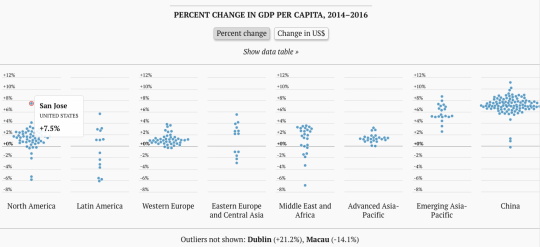
    And here is an interesting interactive chart (better to click through) that shows the % change in GDP per capita. 

    image

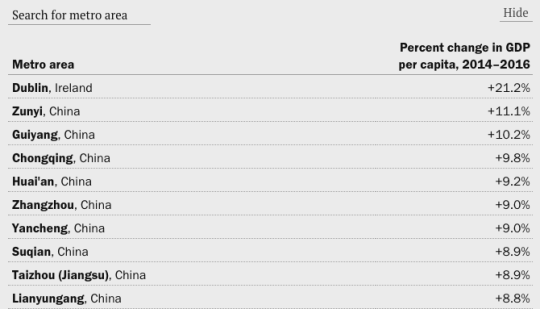
    Look at how much of an outlier San Jose is. Though, check out Dublin in the footnote. And if you look at the actual data table, it is all China, except for Dublin at the top.

    image

    For the rest of the charts, click here. And to download the full Global Metro Monitor report, click here.

  • The City as a Place for People

    The City of London Corporation recently published a report called “The City as a Place for People”, which talks primarily about itself and how great London is as a magnet for talent. 

    But as self-serving as it may be – the report is timed to be ahead of this year’s MIPIM – there appears to be some data and interviews backing up the claims.

    58% of “institutional investors” said that London is the best European city for business. Dublin was next at 22%. 

    A separate survey of 2,568 “corporate decision makers” in Europe revealed that 21% of respondents felt that London was the best European city for business, followed by Paris (13%) and Frankfurt (7%). When asked which city had the best talent pool, the responses were fairly similar.

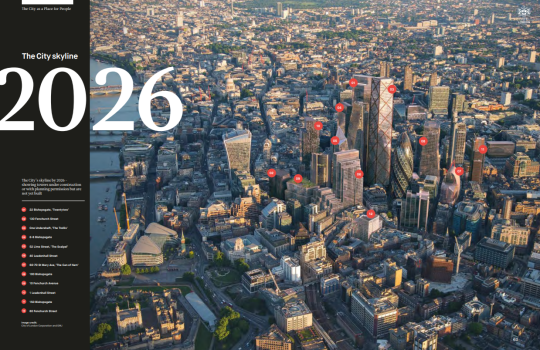
    Also included in the report is a rendering of the City’s skyline by 2026. These are always fun to see. Here is a screen grab:

    image

    It is showing all towers under construction and all towers with their planning permissions in place. If you’d like to download the full report, you can do that here.

  • Just put up a sign

    Back before the 2008 financial crisis, I did a short stint working for a real estate developer in Dublin, Ireland. 

    Most of our projects were in Ireland, but our consultant teams were sometimes from all over.

    One day we were having a meeting with our architect from Germany and we started talking about a particular project’s green space.

    But this wasn’t the sort of green space that was supposed to be actively used. It was a green space that, I guess, you were just supposed to look at and admire for its greenness. 

    So one of my Irish colleagues asked, while referencing the proposed design: “How are we going to keep people off the grass?”

    Our German friends didn’t immediately appreciate the concern and responded with: “What do you mean?”

    Irish: “How will we stop people from walking and hanging out on the grass?”

    German with serious face: “Oh. We will put up a sign.”

    At that point, every Irish person in the room just started laughing and more or less said: “Yeah, that’ll never work.”

    Cultural differences can be subtle.