Daily insights for city builders, delivered every morning at 6 AM ET. I’m Brandon Donnelly — a Toronto-based real estate developer and founder of Globizen. I’ve been writing here since 2013.

Tag: alex feldman

  • Family-sized apartments are a luxury good

    My friend Alex Feldman sent me an article from the Philadelphia Inquirer this week called: Why is it so hard to build family-sized apartments in Philadelphia? As is the case in many/most North American cities, the article talks about how the majority of new multifamily builds are filled with studios and one bedrooms.

    It then goes on to suggest that some of the reasons for this include: cultural biases in favor of suburban living, antiquated building codes (such as the requirement for two means of egress), exclusionary zoning ordinances, bad urban schools, financing availability, and so on.

    This is something that we have talked about many times before on the blog and, while I do agree that it’s complicated and that there are many variables to consider, I think the key factor remains price. As I said before: “Everybody wants a 3 bedroom condo until they see what they cost.”

    So I think this is probably the most important point in the article:

    Partly that’s because Philadelphia, unlike Boston, New York, and Washington, has a vast supply of rowhouses that are still affordable to people in a position to buy. For those who prefer new construction, the past couple decades have seen a burst of modern rowhouse building.

    If large multi-family apartments were more cost effective than Philadelphia’s vast supply of rowhouses, I am certain that demand would increase markedly. But that is not the case. So I think a more accurate way to view large apartments is as a luxury good. They’re a terrific way to live, if you can afford it.

  • Smarter, simpler, happier

    A good friend of mine in Philadelphia just recommended a new book to me by Diana Lind called, Brave New Home: Our Future in Smarter, Simpler, Happier Housing. I haven’t read it yet, so I can’t in good conscience recommend it to you all or comment with any sort of precision.

    But the New York Times seems to think that Diana has convincingly argued that the single-family home is at least partially to blame for a whole host of our societal challenges — everything from economic inequality to loneliness.

    This is, of course, not an entirely new narrative. But it is perhaps a timely read given that we are living through a period of time where loneliness seems to be on the rise and people are allegedly fleeing our urban centers in search of space and distance.

  • City guides in the pre-smartphone era

    I came across this stack of old Wallpaper city guides while reorganizing a few things over the weekend (because that’s what happens on the weekends now). They are pretty beat up and color faded from travel. It looks like these guides are still being published by Phaidon (along with an app), but it’s been well over a decade since I bought one.

    I know the exact time period of the above books because I used to do really nerdy things like date and location stamp them when I got them. The Rome book was July 2007 and I picked it up in Dublin, while I was there working for a real estate developer before the global financial crisis. I also discovered old phone numbers and email addresses written inside of them. Usually it was a Hotmail address.

    What I liked about these guides is that they were fairly condensed — good for a long weekend — and they were generally design-focused — perfect for architecture nerds like me. Their restaurant, bar, and club selections were also just fine as a jumping off point. After that it was up to you to make your own adventure.

    I sent this photo to my friend Alex Feldman over the weekend — he also went without any sleep in Berlin — and he reminded me what it was like at this time. This was 2007. The first iPhone was just being released. Its map functionality was nowhere near what it is today (or didn’t exist). And I certainly didn’t have one. I had a Blackberry with a plastic wheel on the side. It was basically a giant pager.

    To navigate a city at this time meant using a physical map. It also meant getting repeatedly lost and having to ask real people where to go. Alex also reminded me that I made him wander all around Berlin so that I could buy a new pair of glasses. What can I say, this was pre-laser Brandon and I needed cool architect glasses. They ended up being red.

    As frustrating as this must have been at times, there’s something nice about traveling without knowing each and every step and without being able to summon an Uber at any point in time to take you exactly where you want to go. In fact, this is probably the central ingredient of all good travel: you need to allow yourself to be open to new experiences.

    One of the great lessons of Anthony Bourdain was that you have to get out of your comfort zone. Cities have both highs and lows, but there’s real value and authenticity in the lows if you’re willing to engage beneath the surface. Perhaps that is the irony of old fashioned guide books in the pre-smartphone era. They were supposed to tell you exactly where to go, but they actually helped you find the opposite.

    The only city that I never actually got around to visiting from the above stack is São Paulo. As you can tell, Brazil has been on my list for many years. I did make it to Rio de Janeiro a few years ago and São Paulo was supposed to be October 2020. But I’m pretty sure that trip will need to wait. Maybe I should leave my phone at home.

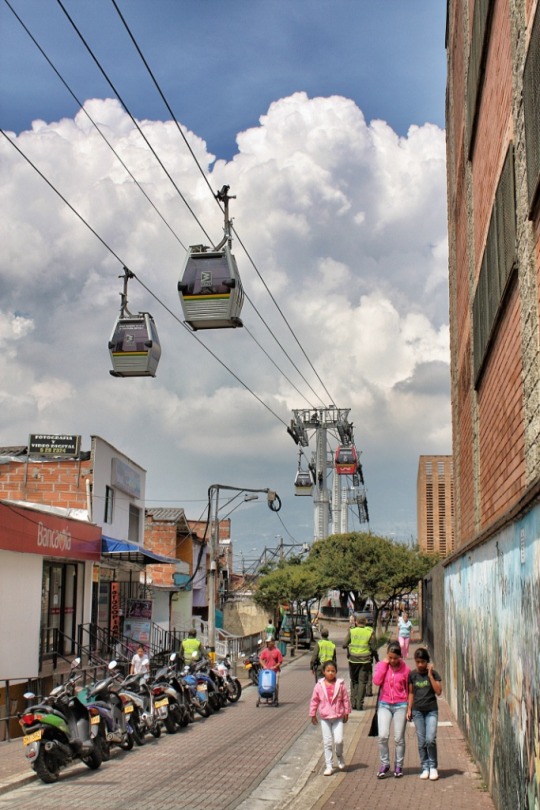
  • How Medellín fixed its slums

    I have written about Medellín, Colombia before on the blog. But the content has mostly come from my urbanist friends. About five years ago, my good friend Alex Feldman — who is a Managing Director at U3 Advisors — wrote this guest post about what other cities could learn from Medellín. He wrote it following a trip to the city for the World Urban Forum.

    I haven’t been to Colombia, but it’s high up on my list. So I enjoyed watching the story of Medellín’s turnaround in this Future of Cities Retro Report. It is the same story that Alex told over five years ago, but that doesn’t make the lessons any less valuable. (If you can’t see the embedded video at the bottom of this post, click here.)

    Eugenie Birch — who is interviewed in the video and who is a professor at my alma mater — hits the nail on the head when she says that a lot of this stuff isn’t rocket science. Look, we know how to lay pipes. We know how to build transportation systems. It comes down to this: Is there the political will?

  • The Life-Sized City

    I just discovered a new video series by TVO called, The Life-Sized City. It’s all about the “anatomy of the modern metropolis.” The first episode – which was released on Sep 13 – is on Medellin and is just under an hour long. I have a feeling that many of you will like this video series.

    Whenever I watch videos like this, it makes me think that I should be starting a city building-focused vlog. I am a big fan of this format. I follow a handful of vloggers. And I think it could be a lot of fun. But sometimes you just have to say no.

    For those of you who aren’t longtime readers, I would also like to point out that my good friend Alex Feldman wrote a guest post on this blog over 3 years ago following a trip to Medellin. It’s about what cities could learn from Medellin’s extraordinary turnaround. If you missed it, click here.

  • Medellín wins 2016 Lee Kuan Yew World City Prize

    image

    Thanks to my friend Darren Davis, I just recently learned about something called The Lee Kuan Yew World City Prize.

    Named after Singapore’s first Prime Minister, the prize is a biennial award that honors cities who have made, “outstanding achievements and contributions to the creation of liveable, vibrant and sustainable urban communities around the world.” Along with the prize comes $300,000 (Singapore Dollars), which is about $287,000 Canadian as of today.

    The 2016 Prize Laureate is Medellín, Colombia.

    Over the past two decades, the city has transformed itself from one of the most dangerous cities in the world to one that has become a model for social inclusion and urban innovation. Here is a video that talks about the transformation. It’s a bit cheesy, but it does provide a high-level overview of their urban initiatives. A lot of them will serve as a reminder about the importance of urban connectivity.

    If you’re a regular reader of this blog, you may also remember that my good friend Alex Feldman (VP at U3 Advisors) wrote a guest post about Medellín after he visited the city for the World Urban Forum almost two years ago. That post was called, What cities could learn from Medellín.

    It’s worth mentioning that the runners-up for this year’s World City Prize were Auckland, Sydney, Toronto, and Vienna. In the case of Toronto, our “far-from-ideal transit” was specifically called out as a negative. Thankfully we are now working on road pricing, which will provide additional funding for transit. 😉

    Image by Jorge Gobbi

  • 10 reasons to visit Philadelphia right now

    image

    Today’s ATC post – which happens to be a guest post – is coming to you live from on board the UP Express train that runs from Union Station in downtown Toronto to Pearson Airport. (Everywhere should have free wifi.)

    I’m on my way to Philadelphia and I’ve been wanting to try this train since it opened earlier this summer. It feels great to finally ride it. It’s everything I could have hoped for. It even has that new car smell 🙂

    Last month I wrote a post called, 10 reasons to visit Toronto right now. It was in honor of my good friend Alex Feldman’s visit. Well now it’s my turn to visit Philadelphia and he has decided to return the favor and do a Philly version of that same post. 

    Alex is to Philadelphia what I am to Toronto. He grew up in Philly. He was educated in Philly (we went to Penn together). And he’s super passionate about the future of Philly. And I think that’s how everyone should be about their city.

    So I hope you enjoy his list of 10 reasons to visit Philadelphia right now. It’s basically my to-do list for this weekend.

    ———————————————

    10. World Heritage City: Philadelphia is on track to become the first World Heritage City in the United States. This UNESCO designation will underscore the city’s historic importance as the birthplace of American Democracy as well as the historic urban fabric which gives the city it’s walkable, urbane character.

    9. Shopping: Philadelphia has come a long way as a shopping destination. Conde Nast Traveler recently ranked the city as number 2 out of the best shopping destinations in the world. 3rd Street in Old City has become a hotbed for independent boutiques while Rittenhouse Square has attracted new chains such as Uniqlo, Theory, and Vince. More is on the way with a complete re-make of the Gallery shopping mall slated to start soon and the new East Market complex under construction. 

    8. The Pope is Coming:  In case you haven’t heard, Pope Francis will make his first visit to the United States – with a 3 day visit to Philadelphia in late September. The visit will coincide with the World Meeting of Families gathering. A crazy number of visitors (2 million?) are expected to descend on the city – causing Philadelphians to panic, complain, and attempt to rent their houses for ridiculous amounts of money. But this important visit will help raise the profile of the city on the international stage.

    7. Building Boom: There is probably more development happening in Philadelphia right now then any other time in recent history. The skyline is growing with additions by Norman Foster, Cesar Pelli , and Kohn Pedersen Fox. New apartment buildings, condos, and rowhouses are under construction across the city (rental vacancy rates are less than 2%). In addition the Barnes Foundation and the new Singh Center for Nanotechnology mark impressive additions to the city’s architectural landscape.

    6. Public Spaces: Philly’s public realm has seen massive investment over the last several years. A complete remake of the landscape outside of City Hall has become the new Dilworth Park. The designers of NYC’s highline have added two public spaces to the city (Race Street Pier and the new Central Green in the Navy Yard). And Schulkill Banks recently added a new boardwalk which the New York Times raved about when they ranked Philly as the number 3 city to visit in 2015. More is on the way with the first phase of the Reading Viaduct Rail Park expected to start soon.

    5. Waterfront: Philadelphia’s Delaware River waterfront has long been cut off from the city by interstate 95. Things have started to change recently, with new trails and pier parks recently added to the working waterfront. Even Penn’s Landing, the city’s much maligned waterfront attraction is seeing improvements – including the tremendously popular Spruce Street Harbor Park – a pop-up park featuring floating beer barges, shipping container food stands, and tons of hammocks.

    4. Food: Philly is one of the best food cities in the United States. So much is happening right now in the city’s dining scene, it’s hard to keep track of the latest restaurant openings. Neighborhoods such as Fishtown and East Passyunk have emerged as hot dining districts with BYOB chef driven restaurants. More can be gleaned from the Washington Post which recently summarized the dining scene better than I can.

    3. Pop-up Gardens: One of the best reasons to visit Philly in the summer is the opening of the Pennsylvania Horticultural Society Pop-Up gardens. The wildly popular beer gardens, began several years ago as an initiative to remake underused or vacant lots into useful public spaces. This summer, 2 gardens – one on 15th and South and one at 9th and Wharton have been transformed into vibrant spaces for eating, drinking, and hanging out.

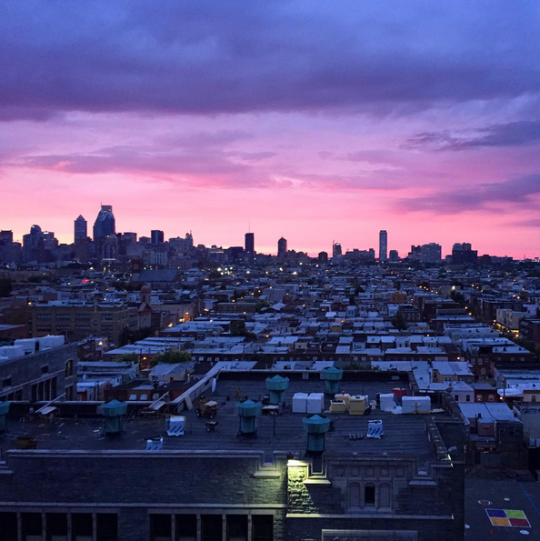
    2. Le Bok Fin: Speaking of temporary uses, the most recent addition to Philly’s pop-up (or iterative placemaking) scene is a rooftop bar called Le Bok Fin. Situated on the 8th floor of an old vocational high school in South Philly (and named after the school’s restaurant – which in turn is a play on one of Philly’s most famous French restaurants). This is the first iteration of development at what is planned to become an amazing new center for creatives inside the old school – being led by Lindsey Scannapieco and her team at Scout LTD. Check out Le Bok Fin for incredible views of the city skyline (especially at sunset).

    1. Bike Share: While a little late to the party, Philly recently launched it’s own bike share program – which is proving to be a huge success. Dubbed Indego, the new bike share is easy to use, has 60 stations, more than 600 bikes and is becoming one of the best ways to hop around town. Check one out and go explore Philly!

    Image: Alex Feldman

  • Atlantic City is the next Detroit

    If you have been following the headlines over the past year, you’re probably aware that Atlantic City — the “Gambling Capital of the East Coast” — is in trouble. This year alone, 4 casinos shut their doors – including Revel, which only opened in 2012.

    To be perfectly honest with you, gambling isn’t my thing. I’ve only been to Atlantic City once, and it was really just so that I could say I had been (it was when I used to live in Philadelphia). But I know that many people derive a lot of entertainment value out of gambling.

    However, I worry when cities starting believing that a casino can fix all of their city building and economic development challenges. They are not a silver bullet. And many would argue that they cause far more harm than potential benefit. The negative socioeconomic impacts have been well documented.

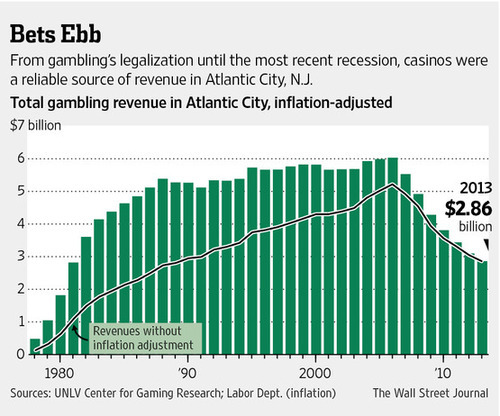
    In the case of Atlantic City, I suppose you could say that casinos “worked” – for awhile. But that’s because Atlantic City had a monopoly on gambling. In 1978 the city opened the first legal casino in the eastern United States. And that led to a boom in casinos and a spike in municipal revenue. But those revenues peaked in 2006 and have been on the decline ever since. 

    My good friend Alex Feldman argued in a recent Next City article that Atlantic City is, quite frankly, the next Detroit. It repeated the same mistakes and now it’s going to need to go through the same painful rebuilding process:

    It’s no exaggeration to say that Atlantic City is poised to become the next Detroit. In many ways, the trajectories of the two cities are similar. Both cities relied on one industry to prop up their economies — and both failed to innovate as competition increased. Similarly, both Atlantic City and Detroit failed to invest in a sense of place — casinos and factories were more successful when their customers and employees had little reason to go outside. The result: defensively built cities designed around the automobile that gave visitors little reason to stay.

    And I think he’s right. The time has come to rethink Atlantic City. Onwards!