Daily insights for city builders, delivered every morning at 6 AM ET. I’m Brandon Donnelly — a Toronto-based real estate developer and founder of Globizen. I’ve been writing here since 2013.

Tag: downtown

  • Rethinking downtowns to improve urban mobility

    Jarrett Walker of Human Transit recently published an interesting post talking about downtowns. His argument is that we shouldn’t be planning our transit networks around the traditional notion of a single-centered city.

    Here’s a snippet:

    So growing a single downtown isn’t the key to becoming a great transit city. Quite the opposite, it’s best to have a pattern of many centers, all generating high demand, and supporting balanced two-way flows between them that let us move more people on less infrastructure.  This is the great advantage of Paris or Los Angeles or the Dutch Randstad over Chicago or Manhattan.

    Now, there are many cases where a singular economic center still dominates an urban region. See downtown Toronto. And many will argue that the current economic environment is creating more, rather than less, concentrated urban spikiness.

    But at the same time it is quite clear that many of our cities have shifted away from a monocentric model to a polycentric one. 

    I mean, just look at all employment nodes that have developed across the Toronto region. The idea that everyone comes downtown in the morning and then leaves in the evening has become an anachronism for many. Early in my career I spent 4 years commuting from downtown to the suburbs.

    So what is happening is that our cities need to start performing more like point-to-point networks. This isn’t a new thought. But it’s a lot harder to execute on compared to what many cities have been used to. 

    You need a critical density of both residents and employers and the right kind of connectivity to create a true “mobility hub.” In Toronto, you could argue that we really only have one of those and it’s centered around Union Station.

    But I think that will change for many cities. And when we do get it right, we will be doing a lot to improve the crippling traffic congestion that so many of our cities are suffering from.

  • A sports and entertainment corridor

    On Sunday afternoon I went to see the Blue Jays. It was the last home game of the season before the postseason and the only game I’ve gone to see this season. (Thank you Chris for the ticket.)

    And what a last game it was. 

    We won 5-4, but we hustled for the win. We squeaked it out at the end with a pinch runner that stole 2nd base (and then tied the game in the bottom of the 8th) and with Josh Donaldon’s walk-off home run in the bottom of the 9th with 2 outs. I’m pretty sure the Jays were hungover from celebrating their first playoff berth in 22 years – that’s why it was so close. It certainly made for a gripping finish though.

    After the game everybody was jazzed up and spilling out onto Bremner Blvd in front of the Rogers Centre. I’m not sure if it was premeditated or not, but the entire street was closed to cars. And it reminded me of something that I’ve thought for years: that Bremner Blvd should be made into a kinds of sports and entertainment corridor connecting the Rogers Centre in the west with the Air Canada Centre and Maple Leaf Square in the east.

    Bremner is not a long street. But it connects the place where Canada’s only (MLB) baseball team plays and where Canada’s only (NBA) basketball team plays. Right now it’s a fairly nondescript street. But it doesn’t have to be that way. It could be something really special.

  • How Melbourne reinvented itself one block at a time [Video]

    https://500px.com/embed.js

    Melbourne is famous in urbanist circles for the revitalization of its central area. In 1992, 40% of the buildings were empty above the first floor and only 5 (yes five) residents actually lived in the core. Everyone had fled to the suburbs and the city had hollowed out.

    Today, there are over 29,000 residents in the central area and Melbourne has become revered around the world for its vibrant public spaces and innovative laneway repurposing. 

    Here’s a quick 11 minute video that explains how they did it (via The Urbanist). Click here if you can’t see it below.

    [vimeo 131396094 w=500 h=281]

    What is clear from the video is that it took a lot of work convincing property owners and getting them to buy into the vision. Being able to repurpose the laneways often meant punching through blank walls at the base of buildings. And so there was pushback.

    Here in Toronto I’ve heard people say that we’re not Melbourne and we shouldn’t expect to have similar kinds of urban spaces. Well guess what, neither was Melbourne in the 1980s and 1990s. It was a dying city. But they made it happen.

  • Guest Post: Three minutes that rule the world – Will demolishing the Gardiner East actually make traffic worse?

    Today on Architect This City, we have a guest post by Darren Davis, who is a transport planner in Auckland, New Zealand. He’s a regular commenter on this blog, and I know he’s been following the Gardiner East debate quite closely – as many urbanists around the world are. I appreciate him offering and taking the time to write this piece. Thank you.

    ——————————–

    The decision this month on whether to demolish the Gardiner East Expressway and replace it with a surface boulevard or to rebuild it with a similar elevated structure will be a watershed moment for Toronto, akin to the decision not to have freeways in the urban core of Vancouver in the late 1970s.

    There are numerous good reasons why removing the Gardiner East elevated structure is the right move for Toronto, covered previously by The Globe and Mail and in the Council for Canadian Urbanism’s open letter to Toronto City Council. If you aren’t aware of these, I strongly recommend reading them. 

    Also of note are two things:

    1. Just 3% of Downtown commuters drive on the Gardiner Expressway East, a tiny fraction of the 68% who arrive Downtown on public transit.
    2. The “remove” option does not reduce traffic capacity over the “hybrid” option but could reduce travel speeds in uncongested conditions (read on for why I don’t think that this will happen in real life).

    However, one element of this debate that has not got much airtime is the transportation modelling that claims an additional two to three minutes travel time with the “remove” option over the “hybrid” option which retains the elevated expressway in a slightly modified form. 

    Toronto Mayor John Tory has stated that "I didn’t get elected to make traffic worse. And let’s be clear, removing that piece of the Gardiner will almost certainly make traffic worse.” But is it in fact true that demolishing the Gardiner Expressway East will make traffic worse as the transportation modelling claims?

    The key thing to understand is that transportation modelling, which tries to predict future travel times, is the product of a bunch of assumptions which may not in fact be borne out in real life. 

    For example, the effect of induced traffic, where additional traffic capacity leads to additional traffic being attracted to the route, is reasonably well known but generally not factored into transportation modelling. Induced traffic happens because increased travel speeds attracts traffic that would have otherwise avoided the route at congested times; attracts people to drive where they previously used other modes and encourages trips that would not otherwise have taken place. The effect of induced traffic is to quickly nullify the benefits of adding traffic capacity.

    However, what is less well known is that the reverse happens where there is either a reduction in traffic capacity (not the case in Toronto as the “remove” option retains the same traffic capacity) or speed.

    This is because in this situation, four things happen:

    1. Some travel re-routes. The “remove” option with a widened Lakeshore Boulevard as part of the street grid simply gives more ability for traffic to re-route away from congestion over an elevated expressway structure where drivers are literally trapped until they reach their exit.
    2. Some travel re-times. Some people will retime trips to avoid congested travel times, such as starting and/or finishing work at less congested times.
    3. Some travel changes mode. Some people will be encouraged to change mode by the perceived worsening in traffic conditions.
    4. Some travel is avoided entirely. Some people will choose not to travel at all in the peak of the peak. For example, this could take the form of working from home or shopping on the internet instead of by car.

    Transportation models only take into account the first item but not the others. The modelling is also sensitive to traffic growth assumptions and assumed mode split and trip distribution. Often transportation models assume continued growth in car travel even though per capita kilometres travelled peaked about a decade ago.

    While this may all sound well and good theory, does this actually happen in practice?

    In Auckland city centre, we have extensive experience with the reallocation of road space away from general traffic. Many busy key city centre approach routes have had general vehicle lanes reduced to make way for bus lanes (which generally carry around 65-70% of the people moving capacity of the street). 

    This has involved up to a 50% reduction in private vehicle capacity (whereas in Toronto, the “remove” option retains the same traffic capacity but may slow throughput). Auckland has done two of these in the past twelve months – both involved converting a general traffic lane to a bus lane. 

    Don’t get me wrong: There is sometimes pain at implementation with about a three week period of congestion as car drivers adapt to the new reality – and most likely negative media coverage will accompany this. But after about a month, equilibrium will be restored and life will continue much as it did prior to the change. 

    Part of this is that there will be various “optimisations” during this introductory period where signal timings are adjusted and other tweaks made – the sort of tweaks that can only be fine-tuned in a real world situation. But a bigger part of this is that the four factors above – re–routing, re-timing, mode change and avoided travel – come into play.

    I cannot overemphasise enough that life will return to normal surprisingly soon if the Gardiner East Expressway is demolished and replaced by a widened Lakeshore Boulevard.

    My advice

    When people talk about two to three minutes of extra travel time, take the foregoing into account and take those claims with the very big grains of salt that they deserve. If Toronto makes the right choice and chooses the “remove” option, my bet is that the biggest surprise of all will be how little difference it makes to peak travel times for the 3% of Downtown commuters who used to use the Gardiner Expressway East.

    Disclaimer

    The author of the above post is an employee of Auckland Transport, however, the views, or opinions expressed in this post are personal to the author and do not necessarily represent the views of Auckland Transport, its management or employees. Auckland Transport is not responsible for, and disclaims any and all liability for the content of the article.

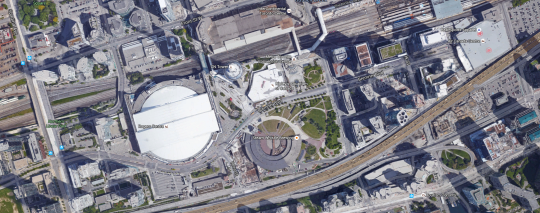
  • The infrastructure sandwich

    Today I came across the following tweet by Brad Tabke. (Brad is the mayor of Shakopee, Minnesota.)

    //platform.twitter.com/widgets.js

    On the left of the image is downtown Memphis. On the right is the Mississippi River. And in the middle is, well, a bunch of elevated highways. 

    It’s a powerful image regardless of where you happen to be from. But if you’re from Toronto, you might know why I’m posting it today.

  • A new chapter

    Photograph St. Lawrence by Ralph Sobanski on 500px

    St. Lawrence by Ralph Sobanski on 500px

    I have an announcement to make on Architect This City today.

    Next week I’m joining the development team at CAPREIT (TSE: CAR.UN) here in Toronto. CAPREIT is one of Canada’s largest residential landlords. They are a growth-oriented real estate investment trust with over 41,839 residential units in major urban centers across both Canada and Ireland.

    They also happen to be headquartered in the St. Lawrence Market area, which means I now live and work in the same neighborhood. As we discussed here, location matters a lot.

    So here’s to a new chapter. I’m looking forward to diving into the multi-family business. Change is good.

  • Moving downtown

    Last month it was announced that Amazon will be taking 127,000 square feet across 5 floors in a new office tower in Toronto’s emerging South Core neighborhood. The space will be used for about 800 employees and they’re expected to take occupancy this fall.

    At the same time, I learned that Amazon will be joining Apple (positioned 6 floors below them in the same tower) and Cisco in South Core.

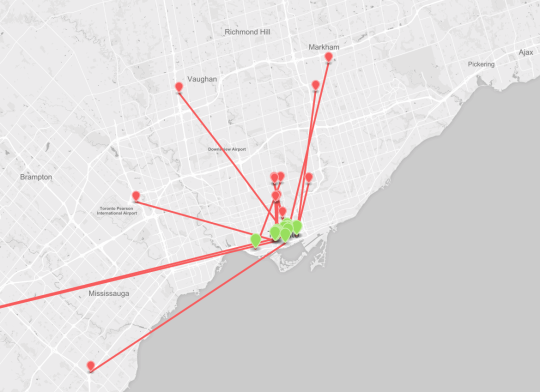
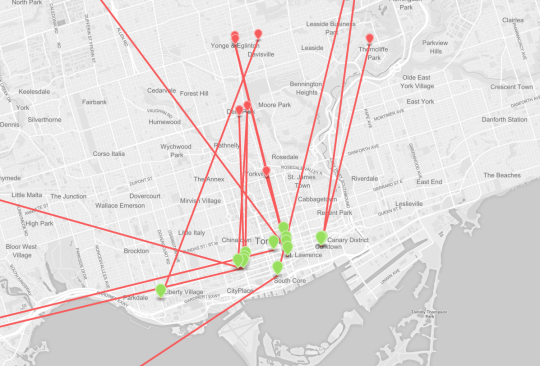
    On top of all this, a friend of mine then tweeted out a list of major tenant re-locations here in the city. The data is from CBRE and the timeframe is from 2009 to 2014 (Q1).

    The first thing I noticed when I looked at the data is that there’s a clear trend towards downtown. Perhaps that was the point of the study, but it’s still interesting nonetheless. 

    From Google and Deloitte to eBay and Aol, every single tenant in the CBRE list is or will be moving downtown (or to the shoulders of downtown).

    Here’s what that looks like from a regional scale (red marker is where they were; green marker is where they are going):

    image

    And here’s what it looks like zoomed in closer:

    image

    This, of course, is a trend that has been happening for years. But I still think it’s worthwhile repeating how clearcut it seems to be. 

    Companies know that their greatest asset is human capital. And they have quickly realized that a lot of young smart people want to live and work in dense walkable communities. They’re simply moving to where people already want to be.

    So here’s a question for the Architect This City community: On a scale of 1 to 10, how important is a company’s location when determining whether or not you’d like to work for them? Let’s talk about it in comment section below.

  • From suburban houses to downtown condos

    Last Friday the Financial Post published an interesting article talking about Mattamy Homes and the new office that its founder, Peter Gilgan, is in the process of opening up downtown in the Toronto-Dominion Centre (which just so happens to be my favorite office complex in the city).

    At 64 years old, Peter recognizes that his company has changed and the world has changed. He he himself recently moved downtown and now he’s bringing his company with him.

    “Our Oakville office [a western suburb of Toronto] is a reflection of what our business was 25 years ago,” he says. “We were a local, west-end Toronto builder. Now we’re the largest home builder in Canada and we’re the largest private home builder in all of North America.”

    Come September he will move his finance, legal, IT, human resources and strategic marketing team —  about 100 of Mattamy’s 1,100 staff — into the new downtown digs. He wants to attract “the absolute best talent.”

    “The young people seem to really want to work down here. So that’s one reason. The other thing is to make sure the business has the capital to move forward and expand. Well, where’s the capital? It ain’t in Oakville.”

    This of course isn’t a new thing for suburban homebuilders. Many in Toronto have made the switch – or at least expanded – from suburban houses to downtown/urban condos. And I’m assuming that’s what is going to happen here.

    Still, it’s fascinating to see this trend continue. Young people really do want to live and work “down here.”

  • Architect This City x Porter Escapes (in Québec City)

    Towards the end of last year I received a one line email from a reader asking me what I thought about Porter (the airline that operates out of Toronto’s island airport downtown).

    I followed suit and responded with one line: “I’m a big fan.” I then pasted a few links to posts I had written where I talked about Porter, the island airport, and why I think they are good for Toronto.

    It turns out that was the right answer 😉

    Because today I’m excited to announce a fun collaboration between Architect This City and Porter Escapes. This weekend I get to explore Québec City and do something I love to do, which is photograph cities, think about cities, and write about cities. (And eat poutine.)

    Here are my travel essentials for the weekend (I wish it was a better photo):

    image

    The first thing I should tell you though is that Porter Escapes is different than simply Porter. Porter Escapes is their “packaged vacation” company, so it’s designed for people who want a simple way to book entire getaways (flight, hotel, activities, and so on).

    In my case, I’m going to be staying at the Château Laurier. I also have a bunch of activities planned out for Saturday during the day. Stay tuned.

    I had initially planned to squeeze in some snowboarding at Le Massif and try out the nicely branded train that goes from Québec City right to the mountain. But my back and shoulder are still tender from my spill in Banff.

    Still, I hope you’ll follow along on Twitter, Instagram, and Snapchat, and using #PorterEscapes. And if you happen to be in Québec City this weekend, let’s grab a pint and poutine.

    I’ve also been told that Porter Escapes will be launching a special promotion over the next few days for escapes specifically to Québec City.

    Note: I’m supposed to tell you that it’ll be at a price point that you should never expect to see again (i.e. it’ll be a steal).

    Happy Friday 🙂

  • What’s your complete neighborhood?

    Photograph Toronto - St Lawrence Market by Chris Dufresne on 500px

    Toronto – St Lawrence Market by Chris Dufresne on 500px

    This past Saturday night I was out with a few friends in my neighborhood (St. Lawrence Market area). And I was delighted to see how busy it was. Virtually every bar or club we walked by had a line down the street.

    Being the city geek that I am, I started thinking about two things: (1) how often I get localized to my neighborhood (I have data to back this up) and (2) what makes a “complete neighborhood”, such that you’re even able to be localized?

    In some ways the idea of a “complete neighborhood” is universal. Everybody needs a grocery store and access to food, for example. But in other ways, a “complete neighborhood” is very much a personal thing – you want goods and services that are important to you.

    So today I thought I would do a quick breakdown of the goods, services, and amenities that I really value in my neighborhood and that I think make it more or less “complete.” This list is a combination of universal and personal choices in no particular order. At the end, I summarize some of the things I wish I had.

    What I have:

    • A 5-10 minute walk to subway and streetcar
    • A 24/7 grocery store
    • A world famous food market (St. Lawrence Market)
    • Staple coffee shops (Starbucks and Balzacs)
    • Lots of restaurant and food choices (including decent Mexican, one of my favorite foods, and Pho, for when I feel a cold coming on)
    • 2 drugstores (Shopper’s Drug Mart and a new Rexall)
    • A great gym that’s less than a 10 minute walk away
    • An outdoor/athletic store that also fixes bikes
    • Cool local bar (AAA) where I can watch the Raptors (because I don’t own a TV)
    • After work bar with a good Happy Hour (Pravda)
    • Patios for the summer (all along the Esplanade)
    • All the major banks
    • Nearby recreational amenities (bike trails, waterfront, etc.)
    • Local employment base (Wattpad, BNOTIONS, etc.)
    • Great architecture (from Daniel Libeskind to the classics)
    • High walkability

    What I wish I had:

    • Less chains and a few more independent businesses
    • A hip indie coffee shop where the (male) staff have waxed moustaches
    • A good takeout sushi place
    • A pool that I could walk to (I ride my bike to Regent Park)
    • A liquor store with longer hours (but alas this is Ontario)

    Those are my working lists. What would create a complete neighborhood for you? And how does your current neighborhood hold up?