Daily insights for city builders, delivered every morning at 6 AM ET. I’m Brandon Donnelly — a Toronto-based real estate developer and founder of Globizen. I’ve been writing here since 2013.

Tag: development

  • Bringing laneway suites to Toronto

    This morning I presented and sat on a panel at BILD called “bringing laneway suites to Toronto.” The other participants were Councillor Mary-Margaret McMahon, George Pantazis (Planner at the City of Toronto), Mike Collins-Williams (Director, Policy at OHBA), and Andrew Sorbara (co-founder of Lanescape).

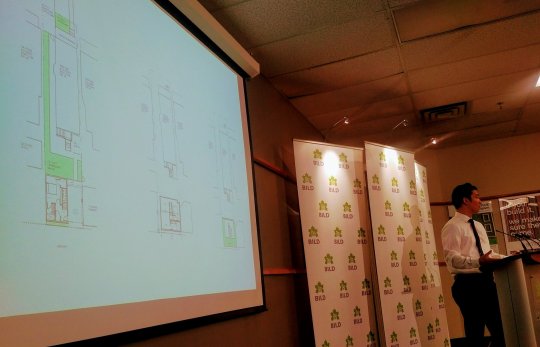
    Here is a photo that Mike took of me while I was talking about my failed laneway house:

    image

    For those of you wondering if/when this will happen in Toronto, here are the key takeaways from this morning: The city is already drafting laneway suite policies specific to Toronto & East York (not the other parts of the city) and they are due to report back to council in Q2-2018. Nothing is 100% certain at this stage, but there’s lots of optimism. 

    Councillor McMahon delivered this morning’s opening remarks and I was impressed by her deep commitment to laneway suites. I was also impressed by her stance on NIMBYISM, saying that education is important and that we can’t let NIMBYs stop what makes sense for the greater city.

    She gave the example of the 6 storey condominium in her ward that faced fierce community opposition a number of years back. If you can’t put a midrise building on a main street in this city, where can you put it? 

  • A cohousing case study

    There’s a lot of interest right now in micro apartments. Here is a recent example from New York City. Generally speaking the model is driven by a need to increase housing affordability: shrink the apartments; lower the prices. 

    To compensate for these smaller units, the buildings are often equipped with larger shared spaces and a desire to create a sense of community.

    The below TED talk by architect Grace Kim is an interesting case study of a project that started, first, with a desire for cohabitation. Her thesis is that cohousing can make us happier, less lonely, and more socially connected.

    The cohousing community that she profiles is one that she both designed and developed and one that she now lives in and practices architecture out of.

    If you can’t see the video below, click here. It’s only 10 minutes. After you’ve watched it, let us know in the comment section below if this is a community you could see yourself being a part of.

  • Locals hate you

    BlogTO recently reported that “snarky anti-condo signs” have been popping up around Toronto. Here is one of them via Instagram. It reads (in all caps): Dear Condo Dwellers: Locals Hate You Go Fuck Yourself

    I find these posters curious, though it is obvious that they are a reaction to growth, intensification, and general change in this city.

    For one, it implies that condo dwellers and locals are mutually exclusive. In other words, “locals” don’t live in condos. Presumably the implication is that they live in low-rise grade-related single-family housing. Or maybe they live in rental housing? Is it a tenure thing?

    According to the latest 2016 Census data, just over 26% of private dwellings in Toronto are condominiums. And about 30% of people live in a building that has 5 or more storeys. If you include “apartments” less than 5 storeys, this latter number jumps to 40%. So many potential non-locals.

    However, it could be that these posters are primarily directed toward new condos and new condo dwellers. This poster seems to have been plastered in front of this recently completed condo building on College Street.

    If that is the case, then I wonder if there is a temporal cut-off for the hate. For example, the condo building that houses (at its base) my regular grocery store was completed in 1983. 

    The units are large and the demographic seems to skew a bit older. Are these condo dwellers – some of which may have been there for over 3 decades – to be hated? Are they non-locals? Or does urban myopia set in after awhile and they become locals?

    At the same time, it wouldn’t be unusual for the residents of an older condo building to oppose a new proposed condo building. So perhaps “local” isn’t about building typology and it’s more about who came first. That’s certainly a tricky one. Better end here.

    A curious poster that could use a bit more specificity. What do you make of it?

  • How to make money with low-risk licensing deals

    image

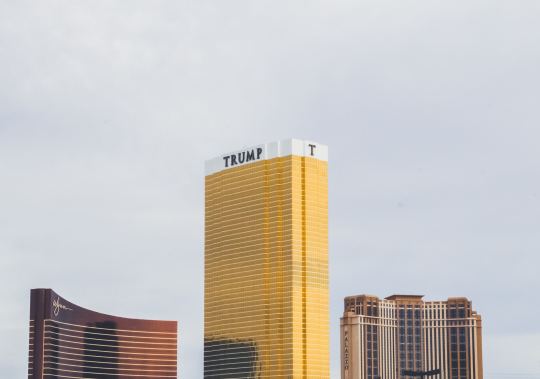
    This morning the Toronto Star published a detailed autopsy of the failed Trump International Hotel and Tower Toronto. It outlines the players, the investors, and what supposedly went wrong. Of course, the headline is all about how Trump managed to make money from the deal – through his well-publicized licensing business – even though the project went bankrupt.

    At the beginning of this year, the Washington Post reported that Trump’s name had been licensed and linked to over 50 properties and that these contracts have earned him at least USD$59 million in revenue. Outside of the US and Canada, the Trump Organization has (or had) deals in Brazil, Turkey, Azerbaijan, India, Indonesia, the UAE, and so on.

    There would have been more money to be made in the actual development of these properties, but the beauty of these licensing deals – for Trump – is that they are “low-effort, low-risk, high-reward.” In fact, this past summer it was reported that the breakup fee at Trump Toronto – the fee to exit all contracts with the Trump Organization – was at least $6 million (guessing that’s in USD).

    This story is not unique to Toronto. And so I have got to believe that there’s major brand dilution happening here. Does the Trump name really bring credibility to projects in some markets? How sustainable is this licensing business? 

    The only other thing that I would add to the Toronto Star article is that the hybrid condo-hotel model has proven to be difficult in this city. It’s perfectly fine to have residential condos and a hotel in one tower. There are lots of successful examples of those. But when the condo units can be put into a hotel pool (and there’s an IRR expectation on the part of individual owners), many seem to have been disappointed.

    Part of the challenge with this model here in Toronto is that the condo-hotel units typically end up with a commercial property tax rate, which, in this city, is much higher than the residential rate. This can suppress values.

    Photo by NeONBRAND on Unsplash

  • The neighborhood of the future (part 2)

    I have been traveling since the weekend and so I am behind on my reading. One of the benefits of writing this blog every day is that I am forced to read as much as I can. I have to be a sponge.

    Right now, I am still reeling in excitement over the Sidewalk Toronto announcement and getting caught up on that reading. 

    This week Sidewalk Labs published the entire vision section of their RFP response to Waterfront Toronto. This is the response that won them the Quayside partnership. It’s 196 pages and can be downloaded here.

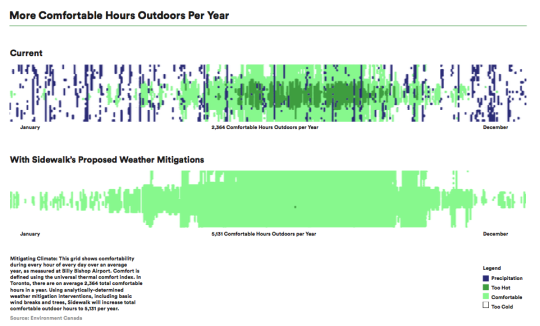
    I’m still making my way through the package, which I am obviously going to do, but I thought this was a great diagram:

    image

    As is stated in their RFP response, inclement weather affects pedestrians and cyclists more than drivers. Toronto’s most notable response has been our PATH system, which pulls both people and retail below grade, away from the elements.

    But Sidewalk’s research suggests that with the right wind, sun, and precipitation strategies, they may be able to 2x the number of comfortable outside hours per year here in Toronto. That’s what the above diagram shows.

    Of course, there is so much more in their RFP response. But I need more time to digest it all. I’ll be sure to report back to all of you once I have done that. If you don’t feel like going through all 196 pages yourself, you can watch this 4 minute YouTube video instead.

  • Supply-side toolkit for greater housing affordability

    image

    McKinsey Global Institute just published a “supply-side toolkit” for cities struggling with housing affordability. This seems to be every successful city.

    The article includes a long list of potential tools. Some of them you may agree with. And others you may disagree with. But I am sure that many of them will be familiar to you. One of the tools in the toolkit is accessory dwelling units.

    Of course, the overarching theme is that housing supply has not and is not keeping pace with housing demand:

    California, for instance, added 544,000 households but only 467,000 net housing units from 2009 to 2014. Its cumulative housing shortfall has expanded to two million units.

    Another one of the tools in the toolkit is “overcoming NIMBYism.” Here is an excerpt:

    People who come to a city to work need to be able to find an affordable place to live there. But the voices of existing homeowners who want to preserve the status quo often drown out those of newcomers, young adults, low-income service workers, and renters who need more housing. After a 2009 audit found that neighborhood councils were not representative of the city’s broader population, Seattle replaced these bodies with a central Community Involvement Commission that includes mayoral and council appointees chosen to represent a broader set of stakeholders.

    I am intrigued by Seattle’s move to create a central body and a new approach to public engagement – one that moves away from local district-councils. However, it appears that this Community Involvement Commission is still very much in its infancy.

    If any of you are familiar with the Seattle market, I would be curious to hear your thoughts on it in the comment section below. I am, however, going to spend some time reading up on it.

    For the full toolkit, click here.

    Photo by Sarah Brink on Unsplash

  • Sidewalk Labs, Amazon HQ2, and the Milanese Leonardo

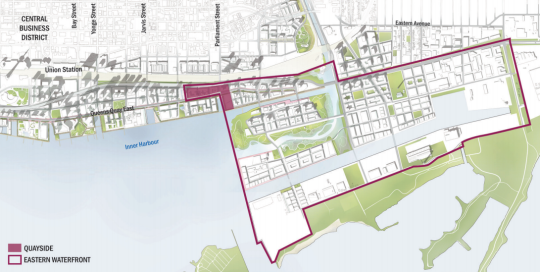
    Earlier this week the WSJ announced that Sidewalk Labs (Alphabet Inc.’s urban innovation organization) is close to a deal with Waterfront Toronto to develop a new 12-acre section of the eastern waterfront. Sidewalk Labs would be their innovation and funding partner. It’s not final yet and it’s still subject to board approval, but the sentiment is that it should go.

    There aren’t a lot of details about the project – other than the fact that it will be fairly big, up to 3 million square feet – but the overall intent is digital city building. It’s about imagining what a city could be if you built it today “from the internet up.” More info about Sidewalk Labs, here.

    I thought of this project as I read Seth Godin’s daily blog post this morning in bed. Here are two snippets from that post:

    When a new technology arrives, it’s often the nerds and the neophiliacs who embrace it. People who see themselves as busy and important often dismiss the new medium or tool as a bit of a gimmick and then “go back to work.”

    There’s never a guarantee that the next technology is going to be the one that moves to the center of the conversation. But it’s certain that a new technology will. It always has.

    Openness matters.

    I’m anxious to learn more details about the project, but this is obviously very exciting. It also creates momentum and strengthens the case for Amazon HQ2 in Toronto. The above 12-acre Quayside area is only the tip of the iceberg. There’s the rest of the eastern waterfront and also East Harbour.
    image

    Some people have been critical of this city’s push for Amazon HQ2. Anthony Lacavera, chairman of Globalive Capital, called this “the biggest Trojan Horse of all time.” His view is that Amazon would simply use HQ2 Toronto as a mechanism for cheaper labor (USD > CAD) and to siphon the best and brightest down to the US.

    Now, I agree that it would be more impactful to create the next Amazon then to simply lure in its second headquarters. Big entrepreneurial successes are what fuel the darwinian evolution of startup hubs. The founders, early employees and investors make boatloads of money and then they start reinvesting that back into the ecosystem by, among other things, backing the next generation of entrepreneurs.

    But does this necessarily mean that an Amazon HQ2 would be detrimental to Toronto by acting as a conduit to the US? Will it discourage entrepreneurship? Should we eschew all US firms out of fear that this may in fact happen? I don’t think so.

    There’s tremendous value in concentrating smart people in one place – ideas build on ideas. And I don’t think technology has been able to disrupt that, at least not yet. One example of this is a theory that Paul Graham calls the Milanese Leonardo:

    You can see how powerful cities are from something I wrote about earlier: the case of the Milanese Leonardo. Practically every fifteenth century Italian painter you’ve heard of was from Florence, even though Milan was just as big. People in Florence weren’t genetically different, so you have to assume there was someone born in Milan with as much natural ability as Leonardo. What happened to him?

    And his reasoning is as follows:

    Nothing is more powerful than a community of talented people working on related problems. Genes count for little by comparison: being a genetic Leonardo was not enough to compensate for having been born near Milan instead of Florence. Today we move around more, but great work still comes disproportionately from a few hotspots: the Bauhaus, the Manhattan Project, the New Yorker, Lockheed’s Skunk Works, Xerox Parc.

    Xerox Parc (Palo Alto Research Company) is a great example of the kind of positive externalities that can happen as a result of smart people being in close proximity to each other while they wrestle with similar problems. It has been well documented that it was Steve Jobs’ visit to Xerox Parc that inspired many of Apple’s early innovations.

    So my view: let’s increase Toronto’s urban metabolism and make it the Florence of 1450.

    Ed Clark – who is leading the charge for HQ2 in Toronto – has been clear that large taxpayer subsidies are not on the table for Amazon. That would not be fair to the existing companies in this city. If that is what it is going to take, then we are not going to win. We will win based on our city, our human capital, and our openness to the rest of the world. That feels right.

    Welcome Sidewalk Labs. Welcome Amazon. This city is open for business and to new ideas. 

    Image: Waterfront Toronto

  • Building relationships

    2003/2004 was roughly the time period when I started to become interested in development as a career. My good friend Rick Sole and I used to talk about it all the time in architecture school. How do we break into this space? There are no formal paths, like law for instance, and so we felt like we had to create our own opportunities.

    What I ended up doing was creating a list of every developer that I felt was doing cool and interesting work. I didn’t know enough about the industry at the time to assess other things and so that was really my only criteria. Do they care about design in their projects? I then started cold emailing and cold calling.

    Not everyone got back to me, but many did and some agreed to meet with me. This was at a time when I had zero experience and I was frankly not very valuable as a hire. So I am incredibly grateful to all of the people who said yes and took the time to speak and meet with me.

    As you go through your career, this curve eventually flips. You go from having no experience and begging people to meet with you to having experience (and other things you can offer people) and people now wanting to meet with you. Generally people want to meet when they think they can gain from you.

    But the best way to build a relationship is to start when you don’t need anything. I will never forget the people that met with me when I had nothing to offer them. And you can bet that I will always have all the time in the world for them.

    I’m not going to claim that I respond to every one of my cold emails. I definitely do not. But I respond to as many as I can and I try and pay it forward with some time. You could say it’s playing the long game, but it’s probably also the right thing to do.

    How do you approach relationship building?

  • Depression babies

    Recently I’ve been seeing a number of posts/articles talking about the dot-com bubble. It seems to be driven by talk of a pending crypto bubble. 

    Whatever the case may be, the recounts are interesting. In this one by venture capitalist Fred Wilson, he talks about how 90% of his net worth went to zero following the crash. And the only reason it wasn’t all of his net worth was because he was fortunate enough to sell some tech stocks in advance of the crash to buy “two significant pieces of real estate.” The two properties were 10% of his net worth before the crash and 100% of his net worth after the crash.

    Fred goes on to talk about how he had to learn about diversification the hard way. And this reminded me of a theory that many of you are probably familiar with called “depression babies”. This is the belief that large macroeconomic shocks – such as the Great Depression and the dot-com boom – create a lasting impact on people’s propensity to take financial risks.

    And indeed, there’s evidence to suggest that this is in fact the case. In this 2010 paper by Ulrike Malmendier and Stefan Nagel, they came to the following conclusion: “Our results show that risky asset returns experienced over the course of an individual’s life have a significant effect on the willingness to take financial risks.”

    I often think about this with respect to my own career. I started working in real estate before the 2008 financial crisis. I also happened to be living in the U.S. at the time – where it was far worse than in Canada. We got off easy. I remember seasoned real estate professionals telling me that it was going to take at least 20 years before the U.S. would build another commercial office building. It was that bad. And that was the sentiment at the time.

    Of course, that wasn’t the case. It didn’t take two decades to resume building. But I like to think that 2008 will remain permanently etched in my mind. It’s my reminder that crashes can and will happen. Don’t forget that. Stay disciplined. At the same time, it’s my reminder that these periodic crashes create opportunities. Because fear invariably makes us overshoot the mark.

  • Houston, the global city

    Houston doesn’t often get a lot of love in urbanist circles.

    Though since Ed Glaeser published Triumph of the City and declared Houston’s unfettered sprawl the secret sauce for housing affordability, it is now frequently held up as the shining example of why housing supply matters.

    But this is a hotly debated topic. 

    Ed Glaeser would argue that increased supply is the key to housing affordability. But Richard Florida would likely be quick to point out that Houston is also one of the most unequal and segregated cities in America. It is not the model we should be following.

    But let’s be positive today on the blog.

    At the bottom of this post is a great talk by Stephen Klineberg called: Houston, The Global City. Klineberg is a Professor of Sociology at Rice University and the founder of the Kinder Institute for Urban Research.

    In this hour long talk, he outlines, among other things, the remarkable transformation of Houston from a one-industry town (oil) comprised predominantly of white people to a mixed economy where every major ethnicity is now a minority.

    He also argues that Houston is at the forefront of the demographic shifts happening all across the country and that, without this inflow of immigrants over the past couple of decades, Houston today would probably look a lot like a decaying rustbelt city.

    It’s a good watch.

    If you can’t see the video below, click here.

    [youtube https://www.youtube.com/watch?v=SJdWYXIr_qE?rel=0&w=560&h=315]