Daily insights for city builders, delivered every morning at 6 AM ET. I’m Brandon Donnelly — a Toronto-based real estate developer and founder of Globizen. I’ve been writing here since 2013.
There’s a lot of debate within urbanist circles about whether or not supply alone can solve or at least mitigate housing affordability concerns. Richard Florida and others will say that, while beneficial, increasing supply isn’t the be all end all. We need to be building affordable housing.
Edward Glaeser, Joseph Gyourko, and others have, on the other hand, argued that middle-income housing is a supply problem and that low-income housing is quite simply a demand-side problem, which could be solved through things like a housing voucher program.
In other words, the cost of housing isn’t necessarily the problem, it’s the low income levels. One of the benefits of supplementing people’s incomes is that it empowers mobility. People can then move to where there are jobs, as opposed to being tied to a specific neighborhood or city.
But this debate is arguably just about the extent of the supply benefits. Intuitively, it makes sense to try and match new housing supply with demand and economic growth. But how far can that take us, particularly in high demand and high productivity cities?
Glaeser (Harvard) and Gyourko (Penn) have a relatively recent paper out called, The Economic Implications of Housing Supply, which looks at, among other things, the “implicit tax” imposed on development as a result of land use restrictions and other supply constraints.
Here are two excerpts:
We will argue that the rise in housing wealth is concentrated in the major coastal markets that have high prices relative to minimum production costs, and it is concentrated among the richest members of the older cohorts—that is, on those who already owned homes several decades ago, before binding constraints on new housing construction were imposed.
But in a democratic system where the rules for building and land use are largely determined by existing homeowners, development projects face a considerable disadvantage, especially since many of the potential beneficiaries of a new project do not have a place to live in the jurisdiction when possibilities for reducing regulation and expanding the supply of housing are debated.
If you’re interested in this topic (and sufficiently nerdy), you can download a PDF copy of the paper here.
Last summer Bloomberg ran a visual essay on how America uses its land. In case some of you missed it, I thought I would share it here today.
They started by breaking the country down into 6 main land uses. Each square represents about 250,000 acres.
What likely won’t surprise any of you is that urban areas punch well above their weight:
Even though urban areas make up just 3.6 percent of the total size of the 48 contiguous states, four in five Americans live, work and play there. With so much of the U.S. population in urban areas, it’s little surprise that these areas contribute an outsize amount to the economy. The 10 most productive metropolitan areas alone contributed to about 40 percent of U.S. GDP in 2016.
Here’s a further breakdown of the map:
There is a lot that is interesting here. Note that golf courses made the cut.
It looks at four possible approaches to improving housing attainability/affordability in the city:
Micro Living: Well-designed micro units can offer a cost-effective alternative to conventional apartments, particularly in central locations where higher land costs can be a barrier to affordability.
Shared Space: Co-living, where residents share amenities and services, can improve affordability and create a sense of community, particularly in walkable, transit-connected neighbourhoods where housing costs are high.
Home Unbundling: Features, finishes and amenities unbundled from the unit price of condominiums can allow greater choice and reduced costs for homebuyers.
Equity Options: With more households renting, and the transition from renting to owning growing ever more challenging, new shared-equity models can help families invest in their home, even if they rent.
In addition, the report also provides a number of project case studies from around the world. If you’d like to download a copy, you can do that here.
We just received a bunch of photos back of our Junction House Sales Gallery. So today is photo day on the blog. (Thank you Dialogue 38 for coordinating these.)
Here’s the front “gallery” area. The artwork hanging on the wall is by local artist, Leeay Aikawa. Her work is terrific. You can see this space as you walk along Dundas Street West.
Here is the model suite pavilion and main reception area (evening shot). The bar area is absurdly long. It was designed to accommodate beers from Indie Ale House down the street.
Dialogue 38, the designers of the space, really wanted the model suite to be a “pavilion” — something akin to Mies van der Rohe’s Barcelona Pavilion. So here’s the ramp that takes you up and inside.
Finally, here’s the model suite. The kitchen is by Scavolini. And the backsplash is a penny tile.
The sales gallery is located at 2720 Dundas Street West and is now open every day of the week except Tuesdays. The hours are 1PM to 7PM during the week and 12PM to 5PM on the weekends.
At the end of last month, Toronto City Council adopted the “Housing Now” action plan. The first phase of the plan involves the public marketing of 11 city-owned sites for the purpose of finding non-profit and private sector partners to help redevelop the lands with new mixed-income housing. It is expected that these lands could accommodate about 10,000 homes.
Here is the list of sites:
As part of the offering, around 2/3 of the built units will need to be rental (the above chart shows more), and of these rental units, 50% will need to be affordable with rents set to 80% of Toronto’s average market rents. All of this should translate into approximately 3,700 new affordable homes. (Mayor Tory’s plan is to build 40,000 affordable rental homes by 2030.)
The City wants to ultimately retain ownership of these lands, and so the sites will be offered up through long-term land leases. It looks like they’ll be for 99 years. The City will also be forgiving a number of fees and levies for the 3,700 affordable homes. They are pegging the PV (present value) of these development incentives at just over $280 million:
Making use of surplus public land to increase the supply of affordable housing certainly makes a lot of sense. But there’s a cost burden associated with these affordable units, which is why discussions around inclusionary zoning often come back to offsetting measures. Who is going to pay for these subsidies?
The above “financial incentives” — which in this case are simply foregone revenue — speak to this cost burden.
This Planetizen article (2014) by Brent Toderian surfaced over the weekend. It is about tall buildings and why we should be focused more on how they are designed, as opposed to just how tall they are. Brent talks about this in terms of “density done well.”
One of the things that is often misunderstood when it comes to tall buildings is the relationship between height and density. It is often assumed that the two are perfectly correlated; but they’re not, which is why I like this quote from the above article:
“Height and density have a relationship, one that can be over-simplified or mischaracterized, but they aren’t the same thing – you can have density without height, and yes, you can have height without density.” -Brent Toderian
Part of the challenge is that density is a more nuanced metric. Height, on the other hand, is a lot easier to understand. How tall is this building? Oh, it is x storeys tall. But that’s only one piece of the puzzle.
I went snowboarding today. As always it was a lot of fun. If only Toronto had mountains.
Here is a Canadian video about snowboarding from 1985 that, I think, does an excellent job demonstrating how resistant to change we humans can sometimes be.
The video sure sounds silly today, but it probably didn’t in 1985. It aired on the CBC.
I am writing this post on my iPad and there doesn’t appear to be a way to embed the video. The Tumblr app isn’t great. So all you’re getting today is a link.
The general media will pick up these numbers and tell you that there’s been a precipitous decline in the number of new condominium sales. But the reality is that 20,028 units were sold in 2018, which is actually in-line with 10-year averages for this region. 2017 was a particularly frenetic, and unsustainable, year.
The average pre-construction sold price for a new condominium in the former City of Toronto (the core) was $1,117 psf last year, and $921 psf across the broader region. These numbers represent significant double digit increases from the year prior. But again, what I don’t think many people appreciate is that the cost environment has also changed dramatically over the last few years.
Construction costs are way up, as are development charges and a myriad of other pro forma line items. The above numbers are simply a result of cost-plus pricing. Here’s where costs are at and here’s where we need to be to make the project feasible. Margins haven’t increased; in fact, they’ve probably been squeezed for many developers.
I think this is an important topic that deserves more transparency and visibility. So I’m hoping to work with a developer friend of mine and publish something more substantial in the coming months.
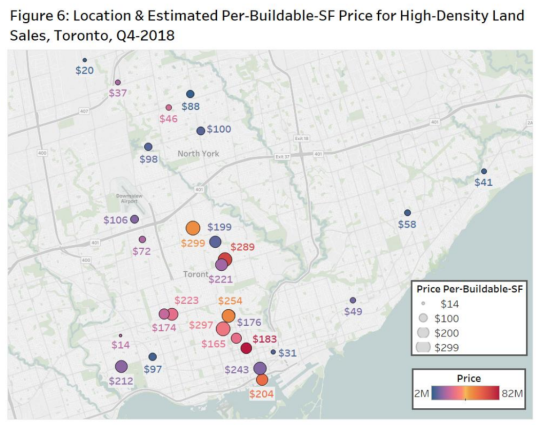
Bullpen Research & Consulting and Batory Management just published their Q4-2018 High-Rise Land Insights Report for the Greater Toronto Area.
Above is a mapping of the estimated per square foot buildable prices for the land that traded hands specifically in Toronto last quarter.
The average is $178 per square foot. And the projected average sale (condo) price is $1,097 psf. That sounds right. You basically need that kind of end pricing to make the math work with today’s costs.
Across the GTA, the average spread between zoned and unzoned land was almost $40 psf. $159 psf versus $120 psf, respectively.