Daily insights for city builders, delivered every morning at 6 AM ET. I’m Brandon Donnelly — a Toronto-based real estate developer and founder of Globizen. I’ve been writing here since 2013.

Tag: developer

  • Airbnb is powering new purpose-built short-term rental buildings

    This past weekend I was in a condo building here in Toronto with large signs in the elevator saying, “No Short-Term Rentals Including Airbnb Are Permitted. Trespassers Will be Prosecuted.” It was the first time I had seen anything like this, but it immediately signaled to me that the building must be having a problem with short-term rentals. Why else would you deface the elevators? There are some buildings that allow short-term rentals, but most don’t.

    However, over the last few years we have started to see purpose-built short-term rental buildings. In some cases, existing apartments buildings were “converted”, as was the case with Niido’s two properties in Nashville and Orlando. Here tenants in the building can rent both unfurnished and furnished apartments and then rent them out on Airbnb up to a maximum of 180 days per year. To date, I think these are the only two properties to use the “Powered by Airbnb” moniker, but more are on the way.

    The developer behind Niido — Newgard Development Group — recently launched a new Powered by Airbnb brand called, Natiivo. This one looks to be focused on for sale product, with two upcoming projects in Austin and Miami. Both projects will have hotel licenses in order to avoid any regulatory risk going forward. But this makes me wonder how materially different this model is from the condo-hotels we’re already familiar with.

    For landlords and developers, the goal is obviously to maximize rents and prices. Allowing (or explicitly encouraging) residents to rent out their place and earn some extra cash, should help with that. And given the way I started this post, we also know there’s a desire to do this, particularly in places with strong tourist demand like in Nashville and Miami. But the reviews are mixed. Not everyone wants to live in a hotel. But then again, not everyone wants to co-live. To each their own.

  • Solving the rubik’s cube

    Developing a building can often feel like you’re trying to solve a rubik’s cube. Among other things, you have to manage a myriad of different stakeholders, all of which — naturally — operate in their own self-interest. There’s the city, community, politicians, various agencies, consultants, tenants, purchasers, lenders, investors, the market at large (of which you really have no control of), and many others. Oftentimes you even have stakeholders whose interests are mutually exclusive. Indeed, the things that they want can sometimes be at odds with each other. Your job is to figure out a solution that satisfies as many of these interests as possible.

    To give you an example, let’s say that you’ve been asked to introduce a stepback into your building in order to break up the elevation. From an urban design standpoint, this may make perfect sense. Hello, datum line. But now your construction costs just went up. You have to transfer your mechanical lines, insulate the roof, introduce new bulkheads, and, for the purposes of this example, let’s say you now need to introduce a structural transfer. This is big cost item that you hadn’t accounted for. And because you just reduced the height of the building to satisfy another stakeholder, you don’t have the excess clear height to accommodate the additional depth required by this new structural element. There is, of course, always a solution. But usually something will need to give.

    At the same time, this raises some interesting philosophical questions. What’s more important in this example? The urban design move or keeping construction costs low so that the building can be delivered more affordably? The cynics will argue that this is a moot point because developers will always profit maximize. But I would encourage you to check out some of my past posts, such as “Cost-plus pricing” and “The impact of inclusionary zoning on development feasibility.” This problem solving dynamic is one of the things that makes development so challenging. But it is also one of the things that makes it incredibly rewarding.

    Photo by Ivan Bandura on Unsplash

  • Two minutes to the subway

    I was in a meeting the other day and we started talking about a wayfinding sign that indicated it was a 10 minute walk to the nearest subway station. We wondered who had made this sign and ultimately decided that the number should be 10. Either they had no idea where the subway was or they were being ultra conservative in their estimate. The subway was — at most — 5 minutes away.

    We then joked that if a developer had made the sign it would say 2 minutes, which I thought was telling. Some people like to describe real estate development as an exercise in risk mitigation. And that is certainly something that needs to be managed. But it’s also an exercise in resiliency, as you get every possible obstacle thrown in front of you. It’s as if the goal is not to build anything.

    So while it’s important to manage the possible risks, I believe you have to be a bit of a glass-half-full kind of person in order to continue the march forward. Otherwise you’d probably give up. My first boss out of grad school used to describe it as reaching into the mouth of a tiger when everyone else figured it was over. I saw her do that time and time again and it made her great at what she did.

  • Finding meaning in life and business

    I started my undergraduate degree as a computer science and physics student. But despite my love of technology (and physics, incidentally), I quickly realized that I didn’t want to end up as a software developer. I was interested in so many other things: art, design, business, real estate, entrepreneurship, cities, and so on. And at the time, I was struggling to remain focused on writing code.

    So by the middle of my second year, I decided to drop every single one of my classes and construct my own program until I figured out what I truly wanted to major in. My course schedule ended up spanning everything from the urbanization of ancient cities to the philosophy of aesthetics. It was a pretty great program if you ask me. But others wondered what I was doing.

    I did, however, already have leanings toward architecture. It felt like the perfect combination of art and science. And so while enrolled in my made up program, I started exploring the possibility of transferring schools and switching majors. Around this time I also started meeting with architects to try and learn more about the profession and see if this is something that I really wanted to pursue.

    I’ll never forget this one lunch. The architect I met with — who will, of course, remain nameless — told me very clearly: “You should do anything besides architecture. If you like drawing become an animator. If you like design, do graphic design. Just don’t become an architect.” Naturally, I came out of that lunch and decided to spend the next seven years getting two degrees in architecture.

    And even though I never became a licensed architect, and almost certainly never will, I would do it all over again given the option. I loved the journey and it is this circuitous journey that led me to where I am today, which is in a highly fulfilling career in real estate. I create new things and those things have the opportunity to improve people’s everyday lives. I’m grateful for that. But the path was anything but clear at the time.

    I am telling all of you this story because I was reminded of it when I read this fantastic article by Charles Duhigg called, Wealthy, Successful and Miserable. It is the story of how Charles, a Harvard Business School graduate, discovered that — despite obtaining boatloads of financial success — many of his classmates actually ended up miserable after school.

    Sure, we all need and deserve basic financial security. And when we don’t have it, money can really buy a great deal of happiness. But there’s lots of research out there, some of which I have written about before, that suggests that happiness quickly plateaus once our basic needs are met.

    As soon as we’re no longer worried about money, we actually crave other things from our paychecks. We want it to also be a source of purpose and meaning. To give one concrete example, the article cites a study about a set of enthusiastic and high performing janitors in a large hospital. What was ultimately found was that they saw their jobs not just as cleaning, but as a kind of healing for the patients. They had purpose.

    But what I found most interesting about the article was the discovery that finding happiness in life and business might require, or be aided by, a bit of struggle along the way:

    And many of them had something in common: They tended to be the also-rans of the class, the ones who failed to get the jobs they wanted when they graduated. They had been passed over by McKinsey & Company and Google, Goldman Sachs and Apple, the big venture-capital firms and prestigious investment houses. Instead, they were forced to scramble for work — and thus to grapple, earlier in their careers, with the trade-offs that life inevitably demands. These late bloomers seemed to have learned the lessons about workplace meaning preached by people like Barry Schwartz. It wasn’t that their workplaces were enlightened or (as far as I could tell) that H.B.S. had taught them anything special. Rather, they had learned from their own setbacks. And often they wound up richer, more powerful and more content than everyone else.

    We are, of course, talking about the “also-rans” at Harvard Business School. They’re no slouches struggling to find work. But I don’t think that negates the point being made here. It can be easy to get caught up doing what we think we ought to be doing when in reality we should be finding meaning in something we hopefully love doing.

  • Cost-plus pricing

    Today, Urbanation released its Q4-2018 market highlights report for the Greater Toronto Area. 

    The general media will pick up these numbers and tell you that there’s been a precipitous decline in the number of new condominium sales. But the reality is that 20,028 units were sold in 2018, which is actually in-line with 10-year averages for this region. 2017 was a particularly frenetic, and unsustainable, year.

    The average pre-construction sold price for a new condominium in the former City of Toronto (the core) was $1,117 psf last year, and $921 psf across the broader region. These numbers represent significant double digit increases from the year prior. But again, what I don’t think many people appreciate is that the cost environment has also changed dramatically over the last few years.

    Construction costs are way up, as are development charges and a myriad of other pro forma line items. The above numbers are simply a result of cost-plus pricing. Here’s where costs are at and here’s where we need to be to make the project feasible. Margins haven’t increased; in fact, they’ve probably been squeezed for many developers.

    I think this is an important topic that deserves more transparency and visibility. So I’m hoping to work with a developer friend of mine and publish something more substantial in the coming months.

  • Tridel unveils smart condominium in South Core

    A few weeks ago, Canadian developer Tridel unveiled its first “smart condominium” at Ten York – a recently completed 69 storey building in the South Core neighborhood of Toronto. Above is an archive photo of the building under construction. I chose this one because its siting between the Gardiner Expressway (left) and Harbour Street (right) is also noteworthy.

    Smart anything is one of those tech buzzwords that is, I know, starting to feel vapid. But Tridel has done some interesting things here with their Tridel Connect platform (a collaboration with SmartONE Solutions). And if you happen to also be in the business of designing and constructing multi-family buildings, I think you’ll find it to be a useful case study.

    At Ten York, you can now use your phone as a key fob. People buzzing up are shown to you on your wall pad so you can confirm identity. The suite entry doors use digital locks, which means you use an access code instead of a key. Additional codes can be created for family and friends or for service providers like dog walkers and cleaners. You’re also given a log of who has come and gone. And of course there’s an automated parcel delivery system.

    If you’d like to see all of the features in the live, I suggest you take a look at the “b-roll video” that was included as part of their press release. Tridel is excellent at implementing new technologies and I know that they frequently reserve test suites in their projects to try some of them out. This is a great thing for the industry and for consumers.

    Image: Tridel

  • Limits of housing affordability

    The San Francisco Chronicle recently published an article called, “SF residential projects languish as rising costs force developers to cash out.” It talks about the impact that rising costs (both construction and other) are having on new housing supply. Some developers aren’t building even though may have entitled sites. And that’s because the math doesn’t work, even though we’re in a market with a severe housing shortage.

    Here is an excerpt from the article that talks about the kind of pricing that is needed in order to make a project work:

    Chris Foley, a real estate investor and partner in brokerage firm Polaris Pacific, said that in the current construction environment a condominium developer needs to sell units for at least $1,400 a square foot for a wood-frame building and $1,800 a square for a taller, steel-frame midrise or high-rise. Even in a city where more than 80 percent of the population is priced out of the market, those numbers are a stretch, Foley said.

    San Francisco also has inclusionary zoning, which requires a certain percentage of units in any new development to be priced below market. According to the article, it is 18% for new rental projects and 20% for new condo projects. That’s a cost that needs to be absorbed by the remaining market rate units – so price accordingly. 

    The MIRA tower designed by Studio Gang is currently under construction and has 156 affordable units and 393 market rate units. The market rate pricing looks something like this:

    That’s the case with three buildings rising near the new Transbay Transit Center: Mira, the Avery at 400 Folsom St., and One Steuart Lane, which overlooks the Embarcadero at the foot of Howard Street. Unless there is a remarkable drop in the market, units in all three of those buildings will probably have an average sales price of more than $2,000 a square foot and penthouses could fetch $3,000 or even $4,000 a square foot. A 3,326-square-foot penthouse at 181 Fremont St., which opened last spring, recently sold for $15 million, or $4,500 a square foot.

    Projects being squeezed by rising costs is something that we are also seeing here in Toronto. And I don’t believe that the general public fully appreciates that there are limits to the costs that can be shouldered by new development. And the reason for that is because there are limits to what people can afford to pay for new housing.

    Photo by Jamie Street on Unsplash

  • The real reason people oppose new development

    image

    A good friend of mine just sent me this fascinating research paper called: Opposition to Development or Opposition to Developers? Survey Evidence from Los Angeles County on Attitudes towards New Housing. It is a study out of UCLA that was published earlier this year by Paavo Monkkonen and Michael Manville.

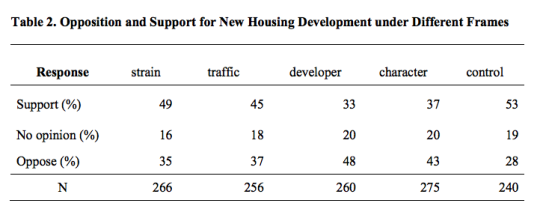
    For the paper, they conducted a survey-framing experiment with over 1,300 people in Los Angeles County to test how strongly they felt about a number of common anti-housing sentiments; arguments such as traffic congestion, neighborhood character, and strain on local services. 

    However, they also introduced another argument: large developer profits. And interestingly enough, they discovered that respondents were 20 percentage points more likely to oppose a new hypothetical housing development when the survey was framed around the developer making a lot of money.

    Here is a table from the paper showing the various frames, as well as the percentage of people who supported, had no opinion, and who opposed. Note that under the “developer” frame, the opposition number is 48%.

    image

    So their “takeaway for practice” is as follows: “Housing opposition is often framed as a form of risk aversion. Our findings, however, suggest that at least some opposition to housing might be motivated not by residents’ fears of their own losses, but resentment of others’ gains.”

    Photo by Cameron Stow on Unsplash

  • The biggest challenge in revitalizing the Rust Belt

    image

    Jason Segedy, who is the Director of Planning and Urban Development for the city of Akron, Ohio, recently penned a two-part series in the American Conservative about urban revitalization in the Rust Belt. Part two is specifically about the importance of new housing in “cities left for dead.”

    As I was reading through the piece, my first thought was that it would be a good follow-up to yesterday’s post on “winner-take-all-urbanism.” The contrast between alpha cities like San Francisco and Rust Belt cities like Akron is stark.

    The former city can’t build housing fast enough. And the latter city was forced to implement a citywide, 15 year, 100% residential property tax abatement program just to induce new investment. Any and all new housing is eligible.

    But as I got further down the article, I was struck by something else. I was surprised to hear Segedy say that, rather than market forces, community opposition is “perhaps the biggest challenge of all” when it comes to delivering new housing in these markets.

    Here is a longish excerpt that I would encourage you to read:

    Although you might think that people living in neighborhoods with a large number of abandoned houses and vacant lots would be thrilled to see new houses being built, you might be surprised to learn how often this is not the case. Sometimes neighbors prefer to have the vacant lot remain as green space. Sometimes they worry that the new housing will not be expensive enough, and will bring their property values down. Other times, they worry that the new housing will be too expensive, and will bring their property values (and taxes) up.

    When it comes to new housing, everyone is a critic. I have heard people complain that housing which they will never live in is too dense; that housing which they will never purchase is too expensive; that housing which they will never be inconvenienced by will generate too much traffic; and that housing which they will never look at is not architecturally appealing.

    After 23 years as an urban planner, I can honestly report to you that, contrary to popular belief, most people are strongly in favor of heavy-handed and draconian government regulation of private property—as long as it is someone else’s private property, and not their own.

    Residents and community activists who are opposed to new housing often demonize the real estate development profession as being “greedy”, overlooking the fact that their own home was developed by a developer, built by a builder, and sold by a realtor—most likely for a profit. This isn’t to argue that every development professional is a white knight, but it is important to remember that the vast majority of people who work in the real estate and construction sectors are not the enemy of neighborhoods. Without them, there would be no neighborhoods.

    According to Segedy, Akron has lost 32% of its peak population. Cleveland has lost 58%. And Detroit has lost 64%, leaving almost 1/3 of its land parcels vacant. (These are 2017 figures.) Surprisingly, this doesn’t appear to change how many people feel about new development. 

    No more new housing. We’re full. Unless, of course, that housing is for me.

    Photo by Nolan Issac on Unsplash

  • It Will Never Work

    On March 31, RIBA North (Royal Institute of British Architects North) in Liverpool will be opening the doors on a new exhibition that explores 25 years of award winning work by the developer and self-described “regenerator”, Urban Splash. I love the name of the exhibition. It’s called: “It Will Never Work.”

    Here is a short description of the exhibition:

    Urban Splash profess to have started without a plan, purposefully ignoring advice and routinely rejecting accepted development processes. At every step ‘it will never work’ has been a call to action rather than a discouragement.

    The company’s maverick presence on the development landscape of the North has changed the way we live, work and play in our cities, and their continued success as ‘established innovators’ is helping to shape urban futures.

    If you aren’t familiar with the work of Urban Splash, I would encourage you to check them out. When I was first starting out in development and scouring the world for developers that actually cared about design and cities, these guys were on my shortlist.

    So I have been a longtime follower and I have developer friends here in Toronto who I know also admire their work. Sadly, I have no plans to be in Liverpool anytime soon. But maybe some of you do.