Daily insights for city builders, delivered every morning at 6 AM ET. I’m Brandon Donnelly — a Toronto-based real estate developer and founder of Globizen. I’ve been writing here since 2013.

Tag: data

  • Rural America is the new inner city

    There’s an argument going around these days that rural America is the new inner city. That is, rural America has replaced inner cities as the geographies facing the greatest socioeconomic challenges. 

    In fact, it’s time for the stigma associated with the term “inner city” to disappear – if it hasn’t already. Blight no longer seems to be the concern. Instead, the concern is that our inner cities are becoming exclusive enclaves for the rich.

    The United States Department of Agriculture recently published data on educational attainment within rural areas. And since education is one of the biggest drivers of economic prosperity, it’s valuable to look at this data. 

    The first thing to note is that while educational attainment within rural areas is increasing, it still lags urban areas:
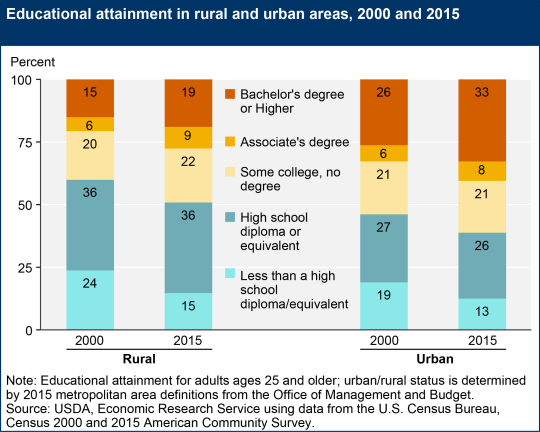
    image

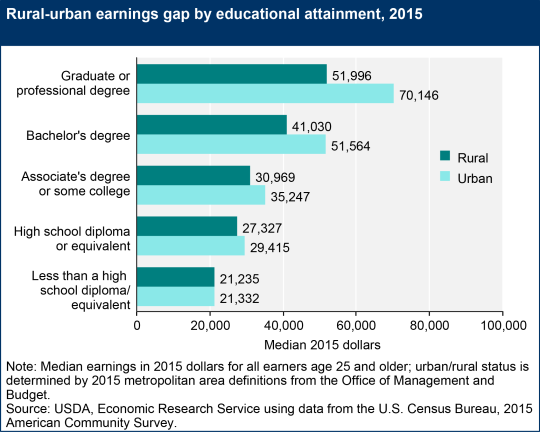
    The second thing to note is that even with the same level of higher education, the labor market will generally pay you more if you live in an urban area:
    image

    However, the spread between rural-urban increases as you move up the education ladder. With less than a school diploma, there isn’t much difference. But with a graduate or professional degree, there’s about a ~35% increase in earnings, on average, according to the above chart.

    So it should come as no surprise that many smart and educated people are choosing to live in urban areas. They should make more money.

    All charts from the U.S. Department of Agriculture.

  • Data is the new oil

    “A NEW commodity spawns a lucrative, fast-growing industry, prompting antitrust regulators to step in to restrain those who control its flow. A century ago, the resource in question was oil. Now similar concerns are being raised by the giants that deal in data, the oil of the digital era.“

    The Economist just penned an interesting piece arguing that the world’s most valuable resource is no longer oil, but data. That’s why the five most valuable publicly traded companies in the world are all tech/data companies.

    But the point they are really making is that current antitrust remedies are poorly suited to this new precious commodity. For example, in today’s world authorities need to be thinking not just about firm size, but about the extent of their data collection.

    There’s a reason firms with no (meaningful) revenue get acquired for huge numbers. Yes, sometimes it’s just for the talent. But it’s also because of the data they control and the potential threat they pose.

    So much of what we do today leaves a digital trace. And those traces are hugely valuable. I suspect we will be hearing more about this as the data economy continues to spawn tech giants.

  • Steven Ballmer launches USAFacts

    Steven Ballmer – the former CEO of Microsoft and current owner of the LA Clippers – has just launched a website called USAFacts

    He describes it as a 10-K for the US government. Put differently, it is a non-partisan website offering a “data-driven portrait of the American population, our government’s finances, and government’s impact on society.” It provides a complete look at revenue and spending across federal, state, and local governments.

    There is no commercial motive behind the website and Ballmer has been quoted in the New York Times saying that he’s “happy to fund the damn thing” whether it ends up being 3, 4, or even 5 million a year.

    I love good data and in this current era of “fake news”, I think these sorts of initiatives are exactly what we need.

  • February housing numbers

    The Building Industry and Land Development Association (BILD) announced its February (2017) numbers today for the Greater Toronto Area. Here are some of the highlights:

    – At the end of February, there were 324 detached homes available in developer inventories. Ten years ago, this number was was 12,064 (detached only). 

    – If you consider all low-rise homes (detached, semi-detached, and towns) the above numbers are 1,001 (2017) and 17,304 (2007), respectively.

    – Average price of a new detached house is now $1,469,449. For all ground-related housing – again, including semis and towns – it’s $1,081,013.

    – There were more than twice as many condo apartments sold than low-rise homes in February.

    – Condo inventory is also dropping and reached a low of 10,342 units.

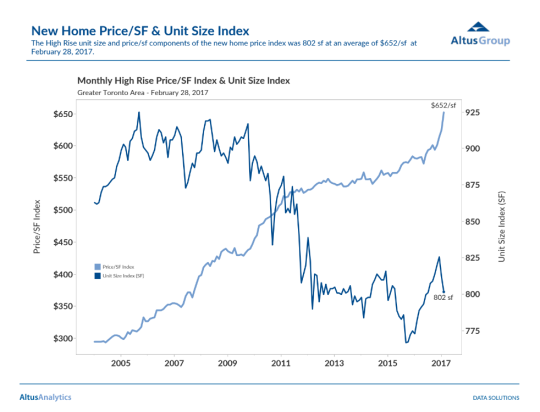
    – Average price of a new condo increased to $652 per square foot and the average unit size decreased to 802 square feet.

    Here’s that information in a chart from Altus Group:

    image

    The overall story here continues to be about decreasing inventory and increasing prices. There’s also the ongoing shift from low-rise to higher density housing, which I don’t view as a bad thing.

  • What Facebook knows about you

    Here is an eye-opening article from data scientist Vicki Boykis outlining the number of ways in which Facebook collects data about its users. It’s called: What should you think about when using Facebook?

    One of the more surprising tidbits from Boykis’ article is that Facebook collects keystrokes. That means if you start typing a status update but never actually post it, that information is still fair game.

    Facebook previously used this data for a study on self-censorship. That sounds like like a fascinating study, but I’m sure the thought is also scaring many of you if you care about privacy.

    Here is a quote from the article that gets at the core of what is going on:

    “The fundamental purpose of most people at Facebook working on data is to influence and alter people’s moods and behaviour. They are doing it all the time to make you like stories more, to click on more ads, to spend more time on the site.”

    A worthwhile read. And in case you didn’t already know, if you go to Settings -> Download a copy of your Facebook data, you can get a pretty good dump of your activity, including every private message you’ve ever sent on the platform.

  • 2016 Census: Population and dwelling counts

    image

    Today marks the release of the first tranche of Canada’s 2016 Census data: Population and dwelling counts. The next data release is scheduled for May 3, 2017, and will include age and sex, and type of dwelling. For the full release schedule, click here.

    For policy makers, city builders, data nerds, and many others, today is an important day. And that’s because 2016 marked the return of the “mandatory long-form questionnaire”, which had been eliminated in the 2006 edition. The short-form questionnaire was used. That means it’s been over 10 years, since we’ve had access to long-form data about this country.

    Given that the 2016 Census had one of the highest response rates on record (98.4%), I think it’s safe to say that most Canadians understand the value of good data. In fact, when the Census was released it started trending on Twitter, with many people complaining if they hadn’t receive the long-form version. People wanted more survey. They wanted the ability to share more information.

    All of this is important because it helps decision making. Here’s an excerpt from a recent Toronto Star article:

    “The mandatory long-form census questionnaire provided regions and cities and communities with really valuable and reliable long-term information about the changing nature of the city and its neighbourhood that’s not available from any other source,” said David Gordon, an urban planning professor from Queen’s University.

    So stay tuned to the Census Program website. Regardless, I’m sure we will be seeing a surge of infographics and other activity following each data dump.

  • Turning data exhaust into gold

    Last year, social media company Foursquare predicted that Chipotle would see a ~30% drop in its Q1 2016 sales. It knew this because the geo-location data from people using its app (check-ins and passive visits) was also down. They had figured out the relationship between foot traffic and sales. I think I wrote about this in the first half of last of year.

    Not surprisingly, lots of companies – including those on Wall Street – are now starting to pay attention to data sets such as these. Matt Turck wrote a great blog post about it this morning, called: The New Gold Rush? Wall Street Wants your Data. Here’s an excerpt:

    That a social media company could be building a data asset of immense value to Wall Street is part of an accelerating trend known as “alternative data”. As just about everything in our lives is getting sensed and captured by technology, financial services firms have been turning their attention to startups, with the hope of mining their data to extract the type of gold nuggets that will enable them to beat the market.

    The opportunity is open to a wide range of startups.  Many tech companies these days generate an interesting “data exhaust” as a by-product of their core activity.  If your company offers a payment solution, you may have interesting data on what people buy. A mobile app may accumulate geo-location data on where people shop or how often they go to the movies.  A connected health device may know who gets sick when and where.  A commerce company may have data on trends and consumer preferences. A SaaS provider may know what corporations purchase, or how many employees they hire, in which region. And so on and so forth.

    We may be calling this alternative data right now, but it is almost certainly just a matter of time before it simply becomes: the data. 

    I like the term “data exhaust” that Matt uses, because it feels like it accurately captures what is going on right now. The new economy is producing a lot of byproduct. If you clean it up and package it in the right way, then you might be creating additional value. But if you don’t, then it’s probably just exhaust.

  • Uber Movement

    Uber just announced that it will be providing access to the (anonymized) traffic flow data generated from its over 2 billion rides. This new product is called Uber Movement and the goal is to help cities make better infrastructure decisions. Because indirectly, that also benefits them. 

    Here’s an excerpt from TechCrunch:

    “We don’t plan infrastructure, we don’t plan cities, we’re never going to do that,” explained Uber Product Manager Jordan Gilbertson in a briefing. Not controlling those aspects of Uber’s business means that it must do whatever possible to influence their improvement indirectly, which Movement can certainly help to do. More efficient transportation in a city in general means more efficient Uber service delivery, happier customers and better usage rates.

    You can request access to Uber Movement today. But the service will be made available first to city planners and policymakers, and then to the general public. I would be very curious to see what the data reveals for Toronto, as well as for other cities.

  • Flood-prone areas see dip in real estate sales

    image

    The New York Times has an interesting article up talking about the possible impacts of climate change on coastal real estate in the United States. In it they make the argument that sales velocity is declining in flood-prone areas. Here are two snippets:

    Over the past five years, home sales in flood-prone areas grew about 25 percent less quickly than in counties that do not typically flood, according to county-by-county data from Attom Data Solutions, the parent company of RealtyTrac. Many coastal residents are rethinking their investments and heading for safer ground.

    In the past year, home sales have increased 2.6 percent nationally, but have dropped about 7.6 percent in high-risk flood zones in Miami-Dade County, according to housing data. Many coastal cities are taking steps toward mitigation, digging runoff tunnels, elevating roads and building detention ponds.

    I would like to see more data supporting this argument, but I can’t say I’m surprised. Flood risk is certainly something I would think about – particularly in high-risk areas such as South Florida. Florida has 6 of the 10 most vulnerable urban centers in the US.

    The other piece that caught my attention is this:

    Flood risks are easily overlooked because past flood damage often goes unreported and, as in Virginia, the burden of discovering it falls to the buyer. LexisNexis, a news and legal research company, can supply sellers a report with the history of flood claims on the property, but buyers usually do not know to ask for it. FEMA collects information on federal insurance claims for homes nationally, but the agency has been reluctant to make it public for privacy reasons.

    It is yet another example of how opaque the real estate industry is. A lot of the information – assuming it’s even available – is fragmented across a number of different sources. If you’re playing hot potato, this obviously works to your benefit. But I don’t believe it’s the best thing for the overall market.

  • A location intelligence company

    I have written about Foursquare a number of times over the years (here and here) and I continue to be a regular user. I am intrigued by all of the location-based data that they collect through their apps. 

    Below is a recent Recode Decode (podcast) with Dennis Crowley (co-founder) and Jeff Glueck (CEO) of Foursquare. They are talking about what’s next for the company. If you can’t see it below, click here.

    https://art19.com/shows/recode-decode/episodes/aa400a60-ebc1-49bb-96b1-0d7aac7ca9e8/embed?theme=black

    Here’s a content sample from Recode:

    Today, Foursquare makes most of its money from selling that data to big companies, calling itself a “location intelligence company.” But as co-founder Dennis Crowley and CEO Jeff Glueck explained on the latest episode of Recode Decode, hosted by Kara Swisher, they haven’t stopped thinking about everyday users.

    “Imagine a friend is walking alongside you,” Crowley said. “Can we make a personality like that, that talks to you in that sense? It’s not 30 years out. We’re going to be playing with this stuff a year from now.”

    “I want to make that Scarlett Johansson that whispers in your ear, but it’s all about local places and local discovery,” he added. “I want to replicate the experience of walking through the city with a friend that knows the city inside and out, and I want to make that for millions of people.”

    I thought some of you might find this interesting.