Daily insights for city builders, delivered every morning at 6 AM ET. I’m Brandon Donnelly — a Toronto-based real estate developer and founder of Globizen. I’ve been writing here since 2013.
The cost of container shipping continues to come to the forefront in this current environment. Today I was reviewing prices from a number of our suppliers and the rates for a FEU (forty-foot equivalent container) now seem to range anywhere from $8k to almost $18k (both CAD), depending on the origin.
This is up from a few thousand at the beginning of the year, and from far less prior to that. To help illustrate this point, above is a chart I found over at Statista showing an aggregated global container freight rate index from July 2019 to November 2021. This chart, which is in USDs, suggests that container rates may have peaked and be now tapering off, but who knows really.
This is a challenge for our suppliers and partners to manage through and it is a challenge for us to manage through. In some cases these additional costs will necessarily trickle down to the end consumers of the spaces that we and others are building. But in other cases that is not possible.
Building new buildings takes a really long time. It is not uncommon for development timelines to to span 5-10 years, and sometimes even longer. It is particularly frustrating when you see unnecessary roadblocks and delays throughout the process. But that’s a topic for another post.
Perhaps one of the positives of these timelines is that they force you to think well into the future. Take for example electric vehicles. Most car manufacturers have already announced aggressive electrification targets for the year 2030.
What that means is that if you’re starting a new project today, you have to assume that it will be completed into a world where many more people will be coming home and plugging in their car. Perhaps it will be the majority of people. So you probably need to plan for that.
Another way to think about development is that it is a leading indicator for what’s coming. If we stick with the example of cars and parking, I think it’s pretty clear that parking is becoming increasingly scarce in our biggest cities. The pressures are simply too great.
In all of our Toronto projects, we are currently building no more than about 0.4 parking spaces per suite. And there’s pressure to bring this number down even further. There are lots of examples of zero parking. The biggest reason is costs, but we also know that big cities don’t function well when everyone is driving around.
This is also not a new trend.
If you look at the multi-family buildings that Toronto completed in and around the 60s and 70s, many will have parking ratios in the range of 1-2 parking spaces per suite. This is totally untenable in today’s environment (except for a small subset of the market) and I bet you that a lot of this parking is now sitting vacant.
Things change. Development can sometimes tell you what those changes might be.
Every year my friends at Urban Capital publish an annual magazine called Site. And every year it contains some great articles about the real estate development industry across Canada. (Some of you may also remember that I’ve written a few articles for it in previous years.)
Well this year’s issue is out and there are a few featured articles that I’d like to draw your attention to:
What happens when 175 (mostly) women get together to design a condominium?Link
Why have Toronto condos become so %@$#$! expensive?Link
This last one is a topic that we have talked about many times before on the blog. But here, UC has provided a quantitative comparison between a project they did in 2005 and a project that they’re doing today in 2020. Here’s what they found:
Average condo prices in the City of Toronto are up about 150%. But…
Land costs are up 160%.
Soft costs are up 118%.
Construction and related costs are up 91%.
Financing costs are up 93%.
Government fees, charges, and taxes are up 413%.
And development charges (a subset of the above) are up 3,244%!
At the same time, the profit margin over costs is down about 45%.
(As a point of comparison, CPI only increased by about 26.5% during this same time period.)
The point here is that condos are so %@$#$! expensive largely because of cost-plus pricing. Government fee increases are also outpacing every other cost bucket.
If you’re developing new housing in Toronto, you have no choice but to accept these rising costs. You have to pay development charges and you have to pay them when you’re told, even if that means swallowing some new massive increase.
So by necessity, end prices get continually pushed as a way to try and absorb these costs. You figure out what your costs are going to be and then you price accordingly. But of course, you also have to ask yourself: Can people actually afford this kind of pricing and can this neighborhood support it?
Sometimes the answer is yes, which is why development continues. But sometimes the answer is no. In this case, the next step is simple: you don’t build.
Why do some buildings cost more to build than others? And how is it that some cities, as a whole, seem to build more cost effectively than others? Without getting into the specifics of how different markets work, I thought it would be valuable to outline some of the cost drivers that impact new developments. But keep in mind that this is by no means an exhaustive list. So, please feel free to add whatever I’ve missed to the comment section below.
Below-grade parking is hugely expensive. It’s almost always a loss leader. You lose money building it. That’s why parking ratios matter a great deal. If you’re building in the suburbs at 1 to 1 parking vs. 0.2 in the core, you’re simply building more of something that doesn’t make money. There’s also the question of whether you need to build a watertight below-grade, or if you can discharge any groundwater into the municipal infrastructure. Big cost difference.
Union vs. non-union construction labor.
Building stepbacks add cost and create additional complexity. To build more cost effectively, you really want repetition. But terraces are awesome. I get it.
Impact fees, development levies, and other government fees can vary widely across cities. As I’ve mentioned many times before on the blog, these line items can add up to 20-24% of the price of a new condominium here Toronto.
Time is expensive. One of the bigger line items in a development pro forma is financing interest charges. The longer things take, the more expensive the housing needs to be.
Markets are unique. Quebec, for example, has relatively low electricity rates. For this reason, it’s pretty common for homes in Quebec to use electric heating, which is usually pretty cost effective to install. According to this 2019 study, 68% of Ontario households rely on natural gas heating. In Quebec, the number is only 5%.
Depending on what you’re building next to, you may face additional costs. For example, if you’re building right up against a rail line, you may need to construct a “crash wall” in order to safeguard against possible derailments and you’ll probably need to up the STC rating on your windows because of the higher noise levels. These costs will not be insignificant.
In theory, land costs are supposed to be the residual claimant in a development pro forma. What that means is that you should back into your land value after calculating your projected revenue and considering all of your other development costs. If your revenue is lower, so too should be your land cost. Land cost as a percentage of total costs will, naturally, vary across different markets.
Yesterday I made a comment on Twitter about most people not understanding to what extent government bureaucracy inhibits the delivery of new housing in this city. It received a number of responses, including remarks about how development charges have also recently doubled and how this statement applies to pretty much every city out there. But there was also a comment about developers not being transparent and not properly explaining the impact to the public. In other words: please demystify the development pro forma. I thought that was a fair remark, and so this post is going to be a response to that comment.
Before I begin, it’s important to keep in mind that most developers have investors. These investors put up most of the money required for a project and in turn they take most of the profits. However, there is typically a “promote” in place, which is just an incentive structure that pays the developer more of the profits (disproportionate to the cash they invested in the project) if they perform and hit certain return benchmarks. All of this is to say that developers aren’t usually the ones holding all of the cash (which is what a lot of the public seems to think) and they are accountable to their investors to do what they said they would do.
Now let’s run through the costs that make up a “typical” development pro forma. For this example, I am going to assume that we’re talking about a 100,000 square foot mid-rise building; the kind that you might build and find along any one of Toronto’s Avenues. If we were doing this in real life, we would get more precise with the areas and consider gross construction area, gross floor area (city definition), and the net saleable/rentable areas. But to keep the math simple, we will ignore these differences. That’s the approach I’m going to take overall in the post. What you need to know, though, is that you have to pay to build the entire building, but you only get to collect revenue on a portion of it. That’s why the “efficiency” of a building matters.
Land
The value of development land is a function of what you can build and the revenue you can ultimately collect. So location matters a great deal. Based on the latest high-density land report from Bullpen and Batory, the average price of an unzoned mid-rise site in the City of Toronto is about $231 psf. So let’s assume a land cost for our project of $23.1 million. Assuming we can get land financing at 60% of the value of the land (loan-to-value), that would mean we’re putting up $9.24 million of cash (plus a loan guarantee!) and borrowing $13.86 million to start our project. At 5.25% per annum (interest-only loan), our annual interest charges would be about $727,650. From now on forward, we’re going to pay ~$60k in additional interest charges for every month that our project is delayed. Buckle up.
You should now begin to see why time is so valuable and why government bureaucracy can be so frustrating. As a developer, you’re heavily incentivized to move things forward, whereas it can often feel like everyone around you is trying to deliberately erect roadblocks in order to slow you down and make your project more expensive to build. Oftentimes, it is because it is less risky for them to punt things down the road and not make a decision. That is not the case for us and our project.
Hard Costs
Onto construction (or hard) costs. As many of you know, these have risen dramatically over the last 4 to 5 years. On some of our projects, we have added over $100 psf in hard costs alone. Part of this has to do with a busy construction market and part of this has to do with new building requirements: watertight undergrounds, new Green Standards, and so on. For our project, which is on the small side, let’s assume $360 psf for a total of $36 million. This would include our direct construction costs and our construction manager’s overhead (general conditions). We should also prepare for some of the trades to decline to bid on our project because it is too small and not worth their time.
Soft Costs
Soft costs include everything from consultant costs and interest charges to government levies and management fees. Like everything in your pro forma, these absolutely need to be broken out line by line. Don’t be lazy here. But for the purposes of this simplistic example, we’re going to use 75% of hard costs, which works out to be $27 million (or $270 psf). When I first started out in the development business, the rule of thumb was closer to 25% of hard costs. But times have changed. Government fees, alone, can make up about 1/4 of the price of a new condo in Toronto.
Adding up all of these costs, we’re at $861 psf or $86.1 million in costs. It’s now time to consider the revenue side. $1,000 psf seems like a nice round number, so let’s start there and assume we’re going to sell our condos for that. Typically in Toronto, the price you pay is inclusive of HST, so that liability will need to be deducted from our revenue line. It’s not a straight 13% because of the new home rebate, but the rebate also hasn’t been properly indexed since it was introduced and so the liability could still be upwards of 10%. (This is worthy of a separate blog post.) The result is $900 psf in revenue and a margin on costs that is less than 5%. No sensible developer would want to do this project. One misstep (or development charge increase) and you’re dead.
So let’s increase our condo prices to $1,100 psf. Maybe that will work. In doing that, we get to a margin on costs that is nearly 15%. Okay, now we’re in the range. But let’s say we just got delayed by 6 months (boom, interest charges) and our hard costs turned out to be off by $15. They’re actually working out to be $375 psf because of some new tariff and because the formworkers in the city are all tied up on bigger projects and couldn’t give a shit about our cute little infill project. Now we’re offside again in terms of our margin on costs. No problem, let’s try and push condo prices a bit more. Is $1,150 achievable? Perhaps. But ideally, given the above, we would want to be at $1,200 psf just to be safe.
This is an overly simplistic example of the math that goes into a development pro forma. But hopefully it begins to show you (1) just how many moving parts there are in a development project and (2) the kind of pricing that is required in today’s cost environment. Developers are reacting to the costs that they are being thrown and it is creating upward pressure on home prices. (See related post: Cost-plus pricing.) So far there has been enough elasticity in the market to absorb these price increases, but that may not always be the case. If you have questions about this post or disagree with any of my assumptions, feel free to leave a searing comment below.
Using data from Turner & Townsend, Curbed recently reported that the most expensive city in the world in which to build is now San Francisco. On average, it costs USD 417 per square foot. San Francisco is followed by New York ($368 psf), London, Zurich, and Hong Kong. New York took the top spot last year, but San Francisco shot up this year because of, you know, tech.
This number was calculated using a blend of six different types of construction, everything from apartment high-rise and prestige office to general hospital and warehouse distribution centers.
Now, I’m not exactly sure what this number includes. But I’m assuming it is only direct construction costs and doesn’t include (contractor) general conditions, land, or any soft costs, which are all significant. Once you add in these other cost inputs, I am sure that you can start to see how things — including the cost of new housing — can quickly escalate.
The average price of popular new condo floor plans in the City of Toronto in October 2019 was approximately $1,275 per-square-foot (psf) and with growth of 3% a year, prices would hit $1,475 psf in 2024. I wouldn’t be surprised to see annual average growth of 4%, which would get you to $1,625 psf in five years in Toronto.
This data was taken from BuzzBuzzHome and — by “popular new condo floor plans” — I believe he means that these are the floor plans that buyers tend to click on and review when they visit the site. So it’s a good indication of buyer demand.
Here’s another quote that stuck out:
Part of the reason that price growth has spiked is a rise in construction costs, development charges, and land prices – this cost-push inflation is passed on to consumers.
That sounds right. And I have been writing about this phenomenon all year. Most of us can probably remember when $1,000+ psf was a high water mark for new construction condos. Now it’s pretty much a floor.
Today was the 2019 Land & Development Conference here in Toronto. I was on a panel in the morning about Proptech. I then sat in on a discussion about construction costs. But after that I had to get back to the office to prepare for a couple of meetings.
Here are my tweet takeaways (from the back of the room) during the construction cost session. You may need to click through to see the full thread.
18 month lag on construction costs when there’s a change in demand. What we are seeing today is a result of sales in 2017. -Niall Finnegan #land19pic.twitter.com/Q5M2Skq26I
The construction cost escalations that we have seen over the last 2-3 years have had a significant impact on new construction in this region. Niall Finnegan’s view is that we are 85% of the way through this “storm.”
From his experience, it takes 18 months or so for hard costs to respond to changes in demand. And so the storm we are currently in is a result of elevated condo sales from 2017-2018.
The general consensus from the panel was that costs should start to moderate sometime soon, though maybe not this year. Nobody really knows when that will happen. But if/when hard costs do adjust, it typically happens quickly.
One comment that didn’t make it into my tweets, but that I found interesting, was about how uncertainty and volatility in the market — like what we are seeing today with construction costs — could actually stifle innovation.
Because it creates additional project risks, it limits people’s appetite for other kinds of risks — like trying new things. I can see that.
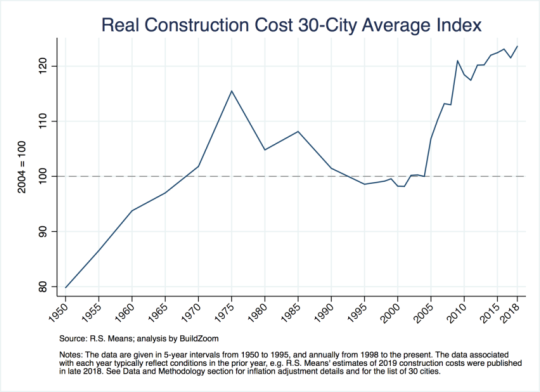
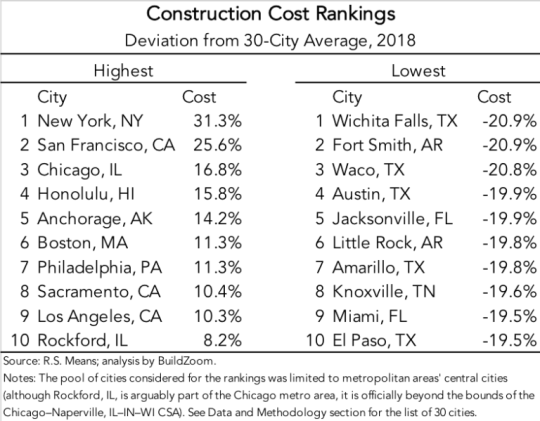
BuildZoom, which is a tool to help people find local contractors, recently looked at construction costs across the US.
Here is their 30-city average index running from 1950 to roughly today:
Here is a chart showing the most and least expensive cities (that is, the cities that deviate the most from their 30-city average):
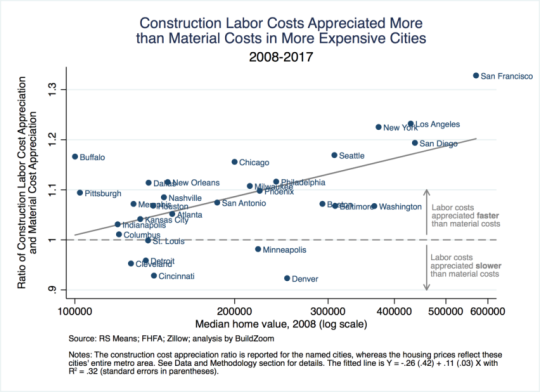
And here is a chart that compares labor cost appreciation to material costs:
Labor costs account for the bulk of the geographic variation in construction costs and the most expensive cities to build in also tend to have the highest median home prices.
The way to read the above chart is that any city with a y-axis value greater than 1 means that labor costs have appreciated faster than material costs from 2008 to 2017.
In the case of San Francisco, labor costs have appreciated 32.8% (> 1.3) faster than material costs.
Part of this likely has to do with the fact that San Francisco is an expensive city in which to live. People have to be paid more if they’re going to work there.
The San Francisco Chronicle recently published an article called, “SF residential projects languish as rising costs force developers to cash out.” It talks about the impact that rising costs (both construction and other) are having on new housing supply. Some developers aren’t building even though may have entitled sites. And that’s because the math doesn’t work, even though we’re in a market with a severe housing shortage.
Here is an excerpt from the article that talks about the kind of pricing that is needed in order to make a project work:
Chris Foley, a real estate investor and partner in brokerage firm Polaris Pacific, said that in the current construction environment a condominium developer needs to sell units for at least $1,400 a square foot for a wood-frame building and $1,800 a square for a taller, steel-frame midrise or high-rise. Even in a city where more than 80 percent of the population is priced out of the market, those numbers are a stretch, Foley said.
San Francisco also has inclusionary zoning, which requires a certain percentage of units in any new development to be priced below market. According to the article, it is 18% for new rental projects and 20% for new condo projects. That’s a cost that needs to be absorbed by the remaining market rate units – so price accordingly.
The MIRA tower designed by Studio Gang is currently under construction and has 156 affordable units and 393 market rate units. The market rate pricing looks something like this:
That’s the case with three buildings rising near the new Transbay Transit Center: Mira, the Avery at 400 Folsom St., and One Steuart Lane, which overlooks the Embarcadero at the foot of Howard Street. Unless there is a remarkable drop in the market, units in all three of those buildings will probably have an average sales price of more than $2,000 a square foot and penthouses could fetch $3,000 or even $4,000 a square foot. A 3,326-square-foot penthouse at 181 Fremont St., which opened last spring, recently sold for $15 million, or $4,500 a square foot.
Projects being squeezed by rising costs is something that we are also seeing here in Toronto. And I don’t believe that the general public fully appreciates that there are limits to the costs that can be shouldered by new development. And the reason for that is because there are limits to what people can afford to pay for new housing.