Daily insights for city builders, delivered every morning at 6 AM ET. I’m Brandon Donnelly — a Toronto-based real estate developer and founder of Globizen. I’ve been writing here since 2013.

Tag: construction costs

  • Downward pressure on parking supply

    There’s a significant amount of downward pressure on parking supply in most major cities. Part of this has to do with the push toward more sustainable forms of transport, which is, of course, a good thing. But it also has to do with rising construction costs, the fear of obsolescence in the wake of autonomous vehicles, and probably many other factors.

    Developers, ourselves included, have responded by being cautious about the amount of parking being provided and by considering alternative future uses for the parking that is being built. I think it is also obvious that we will continue to see more, rather than less, parking stackers and other more efficient parking solutions.

    So far the cost of parking in dense urban centers has continued to rise. A new parking spot in the core of Toronto priced at $100,000 would not surprise me. And Hong Kong recently set a record for what is allegedly the most expensive parking spot in the world: USD 765,000 or CAD 1 million.

    But what is going to happen going forward?

    Researchers at the Singapore – MIT Alliance for Research and Technology and MIT Senseable City Lab, along with Allianz, have recently tried to quantify what the impact of autonomous vehicles will mean on required parking, and on traffic, in Singapore. The study is called Unparking.

    Today, they estimate the total number of parking spots in Singapore to be around 1,370,000. This is based on minimum parking requirements from the Housing Development Board and on the idea that home-work commuting consumes two parking spots: one at home and one at the office.

    They model four different scenarios, but the last one is based on fully autonomous vehicles and on shared parking spaces. Holding current mobility demands and traffic volumes constant, the demand for parking in this scenario drops by 70%.

    It is possible to reduce the number of parking spaces even further to 85%, but this has a negative impact on traffic congestion in their model. Fewer parking spaces means the autonomous vehicles have to drive around more picking people up. 

    I also don’t know if there was any consideration given to induced demand as a result of the more affordable autonomous vehicles. Demand for transportation services is generally thought to be fairly elastic.

    Whatever the case may be, numbers are made to be questioned. And Singapore is a unique city-state. But ¼ the amount of parking does not seem that far fetched to me.

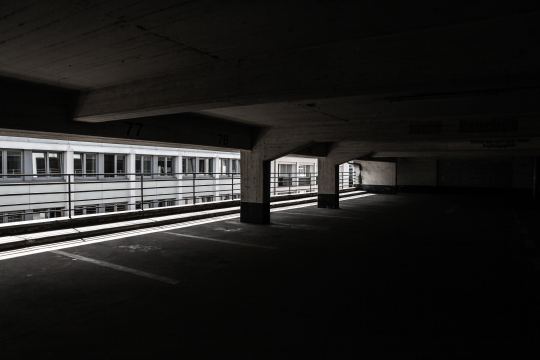
    Photo by Tobias Jussen on Unsplash

  • Construction costs are no joke right now

    I don’t know what it’s like in your market, but everyone is talking about it in the industry here in Toronto. Combine these rapidly rising hard costs with higher development charges and inclusionary zoning and you get significant upward pressure on condo prices and apartment rents. 

    This is also one of the reasons – perhaps it is the main reason – why you’re seeing some projects get cancelled. These are projects that maybe sold in one market (lower revenues) and are now trying to build in another (higher costs). The math no longer works. Sorry.

    I mention this today not to complain, although I’m always up for a good industry commiseration over beers, but because I often hear people lament that Toronto needs better design. Why aren’t developers using triple-glazed windows? Why aren’t developers thermally breaking the balconies?

    I will always advocate for better design. That is core to my belief system. But everything costs money. There are very real limits in this equation. And markets have a funny way of telling you exactly what those are.

    Photo by Filip Mroz on Unsplash

  • The cost of parking minimums

    Access Magazine has a good piece on parking minimums and the cost they create for our cities. The article is by Donald Shoup, who is Professor of Urban Planning at UCLA. He is also the author of The High Cost of Free Parking.

    Here is his argument:

    “Minimum parking requirements create especially severe problems. In The High Cost of Free Parking, I argued that parking requirements subsidize cars, increase traffic congestion and carbon emissions, pollute the air and water, encourage sprawl, raise housing costs, degrade urban design, reduce walkability, damage the economy, and exclude poor people. To my knowledge, no city planner has argued that parking requirements do not have these harmful effects. Instead, a flood of recent research has shown they do have these effects. We are poisoning our cities with too much parking.”

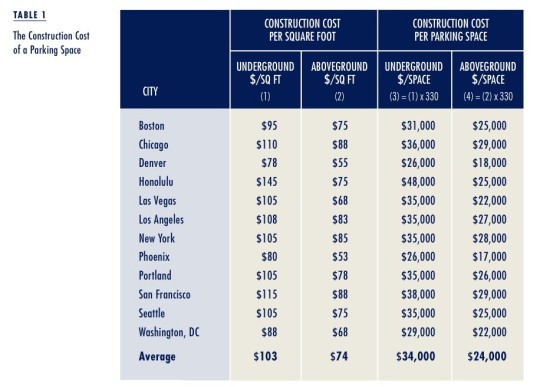
    And here’s his summary of what it costs to build a parking stall in various US cities (both underground and aboveground):

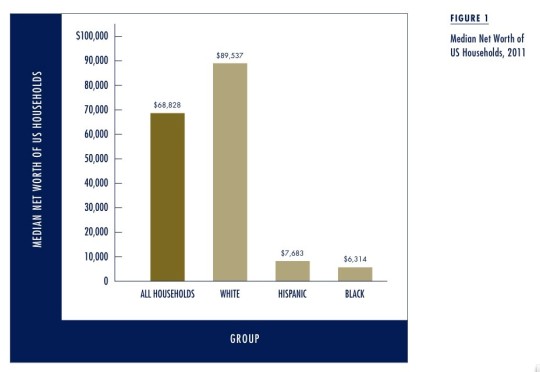
    To put these numbers into perspective, he also looks at the median net worth of US households (2011) to show just how expensive this parking is for some groups. 

    Because remember, these parking costs get embedded into the cost of housing, retail stores, and so on.

  • Stuck in condoland?

    Toronto Life recently published an interesting article called Stuck in Condoland. A lot of people have mentioned it to me, so there seems to be a lot of interest in the topic. It basically profiles the lives of a few young families who live downtown and are trying to raise young children in relatively small condos (think 700 square feet).

    I thought it was interesting because I like the idea of small and efficient living. The average post-war bungalow in Toronto was probably less than 1,000 square feet. And so this modern notion that you need a big house in order to properly raise a family is a relatively recent phenomenon. Although we’re a richer city today and that’s what happens when people become wealthier: they consume more.

    But the article also makes it seem that developers only want to build small condos and that larger condos and single-family homes just aren’t profitable enough. Thus the reason all these families are being forced to into tiny shoeboxes in the sky. But that’s not really true.

    Look, just like every other for-profit business on the planet, developers are concerned with making money. And so they will always look for ways to increase efficiency, drive down costs, and so on. But there are certain realities of the market that developers don’t have control over.

    First, developers aren’t building new single family homes in the city (at any sort of meaningful scale) because there’s no land to do so. And because the land use policies in place and the current thinking around how we can more sustainably build our cities for the future dictate that we should be building more intensely. In other words, building up. So it’s not a question of developers not wanting to build single family homes; it’s a question of not being able to.

    Second, trust me when I say that if the market wanted large 3 bedroom family units, developers would build them. Mandating them is a useless exercise if people don’t want them or are unable to afford them.

    The challenge we face is that a reinforced concrete condo tower is more expensive to build than a wood-framed single family house. So until land values get to a point where single family homes become the more expensive option (compared to condos), I don’t think we’ll see a huge rush towards 3+ bedroom suites.

    This is my hypothesis at least. Because when you buy house, you’re really buying two things: the house itself and the land. If the house itself (wood) is cheaper to build on a per square foot basis than a condo (concrete), then the variable that will make a difference is the land. And as people like to say: “buy land, they ain’t making any more of it.”

    So what I’m saying is that I just don’t think the situation is as simple as: “developers are bad, all they want to do is build tiny condos and make lots of money.” It’s more complicated than that. But I do believe the question of how families are going to live in the city is an important one.