Daily insights for city builders, delivered every morning at 6 AM ET. I’m Brandon Donnelly — a Toronto-based real estate developer and founder of Globizen. I’ve been writing here since 2013.

Tag: congestion charges

  • Why we shouldn’t blame Uber for traffic congestion

    It has become fairly common to blame Uber (and ridesharing in general) for increased traffic congestion. I hear it all the time: “If only there weren’t so many Ubers on the road, traffic would flow more freely.” While there are studies suggesting that “deadheading” miles do have a negative impact and that Uber can draw people away from public transit (that’s bad), I think it’s important to consider the bigger picture here. So let’s try and do that today.

    Firstly, let’s think about who traffic congestion directly impacts (indirectly it’s everyone). If you’re a pedestrian, you don’t care about traffic congestion. In fact, maybe you gain satisfaction from seeing other people stuck in it. (There’s even a German word for this feeling.) Similarly, if you’re riding the subway, taking any form of transit on its own right-of-way, or riding a bike, you likely also don’t care about traffic congestion. It doesn’t directly impact you.

    Where you do care about congestion is if you’re in something like a bus that is stuck in traffic or if you’re driving. In the former case, you’re probably thinking, “hey why can’t these people take the bus like me. Then we’d have less traffic!” And in the latter case you’re probably thinking, “if only there weren’t so many Ubers and bike lanes, then I wouldn’t be stuck in traffic!” Ironically, this is arguably the biggest segment of people who feel they are being impacted by Ubers.

    Secondly, let’s think about how Uber vs. driving might impact traffic congestion differently. In both cases, I would think that the majority of use cases involve one person (excluding drivers in the case of Uber) going to their desired destination. So from a raw space per person perspective, they both take up a similar amount of urban space.

    The differences are that the Uber likely had some amount of deadhead miles. In other words, it spent time driving around looking for its next passenger. And it likely targeted already busy areas because that’s where it was more likely to find someone. Individual drivers don’t do this. They go from point A to point B.

    However — and this is a big however — drivers do require parking once they get to where they’re going. Ubers don’t. This both takes up more space and oftentimes requires some amount of circling around. This is a significant difference and it begs the question: which is worse? Deadhead miles or all of the parking that cars generally require? I would argue the latter.

    Where I’m going with all of this is that I think the criticism of Uber is misdirected. It doesn’t get at the real underlying problem. If traffic congestion exists, it is because they are too many cars for a finite amount of road space. This includes the people who choose to drive themselves around. In fact, you could argue that they’re the most impactful to cities. The way you solve this is simple: you price congestion and you encourage alternative forms of mobility.

    Everything else is just a distraction.

  • Dynamic transit pricing

    Over the years on this blog, we’ve spoken a lot about dynamic pricing when it comes to roads and traffic congestion. And in this instance, the principal intents are to price congestion, improve traffic flows, and encourage other modes of transport. It follows the logic that if you’re going to tax things, tax the things you want less of.

    But what about using dynamic pricing for the opposite purpose — to induce demand?

    Diana Lind recently wrote about this here and talked about how London is exploring using dynamic pricing on its transit system. But rather than increasing prices during periods of high demand, I would imagine that the idea is to reduce prices when demand is lower. Already, it is piloting reduced fares on Fridays when its ridership drops by about 10%.

    It’s an interesting idea because, if done correctly, it should get more bums into seats on transit. And maybe it’s actually a more equitable pricing model.

  • What would you do if you were Mayor?

    Let’s assume that you’re Mayor of your city and that, for whatever reason, you have no need to pander to voters. You’re a benevolent dictator. You can do whatever you think is best overall for the city and it will just happen. What would you do? This is more or less the question I asked on Twitter this morning, and I think it’s only fair that I answer my own question. So here is a non-exhaustive list of items that came to mind while thinking of Toronto:

    • Substantially increase the pay of public sector workers throughout the city and bonus them based on measurable outcomes. Forget things like time limits on development applications; instead align incentives. For example, if we’re trying to get more shovels in the ground on affordable housing, incentivize people based on building permits issued. I’ll never forget what Roger Martin told me while I was at Rotman. When he became Dean of the school, Rotman was a whatever business school that wasn’t faring all that competitively in the rankings. One of the problems he discovered was that the school’s professors were getting paid far less than those at Wharton, Harvard, Stanford, and so on. So if you were a star, why would you ever want to teach at Rotman? He immediately matched the salaries of those top-tier schools and then, not surprisingly, the top-tier talent arrived. You get what you pay for.
    • Immediately price roads and congestion, and direct, to the fullest extent possible, the funds toward transit and cycling infrastructure. At the same time, the planning and building of transit would be depoliticized. There would be a reccurring funding stream and a plan that we’re continually building out. Minimize protracted debates. Never stop building. There’s a lot of talk this mayor election about solving traffic congestion. I have yet to see a plan that will actually work. Accurately pricing congestion likely won’t be popular, but I can guarantee you that it will be highly effective.
    • Ensure that property taxes are sustainably covering the costs of operating the city and then, at a minimum, peg all future increases to CPI.
    • Make any new housing development less than 12 storeys as-of-right. That would mean, no rezoning process and no site plan approval; just straight to building permit.
    • Empower the private sector to build affordable housing through incentives and subsidies. Affordable housing isn’t feasible to build on its own, which is why nobody is doing it. Inclusionary zoning also won’t get us there. Make developers want to build it and they’ll do it.
    • Liberalize licensing and cut red tape to empower small entrepreneurs across the city in various industries. A perfect example in my mind is street food. Toronto is the most diverse city in the world with some of the best restaurants, and yet the only thing you can buy on the street is a stupid hot dog. If we empowered small entrepreneurs to setup shop on our streets, we would easily have the best street food scene in the world. And I am positive that there are countless other latent opportunities in this city that are being held back by dumb and archaic rules.
    • Make dramatic improvements to our public realm with an eye toward becoming the most beautiful and livable city in the world. Finally pedestrianize Kensington Market, remove the elevated Gardiner Expressway, make it so that we can swim in the Lake, build beautiful public washrooms all across the city that are actually open and aren’t gross, and the list goes on. And yes, “beauty” should be requirement so that we don’t end up with shit like this.
    • Focus on art, design, culture, and innovation as central pillars of Toronto’s brand. Miami is a good example of what this approach — along with favourable taxes and nice weather — can do for a city. I’ve said this before, but here’s just one example: Toronto is in many ways the birthplace of the cryptocurrency Ethereum. Why is nobody talking about this? Why are we not celebrating and leveraging this? It’s a missed opportunity. Broadly speaking though, I think just having and doing three things can be effective in promoting new ideas for these pillars: have reasonably affordable housing, be a city that young people want to live in, and remain open and tolerant to immigrants.
    • Stop thinking of the night-time economy as a nuisance and instead think of it as a powerful economic development tool. I recently responded to this “night economy survey” that the City of Toronto released and the obvious bias is that nighttime things are seen as a terrible nuisance. In other words, “tell us how do we make all of this less annoying for grouchy voters.” My response was to extend last call to 4am and to start thinking of it as an opportunity to draw in young people, tourists, and whoever else. This complements my previous point.

    This is, again, a completely non-exhaustive list. But if I had to summarize the overall ambition, it would be to make Toronto a truly exceptional and remarkable city. We should never be happy with mediocrity.

    What else would you do? Leave a comment below.

    Photo by Aditya Chinchure on Unsplash

  • Revisiting road pricing

    Following the Toronto Transit Commission’s approval of a 10-cent fare hike, Cherise Burda of the Ryerson City Building Institute penned an article titled: It’s time for Toronto to consider road tolls.

    I am a big supporter of road pricing and I have written a lot on this topic over the years. There’s even a guest post by Darren Davis on this blog – he is a transport planner with Auckland Transport. 

    I don’t have much to add right now, but I did want to help promote Cherise’s post and I did want to link back to all of my previous posts (including Darren’s). Click here for a list of posts tagged with “road pricing.”

    There’s a mental model in Toronto, and many other cities, that remains centered around subsidized roads and artificially low residential property taxes. Because, well, that’s the dream.

    Nobody wants to pay more for anything – I get it. But I think we can all agree that this region has not solved the traffic/mobility problem. In fact, it’s one of our biggest weaknesses. 

    So what are we going to do about it? I reckon the answer is something other than the status quo.

  • How to encourage traffic congestion in your city

    City
    Observatory recently republished their
    commentary
    on a report (released earlier this year) called Who Pays
    for Roads
    . I missed their original post, so this is new to me.

    The report
    and commentary are all about the mispricing of roads/driving and the fallacy
    that “user fees” (gas taxes, tolls, and so on) are enough to completely cover
    the costs associated with driving.

    I have been
    a vocal supporter of road pricing and/or congestion charges here in Toronto, and
    so I’d like to share two pieces from their commentary.

    The first
    is this paragraph, which talks about how mispricing leads to demand issues
    (i.e. traffic congestion):  

    The conventional
    wisdom of road finance is that we have a shortfall of revenue: we “need” more
    money to pay for maintenance and repair and for new construction. But the huge
    subsidy to car use has another equally important implication: because user fees
    are set too low, and because, in essence, we are paying people to drive more,
    we have excess demand for the road system. If we priced the use of our roads to
    recover even the cost of maintenance, driving would be noticeably more
    expensive, and people would have much stronger incentives to drive less, and to
    use other forms of transportation, like transit and cycling. The fact that user
    fees are too low not only means that there isn’t enough revenue, but that there
    is too much demand. One value of user fees would be that they would discourage
    excessive use of the roads, lessen wear and tear, and in many cases obviate the
    need for costly new capacity.

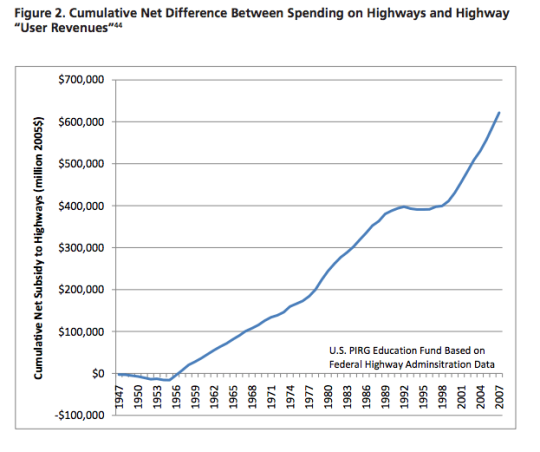
    And the second is this chart, which shows the cumulative net
    subsidy to highways in the US from the late 1940’s:

    image

    The point of all this is that when you subsidize something
    it’s because you’d like to see more, not less of it. So why then are we even surprised by the crippling traffic that plagues our
    cities? We are doing a lot to encourage exactly that.

  • How to save 8 minutes on Toronto’s highways

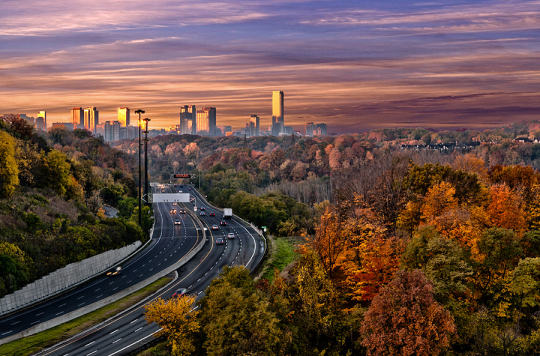
    City in Colour by Greg Patterson on 500px.com

    https://500px.com/embed.js

    Three months ago when Toronto City Council voted
    not to remove the Gardiner Expressway
    East (which in
    my view was a mistake
    ), it did so with a commitment to look at tolling
    options for both the Gardiner Expressway and the Don Valley Parkway (which in
    my view is a positive thing
    ).

    Last week a preliminary report was released
    discussing some of those tolling options. If reading dry city reports is your thing,
    you can do that here.

    The Coles Notes version (CliffNotes for you
    Americans) is that a $3 flat toll on both the Gardiner and the DVP – the same
    cost as riding transit in this city – would be expected to reduce vehicles on the highways by 9% and 12%, as well reduce end-to-end travel times by 3 minutes and 5
    minutes, respectively. There’s obviously a lot more in the report, but these
    figures stood out for me.

    Given how monumental the
    3 minute delay
    was in the Gardiner East debates, it will be interesting to
    see whether people treat a 3 minute time savings in a similar way. I suspect
    they won’t. The cost will be the larger issue.

    I’ve been a
    vocal supporter of tolls and road pricing on this blog
    . One of the main reasons
    for that is because I view the demand for highways as being largely inelastic
    and therefore a potentially great source of transit funding.

    The discouraging part of the above report is
    that its primary goal is to explore tolls for the purpose of “offsetting
    capital, operating, and maintenance costs.” The primary goal is not to come up
    with sustainable sources of transit funding.

    Having these costs paid for by user-fees as
    opposed to general taxes is still a good thing in my view. But an even better thing
    would be to help fund mobility solutions that we know will be far more
    effective at getting people around this region as millions more people move here
    in the coming decades.

    The other discouraging part of the report is
    that near the end it explains that while the City of Toronto Act of 2006 allows
    for toll highways, they cannot be implemented without the Province passing
    regulation.

    It’s a reminder that our governance structures do
    not reflect the current urban reality of this country.

  • Guest Post: For whom the road tolls?

    For those of who were following Architect This City during the Gardiner Expressway East debate here in Toronto, you might remember that Darren Davis (transport planner with Auckland Transport) wrote a guest post called, Three minutes that rule the world – Will demolishing the Gardiner East actually make traffic worse?

    It was an incredibly popular post at the time, so I’m thrilled that Darren volunteered to do another one on road tolls. This is a topic that I’m very interested in and have written about a few times. Road pricing, as you’ll see below, puts us in a bit of a chicken-and-egg situation. But sooner or later I think we will need to get our head around it, as will many other cities.

    I hope you enjoy today’s post. Thanks again Darren.

    ——————————-

    A recent post on Architect This City, The Tragedy of the Commons, raised a fundamental but all too often forgotten point about transportation: That in networks where the price of use doesn’t change when demand changes, there is no effective mechanism to manage that demand.

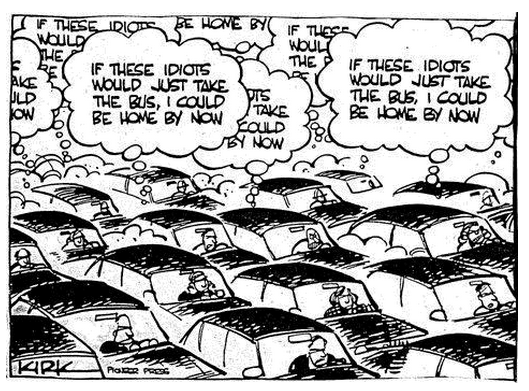
    Because there is no incentive to act in the public good, we often act in what we perceive to be our own personal interest, which is often the antithesis of the public interest. And remember that if we are driving, we are traffic. So often people will sit fuming in their cars in the midst of congestion with thoughts like in this cartoon. But of course with unpriced roads, there is no real price signal to these drivers to consider taking the bus.
    In a world where time is money, we are constantly berated about the economic costs of congestion. In 2011, the Toronto Board of Trade estimated that congestion in the Toronto region alone cost the regional economy $6 billion a year, rising to an estimated $15 billion in 2031 should no action be taken. More recent research by the CD Howe Institute pegs this figure at up to $11 billion.

    Given these sorts of eye-watering figures, one might be tempted to think that car drivers, and in particular the goods industry, would be flinging their wallets open at the chance to buy their way out of congestion. And in fact Toronto has the 407 Express Toll Route which has elements of variable road pricing. However, while the 407 ETR carries around 350,000 vehicles per day, price increases have been matters of controversy. It provides some ability for those who can afford it to bypass Toronto’s notorious traffic congestion, but its fundamental weakness is that it’s just one road in one of North America’s largest city-regions.

    Similar stand-alone efforts to address congestion in Metro Vancouver with tolled routes, such as the Port Mann Bridge on the Trans-Canada Highway and the Golden Ears Bridge, have fallen well short of their projected traffic volumes, while nearby untolled bridges such as the Patullo Bridge are heavily congested. We have a similar experience in New Zealand where our two tolls roads, with car tolls of $2 and $2.20 respectively, experience diversion rates of up to 30% to the alternative but substantially longer and slower free routes.

    This brings up a fundamental paradox: Congestion costs the economy a fortune and congestion is a top-of-mind frustration, yet people seem reluctant to pay even comparatively small amounts to bypass congestion.

    For example, the City of Toronto’s Roundtable on Gridlock & Traffic Congestion in February 2014 came up with the usual shopping list of “transportation systems management” responses – improved management of curbside space and construction projects; synchronized traffic signal phasing; better traveller information and improved incident response. While these are all worthwhile responses, they only improve system operation at the margins. Encouraging greater use of public transit was the very last recommendation and there was not a single mention of charging or pricing as a tool to address congestion. And the feverish activity continues with a hackathon called TrafficJam on October 2 – 4, 2015 with the goal of fixing Toronto’s traffic woes.
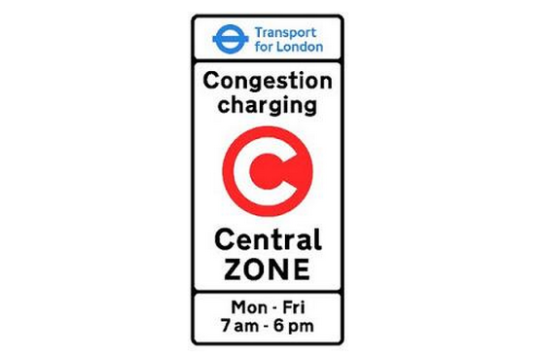
    The very few cities that have actually had significant success at reducing traffic congestion – notably Singapore, London and Stockholm – have done this through cordon-based congestion pricing wherein if you pass the cordon, you pay the congestion charge. Entering central London on a weekday between 7am and 6pm will set you back a cool £11.50 ($C23.30). From 2003 to 2013, about £1.2 billion ($C2.42 billion) of congestion charge revenue has been invested in public transport, road and bridge improvements and walking and cycling, of which £960 million ($C1.94 billion) was for bus improvements. These measures have included significant road space reallocation to improve conditions for pedestrians, cyclists, public transit and the urban realm.

    The latest Travel in London report states that “Over the 10-year period from 2003, total trips have increased by 11.4 per cent, with particularly notable increases of 52.3 per cent in rail trips and 32.0 per cent in Underground and DLR [Docklands Light Railway] trips, with cycle trips (as main mode) increasing by 53.9 per cent. Car driver trips decreased by 12.7 per cent over the same period” (my emphasis).

    One interesting insight is that Stockholm trialed congestion charging and then reverted to business as usual of unpriced roads in advance of a referendum on congestion pricing. This gave Stockholmers a clear sense of the difference in traffic congestion and was crucial in supporting a yes vote in the referendum.

    Stockholm has experienced a permanent reduction in traffic of about 20% across the toll cordon and congestion decreased by 30 – 50% – which demonstrates that traffic volume reductions have a disproportionately positive impact on congestion. About half of the “disappearing” drivers changed to transit, the rest to other alternatives such as different departure times and destinations and taking fewer trips.

    For more on Stockholm, I suggest reading the Tools of Change case study on Stockholm Congestion Pricing.
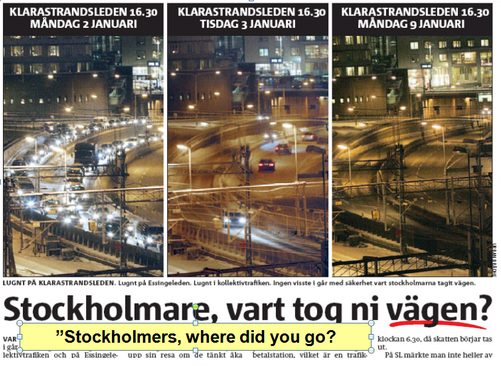
    Before and after congestion charge photos of traffic levels in Stockholm

    While this sounds very promising, congestion charging has significant equity implications and requires upfront investment to provide people who either choose to or can no longer afford to drive with transportation alternatives. Both Stockholm and London invested very heavily in public transit in advance of implementing congestion charging.

    And this brings up a big issue for Toronto. 

    For congestion charging to have a meaningful impact on congestion without stifling economic activity or impeding people’s ability to move around, the core capacity of Toronto’s transit system would need to be addressed first. In particular the Yonge Line capacity enhancements, Metrolinx’s Regional Express Rail and most likely the Downtown Relief Line would need to be in place to provide both capacity and choice for people who either needed or wanted a travel alternative to any congestion charge.  This would mean that Metrolinx’s Big Move might need to get even bigger.

    Disclaimer: The author of the above post is an employee of Auckland Transport, however, the views, or opinions expressed in this post are personal to the author and do not necessarily represent the views of Auckland Transport, its management or employees. Auckland Transport is not responsible for, and disclaims any and all liability for the content of the article.

  • What we could do to improve traffic in Toronto

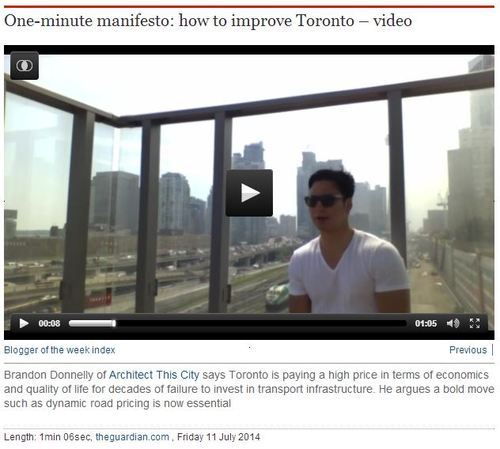
    This morning The Guardian Cities published my one-minute video talking about how much traffic sucks in Toronto and why we should be considering bold initiatives like dynamic road pricing.

    The video was shot on the sundeck of my building on a holiday Monday (meaning traffic volumes should have been less). The dirty glass makes the city look a lot smoggier than it really is, but it felt appropriate for the topic I was discussing.

    I’m sure many of you will disagree with what I’m advocting for, so let me know your thoughts in the comment section below.