Daily insights for city builders, delivered every morning at 6 AM ET. I’m Brandon Donnelly — a Toronto-based real estate developer and founder of Globizen. I’ve been writing here since 2013.

Tag: condominium

  • And that’s a wrap

    Mark Garner (Downtown Yonge BIA), Jon Simo (Neon Demon Studio), Rebecca Stubbs (Downtown Yonge BIA), Brandon Donnelly (Slate Asset Management), Rick Sole (Globizen Developments)

    What a weekend.

    Almost 4,000 people came through the Junction House sales office for our neon popup gallery. At one point throughout the day on Saturday, there was an over 1 hour wait to get in. The team had to implement a viewing time limit in order to keep the line moving.

    The event surpassed all of our expectations in terms of visitors and buzz. Many of the local businesses in the area also experienced a pop in foot traffic as a result.

    The Downtown Yonge BIA and Neon Demon Studio (as well as many others) did an incredible job coordinating and curating the exhibit. And we are thrilled to have played a small role in bringing it to life.

    What is clear to me after this weekend is that people really love neon (and, of course, Instagramming said neon) and that there’s a market here in Toronto for a permanent museum. It’s going to happen.

    For those of you who missed the exhibit, there’s no shortage of photos online. Check out #JunctionHouse and #NeonMuseumTO to get started. A big thank you to the entire team for making this happen.

    For more information on our Junction House condominium project, click here.

  • Price of a new condominium in Toronto increased 12.5% over the last year

    This morning BILD and Altus Group released their January 2019 new home sales figures for the Greater Toronto Area.

    Here are the highlights:

    • 1,362 new homes sold in January 2019 across the GTA. This is up 14% compared to last January.
    • Of these, 942 (~69%) were condominiums (includes low, mid, and high-rise, as well as townhouses). And 420 (~31%) were single-family homes (includes detached, semi-detached, and freehold townhouses).
    • Condominium sales volume is sitting only about 5% below the 10-year average and the benchmark price increased this month to $803,638, which represents a 12.5% year-over-year increase.
    • On the other hand, single-family home sales are down about 53% from the 10-year average and the benchmark price decreased by about 8.1% compared to last year. It is sitting at $1,130,046.

    While there continues to be a bifurcation in the new home market, we are seeing improvements across the board and the data is consistent with Altus’ prediction that 2019 will see an increase in overall sales.

    It is also important to consider how geography might factor into the above numbers. Here are the January sales numbers for the last three years broken down by region within the GTA:

    Just under 80% of the new condominiums sold last month took place in Toronto, whereas only about 1.2% of the single-family homes sold last month took place in the city. You can count them on one hand. There were only 5.

    So rather than just look at this in terms of housing type, I think the other way to interpret the data is that it could suggest strong and continued demand for centrally located and transit-oriented communities.

    And that just so happens to translate into a condominium.

    Photo by Eugene Aikimov on Unsplash

  • Average price of a new condo in Toronto is now above $1,000 psf

    Urbanation released its Q3-2018 condo market results for the Greater Toronto Area earlier this month. 

    Here are a few highlights:

    – The unsold inventory of new condos in development is currently 33% below the 10-year average of 14,806 units.

    – Year-to-date sales of new condominiums decreased to 14,055 units from 25,839 units (same period last year). 2017 was a record year.

    – The average price per square foot for new project launches in Q3-2018 was $1,044 psf. This is the first time the average has broken the $1,000 psf mark. 

    – This is a significant price increase from last year and it is being driven by low supply, stable demand, and rising development/construction costs (my opinion).

    – The average unit size for project launches in Q3-2018 was 714 sf.

    – The average opening quarter absorption rate remains above 55%. It has been this way since Q1-2016.

    For the full press release, click here.

  • Plus atelier

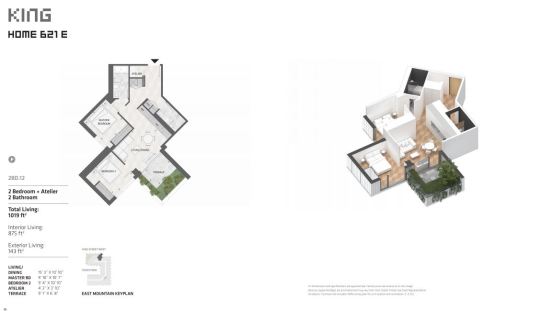
    This morning I went through some of the floor plans for King Toronto, which are now up on BuzzBuzzHome. In case you’re wondering, they are currently showing an average price of $1604 per square foot.

    Here is a 1 bedroom + atelier:

    And here is a 2 bedroom + atelier:

    Right away you’ll probably notice a few things. 

    There are no dens in these plans. They have been replaced with ateliers, which sounds cool. I want my own atelier where I make things. But it may also be a clever way to get around calling them studies or nooks.

    A lot of people in the industry have been commenting on how they’ve included the exterior living space in the calculation of total area. That seems logical to me, especially for a project like this where the terraces form such an integral part of the architecture.

    The other thing I noticed is that the buildings are, actually, being referred to as mountains. This has been part of the project’s design narrative since the beginning. So I like the consistency. The above plans are for suites within the “east mountain.” 

    But what I wanted to ask all of you today is whether you find the addition of a 3D plan helpful. It’s obviously not new, but it is still fairly uncommon, at least in this market. Do you think it’s worth it?

  • Unpacking the family condo

    John Lorinc has a piece in the Autumn 2018 issue of University of Toronto Magazine that is worth a read. It covers families in Toronto being priced out of the low-rise housing market and/or making the conscious decision to live in an apartment or condo.

    He raises an important question:

    The big question hovering over this generational transition is all about city-building, and whether increasingly dense metropolitan regions such as Toronto and Vancouver can figure out how to turn all those newly sprouted forests of highrises into true communities that are both affordable and appealing to the wide range of people who call these cities home.

    The reality seems to be that more people in this city – out of economic necessity and/or because of a lifestyle preference – are choosing to raise a family in multi-dwelling housing. I live in a condo and my neighbors are raising a child two doors down from me.

    I am sure that we will continue to see more of this and I am sure that we will get better at designing for families. We are trying to do our part with the 2-storey homes that we have incorporated into our Junction House project. 

    I would, however, like to respond to the underlying tone in the article that but for developers being stubbornly resistant to larger 3-bedroom apartments in this city, we would have a myriad of new condominiums filled with families.

    The reality is that there are market and structural forces (including cultural biases) that steer what gets built.

    There are affordability considerations. Larger condos cost more money than smaller condos. And that prices out many families, particularly if there are cheaper alternatives available in the form of low-rise housing. 

    The reason we appear to be at an inflection point today is because the cheaper alternatives are disappearing. (This of course returns us to the broader question of overall housing affordability.)

    There are also timing and financing considerations that likely create a supply-side bias. Most lenders require that a certain number of condo units be pre-sold before construction starts. 

    This means that, as a developer, you need people that can both afford what you’re selling and that are willing to buy three to five years out, and perhaps even longer. That can be difficult for many families.

    Lastly for this post, there’s the GST/HST New Housing Rebate in Ontario, which I have argued before on the blog could be incentivizing smaller suite sizes and could use a refresh for today’s home prices.

    All of this is not to say that we shouldn’t be designing for urban families and that we shouldn’t be focused on delivering more affordable housing to this and other cities. Those are two very important things.

    It is simply to say: there’s a lot going on here that needs to be unpacked. 

  • The real reason people oppose new development

    image

    A good friend of mine just sent me this fascinating research paper called: Opposition to Development or Opposition to Developers? Survey Evidence from Los Angeles County on Attitudes towards New Housing. It is a study out of UCLA that was published earlier this year by Paavo Monkkonen and Michael Manville.

    For the paper, they conducted a survey-framing experiment with over 1,300 people in Los Angeles County to test how strongly they felt about a number of common anti-housing sentiments; arguments such as traffic congestion, neighborhood character, and strain on local services. 

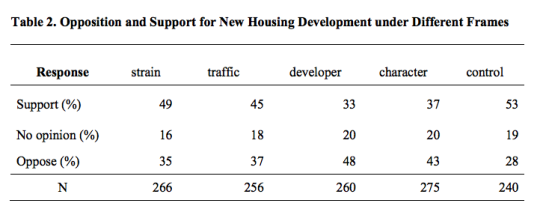
    However, they also introduced another argument: large developer profits. And interestingly enough, they discovered that respondents were 20 percentage points more likely to oppose a new hypothetical housing development when the survey was framed around the developer making a lot of money.

    Here is a table from the paper showing the various frames, as well as the percentage of people who supported, had no opinion, and who opposed. Note that under the “developer” frame, the opposition number is 48%.

    image

    So their “takeaway for practice” is as follows: “Housing opposition is often framed as a form of risk aversion. Our findings, however, suggest that at least some opposition to housing might be motivated not by residents’ fears of their own losses, but resentment of others’ gains.”

    Photo by Cameron Stow on Unsplash

  • Five year anniversary

    Today is the five year anniversary of this daily blog. That’s over 1800 posts. 

    It’s almost hard to believe that it has been that long. It seems like just yesterday I was on year 2 or 3. But at the same time, it’s almost hard for me to remember a time when I didn’t blog every day. I guess we’re calling it a habit at this point.

    One of the most common questions I get regarding this blog is: “Do you pre-write posts?” The answer is never. Okay, almost never. Sometimes I’ll pre-write a post if I know I’m going to be on a plane for 12 hours and I won’t make the timezone cutoff. But generally as a rule I don’t.

    Part of the reason I don’t is because it breaks the habit. This is something I do every day. And I like that routine. I also want the posts to be timely and I want to be able to write about things that may be on my mind that day.

    Momentum is a powerful thing. And when you’ve been doing something for a number of years, and especially something as public as this daily blog, there’s a powerful incentive to keep doing it. That’s how streaks work.

    However, in the world of development, five years is perhaps not that long. It’s maybe one project. Streaks take a lot longer to establish.

    This summer One Delisle by Studio Gang went public and you’re now starting to see (bright neon) teasers for Junction House. Both of these projects are many years in the making. The Junction House story started in early 2016.

    So I reckon that this blog needs at least another five years so that there’s enough time for the really juicy stories to surface. I’ll endeavor to do exactly that. 

    Thanks for reading and making this community what it is. See you tomorrow.

  • Photogenic neon in the Junction

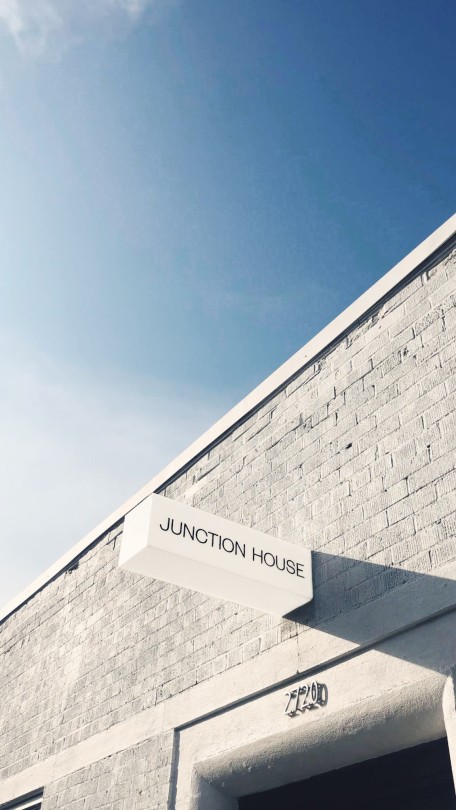
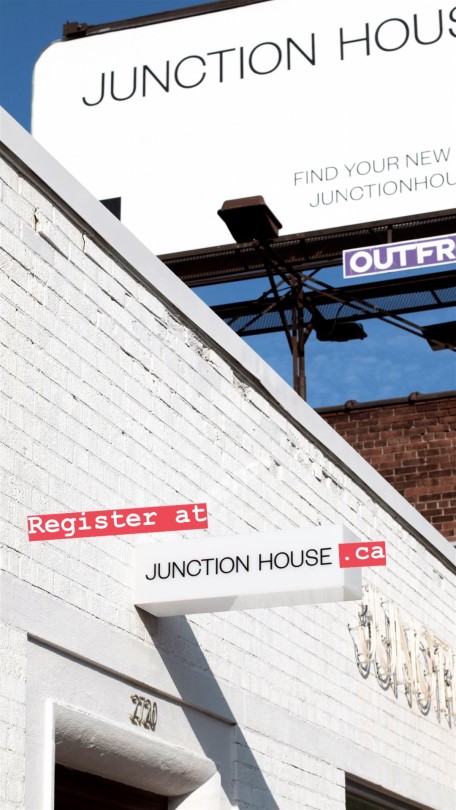
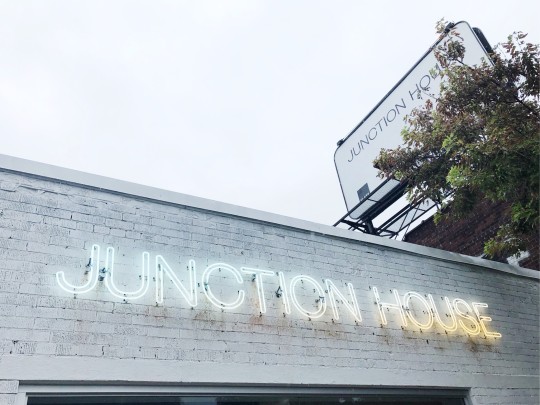
    We just finished putting up some additional signage at the future sales office for Junction House. Clean and minimal, but fun. I am pretty pumped with the way everything turned out. Creative and photos by Vanderbrand. Instagram story mashup and failed neon photo by me.

    This week I learned that properly photographing neon takes a bit of work. The neon “Junction House” sign is actually all white when you see it in person. Apparently it has something to do with the frequency. 

    I’m going to go back one evening with my tripod and Fuji and see if I can do better.

  • Condo rents in Toronto are up 11.2% from last year

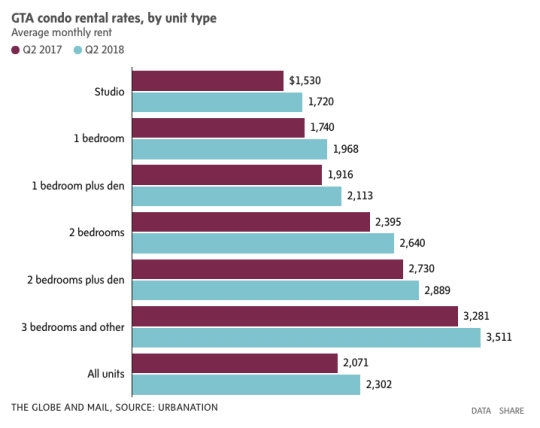
    Yesterday Urbanation released its Q2-2018 rental report for the Greater Toronto Area. It tracks both purpose-built rentals and condominium rentals, the latter being condominium units that are listed for rent on MLS. The average condo rent, for all unit types across the GTA, is up 11.2% year-over-year to a face rent of $2,302 per month.

    Here is a chart from the Globe and Mail:

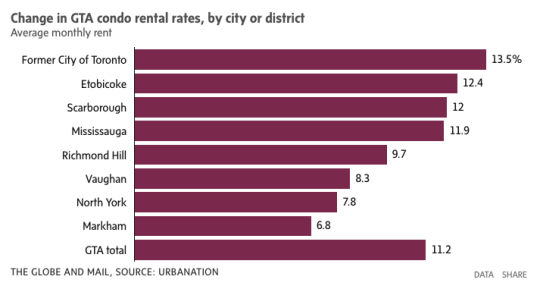
    The former City of Toronto, which includes downtown, is actually up 13.5%:

    But here are the stats that I really wanted to draw your attention to today (figures from the Globe).

    According to Urbanation, there were some 384,000 condo apartments in the Greater Toronto Area in 2017 and nearly 1/3 of them were rented out. Given that the Canada Mortgage and Housing Corporation pegs the total number of rental apartments in the GTA at approximately 311,596, condo apartments represent about 40% of all our rental housing stock.

    So condo buildings are actually doing quite a bit of heavy lifting when it comes to providing rental housing in this region.

  • 11 Hoyt, Brooklyn

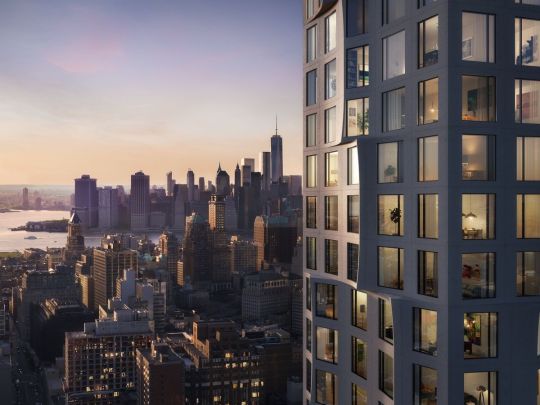
    Tishman Speyer just unveiled a new condo project in Brooklyn called 11 Hoyt. And it just so happens to be Studio Gang’s first residential project in New York City. Preview above. More renderings over here.

    It’s a 51 storey condominium with 480 residences and 55,000 square feet of indoor and outdoor amenities. The unit mix ranges from studios to four-bedroom residences, and prices range from $600,000 to over $4 million (USDs, of course).

    If you’re from Toronto, you’re probably looking at the renderings and thinking to yourself: “There are no balconies or outdoor spaces.” But that’s fairly typical in the NYC market, as I understand it.