Daily insights for city builders, delivered every morning at 6 AM ET. I’m Brandon Donnelly — a Toronto-based real estate developer and founder of Globizen. I’ve been writing here since 2013.

Tag: condominium

  • Locals hate you

    BlogTO recently reported that “snarky anti-condo signs” have been popping up around Toronto. Here is one of them via Instagram. It reads (in all caps): Dear Condo Dwellers: Locals Hate You Go Fuck Yourself

    I find these posters curious, though it is obvious that they are a reaction to growth, intensification, and general change in this city.

    For one, it implies that condo dwellers and locals are mutually exclusive. In other words, “locals” don’t live in condos. Presumably the implication is that they live in low-rise grade-related single-family housing. Or maybe they live in rental housing? Is it a tenure thing?

    According to the latest 2016 Census data, just over 26% of private dwellings in Toronto are condominiums. And about 30% of people live in a building that has 5 or more storeys. If you include “apartments” less than 5 storeys, this latter number jumps to 40%. So many potential non-locals.

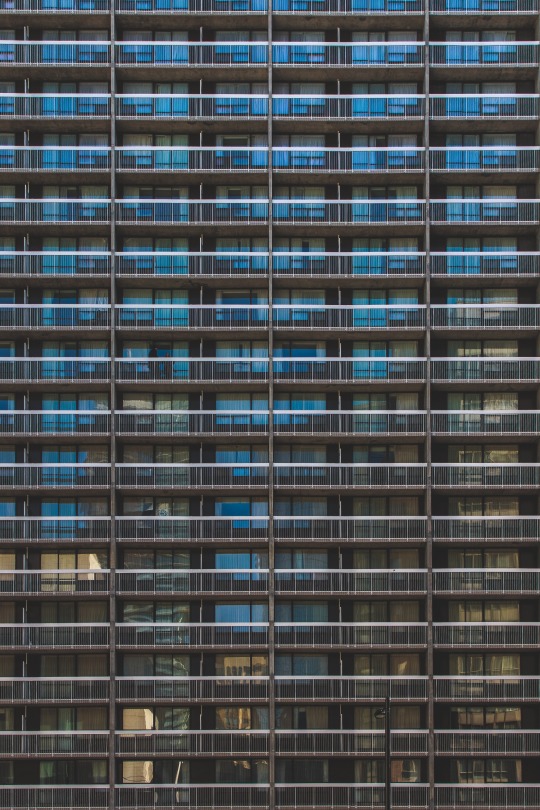
    However, it could be that these posters are primarily directed toward new condos and new condo dwellers. This poster seems to have been plastered in front of this recently completed condo building on College Street.

    If that is the case, then I wonder if there is a temporal cut-off for the hate. For example, the condo building that houses (at its base) my regular grocery store was completed in 1983. 

    The units are large and the demographic seems to skew a bit older. Are these condo dwellers – some of which may have been there for over 3 decades – to be hated? Are they non-locals? Or does urban myopia set in after awhile and they become locals?

    At the same time, it wouldn’t be unusual for the residents of an older condo building to oppose a new proposed condo building. So perhaps “local” isn’t about building typology and it’s more about who came first. That’s certainly a tricky one. Better end here.

    A curious poster that could use a bit more specificity. What do you make of it?

  • An interview about homogeneous towers

    image

    My friend Randy Gladman, who is Vice President of Development at Triovest Realty Advisors, recently sat down for an interview with Alex Josephson, who is a founding partner of the Toronto-based architecture practice PARTISANS. 

    The topic of discussion was the book that PARTISANS published last year (Rise and Sprawl) and, more specifically, why Toronto’s condominiums all look the same.

    Firstly, let me admit that I haven’t read Rise and Sprawl from cover to cover. So take what you would like from my comments. Still, the book was very successful at spurring a lot of discussion within the industry and so I’ve been getting hit with it since it was released. 

    Generally speaking, I fully support and commend their call for better architecture in Toronto. Here is an excerpt from Alex:

    “There’s a subtle but critical distinction I think some people are missing about the book: We are not criticizing condominiumization; we are criticizing condo architecture. We support density and we support condos. Toronto has become a much more vibrant city as a result of the condo boom. But the values that are driving the designs are suburban. The virulent spread of homogeneous design? That’s practically the definition of suburban. The radiator balconies I mentioned? They’re the result of a hard-wired fantasy that, as Canadians, we all have some kind of God-given right to an outdoor space, namely a back or front yard. And parking lots. Why do we still own and drive cars in the downtown core? This is a serious problem totally born out of a suburban driving mentality.”

    Where I struggle with the book is that it has always felt a bit idealistic, fanciful and, in some cases, elitist (as Randy mentions in the interview). Idealism can be great for spurring discussion (and drawing attention to a practice), but what are the root economic causes for what we are seeing? Virtually every building is a “spreadsheet in the sky”, not just the condo towers in Toronto.

    That said, the discussion does acknowledge that profit will always drive projects. And I do agree with this particular comment about building heights:

    “Anything above twenty stories is inconsequential from street level. So whether it’s twenty or a hundred storeys, I’m mostly indifferent. We are so obsessed in Toronto with height. But height equals money. If we can figure out a way to allow for more height in exchange for better design, we’ll end up with better buildings. But that kind of logic is just not embraced by the city planning culture here.”

    Click here for the full interview in ArchDaily.

  • 3 obscure things to think about before buying a condo

    If you’re an architect, developer, or someone else in the business of building buildings, chances are you have an extensive mental list of things that you would think about before buying a piece of real estate. I know I certainly do. These are things you learn over time – sometimes by making mistakes.

    Depending on the type of real estate, this list would vary. So this is not going to be a comprehensive list of things to consider, by any means. But today I thought I would mention 3 things that a lot of people might not think about when buying a new condo, particularly when buying pre-construction off drawings.

    Noisy Adjacencies: 

    What’s around the suite? Elevator shafts, mechanical rooms, and gyms all create noise. There are measures to protect against all of these noises, but that doesn’t stop me from worrying about these sorts of things. For instance, in my experience, some (many?) condo gyms don’t have the right kind of floor to deal with dropping weights. In these cases, something is usually done after turnover to address the noise complaints.

    Exposed Overhangs: 

    Does the suite overhang the floor below or sit on top of a space that is exposed to the elements, such as a loading bay or walkway? If so, you might get a cold zone if it hasn’t been properly insulated or heat traced. Of course, most projecting condo balconies also create a thermal bridge that can create a cold zone around it. But the first example could be worse. If you live in a place that doesn’t have subarctic winters (Toronto) this may be a moot point.

    Transfer Floors: 

    The most efficient way to build a multi-family building is to repeat the same floor plan as you go up the building. This ensures that everything runs in a straight line. The minute you create stepbacks and offsets, you then need to start “transferring.” This means that structure and services will need to be brought from one location of the building to another. This can lead to deeper structural beams and additional bulkheads which could then impact ceiling heights in the suites. This won’t always be the case, but something to think about when you see dramatic changes in the building’s form next to your suite.

    Again, this is not a comprehensive list, but these are some of the small – perhaps anal – details that I would think about if I were buying a condo. Feel free to add other items in the comment section below. They don’t have to be anal-retentive in nature.

    If you’re on the building side, you work to get ahead of these issues by, for example, anticipating where you could need additional height for transfers and sound attenuation (such as around mechanical spaces). But buildings are complicated and sometimes things happen. It’s a long way from initial sketch to finished occupied building.

  • What’s in a word? A lot.

    image

    One of the things I try to be aware of is the language that I use to describe things. Because the words and conventions we use can impact how we perceive things and they can also reinforce certain inherent biases. (I have a good friend who is an expert on this topic, so he has heightened my awareness.)

    For instance, I find that we tend to equate home and house. In other words, we’ll use the descriptors detached house and detached home interchangeably. And when we say that someone is a homeowner, it can sometimes, or often, mean that they have purchased a house.

    The same does not seem to be true for apartments and condominiums. Rarely do I hear people say that they live in an apartment home or a condominium home. It’s just an apartment or condo.

    This is meaningful because the emotionally charged word is home. It signifies a subjective (and usually comforting) experience, whereas the word house, I would argue, represents a building typology. And so by conflating the two, I often feel that we’re promoting a cultural bias that privileges houses as the ideal building typology. A true home is a house.

    The other word that I often think about in my business is unit. When we talk about multi-family buildings we often – and I’m definitely guilty of this – refer to each suite as a unit. We’ll say things like: “This is a 200 unit building and the unit mix is as follows…”

    Again, I am absolutely guilty of this. But at the same time, I often think about how this word, unit, is probably the furthest thing away from a home. Who wants to live in a unit? That doesn’t sound very pleasant. In fact, it sounds clinical. People want to live in a home. Now that’s a word with positive psychological associations.

    And so by reducing each home to a unit, I think it could be making us lose sight of the fact that each suite will eventually be lived in by someone who will then make it their home. Yes they can be considered a customer who are paying for a product (a great place to live), but I don’t think that should take anything away from its homeyness. 

    I live in a condominium and it is my home. What about you?

    Image: Flickr

  • Condo building identities according to Instagram

    I am very interested in the social side of buildings. What I mean by that is that we usually focus on the quantitative side. We look at sale prices. We look at average prices per square foot. We look at reserve fund balances. And as I recently argued, this is all very important stuff. I think we should do much more to make this data publicly available.

    But there’s also a side to buildings that’s harder to measure: the human side. Sale prices and staged MLS listings don’t tell you what the people who live in the building are like. What the vibe will be like at the pool during the summer. If you can expect to find dog poo in your elevators. But when you live in a multi-family building, I think most people will tell you that the qualitative side also matters.

    So this morning, I thought I would run a little experiment and pull the top Instagram photos for a random sampling of relatively new condo buildings in Toronto. These are public photos that have been uploaded and tagged with that building’s location ID. 

    Obviously there’s an inherent bias since I figure Instagram users probably lean towards Millennials. Also, the top posts could be easily skewed by a small number of heavy influencers. But I still thought it would be interesting to see if any particular identities started to emerge. And I do see some differences that reflect what I would have expected. I wonder how these might relate to the original marketing for the buildings.

    What do you think of the photos below?

    Feel free to do the same for your building and post the photo in the comments below. That could make for a really interesting discussion. My building is the first photo.

  • Throwing butts

    For whatever reason, some of the people living in high-rise buildings believe that if you flick a cigarette butt off a balcony that it will magically disintegrate on the way down. It’s either that or they don’t give a shit about anyone else.

    Because if you happen to live in or manage a building which has patios or terraces at the base of tower, I bet you have this problem:

    image

    Above is a picture of a Belmont cigarette burning through the tarp covering the wooden harvest table on my patio. 

    It’s a destruction of property, an environmental concern (many butts end up in stormwater drains), and a pretty scary fire hazard. I know of many incidences where thrown cigarette butts have started fires in a high-rise building. It happened last year in my mother’s building.

    However, the frustrating thing about this problem is that it’s exceptionally difficult to stop. I know this because I sit on the board of my condo building. The typical response is for management to send out notices to all the residents asking them to stop doing this. But frankly, that does nothing.

    So if any of you know of a company or service (or have a product idea) that can help with this, please contact me. But if no such company or service exists, I am positive that you could create it today and sell to almost every condo corporation and property management company that have a condition where terraces or patios sit below a tower. Because inevitably, there will be someone upstairs throwing butts.

    Many buildings have a similar issue with dog poo. People simply don’t pick up after their dogs. So some property managers have started taking stool samples of every dog who lives in the building. That way they can easily determine which residents aren’t picking up after their dogs. I guess that’s what it takes to get some people to give a shit.

    Of course, this isn’t a problem just in buildings. Cities in general are always fighting litter. That’s why you see ideas like this pop-up:

    //platform.twitter.com/widgets.js

    This particular one (in London) was designed to stop people from throwing their cigarette butts on the street. Instead, you use your butt to vote. In this case: England vs. Australia.

    We talk a lot about big ideas here on Architect This City. What driverless cars will mean for cities, how laneway housing could help with housing affordability, and so on. But the smallest ideas can also matter a lot for city building. Sometimes we forget that.

  • Should condo reserve fund balances be made publicly available?

    No Need For Love by Michael Muraz on 500px.com

    https://500px.com/embed.js

    I’ve been thinking a lot lately about condominium governance and how things might be improved.

    If you own a condominium, you pay a monthly maintenance fee. Let’s say, for example, you own a 833 square foot condo and your maintenance fee is $500 per month. That works out to be $0.60 per square foot.

    For a lot of people, this fee probably feels like a bit of a black hole. The money goes out every month and that’s the end of it.

    But as I explained here, a portion of that fee goes into the condo’s reserve fund to cover future capital expenditures. This is basically an investment you are making for the future benefit of the building.

    As an example, if you’re paying $500 per month, somewhere around 25% could be going towards your condo corporation’s reserve fund. That’s $125 per month. $1,500 per year. $7,500 over a 5 year period. And $15,000 over a 10 year period.

    Now this is an investment that you’re obliged to make, but one that you might not be around to directly benefit from if you decide to sell before capital expenditures are made using the money you’ve invested.

    Of course, if you’re a savvy buyer, you’re going to scrutinize the reserve fund and the corporation’s overall financials before you buy into a building. And sometimes the unit valuations do get deeply depressed by out of control maintenance fees and/or special assessments. So you could maybe argue (as an owner) that your reserve fund investment ends up getting recaptured in an eventual sale.

    But what I wonder is to what extent a properly funded reserve gets accurately reflected in the valuation of the individual units. I suspect not that well. And as far as I know, there isn’t great data on this metric. (If you know of anything, please share it in the comments.)

    It’s certainly important information to have and consider. Again, when you buy a condo unit you’re not only buying the unit itself, you’re also buying the future investments (and liabilities) that others have left before you.

    So what I really want to know: Why aren’t reserve fund balances and building studies made publicly available? This is not easy information to get today.

    But imagine what would happen if the market had full transparency. Imagine if you could see a map of every condo building in your city and sort by age and reserve fund balance. In theory, unit pricing would become more accurate. But even more than that, there would be significant opportunities for collective intelligence.

    Now all of a sudden buildings would be able to benchmark themselves against other buildings to see if their reserve fund is sufficient, as well as learn from other buildings with respect to their history of capital expenditures. It would also hold the building’s management more accountable and allow owners to easily see if the contracts in place are competitive with the overall market.

    I know that a lot of people get nervous when it comes to sharing information like this. I mean, what would happen if your building is underfunded relative to its peers? Would that pull down property values? It certainly could. But if you’re underfunded and you get stuck with a special assessment in 5 years, then your property values are going to drop regardless.

    So I would love to see a lot more condo information made available to the public for free. In my view the benefits outweigh the potential negatives, particularly if this were to be done at scale. Condo corporations are also non-profit entities, so it’s not as if their balance sheets and income statements are filled with sensitive trade secrets.

    But what do you think? Would you feel comfortable if your condo’s reserve fund balance was made available online to the public? Do you even know off the top of your head what the balance is for your own building? I would be curious to know.

  • The housing typologies of American cities

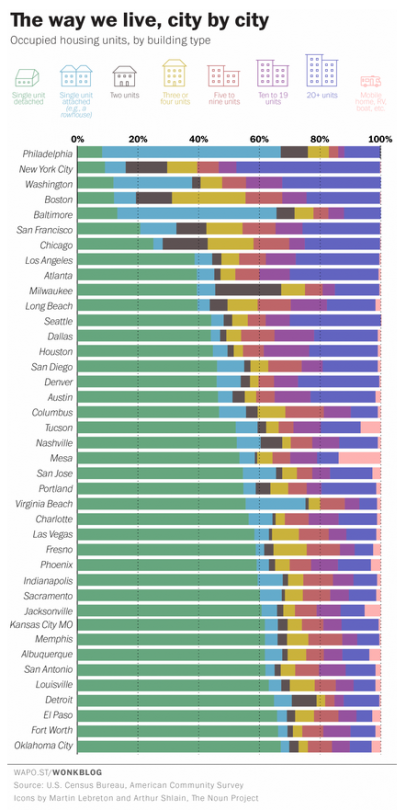
    Yesterday the Washington Post published a great chart showing the housing types of the 40 largest cities, by population, in the US. The list is ordered from lowest to highest according to the percentage of single-family houses in the city (green bar).

    Here’s the chart:

    image

    Not surprisingly, many of the cities at the top of this list (meaning they have the lowest percentage of single-family houses) are in the older east coast cities. 

    It’s also interesting to see just how much the rowhouse dominates the urban landscape in Philadelphia and Baltimore. In Philadelphia, almost 60% of the housing stock is an attached rowhouse.

    Housing is the backdrop for such a big portion of our lives. And when you live in a particular kind of home, it impacts your life whether or not you realize it. The dense rowhouses of Philadelphia and the single-family houses of Oklahoma City are the result of two very different kinds of urban landscapes.

    In Toronto, that backdrop is in the midst of a dramatic change. More and more of us are now living in high-rise condos. That hasn’t always been the case, of course. It’s a recent shift. But it looks like it’ll be a big part of our future.

  • 1 bedroom condo for sale

    image

    I’m hijacking Architect This City today to help my mother out and try something new.

    She is looking to sell her 1 bedroom condo in the Radiocity Condominiums, located at 285 Mutual Street in Toronto. It’s called Radiocity, not because the developers thought New York was cool (my pet peeve), but because the site used to be the headquarters of the Canadian Broadcasting Corporation (CBC) way back when.

    The 2-tower complex is located north of Carlton Street, between Church Street and Jarvis Street, and is adjacent to Canada’s National Ballet School (designed by KPMB Architects). It’s close to College Park and Yonge & College.

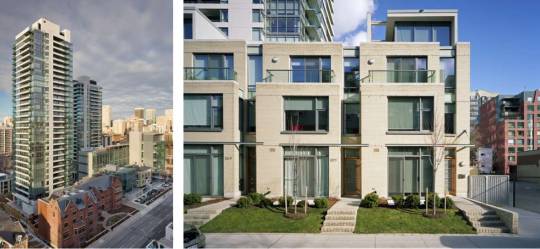
    It was completed/registered in 2005 and won a number of design awards, including one from the Royal Architectural Institute of Canada. Notable about the design is the way it integrates townhouses at the base, a public courtyard (with public art) between both towers, and the Ballet School. (A deal struck with the developer and the CBC allowed the school to buy their portion of the land for $1). 

    The buildings were developed by Context Development and designed by architectsAlliance, which is actually the same developer-architect duo behind the building I currently live and own in. I’m clearly a big fan.

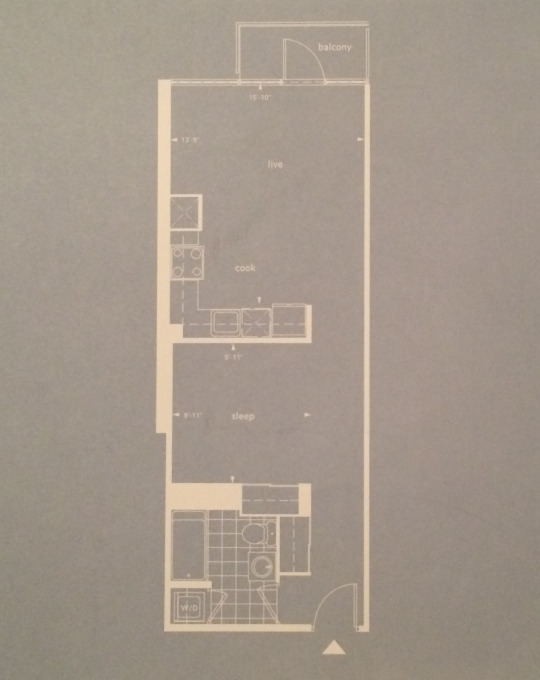
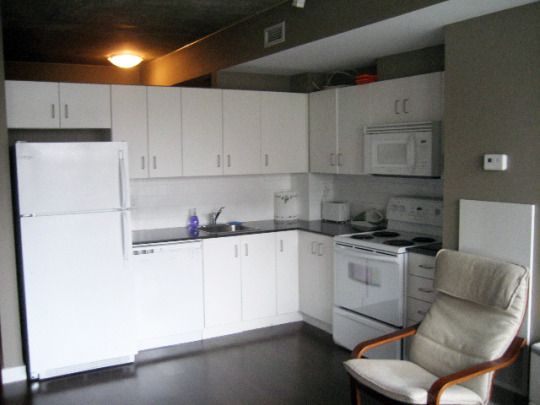
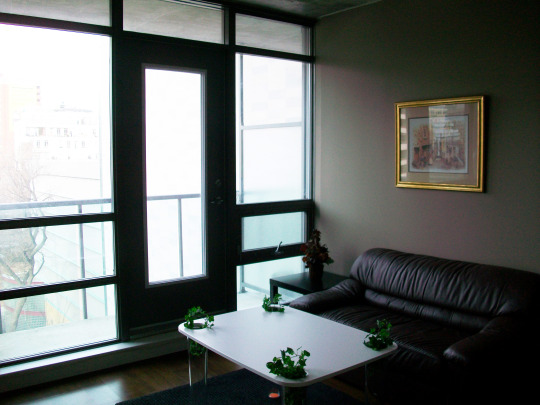
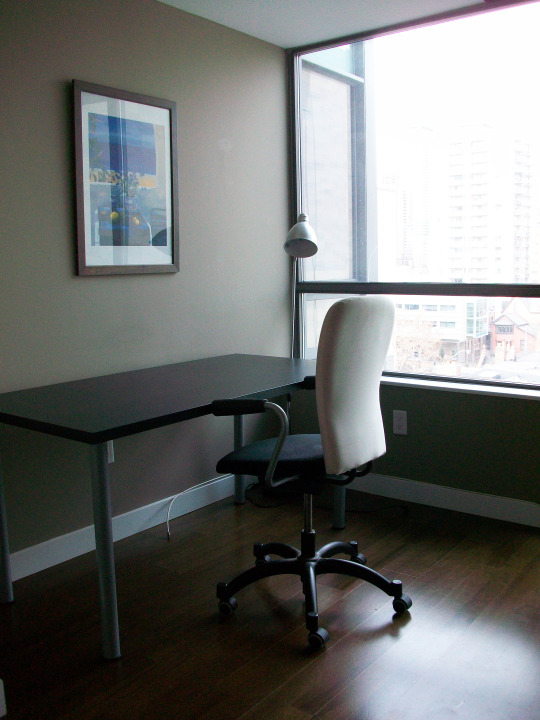
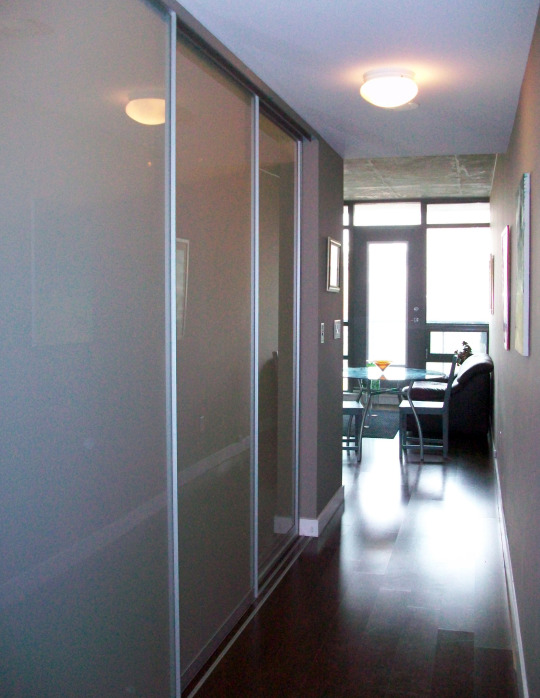
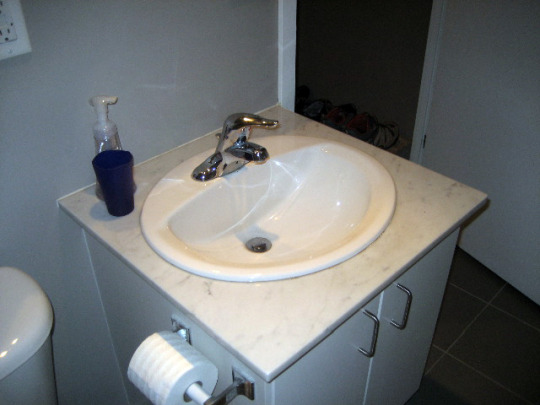
    The suite is about 560 square feet. It has 9’ exposed concrete ceilings. It has one full bathroom (tub), with a stacked washer and dryer. The bedroom is about 10’ x 10’ and is setback from the outside windows and enclosed with 3 x translucent sliding doors from C-Living. (I had them installed myself and they’re much better quality than the sliding doors you’ll find in most new builds.) The kitchen and living area is open concept, and there’s a north facing balcony that overlooks a quiet private courtyard. You basically get a view of trees, greenery, and the city. The suite is located on the 7th floor.

    Here’s the floor plan:

    image

    And here are a few photos. They are all the right proportions and haven’t been stretched to make the space look bigger 🙂

    imageimageimageimageimage

    The building has 24-hour concierge, visitor parking, and 3 floors of amenities. The amenities include a gym, aerobics room, party room, saunas, media room, boardroom, multiple lounges, 2 x guest suites, a party room, and a billiard room. 

    College subway station is a 7 minute walk (600m).

    image

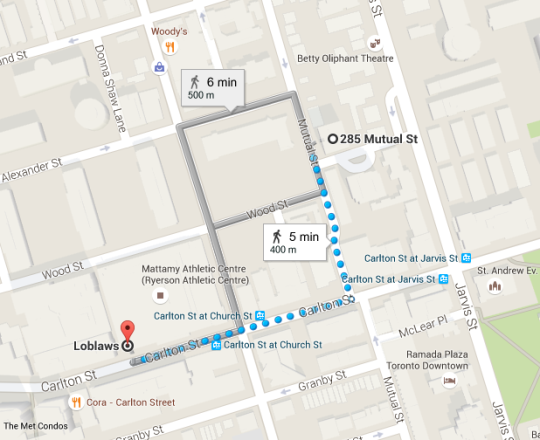
    The Loblaws grocery store at Maple Leaf Gardens (which is awesome and also includes an LCBO) is a 5 minute walk (400m). Though I’m fairly certain you could do it in 4 minutes.

    image

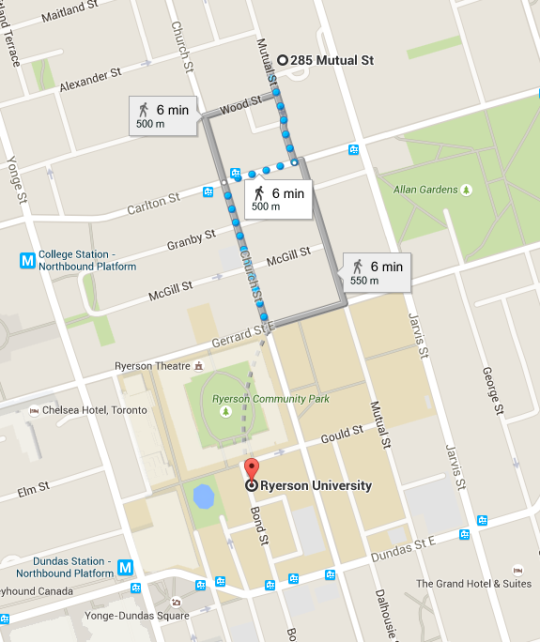
    And you’re a 6 minute walk to Ryerson University (500m).

    image

    The asking price is C$349,900. The maintenance fee is $426.64 per month and the property taxes are $2,039.19 per year.

    It’s a private sale, but she is willing to cooperate with buyer’s agents (2.5% commission). It’s currently furnished, but you can have it either way you want (unfurnished or furnished).

    If you have any questions or would like to book a viewing, please send her or me an email. If you’re an agent just looking for a listing, please don’t. Thanks for reading. Regularly scheduled programming will resume tomorrow.

    Image at the top of this post is from architectsAlliance.

  • The evolving gig economy

    This morning venture capitalist Fred Wilson wrote a post on his blog talking about the gig economy and Hillary Clinton’s economic speech last night. 

    Here’s a snippet from Clinton’s talk:

    Meanwhile, many Americans are making extra money renting out a small room, designing websites, selling products they design themselves at home, or even driving their own car. This on-demand, or so-called gig economy is creating exciting economies and unleashing innovation.

    But it is also raising hard questions about work-place protections and what a good job will look like in the future.

    So, all of these trends are real and none, none is going away. But they do not determine our destiny. The choices we make as a nation matter. And the choices we make in the years ahead will set the stage for what American life in the middle class and our economy will be like in this century.

    The headlines this morning are making it seem like Hillary Clinton is taking direct aim at companies like Uber. But the transcript suggests that she’s being far more balanced than that: these new companies are creating exciting opportunities, and they are not going away, but there are still things to figure out.

    That’s basically how I feel.

    Take, for example, Airbnb. I think Airbnb is a great idea and company. A lot of my friends use it both as consumers and as suppliers of space.

    But for many (most?) condos in Toronto, owners are strictly prohibited from renting out their units on leases that are less than six months. It’s a direct ban on short-term leasing and it’s written into the Condo Corporation’s Declaration.

    And there’s good reason for that. Who wants to buy a condo only to find out that next door is being operated as a nightly hotel? Most people would even prefer that their neighbor is an owner rather than a renter.

    That doesn’t mean I believe Airbnb should not exist. I think we’ll likely end up getting more transparent about how buildings (and portion of buildings) are operating, as opposed to it being a shadow economy. And that could help.

    If you have any ideas for how companies like Airbnb might be better integrated into urban life, I would love to hear from you in the comment section below.