Daily insights for city builders, delivered every morning at 6 AM ET. I’m Brandon Donnelly — a Toronto-based real estate developer and founder of Globizen. I’ve been writing here since 2013.
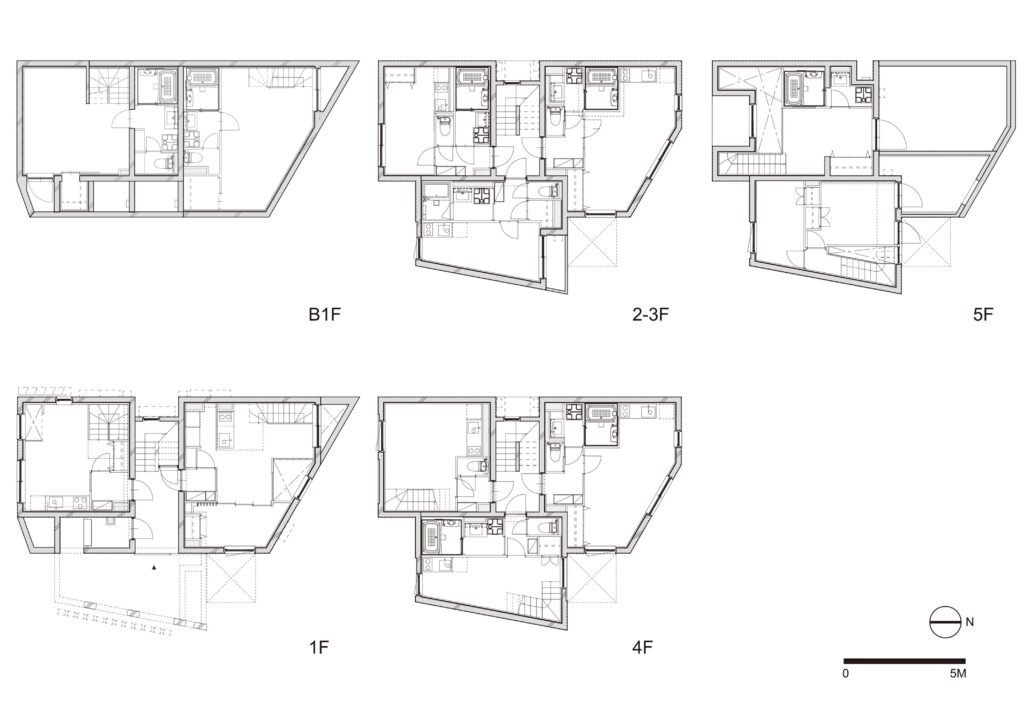
Last week, Globizen shared this 11-unit condominium project in Tokyo on Instagram. Some of you may like the design by Ryuichi Sasaki Architecture, and some of you may not. But regardless, it’s an interesting case study in that the site area is only 152.27 square metres (or 1,639 square feet). The building footprint is 84.86 square metres and the total floor area is 416.68 square metres. If we divide the total area by 11 units, we get an average area per home of only 37.88 square metres, and so these are certainly on the compact side. Here are the floor plans:
The unit composition is as follows:
Ground and basement: 2 x 2-storey homes
Levels 2-3: 6 x single-storey homes
Levels 4-5: 3 homes, 2 of which are 2-storey homes
The other thing you’ll notice is that there’s a single access stair in the middle of the building. As compact as the homes may be, it is this point-access-block design that unlocks the site. To put the site area into perspective, it is almost certainly smaller than the average single-family lot in the central parts of Toronto. A 20′ x 100′ lot is 2,000 square feet, versus the 1,639 square feet we have here (though the proportions are different).
I’m not suggesting that 37.88-square-metre homes are the objective; rather, I’m suggesting that reducing the barriers to developing small infill sites will unlock new housing opportunities that can then be tailored to the needs of the market. Had two egress stairs been required for this building, it would look very different, and may not have ever been built.
The GTA condo market is in a state of economic lockdown. The math doesn’t make economic sense from both the demand side (investors) and the supply side (developers), leaving the market at a standstill.
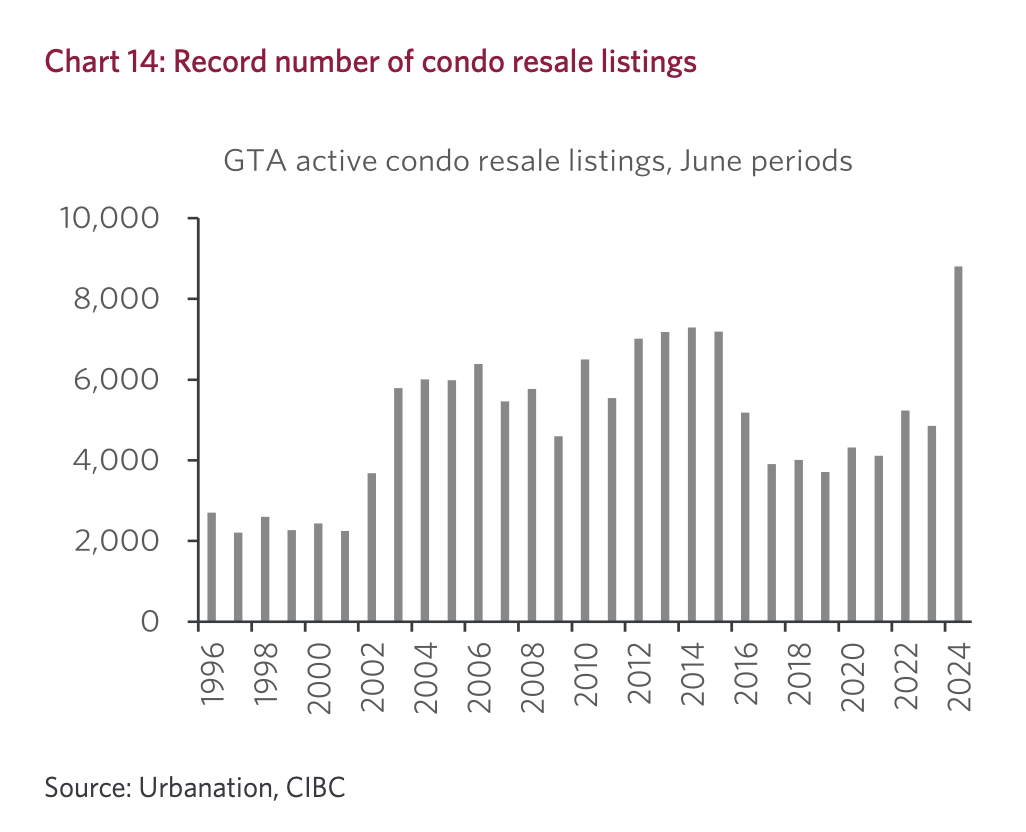
The above excerpt is from a recent CIBC Capital Markets article by Benjamin Tal (CIBC) and Shawn Hildebrant (Urbanation). And what it ultimately means is that the supply of new condominiums in the GTA is falling and will continue to fall for the foreseeable future. Below are two charts, from the same article, that show that.
Because of this, I actually think that, if you need or want a place to live, right now is a near ideal time to buy a condominium, especially if it’s from developer inventory (in an already completed project) or it’s a resale. Of course, most people won’t want to do this because they’d rather buy when most other people in the market want to buy. This is how markets tend to go.
It has been a while since the GTA has gone through one of these real estate cycles, but it is typical: developers are prone to both over-building and under-building. It simply takes too long to build a building, and so it is natural for there to be moments when supply and demand don’t exactly line up.
Pre-selling condominiums is — in theory only — supposed to protect against too much overbuilding. But as we have spoken about many times before, it can be challenging for end users to buy a new home so far in advance. And so the new condominium market has come to rely on investors who want to buy early and then either sell later or rent later.
According to the above article (and MLS data), the share of newly completed condominiums used as rentals reached a peak of 34% in 2023. So a third of new condos. My gut tells me that the actual number is much higher. Many rentals never reach MLS. Overall, I think it’s very safe to assume that the majority of new condominiums are owned by investors.
But right now, fewer investors want to own condominiums, which is why the number of resale listings has spiked this year:
This is, again, why I think right now is an excellent time to buy a condo. You know, be greedy when others… Regardless, this inventory will need to get absorbed and that will ultimately happen. Some of it will go to end users and some of it will go to investors who can make sense of the rental math and/or want to take a long view on Toronto. But if more goes to the former, we will be losing a lot of new rental housing.
At the same time, while all of this is going on, construction starts are likely going to remain depressed (chart 3 above). It’s impossible to know how long this lasts, but at some point we will reach a moment in the cycle where we are under-building new housing. Maybe we’re already there. Development simply can’t turn on fast enough when demand spikes. There will almost always be a lag.
So, since the majority of new condominiums have been serving as new rental housing, there’s a strong case to be made that at some point we will run into a potentially severe shortage of rentals. Condo investors are sometimes vilified in the media, but we will soon find out what happens when you take a big chunk of them out of the housing market.
Urbanation just released its Q2-2024 condominium market survey for the Greater Toronto & Hamilton Area (GTHA), and we should probably talk about some of the data:
The new condominium market reported 1,688 sales in the quarter. Outside of Q2-2020 (the pandemic), this is the lowest in the past 20 years. Note: This number is self-reported by developers.
Of the 3,625 homes launched for pre-sale during the quarter, only about 17% got absorbed/sold. That’s about ~616 homes, which isn’t very much when you spread it out across the region’s projects.
Unsold inventory increased to 25,893 homes. Urbanation equates this to 34 months of supply, versus a more “balanced level” of 10-12 months. This number breaks down to 15,157 homes in pre-construction projects, 9,788 homes in projects under construction, and 948 homes in recently completed buildings.
This is higher than Urbanation’s 20-year average, but the way I see it is that the ~15k homes in pre-construction projects could very quickly evaporate. If those projects don’t get to construction (and most probably won’t in the short term), then that inventory will disappear from the market. On the other hand, the ~11k homes under construction or recently completed is a hard number. These homes exist, or will soon exist, and they’ll need to get absorbed at some point.
There are also going to be homes that are currently sold, but where buyers ultimately say “yeah, I’m not going to be able to close.” So there will be some non-zero percentage of homes that will need to be reabsorbed. I don’t know what this percentage will be, but if it’s something like 5%, that’s not nothing. (See below for the number of condominiums under construction right now.)
Not surprisingly, average asking prices for unsold homes only declined about 2.6% over the past year. Prices have remained markably sticky. And this is how you know that development happens on the margin. Because developers are infinitely better off selling homes and starting construction, compared to holding lots of unsold inventory and starting construction, whenever. The fact that developers aren’t dropping prices to sell more homes demonstrates that they can’t. They’re hitting the floor of financial feasibility.
Finally, last quarter saw 727 new condominium homes start construction. In theory, this could have been a single tall building, though that probably wasn’t the case. As new starts fall, the number of condominiums under construction will naturally also fall. The current number is 87,508 homes, which is almost 19,000 less than a year ago. I expect this number to keep coming down.
It is disappointing to me that we often vilify all condominiums as being “luxury condos.” I think the rhetoric is disingenuous and I think it distracts us from finding more productive solutions. As Mike Moffatt points out in this thread, if you look at virtually all major cities in Canada, the most affordable housing options are going to be condominiums and not low-rise freehold houses.
In his case, he looked at current for sale listings in London, Ontario, and found that for homes under $400k, about 81% of them were condominiums, and for homes over $1,200,000, only 4% of them were condominiums. Again: the real “luxury homes” are the low-rise houses that not the condos.
Now to be fair, John Pasalis is not wrong in responding to the thread and saying that on a per pound basis, or a per square foot basis, condominiums are actually more expensive. I’ve been saying this for years on the blog. When measured this way, mid-rise buildings are one of if not the most expensive housing typologies.
So John’s argument is that, while condominiums may be the more affordable option for 1-2 person households, if you’re a family in need of more space, low-rise housing is likely going to be more affordable for you on a per square foot basis. And I would agree with this statement.
The problem with this approach in the real world, though, is that people don’t buy and afford homes based on this metric. You can’t go to a bank and say, “I want to buy this house for $1.7 million dollars because it’s only $680 per square foot when I include the basement, and that’s better value than this 700 square foot condominium selling for $1,400 psf.”
Sorry, the bank is going to tell you what total price you can afford based on your income. And that’s why condominiums in our market have tended to serve as a critical entry point for first-time buyers. They’re the most affordable option in terms of their total sale price.
So in my view, labelling all condominiums as “luxury” is not exactly productive. It ignores their role in providing more affordable homes; it overlooks the supply constraint that low-rise houses represent in most of our cities; and it’s a distraction from the more systemic issue at hand: how do we make housing more affordable for everyone, including families?
The most boring part of constructing a high-rise, like One Delisle, has got to be installing the shoring piles. Sure there are big rigs moving about on site but, for the most part, there’s almost no visible progress. That is, until you start excavating. Then you get to see said piles and you also end up with a big hole, which is something.
Thankfully shoring works are now complete at One Delisle and we have started on the big hole part (see above photo from our rooftop cam). The next major milestone will be our “bottoming out,” and that’s when the tower crane will go up and our massive raft slab foundation will get poured. Visible progress is certainly more fun.
This afternoon a few people from our team toured two of Fitzrovia’s recently completed rental apartment buildings here in Toronto. For those of you who may not be familiar, Fitzrovia is a relatively young company, but they have quickly become one if not the most active rental developers in the city. They are also ushering in an approach to purpose-built rentals that is more common in the US, but that is still fairly nascent in Canada. Part of this has to do with the fact that Canada took a few decades off from building rental apartments and instead focused on condominiums.
One of the first things you’ll notice is that they have programmed all of our lobbies with a coffee shop and bar called No. 10 Dean. This is their own brand. They operate it. And it serves as both an amenity for residents, as well as a cafe for the general public. This really helps to animate their lobbies, particularly at The Waverley, which is situated next to the University of Toronto and feels more like a co-working space in a cool boutique hotel than the lobby of an apartment building. I like this idea a lot. But it’s also an idea that is a lot easier to execute in an apartment building than in a condominium building.
Some of their other usual amenities include a rooftop pool (called LIDO), a gym (called The Temple), a signature amenity terrace (called STOA — which I’m assuming is a Greek architectural reference), and a pet spa (called Beauty for the Beast). When we went through this afternoon it was raining pretty heavily, but the pool was so great that I still felt a deep urge to pose and take multiple selfies. That’s how you know it’s doing what it’s supposed to. But perhaps more importantly, these amenities are all consistent brand offerings. Go into any Fitzrovia building and you’ll find a LIDO (pictured below).
Generally speaking, real estate companies usually aren’t as good at driving their brands in the same way as other consumer-facing companies. So it’s great to see this kind of design-forward and consistent brand offering being developed here in Toronto. Thanks for the tour and for hosting our team, guys.
Today, Slate Asset Management announced its latest condominium project: Corktown. Named after its neighborhood, Corktown is located in downtown Hamilton just south of the GO Centre station.
Since then, the design has evolved to include a tower on the southeast corner of the block (pictured above) and a mid-rise building along John Street South. This site is also now fully zoned.
So it’s go time. Phase one, called Corktown East, will launch this summer and condo pre-registration is live as of today. To register, head over here.
100 Franklin is my kind of project. Developed by DDG Partners, 100 Franklin is a small boutique condominium project that was completed last year in New York’s Tribeca. From what I can tell, there are only 10 residences in the project, ranging from 1,427 to 3,673 square feet.
A number of things are interesting about this project, particularly when you compare it to how and what we typically build in Toronto.
One, it’s kind of an awkward site. It is made up of two triangular lots that one could have easily dismissed as being not all that developable. (Granted space is a precious commodity in Manhattan.) But DDG made it work (they have an in-house design team). They also managed to stitch the two buildings together so that they read as one big awesome street wall.
Two, it’s only about 30,000 square feet. I mention this because, you don’t see a lot of development at this scale here in Toronto. With entitlements taking as long as they do (among other reasons), it can be a real challenge. So if you’re not capital constrained, you may as well take advantage of the economies of scale associated with going bigger.
Three, I think it speaks to differing cultural attitudes around housing. By Toronto standards, these are very large suites. The average size of a new condominium in downtown Toronto is probably somewhere in the low 600s (square feet). I think that tells you a lot about who is buying and how they think about living in a multi-family building.
Four, it’s downright just a beautiful building with some really terrific brickwork. For photos, check out here and here.
What is your position on outdoor space in multi-family buildings? (Assume you're in the market to buy or rent a new place and assume there's a cost to outdoor space.)
Over the years, I have written a few times about the great balcony debate. It’s a discussion that comes up time and time again as those of us in the building industry go through the process of designing new residential buildings. One the one hand there are the arguments that balconies don’t really get used all that much and that they are bad for the environment (thermal bridging through the slabs). And on the other hand there’s the argument that, regardless of whether or not they actually get used, they form an important part of the buying/renting decision. Usually the former is made by architects and engineers and the latter is made by sales and marketing teams.
Back in 2016, I remarked that I was starting to see more Juliet balconies across Toronto (could have been some sort of bias at work — like when you’re shopping for a new car and then all you can see is that new car). Regardless, there are countless examples of architects and developers omitting balconies and finding creative ways to connect inside and out. But given that this pandemic has forced us to reconsider and reallocate how we use space in our cities, it’s probably worth revisiting the great balcony debate. Has COVID-19 changed how we view outdoor space? And if so, will it last?
I’ve decided to start with a Twitter survey (see above tweet) and then either do a long-form article or a series of posts on the topic. If you have any thoughts that you would like to share (ideally before I write), please leave a comment below or on Twitter.
I am still making my way through (and editing) my photos from Lisbon and Malaga. Here is one that I took from the Playa de La Malagueta. I also posted it to Twitter and Instagram and asked: Should we encourage the personalization and customization of outdoor spaces on multi-family buildings?
This building overlooks the beach and the Alboran Sea. If you look closely, you’ll see that a number of the balconies have been modified to include different kinds of awnings and shade structures. And some look to have been converted to interior space.
A few of you seem to support this level of customization, provided that the overall design integrity of the building is maintained. And I would agree that in this particular instance, it seems to work, which is actually why I took the photo. It gives the facade life.
I recall seeing instances of this in Toronto, but generally speaking it’s not encouraged or allowed. In condominiums, outdoor spaces attached to units are typically defined as “exclusive-use common elements.”
The challenge, here, lies in the subjectivity of “maintaining the overall design intent of the building.” I’m not sure how you codify that, unless you pre-design the options. Perhaps that’s one way of doing it.