Daily insights for city builders, delivered every morning at 6 AM ET. I’m Brandon Donnelly — a Toronto-based real estate developer and founder of Globizen. I’ve been writing here since 2013.

Tag: cities

  • How much does it matter what message a city sends you?

    In keeping with the recent theme about cities, their brands, and the messages they send, I thought I would revisit an old essay (2008) written by Paul Graham (of Y-Combinator) called “Cities and Ambition.” In it, he talks about the various messages that cities send us, such as:

    • You should make more money (New York)
    • You should be better looking (Miami?)
    • You should be smarter (Cambridge)
    • You should be more powerful (Silicon Valley)

    But the most interesting part of his argument is the belief that we are largely products of our environment. No matter how strong or formidable our personalities might be, the message a city sends us is hugely important. In fact, it might be impossible to escape it. Here’s how Paul puts it:

    How much does it matter what message a city sends? Empirically, the answer seems to be: a lot. You might think that if you had enough strength of mind to do great things, you’d be able to transcend your environment. Where you live should make at most a couple percent difference.

    But if you look at the historical evidence, it seems to matter more than that. Most people who did great things were clumped together in a few places where that sort of thing was done at the time.

    You can see how powerful cities are from something I wrote about earlier: the case of the Milanese Leonardo. Practically every fifteenth century Italian painter you’ve heard of was from Florence, even though Milan was just as big. People in Florence weren’t genetically different, so you have to assume there was someone born in Milan with as much natural ability as Leonardo. What happened to him?

    If even someone with the same natural ability as Leonardo couldn’t beat the force of environment, do you suppose you can?

    I don’t. I’m fairly stubborn, but I wouldn’t try to fight this force. I’d rather use it. So I’ve thought a lot about where to live.

    To some, this thought may depress you. I mean, if you happen to live in a city or place with the “wrong” message, you might feel as if you’re missing out. I know that thought certainly crossed my mind when I read his essay. But different messages resonate with different people, and so maybe the message your city is telling you is exactly the one you need to accomplish great things.

    In Toronto, I’d say that the message is similar to that of New York: You should make more money. Oh, and also that you should buy more condos 😉

    What message does your city tell you?
  • The top 10 mega-cities by 2030

    One of the reasons I’m so fascinated by cities is that it’s becoming increasingly more important to get them right. From about 1831 to 1925, London was the largest city in the world. Its population went from somewhere around 1.5 to 2 million people to nearly 7.5 million. London surpassed Beijing as the largest city and was then surpassed by New York.

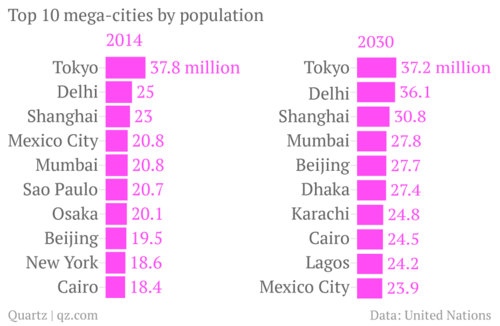
    Today our largest cities are significantly bigger. Tokyo has almost 40 million people and London doesn’t even make the top 10. But there’s also a broader shift taking place. According to a new report by the United Nations, most of the world’s largest cities will be in Africa and Asia by 2030. Here’s a chart from Quartz:

    image

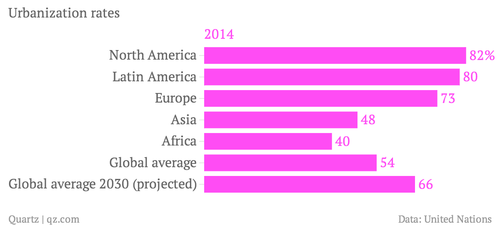
    And the reason for this shift is because Asia and Africa are newly urbanizing, whereas the rest of the world has already urbanized. In North America, over 80% of people already live in cities.

    image

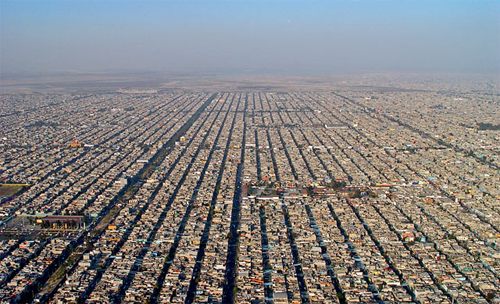
    But even though Asia and Africa are following a trend that has already taken place in the rest of the world, it doesn’t mean we should assume we know what we’re doing. Having spent time in cities like Dhaka, I can attest to the many challenges that these mega-cities are facing and will continue to face as people flood in from the rural areas looking for economic opportunities.

    So while it’s important that we talk about strategies for reviving cities like Detroit – which has a population somewhere around 700,000 – 800,000 people – we should also keep in mind that we have some significant challenges ahead of us in terms of creating a sustainable urban planning agenda for the world.

  • Architect This City is The Guardian Cities blog of the week

    image

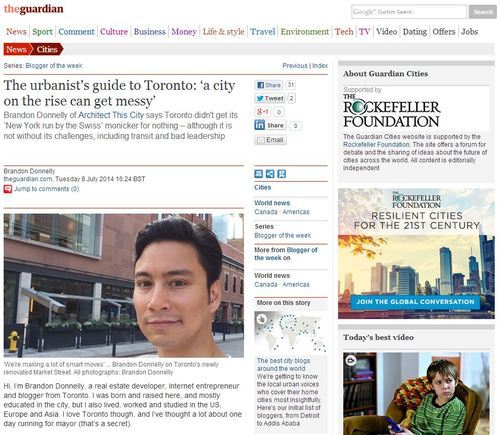
    ATC was featured in The Guardian Cities today as the city blog of the week. It’s a Q&A about Toronto and the idea is for it to be an “urbanist’s guide” to the city. They asked me to be playful and humorous in my responses, and so I tried to do just that.

    But my underlying message was that–despite being an awesome city–Toronto needs to get its act together with respect to mobility and transportation. I also recorded a video talking about this problem, which I believe will be released in the next week or so.

    A big thanks to The Guardian Cities for asking me to participate and to Athlyn Cathcart-Keays for continuing to be an avid supporter of Architect This City.

  • The death of planning expertise

    image

    Yesterday a friend of mine sent me this article written by a city planner talking about the death of planning expertise. The article talks specifically about the rise of “community participation” and how it has undermined the modern planning process. (I guess it’s not just architects who feel undermined.)

    …we have lost respect for “experts”—those who have knowledge and/or experience in a particular field—and have replaced it with a kind of “expertise egalitarianism” whereby everyone’s opinion is given equal weight. But it is not only that the layperson’s opinions are given equal weight, experts increasingly face outright hostility. Laypeople attack experts as being arrogant, elitist, and imposing, if not outright threatening, often because the expert insists he or she knows something the other does not. Even more ridiculous, rather than being viewed as helpful or even essential, expertise is viewed as harmful or even antithetical to community participation.

    But to be clear, the author is not arguing for technocratic rule. He simply believes that community input has reached a point where laypeople with only anecdotal evidence are given equal weight as planning experts, and that it’s miring the planning process and causing less than desirable outcomes.

    This topic is interesting to me for 2 reasons.

    First, it’s interesting because we’re basically talking about a form of decentralization, which, just so happens to be one of the macro trends being ushered in by technology and the internet. It used to be that we couldn’t decentralize. Communication costs were too high and the ability to share information in real time wasn’t possible.

    But today we can. So instead of, for example, only getting the news from one source (a newspaper, perhaps), we get it from millions of people on platforms like Twitter. We trust laypeople, just as much as we do “expert” reporters, to tell us and show us what’s happening in the world. Just yesterday I turned to Twitter to see what was happening with Toronto’s torrential rainfall (#TorontoStorm).

    And as a result of this trend, we’re seeing startups like Popularise that are, in some regards, trying to decentralize the planning process. The platform allows communities to decide what they want to see in their neighborhood and then share it. Think your neighborhood could use an organic grocery store? Great, you can spec that on Popularise.

    The second reason I find this topic interesting is because there’s a school of thought (let’s call it the “wisdom of crowds” school of thought, to name it after a book), which believes that in aggregation the opinions of many can actually be better than those of a few so-called experts.

    And in many ways I agree with this—though there are a number of prerequisites that need be met in order for this to hold true. For example, you can’t have groupthink taking place, which I think you could argue is what often happens with NIMBY movements.

    Nonetheless, there’s a shift taking place and it’s impacting not only the planning profession, but many others. In the end though, I don’t think it will make experts irrelevant. In fact, as industries continue to “open up” and as we harvest more and more data (that previously wasn’t available), I think we’ll all be surprised at how beneficial this ends up being. 

    Image: GSAPP

  • What the hell does gesamtkunstwerk mean?

    image

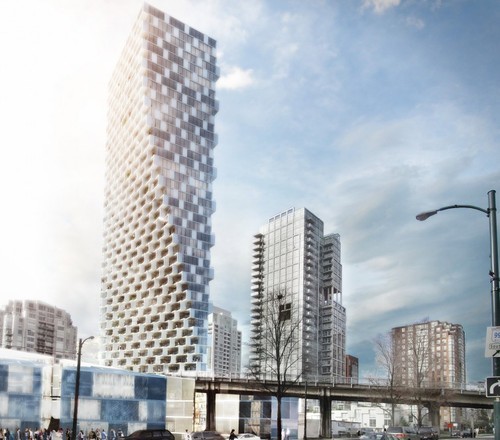
    I’m a big fan of Canadian developer Ian Gillespie and his firm Westbank. They are the developers behind projects like the Shangri-La Vancouver, the Shangri-La Toronto, the mixed-use Woodward’s complex, and the upcoming Vancouver House (shown above) designed by Danish architect Bjarke Ingels (who just so happens to be one of my favorite architects). I would easily count them as one of the preeminent city builders in the country today.

    In support of their commitment to city building (and as a way to offer the public a peek of Vancouver House), they recently staged an exhibition called Gesamtkunstwerk. I think this is great on so many levels. Not only was it probably a great sales tool, but it’s also introducing the public to a largely obscure and academic term, and showing off a deep commitment to design. Unless you studied art, architecture, or something like the philosophy of aesthetics, you probably haven’t come across this term before.

    Gesamtkunstwerk is a German word, which literally translates into a “total work of art.” It was introduced in the 19th century by an opera composer by the name of Richard Wagner, who felt that opera represented a total, or complete work of art. Later, the term was picked up by architects. Some interpreted it to mean that architects should be responsible for everything from the building itself to the furniture and everything else that goes inside of it. Everything was art.

    Westbank now wants to introduce the idea of gesamtkunstwerk into the real estate development business. They want to use it as a guiding philosophy for all of their projects. And what that means is that the building itself and its relationship to the greater city should be thought of as a “total work of art.” They seem to be reintroducing the term with an inherent city building tinge–one that I don’t think was ever there before. 

    What a great philosophy.

    Image: Westbank

  • Thoughts on megacities in the developing world

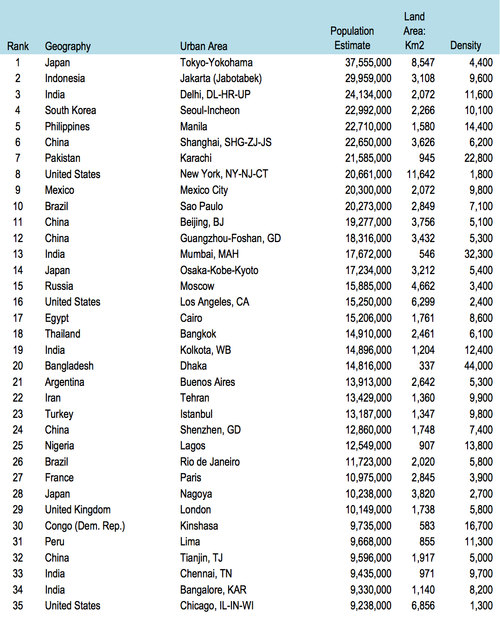
    Without a question, we are living in an urban era. More people now live in cities than anywhere else on the planet and I’ve repeatedly argued that cities are our most important economic engine. As a result of these demographic and economic shifts, we’re seeing megacities at a scale the world has never seen before. Below is a list of the top 35 largest urban areas in the world.

    image

    The top urban area is Tokyo-Yokohama, with a population of roughly 37.5 million people. That’s almost the same as the state of California and is more than the entire population of Canada, which sits at just over 35 million people. London, which, during the 2nd half of the 19th century, would have been the largest urban area in the world is now the 29th largest.

    But at the same time, London arguably remains the most important global city–a title that can only really be rivalled by New York. Which raises an important distinction. One that Aaron Renn clearly identifies in this recent article for New Geography: Just because a city is a megacity, doesn’t mean it is or will ever be a global city. In fact, Renn argues that many of the world’s largest megacities will never “turn the corner” and become leaders of the global economy.

    For that to happen, he believes that the city needs to belong to a country on the rise:

    Moscow was the capital of the Soviet Empire. New York and Los Angeles came of age when America was the rising, and ultimately dominant, economic colossus. It’s the same for Paris and London, two borderline megacities, which rose as imperial capitals. 

    But how much of this is driven by the country and how much of it can be driven by the city itself, upwards? Could it be the city that ultimately empowers the country to rise? I ask these questions because Renn frames his argument as if “national hyper growth” is the only prerequisite that will allow the struggling and underdeveloped megacities to pull themselves up and into the developed world.

    But the problem is that there’s no clear path to prosperous maturity for these megacities.  They are so huge, and their problems so immense that they are difficult to even conceptualize, much less do something about.  The amount of needed infrastructure provision alone – water, sanitation, drainage, transport, telecom, electricity, parks, schools, etc. – is staggering. And that doesn’t even touch arguably more difficult problems like corruption and good governance. Absent national hyper growth – a la Japan or Korea – of a level that creates a plausible claim to being the world’s rising economic power, or the proceeds of empire, it seems unlikely any of these cities will ever succeed. By contrast, smaller cities have a much more addressable problem space.

    Now, I don’t disagree that the problems in these cities seem almost insurmountable. I’ve been to places like Dhaka, Bangladesh. I’ve witnessed first hand the challenges facing megacities in the developing world. 

    But to assume that these cities are lost causes without the nation itself lifting it up, seems almost self defeating and overly pessimistic. It also strikes me as a bit of a chicken and egg scenario. Because if cities are our economic engine, then “national hyper growth” seems difficult without also getting our cities right.

    What comes first?

    Yes, there are and will be reforms that need to happen at the federal level but, at the same time, I think there’s a lot that can and should happen from the ground up. Perhaps that’s part of the reason Singapore has been so successful. As a city-state, its reforms were both top down and bottom up. 

    I want to believe that with the right reforms, policies, and leadership, any country can create a framework in which its cities are able to thrive. And that it’s not just the result of imperial rule or some other circumstance. From good and transparent governance to developed financial markets, there are many things that cities need to truly prosper. But when you get it right, the results can be remarkable. 

    Chart: Demographia

  • Why buy a car when you’ve got mobile apps

    One of the things that many city planners, transportation experts, and municipalities are trying to figure out is how to successfully shift people away from driving towards alternative modes of transportation, such as biking and transit. Now, this is no easy task. There are a myriad of factors that influence a person’s decision to drive or not drive–or if they should even own a car in the first place. Though, land use and density are, in my opinion, probably the biggest.

    But of all the solutions thrown around, mobile apps are typically not within the playbook. However a recent New York Times article is making the argument that it should be, because car-sharing services and apps like Uber seem to be indeed having an affect on people’s decision to own a car. And that’s because in some cities it’s actually cheaper to use Uber every day (than to own a car) and because taxi use has been shown to correlate with other (non-driving) forms of mobility.

    Paradoxically, some experts say, the increased use of ride-sharing services could also spawn renewed interest in and funding for public transportation, because people generally use taxis in conjunction with many other forms of transportation.

    In other words, if Uber and its ride-sharing competitors succeed, it wouldn’t be a stretch to see many small and midsize cities become transportation nirvanas on the order of Manhattan — places where forgoing car ownership isn’t just an outré lifestyle choice, but the preferred way to live.

    And to be honest, I don’t think this is all that far stretched. More and more I find myself wondering why I even own a car. It’s not appreciating sitting downstairs in my garage and, given the frequency in which I use it, I would definitely be better off financially if I simply used an app like Uber or Hailo more often. About the only thing those apps aren’t great for are trips to Home Depot and snowboard trips to the mountain. 

  • How mobile apps are going to help us build better cities

    image

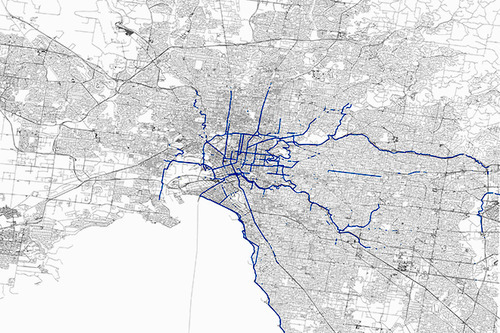
    Some of you might know that I’ve recently started using a mobile app called Strava. It’s a platform that allows you to track your runs and bike rides, as well as those of your friends. It tells you your speed, elevation changes, and it also maps your trips–among many other things. Here’s what my 50 km ‘Ride for Heart’ looks like from last Sunday.

    But what’s even more interesting is how cities are starting to use the data this app collects:

    For $20,000 a year, transportation planners and others can access Strava Metro, which provides an unprecedented look at where and how people are biking. It can tell them where they speed up and slow down, for example, or where they might stay in the street or ride on a crosswalk. That information can reveal where bike lanes or traffic calming measures would be useful, and if those already installed are effective.

    It’s a perfect example of how “tech” is infiltrating so many other sectors. Mobile technology and networks are generating huge amounts of data and it’s happening at an increasing rate. We’re gaining insights into the way people live that simply wasn’t possible before. Some of this information will inevitably be misused, but a lot of it will be used to improve the way we live our lives.

    I know that the City of Toronto also has its own proprietary cycling app and is hoping to collect similar sorts of data from it. But intuitively, I don’t think they’ll be able to compete with the scale of a platform like Strava. Though I certainly applaud the initiative.

    The information age is an exciting time.

    Image: Strava via Wired

  • The first 100 people

    image

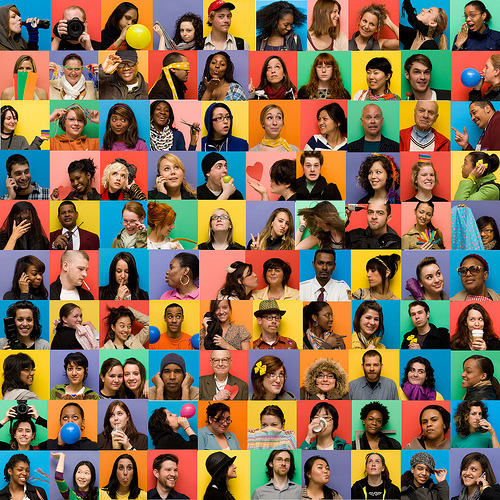
    This past weekend was a milestone weekend for Architect This City. The number of email subscribers surpassed 100 people for the first time. Now, that may not seem like a lot of people, but I think it is. I’m incredibly proud of and grateful for each and every one of you who subscribe to ATC. If I had all of your photos, I would make a collage just like the one above and call it “the first 100.”

    The reason I think 100 people is a lot is because I think of an email inbox as an incredibly personal thing. We live in an age of too much information and our inboxes certainly reflect that. So for somebody to invite and accept the ATC email into their inbox every morning (only a few people subscribe weekly), I consider that to be a big deal. Thank you for that. It really does mean a lot to me.

    I try to ensure that I’m always delivering value to you, which is why I ask for your industry on the full subscription page. I want to know where you’re coming from so that I can do my best to write content that will help you professionally, and perhaps even in life. But if you signed up elsewhere, you may have only entered your email. If you’d like to add your industry, click on “update subscription preferences” at the bottom of one of my emails.

    So far, I know that many of you are architects, city planners, real estate developers, brokers, policy makers, finance people, marketers, and entrepreneurs–to name only a few.

    If you have any specific feedback or have a topic you’d like to see covered on ATC, please feel free to email me or reply to this email (if you’re already a subscriber). I keep a queue of draft posts and I do eventually get to them when the timing is right. Finally, if you feel that somebody within your network would also get value out of what we’re all doing here at ATC, I would really appreciate it if you forwarded this email or shared this post.

    Happy Monday 🙂

    Image: Flickr

  • Cities without ground

    image

    The “ground plane” is an important reference in architecture. The ground is typically where people walk. The ground is where our fabricated buildings meet the earth. And the ground is where our experience of the urban environment–however good or bad it may be–truly takes shape. Often times I feel that we, city dwellers, spend far too much time worrying about the height of buildings and not enough time worry about the ground floor.

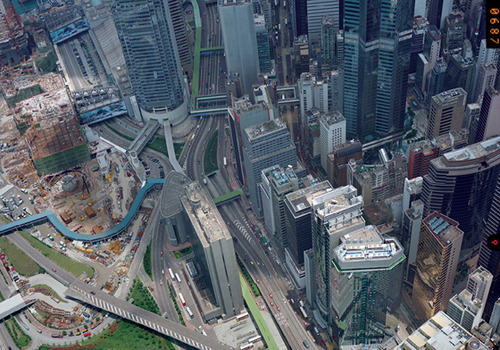
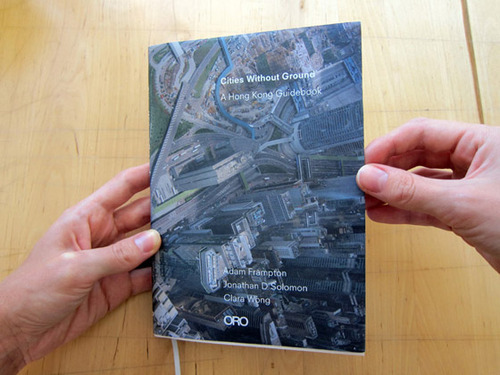
    But what if there were no clearly defined ground plane? This morning I stumbled upon an interesting book called, Cities Without Ground: A Hong Kong Guidebook. The authors call it “a manifesto for a new theory of urban form.” And the argument is that Hong Kong has developed a unique series of public/private spaces that allow it to function as a fully three-dimensional city. 

    image

    Through underground tunnels, above ground walkways, escalators, and other connective infrastructure, Hong Kong is reinventing the way we typically think about cities–both from a user experience and a real estate standpoint. Here’s an excerpt from the Guardian architecture and design blog:

    The phenomenon began in the 1960s, when the Hongkong Land company, one of the main developers in the region, built an elevated walkway to connect a luxury hotel to the second storey of an adjacent shopping mall. An insignificant move, perhaps, but it in fact had the effect of changing the rentable values within the building: suddenly the mall’s second floor units could be rented out for more than those at ground level. It entirely recalibrated the vertical logic of real estate value.

    Now, you could argue that Hong Kong is a unique place. And it is. Other, less dense cities, have found above and below grade walkways to be a destroyer of urban vibrancy. But in Hong Kong it works and, as many other cities around the world focus their energies on urban intensification, we may find that Hong Kong is indeed a new model for urban form.