Daily insights for city builders, delivered every morning at 6 AM ET. I’m Brandon Donnelly — a Toronto-based real estate developer and founder of Globizen. I’ve been writing here since 2013.
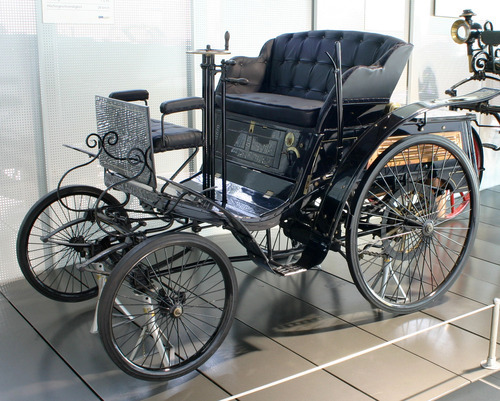
In the spirit of Startup Weekend, I thought it would be interesting to go back in time and pretend to pitch one of the most disruptive innovations of the 19th century: the automobile.
Typically pitches start by first outlining the problem. The idea is to make your audience aware of the pain point, so that they feel excited when you ultimately pitch your solution.
In the case of cars, the incumbent technology would have been horses. So I can imagine somebody standing up and talking about how horses are slow and how they drop stinky poo all over our city streets. And that the time has come for a revolution in personal mobility! Enough of this crap! 🙂
But while many of us probably can’t imagine a world without cars, try and put yourself in the shoes of somebody at the end of the 19th century who can’t imagine a world without horses. And then think about all the things we have subsequently done to make cars thrive:
We paved roads and created networks of freeways.
We invented rules of the road to ensure that people were operating these new devices properly.
We created a licensing system to ensure that anybody who was operating a car was doing so relatively safely and following the rules that had been created.
We created schools that taught people how to be better drivers.
We started insuring cars for when accidents inevitably happened.
We started having to accept fatal car accident and pedestrian deaths.
We had to give over large land masses to parking. In fact, we reorganized entire cities so that the car could be better accommodated.
And we setup government transportation divisions to make sure the needs of the car were always being met.
This is a long list of things we had to do to make cars possible and I’m sure there are many others that I have missed. Today, we all know how disruptive cars have been and we’re certainly questioning many of the things we have done. But we also accept this list as being largely normative.
However, before they were the norm, they were insurmountable challenges. How will we teach everyone how to drive these new cars? How will we minimize accidents? How will we make it easy for people to refuel their cars? Where will people store them when they’re not using them?
Last night was The Laneway Project’s inaugural summit here in Toronto. And I think it was a huge success. This is what the crowd looked like (don’t forget to check the upstairs balcony area):
Over 350 people showed up to fill The Great Hall at Queen West and Dovercourt. It was absolutely incredible. To be honest, I initially thought that it would end up as a small group of city geeks. I mean, it was a summit to effectively talk about back alleys.
But it turns out that there are a ton of people in this city who are passionate about rethinking our urban fabric and finding new uses for these underutilized public spaces. And that’s both really encouraging and exciting. Many thanks to everyone who came out!
The Laneway Project team did an incredible job spreading awareness and, given the success of this initial summit, I can only imagine where this initiative will end up in the future. So a big congratulations to Mackenzie Keast, Ariana Cancelli, and Michelle Senayah for making this happen.
I’m not sure if the event was filmed or not, but hopefully it was and it’ll be made available online. But in the event that it wasn’t, I did want to share one question that the panel got during the Q&A session after our presentations.
The comment made was basically that Toronto will never be Sydney, Melbourne, or Seattle when it comes to our laneways. They have a temperate climate and we don’t. So while it’s nice to show great pictures of their laneways, it’s just not going to happen here.
And that really pissed me off.
So I responded by saying that I disagree. Saying that we’ll never be Sydney or Seattle is capitulating. There are many months of the year where it’s beautiful outside in Toronto, so just because we have a winter doesn’t mean we should throw our hands up in the air and give up.
I then went on to argue that the fact that we have a “shorter season” should be all the more reason that we need fantastic outdoor and public spaces. For the months of the year where it’s beautiful outside, we should be maximizing our enjoyment!
I hope many of you agree as well. Happy Friday all 🙂
Early this morning, before the sun even came up here in Toronto, I had a video conference call with a sharp and talented entrepreneur in Luxembourg. His name is Fräntz Miccoli and he’s working on an interesting startup called KonnectR.
The idea is to create a platform to connect with new people at any point in time and wherever you might happen to be. It may sound like a “hook-up” app, but that’s not the intent. He came about the idea while traveling and looking for other smart and engaging people to hang out with.
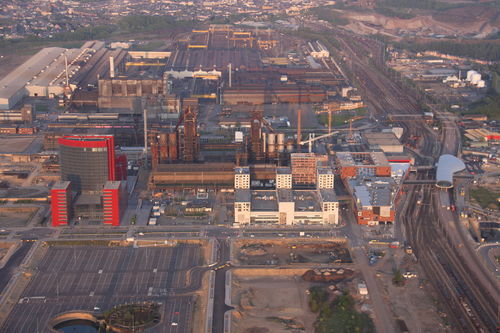
When we started the video conference call this morning, I showed him my window so that he could see the sun just starting to rise. He then showed me his coworking space, which made it seem like he is working out of an old industrial steel mill. Turns out, he is.
The area of Luxembourg he’s working out of is called Belval, which is a neighborhood in the west end of the country’s second largest city, Esch-sur-Alzette. The neighborhood used to consist of the largest steelworks in the country. But with the decline of steel production in Luxembourg, the area fell into decline. Today, it’s being reborn as a 21st century mixed-use community.
The developer behind the project is called Agora. And the site – equal to about 120 soccer fields – will house everything from residences and offices to shopping and cultural institutions. The University of Luxembourg has also centralized their campus in the new neighborhood. Having institutions “anchor” a community is becoming quite common for urban renewal programs. Here in Toronto, we did a similar thing with George Brown College along the waterfront.
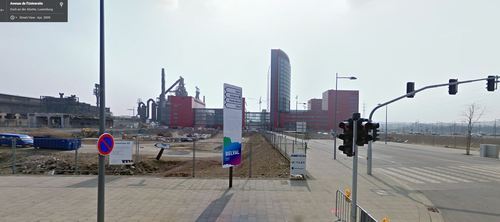
To give you a better sense of the transformation taking place in Belval, here’s a streetview photo from 2009:
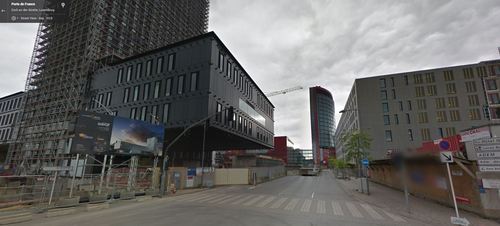
Here’s another one from the same intersection in 2013 (notice the same tower in the background):
I’m always fascinated by urban renewal projects of this scale because it so clearly speaks to the evolutionary nature of cities. Industries die. Businesses disappear. And new uses need to be found. In this case, the area has gone from steel production to tech startups. That’s not surprising.
But at the same time, I think it’s important that we don’t completely erase the past. Here, I think it’s great that they’re preserving some of the blast furnaces and other industrial structures. It gives the area character and a sense of place – which is oftentimes hard to manufacture and always better when it’s authentic.
It feels really good to have shared the details about my laneway project yesterday. It’s a project I’ve been working on for a few years now, and – though I’ve spoken to architects, engineers, and city staff about the project – I hadn’t really gone public with it. And I’m happy I did.
I got a lot of great feedback from the twittersphere. In fact, I didn’t receive one negative comment about the idea of a laneway house in Toronto. Everyone seemed to think it was a great idea and many expressed their dismay with the city’s reticence to formally support them.
I also received a number of encouraging emails, one of which was from a resident of the Toronto Islands. And he raised a really great point: Toronto already has a very successful community of laneway-like houses and it’s called the Toronto Islands.
The streets are no wider than the laneways we have here on the mainland (and even smaller in some cases) and yet there are about 250 houses serving a population of roughly 750. He went on to mention that they even have “downsized garbage trucks”, which are used to navigate the small, car-free streets of the Toronto Islands.
What this reinforces is that our aversion to laneway housing is not because we can’t figure out the logistics of how to service them. We can and are already doing that. If we can figure out how to do that on the islands, I’m pretty sure that we could also figure out how to do it on the mainland.
So what this really comes down is that there isn’t the political will to make this happen. And there isn’t that will, I’m guessing, because there’s a fear of upsetting the established neighborhoods. That’s why Ontario’s Places to Grow Act (2005) was deliberate in concentrating growth in specific areas of the city – it meant that we could say that the rest of the city would receive little to no growth.
We’ve since revised that position with the push to intensify our Avenues with mid-rise buildings. But just as we went from high-rise to mid-rise intensification, I think it’s only a matter of time before low-rise intensification starts to also happen.
I firmly believe that the demand is already there for laneway housing (the Lanehouse on Bartlett pretty much sold out in one evening). It’s simply a matter of now figuring out the supply side of this equation.
While the cult of the star architect has soared over the decades and property developers have displaced bankers as the new super-rich, the figure of the local town planner has become comic shorthand for a certain kind of faceless, under-whelming dullard.
But what really stood out for me are the following two things. First, that people are genuinely interested in cities. I would say that it’s almost trendy to be into cities these days.
Urbanism may have displaced cultural theory as the favoured subject of the academic hipster, but talented young men and women rarely consider becoming town planners.
And second, that we’ve made it difficult for these same interested people to participate in the planning process.
Planners have become simultaneously under-respected and over-professionalised. Their training and practice too often leaves them able to communicate effectively only with other planners and professionals, working in an abstract language that alienates them from people. People are occasionally allowed into the professional planner’s world, but in highly mediated terms dictated by the profession.
This stands out for me because I think that architecture is in a somewhat similar position. I often joke that the more architecture training someone has, the more likely they’re going to like buildings that the rest of the world doesn’t. It all becomes quite insular – just like the Guardian is arguing with respect to planning.
And that may in fact be the reason for the marginalization of both planners and architects (minus the few starchitects that have a distinct brand and can command a premium). If the general public doesn’t like what you do or understand how you create value, why should they care?
I’ve written before about the future of the architecture profession, as well as the reasons for why I decided to never practice architecture. So I won’t repeat it all here.
But I will say that it had nothing to do with me not loving architecture. Because I do and always will. Instead, it was about recognizing that professions are not set in stone. Just like pretty much everything else in this world, they can and will be reinvented.
The following chart is from City Observatory. It compares per capita income against the college attainment rate for the largest US metropolitan areas. If you hover over a circle it’ll tell you the metro area and what the precise numbers are. If you can’t see the chart below, click here.
What they found from this data set is that educational attainment – the percentage of the population with a 4-year college degree – is the single most important factor when it comes to urban economic success. In fact, according to City Observatory, it accounts for 60% of the variation in per capita income across the metro areas listed above. That’s huge.
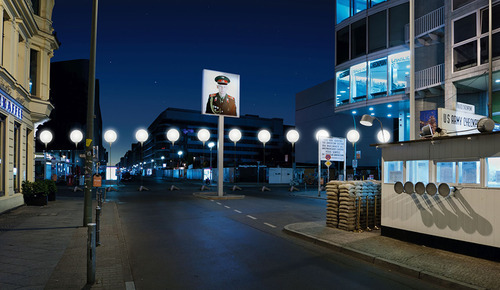
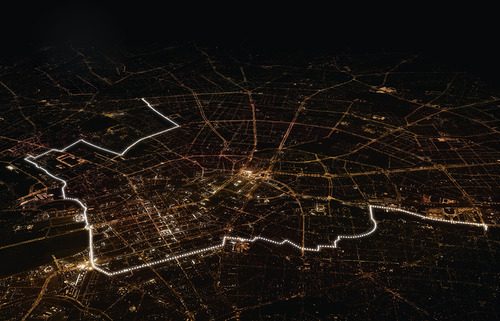
Starting today and running until the end of the weekend, 8,000 glowing balloons will recreate a 15 km long section of the former Berlin Wall. It’s to commemorate 25 years since the fall of the wall.
Here’s an aerial view of what it’ll look like:
I think this is a fascinating art installation. And I wish I could be there to see it first hand. My friend Nick Iozzo is there right now with his wife, so hopefully they’ll respond to this blog post with some highlights.
But none of these divides are anything like the divide faced in Berlin. The Berlin Wall was arguably the most visible physical manifestation of the entire Cold War. Once a major point of entry for Eastern Bloc emigrants, East Berlin was basically bleeding people before the wall went up in 1961. It was designed to keep East Berliners in place.
I can’t even imagine what it would be like to live in a place like that.
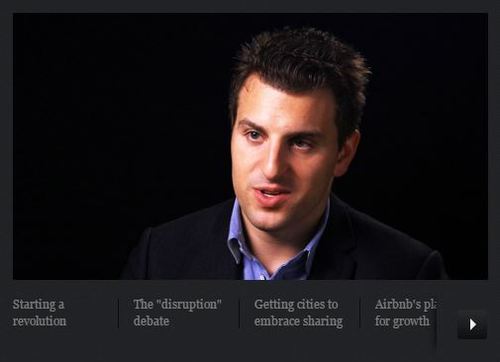
McKinsey recently put out a great interview with one of the founders of Airbnb, Brian Chesky, talking about the relationship between his company and cities. I thought it was fascinating. Click here to watch the video.
If you don’t feel like doing that, I’ve also pasted the interview transcript below and bolded some of the really interesting takeaways. Let us all know what you think in the comment section below.
It’s a currency of trust, and that used to live only with a business. Only businesses could be trusted, or people in your local community. Now, that trust has been democratized—any person can act like a brand.
Airbnb is a way that you can, when you’re traveling, book a home anywhere around the world. And by anywhere, I mean 34,000 cities in 190 countries. That’s every country but North Korea, Iran, Syria, and Cuba.
The reason we started was I was living with my roommate, Joe, in San Francisco, and I couldn’t afford to make rent. That weekend, the International Design Conference was coming to San Francisco. All the hotels were sold out. Joe had three air beds. We pulled the air beds out of the closet, we inflated them, and we called it the “Air Bed and Breakfast.”
The reason it’s grown so fast is, unlike traditional businesses, we don’t have to pour concrete. The infrastructure and the investment was already made by cities a generation ago. And so all of a sudden, all you needed was the Internet.
The ‘disruption’ debate
I never really loved the word “disruption,” because it suggests that maybe it’s the kid in a class who was disruptive, who probably didn’t add a lot to class. I think that we have a lot to add to society.
Over time, cities have gotten so big that the sense of community has gotten lost. And I think once you know everyone, that community can reemerge. And as far as our relationship with cities, we can’t succeed without a city. Or we can’t really thrive without a city. We don’t want to thrive in spite of a city. And I think if we work together, it’s going to be amazing. I think the people win. And I think if we don’t work together or if we fight, the loser isn’t really us or the city—it’s the people in that city.
Getting cities to embrace sharing
Fundamentally, the idea of the sharing economy is going to be great for cities. It means that people all over a city, in 60 seconds, can become microentrepreneurs. And they can be empowered. And they can make an income. Now, this is amazing, but it’s also complicated because there are laws that were written many decades ago—sometimes a century ago—that said, “There are laws for people and there are laws for business.” What happens when a person becomes a business? Suddenly these laws feel a little bit outdated. They’re really 20th-century laws, and we’re in a 21st-century economy.
It’s probably going to be a fair amount of work to revise some of the laws and rethink the way cities and platforms work together, but I think that work is worth it. Because what cities don’t have to do is invest billions of dollars in infrastructure to create jobs. Whereas historically, to create opportunities, cities would need massive projects and investments, these jobs only require the Internet. Now what they need to do is navigate the legal framework, which is typically outdated. We want to work with the cities. We’re not telling them that their laws are terrible. The world continues to change. Laws must continue to adapt for that world.
We want to help cities understand what our world looks like so they can modernize the laws to make sense. We’re not against regulation. We want to be regulated because to regulate us would be to recognize us.
Airbnb’s plans for growth
We want travelers to be able to book homes anywhere. Anywhere includes Asia. Asia’s a nascent market for us. Number two, we’re also looking at other use cases. Airbnb started as a way for travelers to find a budget way to vacation in a city. But now we’re starting to see people who aren’t on a budget. They want a much more high-end experience. And the third is that at the end of the day, if you’re traveling to Tokyo, you’re not traveling to Tokyo to stay in a home or a hotel. You’re traveling to Tokyo—if you’re on vacation—because you want to have an experience. And we’d love to do more to make that experience special and memorable.
The future of sharing: Your free time
I don’t think people would view the jobs created in the sharing economy as jobs. I don’t even know if they get counted as jobs when the White House has a new jobs report. They are jobs. As far as I can tell, people are working, they’re making income, and they depend on that income. Half of our hosts depend on it to pay the rent or mortgage. Maybe it’s a new kind of job. Maybe it’s like a 21st-century job. Tom Friedman talks about how in the future people may not have jobs. They’ll have income streams.
I believe that the sharing economy broadly can probably provide tens of millions of jobs or income streams for people all over the world. This is going to have a pretty big effect on the economy, mostly a good one.
The sharing economy started by democratizing and creating access to probably two of the biggest assets people have: their homes and then their cars. But I think the whole idea of ownership is changing. When my parents were young, owning things was a privilege, and there was a sense of romance to owning a house, owning a car.
Today’s generation sees that ownership also as a burden. People still want to show off, but in the future I think what they’re going to want to show off is their Instagram feed, their photos, the places they’ve gone, the experiences they’ve had. That has become the new bling. It’s not the car you have; it’s the places you go and the experiences you have. I think in the future, people will own whatever they want responsibility for. And I think what they’re going to want responsibility for the most is their reputation, their friendships, their relationships, and the experiences they’ve had.
So I think the biggest revolution will be in the biggest asset of all. The biggest asset is not a house. It’s not a car. It’s people’s time. People’s time may start with just gigs: waiting in line for you, delivering something for you. Over time, I think it’s going to move upmarket. And eventually, menial tasks become real trades, and real trades become art forms.
Somebody may say, “I cook a great brunch. I wonder if people would enjoy having brunch at my house?” And you could be able to book a brunch at someone’s house, instead of at a restaurant. That person isn’t trying to create a restaurant, they’re just allowing someone to have brunch. They build a reputation. One day, that person can be a Michelin-rated chef in their house.
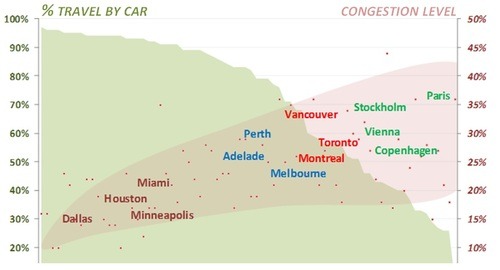
It came from a study that looked at 74 cities in terms of two measures: the percentage of people that travel by car and the traffic congestion levels within those cities.
The way to read the chart is to first look at the red dots. Each dot represents one of the cities studied. The position of the red dot corresponds to that city’s congestion levels. So for example, if we were to take Toronto, the congestion level is 27%.
If you then take that same dot and draw a vertical line to the top of the green shaded area, you get the percentage of people who travel by car. In the case of Toronto, it is 56%.
What’s interesting about this chart is that as congestion levels rise, it forces people out of their cars. In other words, the cities with the highest congestion levels also have the lowest auto share percentages.
But the other way I interpret this chart is that the decision is almost binary: you’re either planning for cars or you’re planning for people. Based on this data, it’s hard to have both.
I’m always on the lookout for great websites and communities dedicated to cities. And today, thanks to a friend of mine, I found a new one called City Observatory. It’s my new favorite site for city geeks.
I’m looking forward to digging into more of their articles, but I did already take a look at the first report they published, which is called: “The Young and Restless and the Nation’s Cities”. Click here to download the PDF.
What the report talks about is a demographic group that they refer to as “Young and Restless”, and which they define as being 25-34 years old and having a 4-year degree. And they focus on this group because they see it as critical to driving local economic development.
They’re the next generation who are going to start those companies and drive growth and innovation. And since the data shows that as people age, they become less willing to relocate (which intuitively makes sense), cities today are quickly realizing that they need to capture this group of smart people while they’re still restless (i.e. mobile).
So if this is important, which cities (in the US) are winning right now? Here are the top 10 cities via City Observatory:
Washington D.C. 8.1%
San Francisco 7.6%
Boston/Cambridge 7.6%
San Jose 7.5%
Denver 7.5%
Austin 7.0%
New York 6.6%
Minneapolis 6.6%
Raleigh 6.5%
Seattle 6.1%
The percentage represents the portion of the population that’s 25-34 years old and has a 4-year degree. I’ve just listed the cities here, but in reality they reference the entire metro areas.
Do any of the cities on this list surprise you? None are surprises for me. It’s more or less what I would have expected to see, except maybe for the absence of Chicago (it’s 12th according to this ranking).