Daily insights for city builders, delivered every morning at 6 AM ET. I’m Brandon Donnelly — a Toronto-based real estate developer and founder of Globizen. I’ve been writing here since 2013.

Tag: cities

  • The spatio-temporal hierarchy of urban form

    I was recently introduced to the work of Brenda Case Scheer – specifically a journal article she wrote called The Anatomy of Sprawl. If you’re the kind of person who enjoys geeking out about cities, this is for you. (Thank you Oliver.)

    What she does in the article is break down the various components / layers of a city according to the rate in which they change. Her “spatio-temporal urban hierarchy” includes: site (slowest rate of change), superstructure, infill, buildings, and objects (fastest rate of change).

    The way to think about this is that the bottom layers of a city – the paths and roads we have chosen to establish – are incredibly persistent. They don’t change all that often.

    On the other hand, buildings do change. Old ones get demolished. New ones get built. There’s a cycle. They too probably feel pretty persistent in many cases, but in comparison to our roads, they change far more frequently.

    The reason why all of this has bearing is because the paths we choose to carve out at the very beginning will ultimately dictate the kind of city that gets built and rebuilt over time.

    The rectangular grid of Manhattan was planned out in 1811. Central Park was missing from this original plan, but it did establish the street network and ownership lots that are now so central to the identity of New York City. That was a 200+ year decision.

    It seems to have worked out just fine for New York. But what if you’re in a position where the existing street network is viewed as failing and/or inappropriate for the future success of the city? 

    Well that’s where things get interesting. Now you need to dig down to some of those base layers and work on changing the (frequently) unchangeable. 
  • World’s best city brands

    Resonance Consultancy – they do brands and strategies for places and products – has just released a new report called: World’s Best City Brands – A Global Ranking of Place Equity.

    With all of these sorts of rankings, it really depends on the research methodology being used and the rigor in which it is being applied. In this case, they evaluated each city based on “six pillars of equity”:

    1. Place: Perceived quality of a city’s natural and built environment
    2. Product: A city’s key institutions, attraction and infrastructure
    3. Programming: The arts, culture and entertainment in a city
    4. People: Immigration and diversity of a city
    5. Prosperity: Employment, GDP per capita entertainment in a city and corporate head offices
    6. Promotion: Quantity of articles, references of a city and recommendations online

    What’s perhaps unique about this study is that it combines measurable statistics with “visitor perception metrics” – data that they mined from social media. Here’s an excerpt from the methodology page:

    “Our team became interested in the way visitors and citizens themselves influence the identity and perception of cities. Increasingly, they do it through their evaluation of experiences on social media and via the comments, images and reviews they share with family, friends and people around the world. These opinions and attitudes, much more than traditional marketing, influence the way people perceive places today.”

    This is a fascinating shift for city brands and is something that we have discussed before on this blog. All of us are now involved in telling the story of the places in which we live and visit.

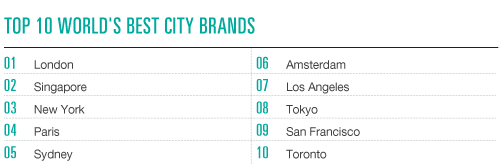
    The entire report is well done and worth a read. It’s also a free download (you’ll need to enter your contact info). But below are the top 10 world’s best city brands. Not really any surprises for me. What about for you?

    image

  • A location intelligence company

    I have written about Foursquare a number of times over the years (here and here) and I continue to be a regular user. I am intrigued by all of the location-based data that they collect through their apps. 

    Below is a recent Recode Decode (podcast) with Dennis Crowley (co-founder) and Jeff Glueck (CEO) of Foursquare. They are talking about what’s next for the company. If you can’t see it below, click here.

    https://art19.com/shows/recode-decode/episodes/aa400a60-ebc1-49bb-96b1-0d7aac7ca9e8/embed?theme=black

    Here’s a content sample from Recode:

    Today, Foursquare makes most of its money from selling that data to big companies, calling itself a “location intelligence company.” But as co-founder Dennis Crowley and CEO Jeff Glueck explained on the latest episode of Recode Decode, hosted by Kara Swisher, they haven’t stopped thinking about everyday users.

    “Imagine a friend is walking alongside you,” Crowley said. “Can we make a personality like that, that talks to you in that sense? It’s not 30 years out. We’re going to be playing with this stuff a year from now.”

    “I want to make that Scarlett Johansson that whispers in your ear, but it’s all about local places and local discovery,” he added. “I want to replicate the experience of walking through the city with a friend that knows the city inside and out, and I want to make that for millions of people.”

    I thought some of you might find this interesting.

  • Place is dead anyway

    Aaron Renn has a few observations up on his blog from a recent trip to San Francisco. Number 2 is as follows:

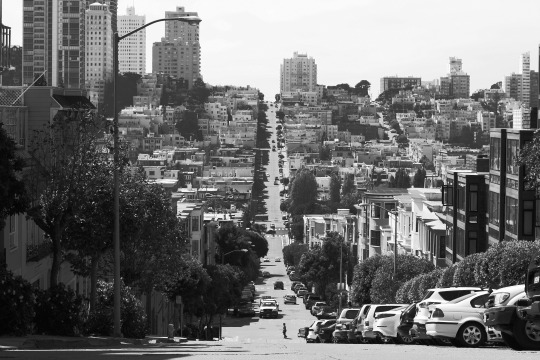
    “A curiously low energy city.  It’s tough to judge any American city’s street energy after living in New York, but San Francisco felt basically dead. Tourist areas around Union Square and the Embarcadero were crowded, and the Mission on a Friday night was hopping, but otherwise the city was very quiet. Haight-Ashbury was nearly deserted and many neighborhoods had the feel of a ghost town. It’s very strange to be walking around a city with such a dense built fabric but so few people.”

    I feel this way every, single, time, I visit San Francisco. I love San Francisco, but outside the main draws, the city feels eerily quiet. I have never understood why that is the case.

    This is something that I am sensitive to because I find it even impacts my own energy levels. For instance, Sundays in Toronto often feel too quiet for me. Fewer pedestrians. Slower drivers. Our collective metabolic rate slows down.

    I love the hustle of a busy city.

  • Total work of art

    image

    I toured 56 Leonard Street in New York today. The only picture I have on my phone is the above photo of the lobby. The rest of the photos are on my Fuji and so they’ll make their way to my Instagram over the coming days. 

    There’s lots that has already been said about the architecture of 56 Leonard, but one thing I wanted to point out was this idea of a “total work of art.” The German word for this: Gesamtkunstwerk. I’ve written about this before, here.

    With many/most development projects, there will be a separate architect and a separate interiors firm. There’s absolutely nothing wrong with this approach, but it could lead to a disconnect between the exterior and interior. Or at least, some architects will tell you that.

    In the case of 56 Leonard, the architect (Herzog & de Meuron) also designed all of the interiors – right down to the kitchens, the sinks and tubs, the light fixtures, and likely a few other things. Hence the “total work of art.”

    It’s incredible to see what happens when you have one design sensibility brought to an entire project. 56 Leonard is beautiful. For the rest of the photos, make sure to follow me on Instagram.

    In case you’re wondering, the condo prices in the building run between $3,500 and $5,000 psf. One of the penthouses recently sold for USD$47 million.

  • Some thoughts on how we plan cities

    I came across this discussion on Twitter yesterday about how so many of the spaces we love in cities would not conform to today’s modern city planning practices:

    //platform.twitter.com/widgets.js

    This is a topic I’ve been thinking about lately and so it’s a timely discussion. In fact, I’ll often come across spaces in Toronto where I’ll think to myself: This is a really great space. But it’s highly unlikely that it could be built this way today. Naturally the question then becomes: What does this say about modern city planning?

    City planning is obviously important. But at the same time, we are almost certainly making mistakes and doing things that we will later regret. I say this not because I’m particularly critical of planning today, but because cities are enormously complex entities and it’s difficult to believe that we’ve figured everything out at this point.

    One thing I wonder about is if we aren’t over-planning and being too prescriptive about our cities. Some of you will probably argue the exact opposite. But hear me out.

    Vancouver is a city that has long been considered to be the gold standard in modern city planning. We talk about its podium + tower building typology. We talk about its “gentle density.” And we talk about its great public and recreational spaces, among many other things.

    But when I was there last month having dinner with a friend of mine, she said something to me that stood out. She said: “Brandon, Vancouver is a boring city. If it weren’t for my family being here, I would happily move to Toronto, New York, or somewhere else.”

    Cities are amazing places because they unleash human ingenuity. They allow new and unforeseen things to emerge. The challenge, I think, is to not sterilize that away when we plan and build. And all of us involved in the building of cities are probably guilty of doing that to an extent.

  • Has there been a “great inversion?”

    Urbanist Richard Florida has spoken a lot about a “great inversion.” This is about poverty moving to the suburbs and the core of cities becoming a kind of “gated suburb.” (i.e. wealthy)

    In response to this narrative, City Observatory recently published a post where they call this a new mythology. Joe Cortright argues that it is simply an exaggeration that sounds good in media headlines. And indeed, if you look at some accounts of poverty, the swings haven’t been that dramatic.

    However, if you dig into this study by Luke Juday at the University of Virginia (cited in the City Observatory article), there have been some interesting changes. 

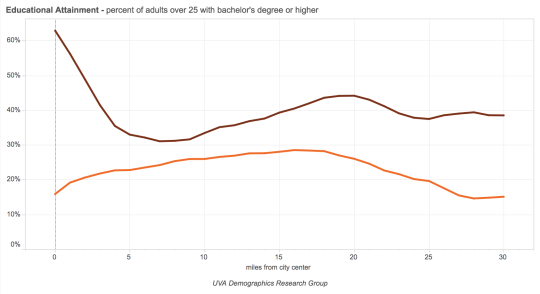
    Below is a chart that shows the percentage of adults (over 25) with a bachelor’s degree (or higher) sorted by distance from the city center. This particular chart is a composite of 7 northeastern (US) cities. The brown line is 2012 and the orange line is 1990.

    As you can see, there has been a huge spike in educated people living in city centers – at least in the northeast.

    Here is that same chart for Atlanta:

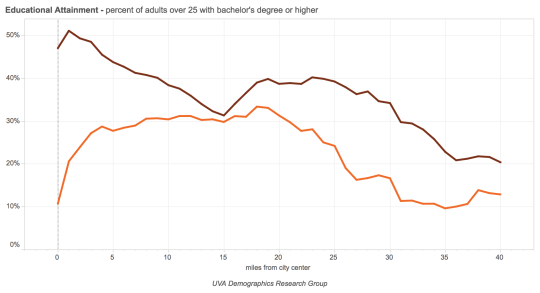
    New York:

    In the case of New York, it looks like the entire city just became more educated.

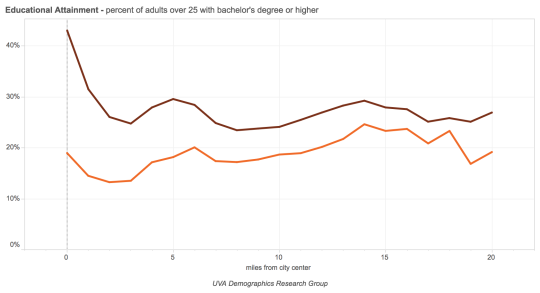
    Miami:

    Educational attainment is often the single biggest determinant of income. So there is something to be said about highly educated people concentrating themselves in city centers. We may not want to call it an inversion of great proportions, but it’s a meaningful shift.

  • The Shinola Hotel, Detroit

    Hotels play such an interesting role within cities. They are public-facing in a way that many other uses are not and they invite a mixing of different people – everyone from transients to locals. It is therefore no surprise that they can serve a variety of different roles. They can be cultural hubs. But they can also be places in which to misbehave.

    When the Drake Hotel opened up on the west side of downtown Toronto in 2004, I remember it feeling far out. It was on the edge of that which was interesting at the time. But it quickly anchored West Queen West with its cultural and nightlife offerings. And today, we could be about to see the exact same story repeat itself in the east end with the new Broadview Hotel.

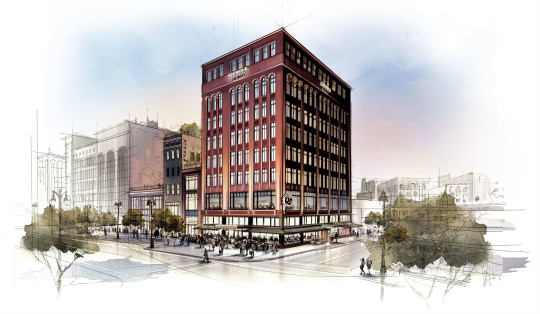
    It’s for these reasons that I was both excited and curious to learn that Bedrock (real estate company) and Shinola are in the midst of launching a new boutique hotel concept in Detroit. It is called The Shinola Hotel. It will be located at 1400 Woodward Avenue. And it will be all about the city of Detroit. They expect it to open sometime in the fall of 2018.

    What I am about to say may be an availability bias talking, but there seems to be a push by many companies into the hotel space. In 2015, Equinox Fitness announced that it would be opening its first hotel in 2018 at Hudson Yards in New York. And just last month furniture retailer West Elm announced that it would be opening a first set of hotels in both Savannah and Detroit. (Go Detroit!)

    West Elm sells furniture. Equinox operates gyms. And Shinola makes and sells watches, bikes, and leather goods. But all of them are now in the hotel space. What other new hotel brands have I missed?

    Image: Shinola

  • Full self-driving hardware

    Tesla has just announced “full self-driving hardware” on all of its cars, including the upcoming Model 3, in anticipation of a big software update to be released sometime around December 2016 (hopefully). 

    This will enable fully autonomous driving “in almost all circumstances” – they mention rain, fog, and dust, but no snow – at a level of safety that Tesla believes is already 2x better than the average human driver.

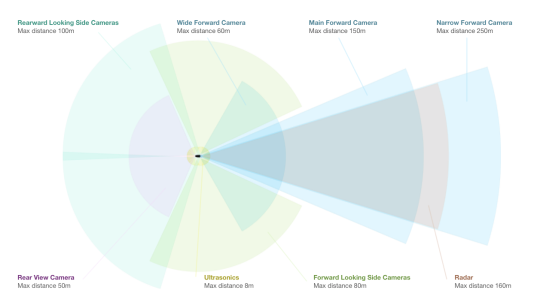
    This is being accomplished through a souped up onboard computer and by increasing the number of surround cameras from 4 to 8. Here’s a diagram (via Tesla) of how those cameras work and how they will capture a 360 degree view:

    image

    A couple of immediate thoughts / takeaways:

    The Smart Summon feature is obviously very cool. Summon on your smartphone and your car will come find you. Elon Musk has said that it will eventually find you even if you happen to be on the other side of the country. 

    But this assumes that there are solid metal snake chargers (or something else) to automatically charge your vehicle somewhere on route. It also suggests that the vehicles won’t be equipped to cross international borders by themselves.

    Elon Musk has said that (unfortunately) retrofitting older Tesla vehicles to full self-driving hardware will be very difficult and costly – the cost delta is greater than buying a new car. This reinforces my belief that leasing, rather than owning, is probably a wise strategy right now given how much change is happening in the auto space.

    Lastly, here’s some fine print from the Tesla Auto Pilot website:

    “Please note also that using a self-driving Tesla for car sharing and ride hailing for friends and family is fine, but doing so for revenue purposes will only be permissible on the Tesla Network, details of which will be released next year.”

    Uber vs. Tesla. Round 1. Fight.

    If you’d like to see a full self-driving Tesla in action, check out the video on their website.

  • Big, bold, and global

    I love the way that urban planner Joe Berridge thinks about Toronto and city building. He is constantly considering our position on the global stage and urging us to fight for a top position by executing on real and meaningful projects. 

    Here is a recent article from the Toronto Star which lists some of those projects. They include everything from a new convention center to creating a fourth university (in addition to the University of Toronto, York, and Ryerson).

    Here’s a snippet:

    We could get “lost in domesticity — very nice, but that’s not enough,” he says, drawing on his experience leading urban renewal projects around the world.

    Toronto’s social cohesion is enough to attract 125,000 new people each year to the region. But they won’t stay if we can’t employ them and provide opportunities. And that requires global thinking.

    Berridge says it is the city’s “moral obligation” to use its taxing power, its wealth, its status as Canada’s only global city and the historical advantages of public education, public health and public services to propel Toronto into super city status.

    Cities will often talk in nebulous terms about being “world class.” That isn’t all that helpful. Let’s be specific and also acknowledge that great things cost money. Are we a top tourist destination? Are we a top convention destination? Are we attracting the smartest people in the world with the best schools? Do we have the best transit and health care systems in the world?

    Toronto is a great city and so it’s perhaps easy to become complacent. But past performance is not an indicator of future outcomes. We need to think in global terms. We need to keep in mind that this is an international competition. And every day all of us step onto that field.

    Thank you Joe for constantly reminding us of that.