Daily insights for city builders, delivered every morning at 6 AM ET. I’m Brandon Donnelly — a Toronto-based real estate developer and founder of Globizen. I’ve been writing here since 2013.

Tag: cities

  • Laneway suites consultation

    I just got home from the Citywide Laneway Suites Consultation meeting that was held this evening at the Evergreen Brick Works here in Toronto. (I guess I do find time to go to public meetings.) 

    For those of you who are interested in laneway housing, or an equivalent housing typology, here are a couple of takeaways from the event.

    There’s political support. Councillor McMahon and Councillor Bailao were there voicing their support for laneway suites. Both see it as an opportunity to diversify the housing stock and increase the supply of affordable ground-related housing in the city.

    Laneway suites (in the context of this current groundswell) are being thought of as secondary suites – exactly like basement suites. This is a smart approach that gets around a number of the hurdles that laneway houses currently face in the city.

    Because of this, the idea is that both the main house and the laneway house will remain under the same ownership. No property severances. No selling off the back lot.

    Other than this, nothing was really put forward in the way of guidelines. The whole point of these public meetings is to solicit community feedback and then roll that into a set of laneway suite design guidelines that will allow these homes to be built “as of right.”

    Obviously there are a number of questions around building height; minimum lot size; window orientation (laneway and/or backyard?); maximum number of secondary suites on a property (would both a basement and a laneway suite be allowed?); and so on.

    The next step is a report that will get submitted to the city in the new year. So if you haven’t already, please complete this Lanescape survey. We’ll see where all of this goes, but right now you can certainly feel the momentum.

    I also don’t think this is a Toronto-specific topic. Many other cities have adopted similar policies and I am certain that many more will do the same in the future. 

  • What is your city’s flag?

    How often do you see it around town? 

    Here in Toronto, I can’t say that I see ours all that often outside of city hall. Am I missing it? Here’s what it looks like:

    image

    In other cities, such as Chicago, the city flag seems to be far more ubiquitous. Here’s what Chicago’s looks like:

    image

    In the case of Toronto’s flag, the two white bands are meant to represent the architecture of Toronto City Hall. The maple leaf is the Council Chamber at the bottom. And there is some suggestion of a letter “T” for Toronto. Wikipedia says the “T” is supposed to be found in the blue space between and above the two towers of city hall, but I’ve always seen the two white bands as being the “T.”

    In the case of Chicago’s flag, the blue bands represent the lake and river (I like that) and the four six-sided stars represent significant events in the history of the city (positioned between the two bodies of water to mimic its actual geography).

    Roman Mars of 99% Invisible has a great podcast and TED talk on this topic. (The study of flags is known as vexillology.) In both instances, he outlines what he believes to be the 5 rules of great flag design. They are:

    1. Keep it simple
    2. Use meaningful symbolism
    3. Use 2-3 basic colors
    4. No lettering or seals
    5. Be distinctive

    Toronto’s flag generally conforms to these rules. But there’s something about the positioning of the maple leaf that makes the flag feel a bit arbitrary to me. I want to rationalize it.

    In any event, I think it could be really interesting if all of us shared our city’s flag in the comment section below and made a comment about how ubiquitous it is within the urban landscape.

    Roman makes the argument that a great flag gives people something to rally behind. And with cities only becoming more important on the global stage, there’s something to be said about having a well-designed flag today.

    I wonder if there will be a correlation between good flag design and ubiquity. My guess: probably.

  • Below-grade urbanism

    I came across an interesting discussion on Twitter last night about tunnels, bridges, elevated walkways, and Toronto’s elaborate (mostly) underground shopping complex known as the PATH. It’s the largest of its kind in the world.

    Here’s the thing: the idea of pulling people off the street and into an underground shopping mall, runs counter to what many urbanists believe is the optimal outcome.

    Below is a footnote I found in a 2006 research paper by Pierre

    Bélanger called, Underground landscape: The urbanism and infrastructure of Toronto’s downtown pedestrian network.

    “The reluctance of urban designers and academics to engage the
    dynamics of the underground is stunning. For almost 50 years, urban
    designers, landscape architects and planners have longed for car-free
    pedestrian environments that are safe, secure and accessible. From a
    planning perspective, the Toronto underground may be the ultimate form
    of attrition of the automobile on the urban landscape: there are no parking
    lots, no asphalt, and no congestion. With its mass-transit accessibility, it is
    an ideal pedestrian network. This reluctance may in part be attributable to
    a prevailing attitude that privately-controlled underground shopping is
    undesirable, at best dismissible. As self-contained environments, they are
    perceived as lying outside the so-called public domain and that they kill off
    street life. As a more legitimate form of collective space, street-level
    activity located within municipal right-of-ways therefore receives much
    more advocacy.”

    Of course, there is truth to the notion that activity gets concentrated below grade. When people visit Toronto’s Financial District for the first time, they’ll often ask: Where is the retail? And then you have to explain that it’s all underground and that we live like mole people from 9-5.

    But despite this reluctance on the part of urbanists, people do seem to like it. When you’re marketing a building in the CBD, being PATH-connected is a feature, not a bug. I always joke that in the summer, I hate the PATH. But in the winter, I love it. 

    There’s also a feeling of hyper-connectivity during business hours in the PATH – particularly at lunch. You have everyone leaving their desks, descending from their towers, and mixing all about in a dense pedestrian-only network. It’s unusual not to run into someone you know.

    So love it or hate it, perhaps we should appreciate it for what it is: thriving city life.

  • Local rail-driven agglomeration economies

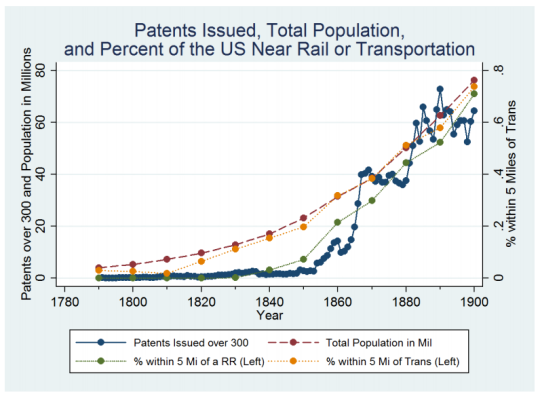
    This morning I came across the below graph in a Medium article by Eric Jaffe of Sidewalk Labs. It is taken from a research paper by Elisabeth Ruth Perlman called, Dense Enough To Be Brilliant: Patents, Urbanization, and Transportation in Nineteenth Century America.

    What this chart shows is patents issued – a proxy for innovation – in all U.S. counties between 1790 and 1900. This data is then compared against access to transport, such as rail. The discovery is a statistically significant relationship between innovation (patents issued) and rail (transport) access.

    The spike in the 1850s (shown above) is as a result of increased rail access.

    But Perlman takes it a step further and asks: what is causing this spike in innovation? Is it because inventors and creators started responding to the larger market now accessible to them because of rail connectivity? Or did transportation somehow improve productivity and the flow of information?

    To answer this question, she dug into the patents themselves (over 700,000 of them) to try and identify how ideas and key words were spreading. What she found is that rail access alone doesn’t encourage innovation. References to new technologies did not increase.

    What mattered was what happened locally. Transportation improvements promoted urbanization and density during her study period, and that’s what drove innovation. Connectivity created agglomeration economies at the local level.

    Obviously a lot has changed since the 19th century. But whether it’s rail connectivity or internet connectivity, have the rules really changed? Place still matters. What happens locally still matters. Perhaps even more. 

    This is an important lesson to consider as we build our cities and invest in transportation. Rail alone isn’t enough. What matters more is what we build around it. Are we dense enough to be brilliant?

  • Thoughts on public meetings

    A few weeks ago I received a community meeting notice in the mail for a new development happening in my neighborhood. I am excited about the project and so I immediately put it in my calendar and told myself: “I’m going to this.”

    But then a work commitment came up and I skipped the event. I always do this. I put these public meetings in my calendar with every intention of going, but then as soon as something else comes up, it gets bumped. So in the end, my voice will not be heard.

    I say this not because I think my singular voice is all that important, but because I suspect I’m not alone when it comes to these community meetings. I live and breathe city building and if I struggle to attend these things, what does that mean for the average resident?

    As soon as you create friction – such as having to go somewhere, physically – you’re going to lose a large segment of people. This also means that only those who are highly motivated will attend.

    I saw this phenomenon play out in my condo building. At our first annual general meeting – when the building still had a bunch of deficiencies and the elevators were spotty – we had a sold out and lively crowd. 

    But as soon as things started humming along in year two (we are now a well-oiled machine), we then struggled to reach quorum. Why show up unless you’ve got a bone to pick, right?

    What was the last public meeting that you attended in your city?

  • Show some laneway love

    I just want to do a quick follow-up to my recent post about the momentum currently developing around laneway housing here in Toronto. 

    In the post, I mentioned that two councillors have come out in support of this housing typology. However, I neglected to mention that Evergreen CityWorks is also at the table, as well as a housing advocacy group called Lanescape. It was mentioned in the comments, but I know that not everyone checks that part of the blog.

    I say this for two reasons:

    1) I thought about starting a similar initiative to Lanescape. (I’ve had lanewaylove.com registered for many years. Brand identity shown above.) But after meeting one of the Lanescape founders this past week, I think it only makes sense for me to instead throw my support behind them. They are accomplishing a lot in this space.

    2) Lanescape has a survey up on their website and the results will be used to guide a laneway suite planning framework that will (hopefully) be implemented by the City of Toronto. So I wanted to encourage you all to complete it. Even if you don’t live in Toronto, still fill it out. It’s important for cities to learn from each other.

    Your support will go a long way in making laneway housing a reality in the city.

  • Revisiting road pricing

    Following the Toronto Transit Commission’s approval of a 10-cent fare hike, Cherise Burda of the Ryerson City Building Institute penned an article titled: It’s time for Toronto to consider road tolls.

    I am a big supporter of road pricing and I have written a lot on this topic over the years. There’s even a guest post by Darren Davis on this blog – he is a transport planner with Auckland Transport. 

    I don’t have much to add right now, but I did want to help promote Cherise’s post and I did want to link back to all of my previous posts (including Darren’s). Click here for a list of posts tagged with “road pricing.”

    There’s a mental model in Toronto, and many other cities, that remains centered around subsidized roads and artificially low residential property taxes. Because, well, that’s the dream.

    Nobody wants to pay more for anything – I get it. But I think we can all agree that this region has not solved the traffic/mobility problem. In fact, it’s one of our biggest weaknesses. 

    So what are we going to do about it? I reckon the answer is something other than the status quo.

  • The Human City

    As a follow-up to yesterday’s post about fluid labor markets and urban density, I thought I would present an opposing view.

    Joel Kotkin is a well known geographer and author. He has published a number of books, the most recent of which is called, The Human City: Urbanism for the Rest of Us. He is also well known as a supporter of the suburbs, which is a somewhat contrarian view in today’s urban-centric world.

    Here is a recent interview he did with Aaron M. Renn (click here if you can’t see it below):

    [soundcloud url=”https://api.soundcloud.com/tracks/257309155″ params=”auto_play=false&hide_related=false&show_comments=true&show_user=true&show_reposts=false&visual=true” width=”100%” height=”450″ iframe=”true” /]

    One of his messages is that the urban core is great for young people without kids, but that we shouldn’t expect it to serve everyone’s needs and wants – particularly those of families. Families need space and affordability, and urban cores are simply not engineered for that.

    Long live the suburb.

  • Your own signpost

    Work Market is an “on-demand talent marketplace.” They connect companies who need work done with skilled freelancers who are looking to do work. Conceptually, we’ve seen this before.

    But this morning, as I was reading this interview with the CEO, the following lines got me thinking:

    “By 2040, I’m pretty confident that every skilled worker will have their own signpost. You will be your own enterprise, in a much more meaningful way than the lip service of today.”

    We are already seeing this phenomenon play out. Social media, for instance, has made all of us our own media brands. So it’s not outlandish to believe that we will also see more, not less, of this in the labor market.

    But what I started thinking about is how this changing relationship between business and labor will ultimately manifest itself in our cities. 

    If we are indeed shifting toward a fluid and dynamic labor market where not only do people switch jobs more frequently, but they have their own signposts, then I have got to believe that urban density will only become more important. We’ll all need to be “plugged in” to the market – both online and offline.

    But what are your thoughts? I think this could make for an interesting discussion in the comments.

  • Are you T-shaped?

    image

    The world-renowned design firm IDEO is known for hiring people described as being “t-shaped.” Here’s a quote from an interview with CEO Tim Brown explaining what that means:

    “T-shaped people have two kinds of characteristics, hence the use of the letter “T” to describe them. The vertical stroke of the “T” is a depth of skill that allows them to contribute to the creative process. That can be from any number of different fields: an industrial designer, an architect, a social scientist, a business specialist or a mechanical engineer. The horizontal stroke of the “T” is the disposition for collaboration across disciplines. It is composed of two things. First, empathy. It’s important because it allows people to imagine the problem from another perspective – to stand in somebody else’s shoes. Second, they tend to get very enthusiastic about other people’s disciplines, to the point that they may actually start to practice them. T-shaped people have both depth and breadth in their skills.”

    For an interdisciplinary design firm like IDEO, I’m sure you can see why the above would be important. But I also think it’s hugely important for those of us who work in the arena of the built environment.

    City building projects don’t get accomplished by individuals, alone, or “I-shaped people” who don’t play well with others. They get accomplished by people with breadth in their skills and by large cohesive teams with vastly different core competencies. The notion of the individual genius is overplayed.

    New buildings, for instance, typically involve a coming together of the project team (hugely diverse in and of itself), the city, the community, and other stakeholders. You can try and bully your way through that process or you can try and navigate through with empathy.

    Based on the tremendous success of firms like IDEO, one could certainly argue that creativity and innovation seem to thrive more on empathy.