Daily insights for city builders, delivered every morning at 6 AM ET. I’m Brandon Donnelly — a Toronto-based real estate developer and founder of Globizen. I’ve been writing here since 2013.
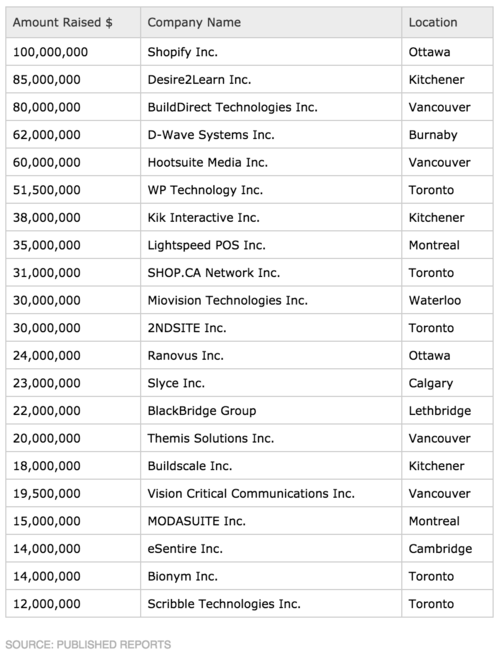
To put things into perspective, total venture dollars invested in Canada last year (2014) was around $1.9 billion. In the US, that number is estimated to be somewhere around $48 billion. So there’s a big spread here. But the Globe is arguing that there’s a shift towards medium-sized Canadian tech companies raising larger and larger rounds.
Here are the top 21 largest venture capital investments made in Canada over the last 18 months:
At the same time, there’s also an attitude change that seems to be taking place. Confidence is growing. Here’s a quote from Mike McDerment of Freshbooks from the same article:
“Our goal is to be an anchor tenant in Toronto. At Freshbooks, we want to build a global company that really contributes in some meaningful way to the city,” Mr. McDerment said. He touts the local schools and talent pool and downplays the Valley’s head start.
“The money is shameless – it’ll just go wherever. It wants the opportunities,” Mr. McDerment said. “I don’t see why Toronto can’t beat Silicon Valley.”
All of this is important because the medium-sized companies of today will hopefully become the large-sized companies of tomorrow. And that’s what you need to build a thriving startup hub. You need big successes. You need those companies going public and generating wealth for their employees and communities.
Thankfully, that seems to be where we’re headed. The first company on the list above – Shopify – is already preparing for a dual US-Canada IPO.
It should start from the premise that the fundamental underpinning of the Canadian economy to have prosperity is dependent on the success of the cities, because 80 per cent of Canadians live in cities. -Toronto mayor John Tory
This week the leaders of Canada’s 22 largest municipalities are gathering in Toronto to figure out how to put urban issues on our national agenda. This is a topic I’ve touched upon many times before on Architect This City, but I continue to believe that it’s one of our most pressing issues.
We know that the vast majority of Canadians live in cities (see above quote) and we know that the vast majority of our economic output is concentrated in cities. In fact, roughly half of Canada’s GDP is produced in our 6 biggest cities alone – Toronto, Montreal, Vancouver, Calgary, Edmonton, and Ottawa-Gatineau.
But despite this concentration of wealth and economic activity, our governance structures do not reflect this reality. They’re outdated. They were built for a Canada that has passed. And so in my view, there’s a significant amount of untapped potential lying dormant in our cities if only we could get around to properly empowering them. There’s a “stimulus package” waiting to be unleashed.
In anticipation of this week’s leadership meeting, the Globe and Mail published an article called, Canada’s big city mayors ready to push urban agenda. And in it they included a number of interviews with Canadian mayors. It’s fairly long, but definitely worth a read. Here are a few relevant sound bites…
Vancouver mayor Gregor Robertson
We have an archaic system. Cities aren’t recognized in our constitution. It’s unbelievable. But Big City Mayors have set aside those important gaps because the needs are now so urgent on housing and transit, we can’t afford to spend a couple years debating structural change. For the time being, the focus is just on ensuring there’s more federal capital provided for transit and other urban infrastructure.
Calgary mayor Naheed Nenshi (on municipal funding sources)
I would prefer to levy myself, so that I’m ultimately accountable to my citizens and, if they don’t like it, they can get rid of me. Allowing others to levy the tools takes away predictability and stability, as well. That said, we’re starving here, and any improvement to the system that leads to those predictable, stable cash flows is a good thing.
Winnipeg mayor Brian Bowman (on the most pressing issue facing Canadian cities)
I’d say without question infrastructure and new funding models to modernize the ways that cities fund themselves. That’s something I’ve started discussions on already with some of my counterparts, Mayor [Naheed] Nenshi in Calgary, Mayor [Don] Iveson in Edmonton as well as Gregor Robertson in Vancouver. We’ve talked about a number of topics including the missing and murdered indigenous women and girls issue, public transit and rapid transit development. But the one consistent theme is that the way cities are funded is outdated.
Toronto mayor John Tory
I start from this premise: Are people paying enough taxes? In many cases, you could argue, not only are they paying enough taxes, they can’t afford to pay any more. We should be looking at the total amounts paid to all three levels of government and how that is being allocated. Do we believe that, in the case of Toronto, the federal and provincial governments are making adequate investments in transit, given the amount of money they take out of this area in taxation? I would say the answer is: not yet. [But] they have been doing better.
Montreal mayor Denis Coderre
We are negotiating a new pact between the province and Montreal, and it’s all about municipal autonomy. We need tools so we’re not always waiting in the hallway at the end of legislative sessions looking for amendments to make the city work better. Since 85 per cent of immigration in Quebec is going to Montreal, we need more control over tools of integration, like job creation and housing. Montreal needs financial leverage…
One of the central themes in his post is the American (and Canadian) fixation on single-family homes:
…the United States is the only developed country of those surveyed, apart from Canada, to widely employ single-family detached residential zones that bar all commercial and multifamily uses.
And the reason for this is largely because of two longstanding beliefs in American (and again Canadian) culture: Your goal should be to become a homeowner, and that home should ideally be a single-family detached home.
But there’s lots of evidence to suggest that these legal protections (and many of the other things being done to encourage/subsidize homeownership) aren’t actually that effective at driving up homeownership.
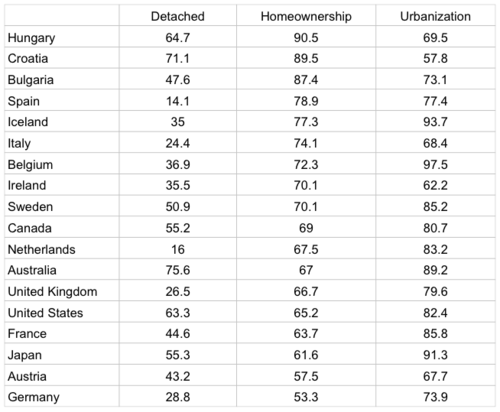
In his post, Charlie includes a chart showing the percentage of detached homes and the homeownership rates for various countries (data is from 2013/2014). I sorted it based on homeownership and added urbanization rates to see if there was any correlation (doesn’t appear to be).
The US and Canada are quite good at putting lots of people in detached housing (though not as good as Australia!), but the homeownership rates are nowhere near the top. In fact, the US falls in the lower half.
Did you think the homeownership rate would be higher in the US?
On Friday my friend Paul Crowe (of BNOTIONS) wrote the following Facebook post (rant) about the retail landscape here in Canada. It was a direct response to the claims that the recent loss of Target, Mexx, and Sony is “a warning sign for our economy.” If the text is too small below, you can also click here to read it on my wall.
I would say that competition did impact these retailers, but the key message remains the same: there’s nothing wrong with failure and companies going out of business (although success is obviously a more ideal outcome).
And it shouldn’t necessarily be interpreted as a bad thing for our economy. In fact, a lot of the time it’s something quite healthy. When companies stop being competitive, the market is supposed to punish them. That’s how this game works.
It’s wintertime in Canada and that means people complaining about the cold and/or the fact that in our climate there are certain things that simply can’t (or shouldn’t) be done when it comes to city building.
A great counter example is Igloofest in Montreal. Unless you’re into electronic music (OK, fine, young people call it EDM today), you probably haven’t heard of it. But it’s basically an outdoor dance party on Montreal’s waterfront in the middle of the winter.
The opening night is tonight and the overnight low is expected to hit -27 degrees celsius. Take a look at the video at the top of this post though (click here if you can’t see it). That’s how many people are going to crowd outside in the cold and dance their hearts out this evening.
And so whether you’ve got harsh winters or summers, there are always creative ways to make it work for you. You just have to own it.
If anyone would like to take a trip to Montreal this winter, I promise to stand by my words and dance outside in the cold. Have a great weekend everyone.
“After a thorough review of our Canadian performance and careful consideration of the implications of all options, we were unable to find a realistic scenario that would get Target Canada to profitability until at least 2021,” said Brian Cornell, who became the new chief executive officer last summer.
I can already hear the keyboards typing as business schools across Canada and the world prepare this case study: Why did Target Canada fail after not even 2 years?
I don’t really want to focus on that in this post, but my initial sense is that they came in too big and too undifferentiated. Maybe they underestimated the particularities of the Canadian market and shopper, but they certainly didn’t come in lean.
They bought up over a hundred Zellers leases and used that platform to obtain a critical mass quickly. But the problem with this approach is that it meant lots of upfront costs and fewer opportunities to adjust as they gained real feedback from the market.
Regardless of what happened, I’m more interested in what the impact will be to the retail real estate industry going forward. Remember, Target is an anchor. And when it entered Canada, it was viewed as an opportunity to refresh some of our tired malls – many of which were already showing signs of dying.
So what happens now? Who comes in to fill their shoes?
I continue to be amazed by the unmet demand for real estate (development) education here in Canada.
Following yesterday’s post on the real estate development process, I received a few emails from readers asking about the best university programs (MBA, MRED, etc.) and the best approaches for becoming a developer.
I also had a good conversation on Twitter, which covered off some details that I had left out from my post (for simplicity) and which resulted in me suggesting that a real estate development school needs to be started here in Toronto:
@donnelly_b I’m game. The Donnelly-Hassan Institute for the Dark Arts.
Now, part of the reason things are the way that they are, I think, is because the real estate industry has been historically dominated by private rich families. People didn’t go to school to learn how to be developers. They learned by doing and that was then passed down to the next generation. All it took was chutzpah.
But as the real estate industry continues to institutionalize and become run by pension funds and large publicly traded companies, I think the point of entry will also become increasingly institutionalized. And that’s where dedicated real estate programs will continue to come in.
I’ve spoken to a few people at the Rotman School – where I did my MBA – and there doesn’t seem to be a huge interest in a dedicated program such as a Master of Real Estate Development (they already offer real estate courses). It’s more of a “longer term” strategy.
But I think that’s a mistake.
I’m confident there’s strong demand from the student side, so hopefully a wealthy donor will step forward to help make this happen. The University of Toronto has both a great business school and a great architecture school. That feels like a great recipe for a first-in-kind joint degree offering.
It was built to correct what had become a major slum on the east side of downtown Toronto. And like many cities around the world, this type of built form was viewed as the solution. Urban slums were crowded and dirty. Density was bad. The solution was to spread people out and surround them with green space.
But that didn’t work out so well. Regent Park failed. So today we are once again starting again. Phase by phase, the old is being demolished and the new is being built. However, unlike the last time, I think this time it’ll be for the better.
But there’s something very ironic about this story.
Before Regent Park became Regent Park, it was called something else: Cabbagetown. That neighborhood of course still exists in Toronto – it’s adjacent to Regent Park – but it’s now a bit smaller having given up a portion of its land to the first iteration of Regent Park.
Today, what remains of Cabbagetown has become an affluent and desirable inner city neighborhood with, allegedly, the largest stock of Victorian housing in North America. But of course it wasn’t always that way. At the time that Regent Park was being conceived, Cabbagetown was a slum. And that’s why we built Regent Park version 1.0. It was the solution for this entire section of the city.
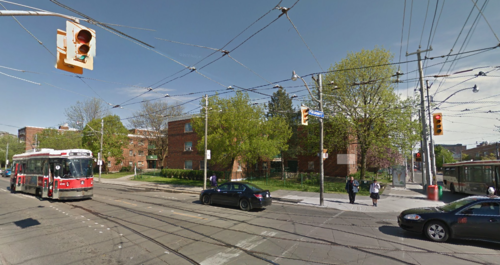
The photo at the top of this post is the southeast corner of Gerrard Street East and Parliament Street. The building at the corner is the Hotel Gerrard. The photo is from 1919, which means it’s a photo of Regent Park when it was still called Cabbagetown. It’s part of what we demolished to make way for the new.
In 2013, that same corner looked like this:
What’s ironic about all of this, is that the area we spared from grandiose urban renewal plans actually became the richest part. And where we intervened is where things got screwed up. So much so that we’re now starting entirely from scratch, again. All of this just makes wonder whether Cabbagetown, in its entirety, would have ultimately taken care of itself had we just left it alone.
But what’s in the past is in the past.
So to end on a positive note, I’d like to share a short video that somebody recently shared with me called Spectrum of Hope. It was co-directed by 7 young artists from the neighborhood who are calling it “a piece for Regent Park, by Regent Park.”
I think it’s a great example of the positive momentum developing in this neighborhood. I hope you’ll give it a watch and then share it around. Click here if you can’t see the video above.
A few weeks ago I wrote about showcasing the Architect This City community. The idea was that there are lots of interesting and talented people who subscribe to this blog, but that there’s no scalable way for me to connect with everyone.
So I wanted to provide an opportunity for you to share a bit about yourself on this blog. I could selfishly learn more about the kinds of people who read ATC; you and/or your company could benefit from a bit of exposure; and you all could get the opportunity to connect with one another.
I didn’t get quite as many responses as I thought I would — which is partially why it has taken me so long to write this post — but I did get a lot of positive feedback on the idea. So I’m excited to share 5 of the people and companies that did respond.
Darren Davis @ Auckland Transport (Auckland, New Zealand)
Proudly car-free Principal Public Transport Planner, and arch transit nerd, at Auckland Transport. Auckland Transport is in the midst of the biggest redesign of the city’s public transport system since the introduction of electric trams in 1902. We are taking a once-in-a-generation opportunity to reimagine public transport by going back to first principles, in an exercise inspired by Human Transit and strongly influenced by its author, Jarrett Walker.
We are a consulting engineering practise — structural, building envelope, restoration, and special projects & renovations — bringing together engineering and intuition to enhance building performance. Entuitive is creative, collaborative, and advanced.
Taya Cook, Development Director @ Urban Capital (Toronto, Canada)
We develop forward thinking condominiums with a focus on urban location, fantastic design and superior customer experience. I work there. Really B, do you need more reasons for awesomeness?
Currently managing a Europe-wide €4m ERDF funded project, ‘Stimulating Enterprising Environments for Development and Sustainability’ (SEEDS). SEEDS is working with 8 partners across 6 countries towards establishing acceptance of the temporary use of abandoned places and spaces as an integral part of longer term planning.
Urbanspace Gallery is a unique venue, dedicated to diverse exhibitions and events that explore how cities work and how we might improve them. Our purpose is to present issues related to community, public space, housing, transportation, planning, governance, and sustainability (among others) in order to further the discussion about our own city and others around the world, while fostering a space of learning and reflection.
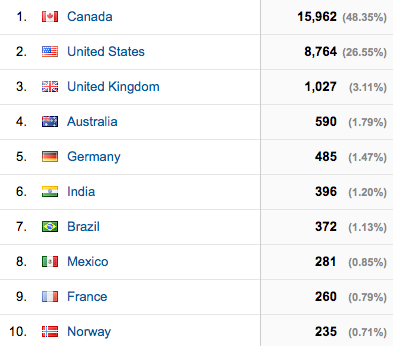
Most of the people who responded were from Toronto and Canada. And that’s not surprising given how local a lot of my content is. Half of the ATC reader base is currently from Canada.
But I did also get emails from many other places all around the world. It always amazes me to see where people are reading from. My only wish is that I could learn more from them (you). So drop me a line. I hope to do another community profile sometime soon.
Depending on where you live, street numbering may not be something you’ve given a lot of thought to. In Canada, and in many other places in the world, the convention is usually to start on one end of the street and count up – with even numbers on one side and odd numbers on the other.
In many cities in the US, they’re even more rational. The streets themselves are numbered and the addresses indicate location. For example in Philadelphia, where I used to live, if you were going to let’s say 1750 Walnut Street, you would know that it’s between the cross streets of 17th Street and 18th Street. It’s a kind of hyper-rational approach, which lets you know precisely the number of blocks you need to go to get to your destination.
But not all countries and cities are this rational.
According to this Economist article – which a friend of mine forwarded me over the weekend – Costa Rica actually had no street numbering system until about 2012. Which means that directions were all based on landmarks: “100 metres south of the McDonald’s.” It seems almost hard to believe. But I guess that’s why ¼ of all mail was getting lost.
Of course, there are also lots of variations in between these two extremes.
Japan numbers its buildings, but they’re often clustered together in blocks and have no particular order or logic to them. Brasilia (Brazil) also assigns numbers based on sectors, quadrants, and blocks. And in Ireland, where I also used to live, they actually never adopted postal/zip codes. They’re one of the few developed countries in the world not to do that – though it’s coming next year.
If your city or country has a unique numbering system or you’ve come across one in your travels, I would love to hear from you in the comment section below.
There are obviously practical reasons to adopt an easy to understand numbering system. People need to be able to figure out where they’re going. But I would also imagine that there are spatial implications to the way you number and the way you organize your city.