Daily insights for city builders, delivered every morning at 6 AM ET. I’m Brandon Donnelly — a Toronto-based real estate developer and founder of Globizen. I’ve been writing here since 2013.
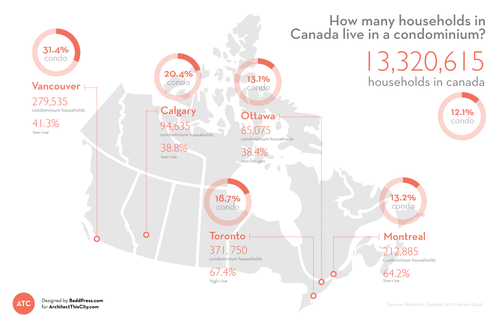
I’ve been meaning to introduce infographics and diagrams into my posts at ATC for quite some time now, so I’m excited to introduce the first one: How many households in Canada live in a condominium? I hope to make this a regular feature.
While a lot of the new development happening in Canada is condominium – particularly in cities like Toronto and Vancouver – the vast majority of households in Canada still live in non-condominium dwellings. Only 12.1% of households are condominium households, which could be high-rise, low-rise, row-housing, or other, according to Statistics Canada.
Perhaps not surprisingly, the Vancouver CMA has the highest percentage of condominium households at 31.4%. I would have expected Toronto to come second, but Calgary (20.4%) actually takes that position (probably) due to an abundance of low-rise condominiums (38.8% of all condos in the CMA). However, Toronto has, by far, the highest percentage of high-rise condominium households at 67.4%. This isn’t surprising to me.
All of the data for this infographic was taken from Statistics Canada and the total number of households in each Census Metropolitan Area (CMA) was assumed to be “occupied by usual residents.” StatsCan defines this as households that are permanent as opposed to ones that could be second homes and so on.
After yesterday’s post about Toronto, I had a friend ask me on Facebook what it is exactly that I think happened to make this city so much cooler. Was it because of one iconic building like Toronto’s new City Hall? Was it because of our recent condo boom? Or was it something else? What changed exactly?
My response was that it’s a generational thing. Let me explain.
Toronto used to have the reputation of being a boring and staid city, and that’s because it was a boring and staid city. In the immediate post-war years, Toronto was overwhelmingly Protestant and the immigration policies at the time were specifically designed to exclude anyone who wasn’t white and from Western Europe or America. If you were Asian, Southern or Eastern Europe (especially Jewish), then you were at the bottom of the entry list.
Prime Minister Mackenzie King reflected the national mood when he observed that “the people of Canada do not wish to make a fundamental alteration in the character of their population through mass immigration.” Discrimination and ethnic selectivity in immigration would remain. “Canada is perfectly within her rights in selecting the persons whom we regard as desirable future citizens. It is not a ‘fundamental human right’ of any alien to enter Canada. It is a privilege. It is a matter of domestic policy.”
In the 1950s and 1960s, Canada started to slowly open up, but only because it needed to. It was in need of labour to fuel its robust post-war economy. Reluctantly, Canada began to look for workers in places like Italy. Initially, Canada had hoped to attract more northern and Germanic-like Italians, but with the European economy picking up, it was the southern Italians who came in the greatest number. In the 1950s, Canada’s Italian population jumped from around 150,000 to 450,000.
But this influx of espresso drinking Catholics was hard for Toronto to adapt to at first. They were so alien compared to Toronto’s population at the time. They wanted to do weird things like eat outside on patios, and that just wasn’t the way we did things here in Protestant and conservative Toronto. We ate inside. That’s where food belonged.
My best friend’s father – who’s also in the real estate development business – once told me that when he first moved to Toronto in the 1970s the real estate business was virtually run by two groups of people: Italians and Jews. In other words, the people building our city were the people that we were once afraid to let come here in the first place.
But in their quest for wealth and a better life (I have so much respect for people who are able to build something from nothing), these new Canadians also reshaped Toronto both physically (through building) and socially (by doing crazy things like eat outside on patios). They were not only building new lives for themselves, they were also rebuilding Toronto. They helped us grow up and not be so stuffy. And I absolutely believe that we’re a better city because of it.
However, I think the true impact of their efforts is happening right now through the next generation – their children. Millennials and Generation Xs (at least the younger ones) don’t remember when Italians were considered aliens. They remember growing up with martini bars on College Street (which is the original Little Italy for those of you unfamiliar with Toronto). They know a different and cooler version of this city.
But most importantly, those subsequent generations are now old enough (and have a lot more generational wealth behind them) to reshape this city even further. And with much deeper roots here, they have the passion to do just that. When I went to graduate school in the US, my parents were afraid I would never come back. That’s what they told me. But the more I traveled and the more I lived outside of Toronto, the more I wanted to come back.
Just like those early wave of pioneering aliens who got us to dine al fresco and taught us that if we shop on Sundays we’re not going to go straight to hell, I feel like I too want to shape this city. I want to make it even better. No city is perfect, but if there’s something you don’t like about Toronto, then here’s my advice to you: Go change it. I can tell you it’s possible, because new immigrants with no money managed to do it.
The first person who can tell me (in the comments below) which restaurant the patio shown above belongs to will get a free Architect This City t-shirt. If you’re from Toronto, this should be an easy one.
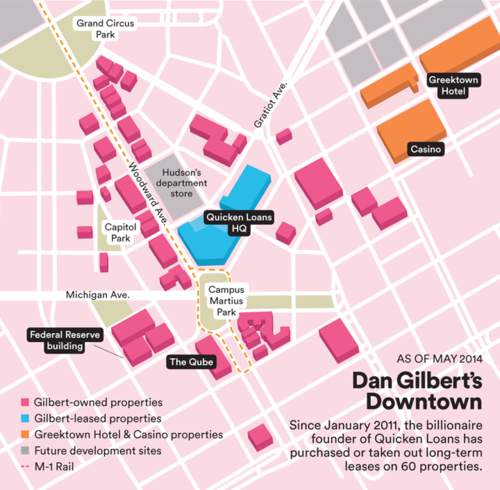
The New York Times published an interesting and popular article last Friday called The Post-Post-Apocalyptic Detroit. It of course talks all about the efforts of billionaire Dan Gilbert, but it also talks about the initiatives of many small and local entrepreneurs who are doing their part to help revive the city – while at the same time making a profit.
One thing that I found interesting about the article is the extent to which the private sector has taken over the responsibilities of the public sector. With only 35,000 of the city’s 88,000 streetlights actually working, the city simply doesn’t have the money to pay its bills. When I visited the city last fall, I was told that the city couldn’t even afford batteries for its parking meters.
So the private sector has stepped up.
In downtown, Dan Gilbert pays for his own security force to patrol the area 24 hours a day both on the ground and through 300 surveillance cameras. And in the Jefferson East corridor, John Stroh III – of the Stroh Brewery Company – is paying for 3,500 hours of private security in order to help transform the area into a walkable retail strip.
It’s a model that relies on the funding and vision of rich people to catalyze change. And it strikes me as a quintessentially American way of going about it. In Canada, I’m not so sure it would be approached in quite the same way, which I think is both good and bad. I think in Canada there would be more government involvement.
If the rich people are there and willing to step up (like they are right now in Detroit), then I would assume the capital would be deployed more efficiently and that change would happen more quickly. But if the rich people aren’t willing to step up, then nothing happens and the place declines.
That might be an oversimplification, but I think there are differences.
To end, I’m going to leave you with this Bloomberg video about Steve Case’s (former AOL founder) “Rise of the Rest” road trip to Detroit. If you can’t see the video below, click here.
If you’re looking for the petition to Prime Minister Stephen Harper, click here.
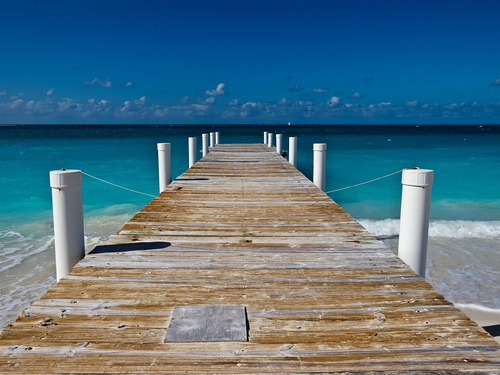
Last Monday the Premier of the Turks and Caicos Islands, Rufus Ewing, was in Canada visiting with Prime Minister Stephen Harper. The purpose of the trip was to “boost ties” between the two countries. It was about trade, which most people would agree is a fairly typical kind of meeting.
However, this meeting struck a different headline in the media. And that’s because–for almost a century–there have been discussions and proposals put forward in this country to annex the Turks and Caicos Islands. The earliest record appears to be from 1917 when Prime Minister Robert Borden first suggested it.
Since then, the idea has been raised on many other occasions. In fact, both Nova Scotia and Saskatchewan have actually stepped forward and formally invited the Turks and Caicos to join their provinces. Here’s what Saskatchewan Premier Brad Wall had to say during this most recent visit:
“I think we want to be constructive in Saskatchewan. If the Prime Minister’s looking for a way to make this happen and doesn’t want to go through the challenge of creating a province or territory, and Turks and Caicos want to make this happen, just, you know, we’d like a tropical island.“
Presumably this approach would be easier than creating an 11th province or 4th territory. But despite these offers and efforts over the years, the idea has always been ultimately rejected. Following this week’s meeting, Foreign Affairs Minister John Baird stepped forward and also firmly rejected the idea:
"We’re not in the business of annexing islands in the Caribbean to be part of Canada. So that’s not something that we’re exploring. We’re not looking at any sort of formal association with the islands.”
But before I dive in, here’s a bit of background on the Turks and Caicos. The country is a collection of approximately 40 islands–most of which are uninhabited. They are a British Overseas Territory, but are self governing. However, from August 2009 to November 2012 the UK temporarily suspended its ability to self govern following allegations of corruption and fiscal mismanagement.
The land area of the country is approximately 613 square kilometres, which results in a population density of 51 people per square kilometre. For comparison, the land area of the City of Toronto alone (not the Greater Toronto Area) is almost equal at roughly 630 square kilometres. The population density averages around 4,150 people per square kilometre.
Now, onto why I believe we should be looking at a union. Here are 5 reasons.
1. They are open to the idea
Canada is not globally known as an imperialistic country and I’m not suggesting we change that. But here we have a case where the Turks and Caicos appears clearly open to the idea of some form of union. Why would we not consider it? And as long as they remain open to the idea, travellers will be able to continue placing the Canadian flag on their backpacks as a way to win friends overseas.
2. We’re aligned
Given that the Turks and Caicos is a British Overseas Territory, the country uses the common law system and the official language is English. (They’re missing French, but I’m sure that could be worked out.) We even share the same monarch. (Although, deep down inside I wish Canada was a republic.) These commonalities would make a proposed union all that much easier.
3. Vacationing and retirement
This is the obvious one that is getting most of the attention in the press. Canada is cold and we spend a lot of money traveling to warmer places. But if Canada had a province that was blessed with the weather of a place like the Turks and Caicos, I’d wager that it would receive a disproportionate amount of our travel and retirement dollars. All of a sudden you eliminate currency risk and the fear of foreign health care, which are both particularly important for retirees. This means that a lot more money would be kept within the Canadian economy. Sorry, Florida.
4. Access to education
53% of the labour force in the Turks and Caicos is made up of unskilled and manual labour. If they are serious about developing their economy beyond tourism, then I believe that education needs to become a significant part of their economic development platform. Thankfully, a union between our country and theirs would open up Canadian universities to the roughly 36,000 people who live in the Turks and Caicos Islands. Our universities are some of the most highly ranked in the world.
5. Economic development
Finally, let’s talk economic development.
Canada is one of the wealthiest countries in the world. And we consistently rank amongt the highest in the world in terms of education, transparency, quality of life and economic opportunities. It’s for these reasons that we’re perceived as a great place to live and invest. About one of the only things we don’t typically offer is great weather.
A union with the Turks and Caicos would obviously change that. But beyond just weather, it would also give Canada a foothold in an important region of the world and provide a stable locale for foreign investment. Similar to the way in which Miami has become the “Capital of Latin America”, the Turks and Caicos could become a meaningful center for trade and investment backed by Canadian stability.
This would benefit not only Canada, but also the Turks and Caicos, who have struggled over the years with fiscal mismanagement and corruption. In fact, the biggest challenge, I think, would be managing overdevelopment and ensuring that the growth and development happens in the most environmentally sustainable way possible.
Petitioning Stephen Harper
So there you have it, 5 reasons for why Canada should seriously consider a union and/or the potential annexation of the Turks and Caicos Islands. If you have any other ideas, or if you completely disagree with everything I said, I would love to hear from you in the comment section below.
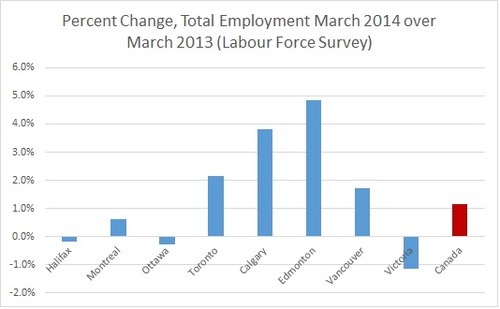
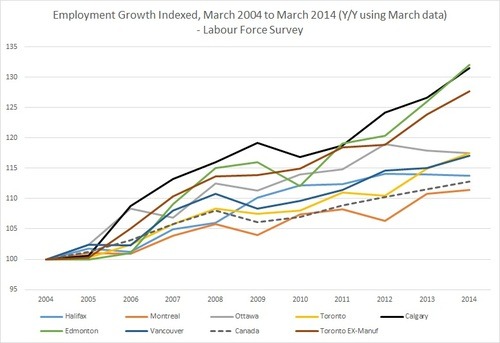
I was reading Wendy Waters’ All About Cities blog this morning and I came across the following charts showing employment growth across Canadian cities. The first chart shows total employment growth over the last year and the second chart shows employment growth over the past 10 years.
What is immediately obvious from these charts is that Calgary and Edmonton–both resource driven economies–have and are leading Canada in terms of employment growth.
Toronto isn’t that far behind though, particularly if you exclude manufacturing from the equation (see second chart). The decline of manufacturing in the Greater Toronto Area really represents a structural change in the economy.
I wanted to post these charts because, for all the talk about the rise of the information and digital age, Canada’s economy is still very much based on natural resources. We extract and sell. And we have one of the largest proven oil reserves in the world.
Now, I’m not opposed to this business model, but there’s lots of evidence out there to suggest that resource dependency ultimately hurts innovation and productivity–which makes sense. If we didn’t have resources, we’d be forced to figure out other ways to make money.
So while it’s great to see our cities growing, let’s not take it for granted.
You can find all the specific numbers here, but what is obvious is that the province is paying for most of this city’s transit expansion. Unfortunately though, it’s being done on an ad hoc basis. Toronto first asks for money and then the province decides whether or not it wants to give it.
This is problematic for a few reasons.
First, it’s an inconsistent funding stream. We all recognize the need for better transit and infrastructure in the city, but the big question is always: Who’s going to pay for it? So far, as we can see, it’s been the province. But that’s not always a sure thing. And it can often become political. If we’re going to get serious about building transit, Toronto needs a consistent funding source that would allow us to start building and not stop.
Second, how come, as one of the major economic engines in this country, we aren’t in a position to pay for our own infrastructure? It’s because our governance structure does not properly reflect the economic realities of today’s world:
Most local governments are formed by a charter or act granted by the province or territory. Local governments are not mentioned in the Canadian Constitution other than to say they are responsibility of the provinces. Consequently, municipalities can be created, amalgamated, or disbanded at the whim of the provincial government which controls them. They are also limited in the amount of interaction they have with the federal government because this would infringe upon an area of provincial jurisdiction. Since each province is responsible for creating local governments in its own territory, the names, functions, and powers of local bodies vary widely across the country. Local governments generally have limited powers, namely creating local by-laws and taxation (property tax).
And yet cities, not provinces, are our biggest economic drivers. We have it backwards. And so I think it’s critical that we look long and hard at ways in which we can better equip our cities with the tools and resources to compete globally. Transit funding is just one example.
This morning I’m going to a memorial service for a close family friend. His name was Ed Hung. You may have read about him in the Toronto Star, because on March 16th, 2014 at 11:00AM Central European Time he died by way of an assisted suicide. He was in Switzerland.
And the reason he was in Switzerland was because, in Canada, you’re not allowed to do what he did. You’re not allowed to seek help and decide when it’s your time to go. That’s supposed to be left up to some greater being.
But what if you’re like Ed? What if you have Lou Gehrig’s Disease and your body noticeably deteriorates within the span of a few months? What if you’ve just lost the ability to do what you love most: play the guitar?
Ed was a lawyer. And a successful one at that. But he loved music. The first time I met him was at my mother’s house one Christmas where he was playing the guitar and singing songs all night. He had a band and that’s what he loved to do.
Sometimes I think it’s a shame that people often don’t get the chance to just do what they love; they have to do other things in order to make enough money. But I suppose that’s life.
Nonetheless, it is somebody’s life. And I agree with Ed in that quality of life is a subjective concept. If you’ve just lost all ability to move your left hand, then it’s you who are going to have to deal with that new reality—not anybody else.
Which is why I fully support Ed’s decision. I didn’t know him as well as I would have liked, but I have a lot of respect for what he did. He took matters into his own hands and did it his way—as he beautifully expressed in his farewell YouTube video.
I know that my family will miss Ed dearly, but he’s left us with something important to think about. Before he passed he wrote a letter called Approaching Death. You can read it here. And in that letter, he delivers a powerful set of lines about the laws in our country:
“…my pride as a Canadian has somewhat diminished after having been on my knees begging to die in another country. This is not fair and I certainly do not wish it upon any of my fellow Canadians.”
I know that this may not sit well with some of you, but I believe in a country built on personal freedoms. And this, to me, is a case of personal freedom. I’m not sure what I would do if I were in Ed’s position, but I know with certainty that I would want the ability to do whatever I decide.
Yesterday I came across an incredibly fascinating chart from Eurostat, analyzing housing tenure (in 2011) across Europe. Here it is:
And here’s what I found interesting.
Working from left to right, there seems to be a clear difference between Eastern and Western Europe in terms of the amount of leverage they use to buy homes. If you look at Romania, not only does over 90% of the population own a home, but they also don’t seem to have any outstanding mortgage or housing loan. That means they’re buying their homes in cash.
By the time you get to the United Kingdom, you start to see numbers that are comparable to Canada and the United States. The percentage of owner occupied homes is sitting at or below 70% and the majority of them have a mortgage or loan.
But as a whole, Western Europe seems much more likely to rent than Eastern Europe. And in the case of Switzerland, more people rent than own. Why is that? This seems odd given its economic strength. But the same could be said for Germany and Austria, which also show relatively low ownership rates. Here’s one possible explanation.
Finally, I found it interesting that in Denmark, the Netherlands, and Sweden, there’s virtually no such thing as subsidized rental housing. If you rent, you’re paying market rate (at least according to this chart). I wonder if this has something to do with there being less income inequality.
If anyone has any insights on some of these points, I’d love to hear from you in the comment section below.
Earlier this month, the Royal Bank of Canada and the Pembina Institute co-published a report on Toronto’s housing market called “Priced Out”. The overarching argument is that homebuyers in the Greater Toronto Area (GTA) are being “priced out” of the areas in which they really want to live, which happen to be walkable and transit-oriented neighborhoods.
In fact, according to their research, 80% of residents in the GTA would be willing to sacrifice space (size of house and yard) if it meant they could live in a more walkable and urban neighborhood. But at the same time, more than 70% of GTA residents say that they live where they do because of affordability reasons, not because of actual preference. This, of course, isn’t new. It’s the whole “drive to affordability” notion—just keep driving until you can afford the housing.
Overall though, the report does reinforce a macro tend that I’ve discussed many times here at Architect This City. People are returning to cities in droves (or would at least like to, if they can afford it).
If you’re interested, the report also has some good data on Toronto and Canada’s housing markets.
Here’s how average home prices in Canada trended between 1980 and 2012. Vancouver became a total outlier starting in the early 90s (thanks Hong Kong).
And here’s a look at housing completions (so new construction) by product type in the Greater Toronto Area. Note how apartments/condos surpassed single-detached houses in and around 2008.
Yesterday, I discovered a Jerusalem-based Italian photographer by the name of Vittoria Mentasti. She has an ongoing project called “A Woman With Two Names”, that’s exploring the identity of Canada’s Inuit community in Iqaluit, Nunavut. Click on the photo below to see the entire gallery.
Here’s her language on the project:
“Iqaluit, the capital of Nunavut, is a city of 7000 people surrounded by tundra and the sea. The only way to get in or out of Iqaluit is from the air. I was interested in the cultural identity shift the Intuit community is experiencing and its consequences. The community, especially its younger members, are trapped between two worlds; they are losing touch with their past and are headed towards an uncertain future.
The process of forced assimilation carried out by the Canadian Government and the Church during the first half of the 20th century, deprived the Inuit of their social and spiritual customs. The transition away from their nomadic roots to modernized living has led to alcoholism, domestic violence and unemployment; symptoms of a society that is floating between its past and present.
Photographing off-moments of everyday life, I was looking to depict the sense of isolation, their ancestral connection to a harsh land, and the feeling of not belonging to “The South”, the way Inuit refers to the rest of the world.”
As one of the most remote and sparsely populated regions in the world, it’s easy to overlook what’s happening here in our country. But there are real problems in our north. In 2011, the Globe and Mail published a Focus Feature on Nunavut where it asked: Is Nunavut a failure of Canadian nation building?
“The rate of violent crime per capita in Nunavut is nine times what it is in the rest of Canada. The homicide rate is around 1,000 per cent of the Canadian average.”
I’m not an expert on this matter, but it seems like everybody is picking up on the same phenomenon. We’ve created an in-between society. A society that’s completely ill-equipped to compete in the modern world, but that’s too far removed from its roots to turn back now. They were nomads and now they’re not.
This is hugely problematic and it’s only going to get worse. Already we’re seeing rising income inequality within “The South.” The returns to being smart are being amplified and twenty somethings with a killer app are turning down billion dollar acquisition offers.
What do you think this does to the north? I’d bet it makes it much worse.