Daily insights for city builders, delivered every morning at 6 AM ET. I’m Brandon Donnelly — a Toronto-based real estate developer and founder of Globizen. I’ve been writing here since 2013.

Tag: california

  • Neighborhood depopulation

    Recently we’ve been talking about California’s Proposition 13 and how it may be creating a disincentive for longtime homeowners to move. They’re enjoying below market property taxes, and so they stay put, even if they may have too much house.

    But this concept of “overhousing” isn’t unique to California. The Globe and Mail just ran a piece talking about how Toronto’s designated “Neighborhoods” are losing people as the nests empty out, seniors remain put, and the broader city booms.

    The rate of depopulation that created the spare bedrooms in Toronto’s low-rise neighbourhoods is stark: “Since 2001, about 52 per cent of the land mass of Toronto has reduced in density of population by about 201,000 people,” Mr. Smetanin says. “Other parts of Toronto have grown by 492,000.”

    The irony of this phenomenon is that the city’s Official Plan considers these Neighborhoods to be “physically stable”, as well as “one of the keys to Toronto’s success.” However, things are clearly changing behind that physical stability.

    Photo by Verne Ho on Unsplash

  • Thoughts on housing in the Bay Area

    I was out for drinks recently with a friend of mine who is a developer in California and she mentioned a few things to me that I thought were really interesting. 

    First, she talked about how virtually nothing gets built in the Bay Area “as of right.” And so the market is hugely supply constrained. She said, you’re lucky if you can get your entitlements in 2 years. It’s starting to take longer. I immediately said: “That’s Toronto.”

    Second, we talked about Proposition 13, which was timely given this recent post. One of the consequences of Prop 13, beyond helping golf clubs survive, is that longtime homeowners seem to be highly incentivized not to move. 

    Their property taxes are so below market that it can be more cost effective for them to stay put as opposed to downsize – even if they have too much house. This means far less turnover in the housing market.

    Third, there really does seem to be a feeling in the Bay Area that it’s at a breaking point in terms of affordability. When a successful software engineer making $200,000 a year can’t afford housing, people naturally start to look to other cities.

    We hear this refrain all the time in the media, but because I’m not active in that market, it was far more impactful hearing it from a friend.

  • The density delusion

    Joel Kotkin and Wendell Cox recently published a piece in the Orange County Register called, “California’s housing crisis and the density delusion.” I’m sure you can guess where this is going, even if you don’t follow the work of Joel Kotkin. But if you do, you will know that he is an ardent supporter of suburbia and the single-family home.

    Here is an excerpt from the article:

    In reality, the YIMBY’s suggestion that new, dense housing will improve affordability for all is patently absurd. Decades of densification in Los Angeles has seen ever higher rents, displacing low-income, especially minority households. Many former transit customers have been driven to lower-rent areas with less transit service, precipitating a massive decline in ridership, even as billions continue to be spent building new rail lines. The Wiener Bill [my link, not theirs] could exacerbate this trend, and likely increase the need for low-income housing, already well beyond the capability of public coffers.

    I fully appreciate the argument that high-density housing isn’t for everyone and that we shouldn’t be “forcing everyone back to the ‘glory’ days of the city of tenements.” But I disagree with many of their points, including the argument that density doesn’t encourage transit ridership. Density isn’t everything, but it’s an important something.

    The article is definitely worth a read, particularly if you disagree with their positions. That’s how you avoid confirmation bias. I was trying to keep that in mind as I read it. Maybe it worked.

  • “I hate golf”

    I am a big fan of Malcolm Gladwell, and not just because he’s Canadian and went to the University of Toronto (my alma mater), although those facts certainly don’t hurt.

    I’m late to his podcast, Revisionist History, so in case some of you are as well, I would encourage you to check it out. Every episode reexamines something from the past and questions: Did we get it right the first time? It’s very Gladwell. It’s a must listen.

    The episodes span a secret research project setup by the Pentagon in downtown Saigon during the Vietnam War to why rich people are obsessed with the game of golf. Spoiler: He hates golf.

    The golf episode will be of particular interest to many of you because it deals with real estate. Malcolm wades into something known as California Proposition 13, which is a constitutional exemption that keeps property taxes artificially low.

    It is what has allowed these “vast, gorgeous, and private” golf courses to continue to exist in expensive cities like Los Angeles. Otherwise they would have long ago drowned under the property taxes following reassessment.

    This also leads to a philosophical debate about what constitutes a change in ownership, since many clubs are member owned and Proposition 13 requires that there not be a change in more than 50% of the ownership. 

    But I’ll stop there. Give it a listen. Malcolm is just excellent.

    Photo by Rémi Müller on Unsplash

  • California State Senator wants to mandate denser and taller zoning near transit

    California State Senator, Scott Wiener, introduced 3 new bills at the beginning of this year intended to address the statewide housing shortage and continue the pivot from a housing-last agenda to a housing-first agenda.

    Here is a summary of the 3 bills:

    These three bills (1) mandate denser and taller zoning near transit; (2) create a more data-driven and less political Regional Housing Needs Assessment process (RHNA provides local communities with numerical housing goals) and require communities to address past RHNA shortfalls; and (3) make it easier to build farmworker housing while maintaining strong worker protections.

    And here is a bit more information about the first one:

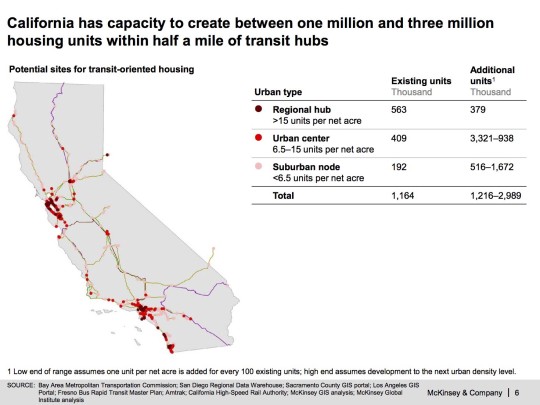
    SB 827 creates density and height zoning minimums near transit. Under SB 827, parcels within a half-mile of high-connectivity transit hub — like BART, Muni, Caltrain, and LA Metro stations — will be required to have no density maximums (such as single family home mandates), no parking minimums, and a minimum height limit of between 45 and 85 feet, depending on various factors, such as whether the parcel is on a larger corridor and whether it is immediately adjacent to the station. A local ordinance can increase that height but not go below it. SB 827 allows for many more smaller apartment buildings, described as the “missing middle” between high-rise steel construction and single family homes.

    The belief is that transit-oriented sites in the state of California have the potential to accommodate up to 3 million additional housing units.

    Fewer barriers to creating new housing. More data. And less politics. You can read more about Wiener’s 2018 housing package over on Medium.

  • Land use restrictions and upward mobility

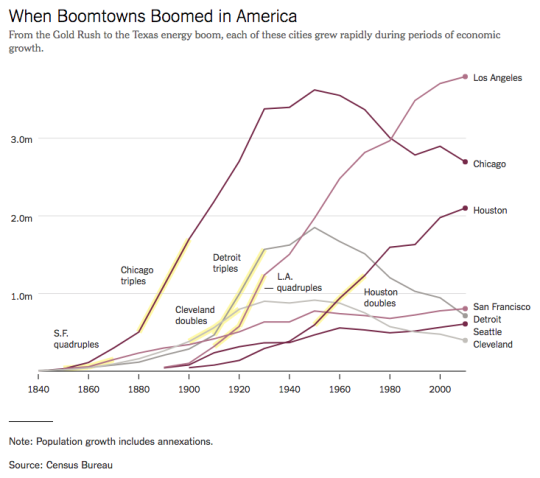
    Throughout US history, economic growth has typically spurred an “enormous reallocation of population.” Here is a graph from a recent New York Times article called: What Happened to the American Boomtown?

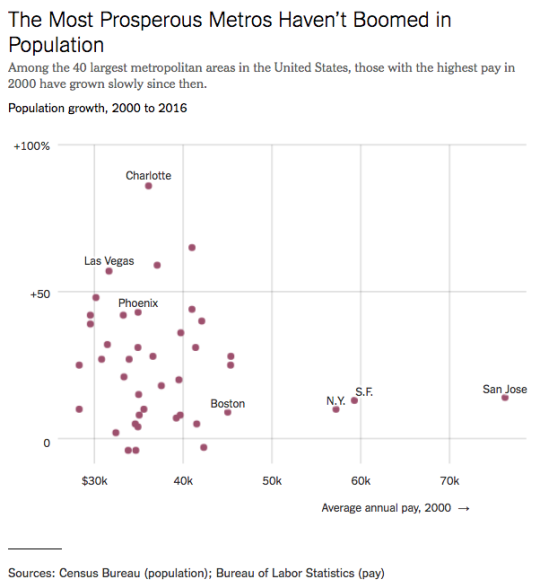
    The argument, here, is that restrictions on development have made it so that the most prosperous cities are actually the slowest growing cities in terms of population. Here is a chart, from the same article, comparing population growth to average annual pay:

    And here is an excerpt:

    But these productive places aren’t growing as fast now as economists believe they should — and as they would if they didn’t impose so many obstacles on new development. Since the 1970s, land use restrictions have multiplied in coastal metros, making it harder to build in, say, San Jose, Calif., than in Phoenix. And the politics of development have become tense, too. In the Boston suburbs, the Bay Area, Brooklyn and Washington, people who already live there have balked at new housing for people who don’t.

    We often talk about the impact of land use restrictions on supply and overall housing affordability. But here is an argument that it could also be impacting upward mobility.

  • The geography of innovation and equality of opportunity

    The Equality of Opportunity Project has a recent paper out called: Who Becomes an Inventor in America? The importance of Exposure to Innovation. Vox also has a summary of the findings, here.

    The overall goal of the project is to “use big data to identify new pathways to upward mobility.” And in this particular study, they discover that in America there are many “lost Einsteins” – people who have the ability, but not the opportunity.

    Not surprisingly, socioeconomic class, race, and gender play a significant role. Children from high-income families are 10x more likely to become inventors (measured in patents) as compared to children from low-income families.

    Geography, place, and environment also matter. Where and how a child grows up has a significant impact on future outcomes. If a child grows up in a city/network that exposes them to other inventors, it increases the likelihood that they too will invent. 

    Where a child grows up also has an impact on the types of inventions, even if the child move cities as an adult. For example, the study found that if a child grows up in Silicon Valley but moves to Boston as an adult, it is still more likely to author patents related to computers because that’s what it was exposed to as a child.

    These associations also impact in a gender-specific way. Women are more likely to invent in a particular technology if they grow up surrounded by similar female inventors. The presence of male inventors has no impact. This makes a powerful case for better gender diversity and strong role models.

    If you would like to read the full paper, click here.

  • Saying no to “Mountain Modern”

    Jackson, Wyoming is one of my favorite places on the planet. (Here is a ski/snowboard video that my friends and I made a few years ago in Jackson.)

    Earlier this year, Eagle Point Hotel Partners and the Brooklyn-based design firm Studio Tack completed a renovation of the Anvil Motel in Jackson – it’s now the 49-room Anvil Hotel

    Apparently reclaimed motels are the new hospitality trend.

    What I appreciate about their approach, is the emphasis on creating something that feels local and contextual. Here are a couple of snippets from Surface Magazine:

    The designers wanted to avoid a rustic feel, or what Ruben Caldwell, one of Studio Tack’s four partners and an avid backcountry skier, calls “Mountain Modern,” referring to architecture, common in places like Vail, Colorado, and Lake Tahoe, California, that excessively uses reclaimed wood and Cor-Ten steel. “We knew we didn’t want to steer anywhere near that,” says Chou, a long-time snowboarder who more recently got into skiing. “It takes a bit of familiarity with ski towns to know what you don’t want to do.”

    The vibrancy of Jackson’s local culture impressed the design team—and Caldwell so much so that he moved there full-time last year. “As a design team,” Caldwell says, “we’re hyper-aware of the need for projects to be deeply embedded into the local scene.”

    It’s easier to copy and paste. But the results are always better when you take a bit of time to understand a place. 

    Image: Anvil Hotel

  • 616 Croft Ave., LLC, v. City of West Hollywood

    The Supreme Court of the United States may soon consider whether inclusionary zoning is in fact unconstitutional.

    A pending petition by the developer of an 11-unit condominium project in the City of West Hollywood is asking whether a $540,393.28 “affordable housing fee” – which is being imposed as a mandatory approval condition – is “subject to scrutiny under the unconstitutional conditions doctrine” set out in previous cases.

    The petition is supported by a collection of researchers and academics from Yale University, George Mason University, as well as many other institutions.

    More specifically, the question asks whether a “mandated permit condition” satisfies the “essential nexus” and “rough proportionality” tests established by the following decisions: Koontz v. St. Johns River Water Management District, 133 S. Ct. 2586 (2013); Dolan v. City of Tigard, 512 U.S. 374 (1994); and Nollan v. California Coastal Commission, 483 U.S. 825 (1987).

    To put it crudely, the nexus and proportionality tests essentially state that for an exaction to be constitutional, there needs to be a reasonable relationship between the ask and the adverse public impacts that can be directly attributable to the project in question.

    Here is an excerpt from the petition:

    Together, the nexus and proportionality tests hold that the government cannot condition approval of a land-use permit on a requirement that the owner dedicate private property to the public, unless the government can show that the dedication is necessary to mitigate adverse public impacts caused by the proposed development.

    In the case of 616 Croft Avenue, the argument is that this 11-unit condo project is not directly responsible for the lack of affordable housing in the city. In other words, the need for affordable housing exists independently of this project. So it fails the test.

    Another excerpt:

    Accordingly, the City
    provided no evidence of nexus and proportionality,
    admitting on the record that the in-lieu fee was not “intended to mitigate impacts caused by development.” Instead, the City explained that the fee was designed to meet “needs for affordable housing that exist independently of the Applicants’ residential
    development project.

    The petition also gets into the fact that, irrespective of this test, inclusionary zoning has not necessarily been shown to have a meaningful impact on affordable housing supply. And it may actually increase housing prices because of a reduction in overall supply and because the cost burden typically gets shifted over to the market rate units. More reading here.

    What do you think of this argument? It will be very interesting to see how this one plays out.

  • One of the most expensive neighborhoods in LA

    image

    Oftentimes when I visit a city I like to ask myself: Which neighborhood would I want to live in if I were to move here?

    Today I spent much of the afternoon hanging around Venice. After we got there, I told my friend that if I moved to LA, I would probably want to live there. I told him that, relative to the rest of the city, I liked the compressed scale of the neighborhood. There are many pedestrian-only lanes and streets beyond the boardwalk. And I told him that I thought it was interesting how the neighborhood seems to combine both bohemians and yuppies (though many people seem to hate the yuppy part).

    But I’m obviously not alone in my thinking. My friend quickly informed me that Venice is one of the most expensive neighborhoods in LA and that it’s been adding essentially no new housing supply. Here’s an excerpt from an LA Weekly article published at the beginning of this year:

    Anti-development activists like to argue that development fuels gentrification, that the construction of new, high-end apartment buildings makes the whole neighborhood more expensive.

    But the case of Venice is a counterpoint. For the last 50 years, Venice has successfully fought developers to a stalemate. The housing supply stayed constant, while demand grew. As a result, the value of property in Venice has soared.

    In 1996, according to data provided by Zillow, the average home value in Venice was $251,000 — more expensive than Silver Lake and Encino but cheaper than Westwood, Studio City, Mid-Wilshire and Los Feliz. Today, Venice’s average home value is nearly $1.6 million, more expensive than all of those neighborhoods — more expensive, in fact, than its historically tony neighbor to the north, the city of Santa Monica, which, according to Alvarez’s research, added more than 10,000 dwelling units between 1960 and 2010.

    Perhaps I should give this some more thought.