Daily insights for city builders, delivered every morning at 6 AM ET. I’m Brandon Donnelly — a Toronto-based real estate developer and founder of Globizen. I’ve been writing here since 2013.

Tag: california

  • Electric scooter startup Lime raises $310 million series D round

    Earlier this month it was announced that the on-demand electric scooter and bike startup, Lime, had closed a $310 million series D round. This values the 18-month old company at around $2.4 billion and brings its total raise to $867.1 million. For comparison, Bird — its main competitor — has raised around $400 million.

    These numbers should tell you about the kind of growth that the “micromobility” startup is seeing. They are now in 15 countries and its riders have taken over 34 million trips. In the last 7 months alone, the company reports that it has seen a 5.5x increase in ridership. They are seen as an affordable last-mile solution. Supposedly 1/3 of its users report an income of less than $50,000 per year.

    Lime entered the Canadian market last fall via Waterloo. They have yet to expand anywhere else, though I suspect we’ll see them in Toronto this spring/summer. One of the barriers is that their scooters (with airless tires) aren’t equipped to deal with snow, so they currently pack them up during the winter months.

    This is in addition to the regulatory challenges they are facing in cities all around the world. But like Uber, I am sure there is a compromise to be had.

  • Boring Company ran a Tesla through its test tunnel

    This week Elon Musk’s Boring Company ran a Tesla through its 1.14 mile-long test tunnel in Hawthorne, California. This was accomplished by using a set of tracking wheels that Elon said, “turns a car into a rail-guided train & back again.” Apparently it is safe up to 150 miles per hour. Here is a video from yesterday’s unveiling (click here if you can’t see it below):

    [youtube https://www.youtube.com/watch?v=WQn-D-i5lyM&w=560&h=315]

    Some, or perhaps many, are skeptical of how this could work at scale in a dense urban environment. The company is imagining a world where every house or office building has one of these lifts (shown in the video) in their garage or basement. But there’s no question it is very cool and apparently this test tunnel only cost about $10 million per mile to dig. That’s progress in and of itself.

  • Thoughts on California’s wildfires

    What is happening in California right now is both sad and scary. I woke up to these photos in the New York Times. So I spent the morning reading up on wildfires and what causes them. 

    I am sure many of you are thinking: Is climate change doing this?

    It’s important to note that California is designed to burn. The characteristics that make the state a highly desirable place to live – mild winters and hot and dry summers – also make it a highly flammable place.

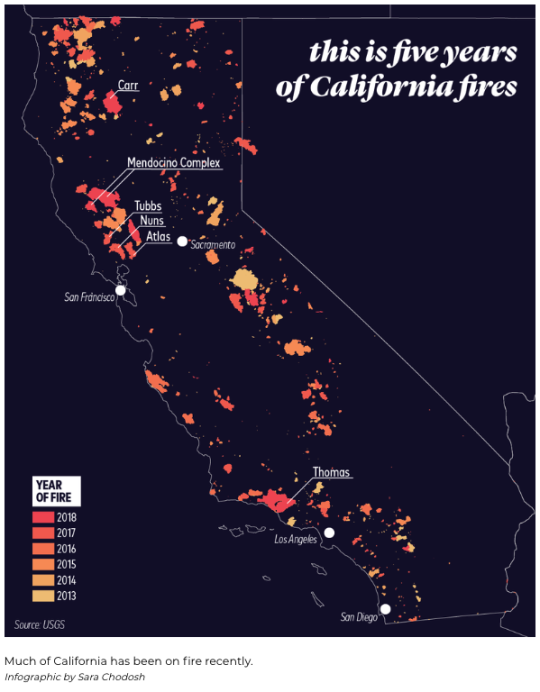
    Below is a map from Popular Science showing how much of California has burned over the last 5 years. Most of California’s hottest fires (13 of the top 20) have occurred since 2000.
    image

    But these naturally occurring fires are actually important for the regeneration of its forests. So one argument is that the current policy of “total fire suppression” is actually partially responsible for this increase in severe wildfires.

    Low-intensity forests aren’t burning like they used to and it is creating more densely packed forests for even larger wildfires. In other words, through our actions we could be exchanging smaller and more frequent fires for bigger and more severe ones.

    The other concern is development. 

    California had a population of about 24 million people in 1980. Today it is closer to 40 million. And much of that growth has occurred outside of existing urban areas (too hard to build). This has meant more people living in suburban and rural areas – adjacent to wildlands.

    Ed Glaeser has repeatedly argued that the best way to respect nature is to actually stay as far away from it as possible. Humans are a destructive species. Living in a dense city is good for the planet.

    Now let’s address the climate change issue.

    Daniel Swain, who is a climate scientist and author of the Weather West blog, published this popular thread on Twitter about a day ago. At the time of writing this post, it had been retweeted and liked over 10,000 times.

    From his perspective as a climate scientist, this is not all about climate change. That’s the wrong question to ask. It’s more complicated and nuanced than that. But climate does indeed act as a “threat multiplier” to the other factors we’ve already discussed.

    Fire season typically begins and ends with rain. When the fall rainy season starts, the fire season ends. One of the biggest risk factors is a dry fall, particularly after a hot and dry summer (or after multiple hot and dry summers, as has been the case in California). 

    Because according to Swain, fall means the start of “offshore wind” season, which can help to stoke these wildfires. 

    Unfortunately, one of the projected outcomes of climate change for California is more precipitation concentrated in the “winter” months, at the expense of precipitation in the shoulder seasons (spring and fall). So that means a longer fire season.

    Swain believes that if Northern California had received close to its typical amount of rain this fall, it is almost certain that this tragedy would have been avoided. 

    That, however, makes me wonder about the relative importance of all the factors we have discussed today.

    For Daniel Swain’s full thread, click here.

  • Public access at Martin’s Beach

    I just learned about the ongoing legal dispute on Martin’s Beach (south of San Francisco) through this New York Times article

    To briefly sum it up, tech billionaire Vinod Khosla bought a 53-acre beachside village known as Martin’s Beach in 2008. On the land is about 47 beach houses, a shop that sold ice cream at one point in its life, and a road that provides the only access to the beach. The road is private, but over the years and before Khosla purchased the property, it provided both parking for and access to the beach. 

    After acquiring the property, the county told Khosla that he had 2 options with respect to the road:

    (1) Keep it open (there’s a gate that controls access). And charge no more than $2 a car for parking, which was the rate charged in 1972.

    (2) Apply for a Coastal Development Permit to change how the access works.

    Khosla opted to do neither and in turn the residents of Martin’s Beach sued him. He’s been in a legal battle ever since. But according to the New York Times, he has about $3 billion sitting in his war chest. For him it is both a matter of principle and a matter of protecting property rights.

    Not surprisingly, tech billionaire fighting to keep people off a public beach makes for a sensational headline in the media. The NY Times argued that every generation has some sort of rich Californian fighting to privatize the waterfront. Khosla is this generation’s “beach villain”.

    But beneath the headlines lies a fascinating legal debate that you can read more about through a blog post that Khosla published earlier this year. For you property lawyers out there, I would be curious to hear your thoughts in the comment section below.

  • Twin Palms turns 60

    2018 marks the 60th anniversary of the Twin Palms neighborhood in Palm Springs, California, and Houzz has just published an excellent story describing the subdivision’s history and its importance for mid-century modern architecture.

    Designed by architect William Krisel and developed by Alexander Construction, the community was initially built with 90 homes. Supposedly each lot was exactly 10,000 square feet and each house had the exact same 40′ x 40′ square floor plan. So 1,600 sf homes.

    In addition to this, each lot had a carport, an open courtyard connecting the house and carport, and a swimming pool. 

    Unlike some of his contemporaries, Krisel was less interested in building one-off homes for the wealthy. He was more interested in tract housing for the masses. And standardizing the plans was one way to achieve greater affordability.

    Krisel still found other creative ways to differentiate the homes, namely by rotating the square floor plan and by rearranging the carport, courtyard, and pool.

    He also employed different rooflines, all of which have become emblematic of this era of architecture and of Palm Springs in general. It was about optionality on top of and around the box.

    If you have a few minutes, check out the Houzz article. The homes are beautiful and the story is compelling: the modern American dream at an affordable price.

    Photo by Nainoa Shizuru on Unsplash

  • SoCal Googie

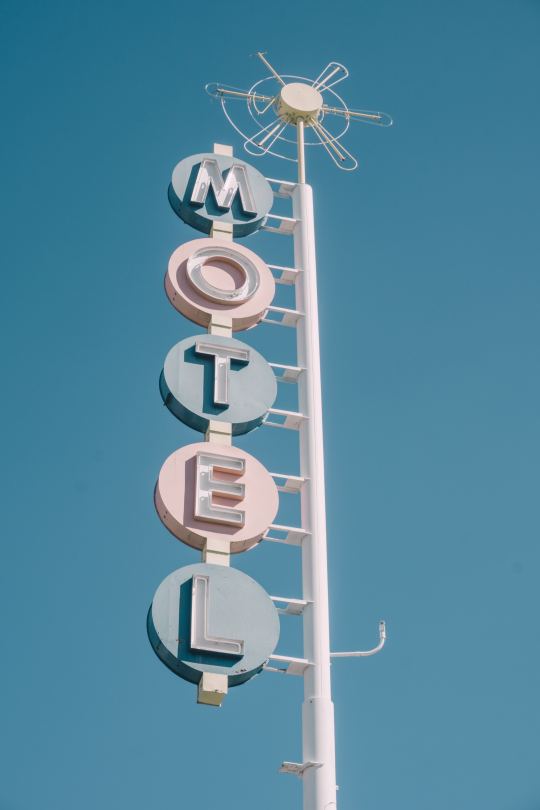
    I must have been sick for this lesson in architecture school, because I just discovered, through Curbed, that there is a subset of mid-century modern architecture known as Googie. It originated in Southern California in the 1940s and was all about the future, car culture, the Space Age, and the many other things that dominated the postwar years. Think starbursts, curvaceous geometric shapes, and bright colors. We all know the architecture. But did you know it was called, Googie?

    Supposedly the Googie movement was given its label by architecture critic Douglas Haskell, who used it in a derogatory way to describe criticize the architectural fashion at the time. Googie was the name of an actual coffee shop in West Hollywood designed by John Lautner. And that’s something that is noteworthy about Googie. It was a form of architecture for average buildings: coffee shops, gas stations, motels, and those sorts of things.

    There will always be critics who eschew that which is fashionable at the time. I suppose one could argue that if you’re being fashionable, then you’re not being timeless. Because fashion is about what’s current. And good architecture should be timeless, right? But there’s something so fascinating about a kind of built form that perfectly captures a particular time and place. Middle of the 20th century. Car-oriented Southern California. 

    Sometimes good architecture and design also needs a bit of time and distance in order to fully appreciate it. What was once garish may one day become treasured. Just give it a generation or two.

    Photo by ian dooley on Unsplash

  • Less, rather than more, housing

    Earlier this year I wrote about the California housing bill (827) intended to dramatically increase housing supply around transit stations all across the state. Well that bill was rejected last month and the Los Angeles Times wrote this post post-mortem explaining why and how it went wrong. Their argument is that it came down to opposition from low-income residents who feared that an increase in housing supply would lead to greater displacement.

    On a related note, the Official Plan Amendment and Zoning By-law Amendment that would permit laneway suites in Toronto went to Community Council this week. They voted to defer the decision for a month. Only 3 of 13 councillors voted to pass the proposal, despite there being 185 letters of support and only 4 letters of opposition. For more information on what the hell happened, check out this Lanescape post.

  • Studio Gang’s first project in Los Angeles

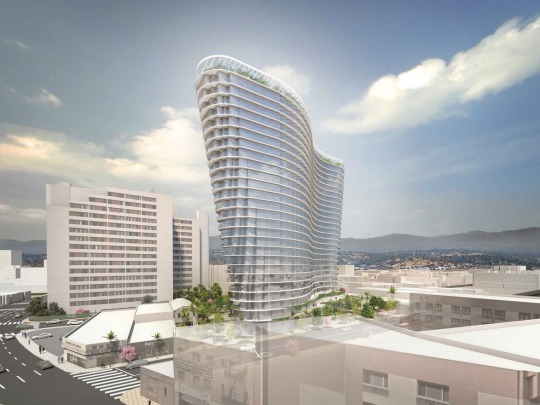
    This past week Studio Gang unveiled its first project in Los Angeles, a curvaceous apartment (300 rental units) and hotel (149 rooms) tower in Chinatown.

    The developer is Paris-based Compagnie de Phalsbourg and the hotel component is expected to be operated by the European brand, MOB Hotel.

    Above is the only rendering I could find. If you would like to read a bit more about the project, check out Curbed LA.

    Image: Studio Gang

  • New, mini, electric skateboard

    image

    Boosted — which is a California-based company that makes electric skateboards — has just released a new smaller and more affordable version called the Mini S.

    Casey Neistat — who helped popularize the original models through his wildly successful YouTube channel — recently vlogged about it and it ended up crashing their website. That’s how things work these days.

    Now, this new version is still USD 750 (so CAD 1,000), but it is significantly less than their other, bigger, models.

    The Mini S goes up to 18 mph and lasts for about 7 miles (optional extended range battery available). So it’s perfect for short jaunts around the city and as a solution to that pesky last mile problem. 

    I am seriously considering getting one for my short commute to the office. That way I’m not breaking a sweat in my suit. But $1,000 remains an awful lot for a skateboard.

    What do you think?

    Image: Casey Neistat via Boosted

  • Likely to liquefy in an earthquake

    Today’s post is going to be a short add-on to yesterday’s post about the sinking Millennium Tower in San Francisco. Today, the New York Times published the below map showing the areas of the city likely to “liquefy in an earthquake.” It goes on to note that “at least 100 buildings taller than 240 feet were built in areas that have a “very high” chance of liquefaction.”

    The article might leave you with the feeling that current building codes are inadequate for the pending “Big One” in San Francisco. So I thought I would reblog this post from last fall which talks, in more detail, about how one of the best structural engineering firms in the world designed the tallest building in San Francisco.

    Image: New York Times