Daily insights for city builders, delivered every morning at 6 AM ET. I’m Brandon Donnelly — a Toronto-based real estate developer and founder of Globizen. I’ve been writing here since 2013.

Tag: brooklyn

  • A new Frame Home in Brooklyn

    Fred Wilson (venture capitalist) and Joanne Wilson (also an investor) have been working on a passive house apartment building in Brooklyn for the last five years. Their development company is called Frame Home. And this past week they received a pretty great Christmas gift in the form of a Temporary Certificate of Occupancy from NYC Buildings.

    At 5 storeys and with only 10 two-bedroom units, you could classify this building as the kind “missing middle” housing that gets so much air time here in Toronto. And so not only have they managed to build relatively small, but they’ve done it using passive house design principles.

    Here are some of the apartment building’s features:

    • Cross-laminated timber (CLT) structure
    • Passive house design approach
    • Triple-pane windows
    • Interior polished and insulated concrete walls (presumably to act as a thermal mass to moderate heating/cooling throughout the year)
    • Solar panels installed on the upper facade and roof (passive house design should, in theory, allow these to supply a big chunk of the building’s energy needs)
    • No fossil fuels used throughout the building — everything is electrical
    • Fully sub-metered units
    • Outdoor circulation spaces/stairs, providing access to a shared rooftop courtyard (I’m assuming these also serve as required egress for the building)
    • Dedicated elevator entrance for every suite (i.e. no interior circulation/corridor spaces)
    • Composting facilities within the building
    • Bike room connected to the ground-floor lobby

    There’s also a co-working and community space planned for the ground floor called “Framework.” Interestingly enough, they have already responded to the current pandemic. Instead of open-air desks, you rent fully enclosed 8′ x 8′ pods that are sound-proofed and come with their own HVAC systems.

    Congratulations Fred and Joanne on such an exciting and pioneering project. (I would love to see the development pro forma!) If you’d like to learn more about Frame 283, here is their website and here is a profile that the New York Times did on the project back in January. Building with CLT is apparently prohibited in NYC. Frame 283 got an exemption.
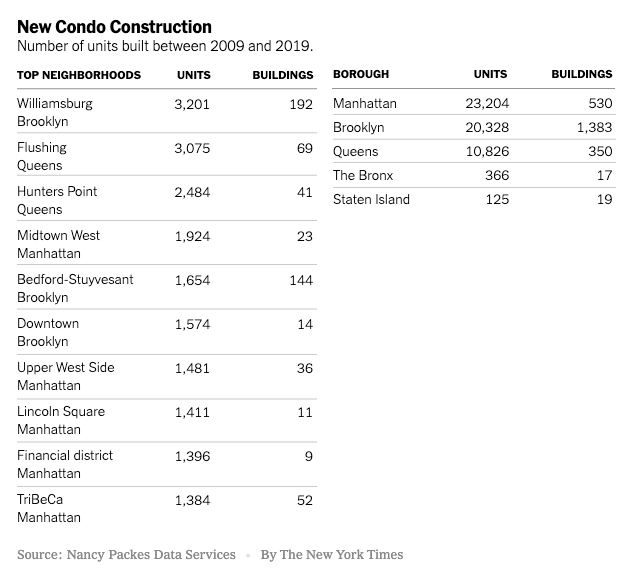
  • Number of condo units built in New York City between 2009 and 2019

    A decade of ultra luxury condos. The New York Times published this story over the weekend talking about how the luxury condo boom of the 2010s transformed New York City, and in particular Brooklyn.

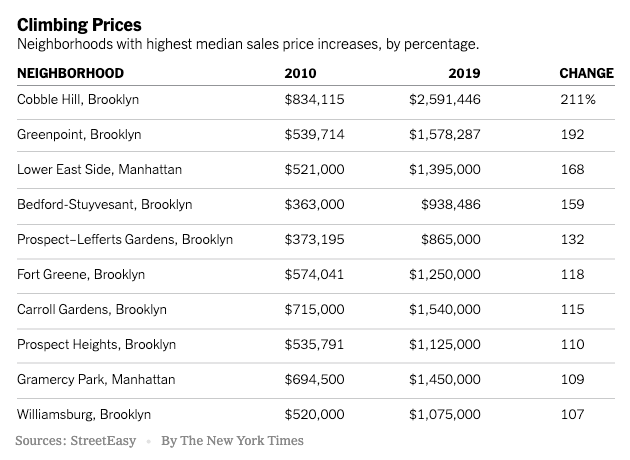
    Below are two tables from the article: (1) The number of units built between 2009 and 2019 across the five boroughs and the city’s top neighborhoods, and (2) the neighborhoods with the highest median sale price increase.

    The overarching theme is that New York built too many “super-high-end condos” geared toward global capital flows. According to one developer interviewed for the article (Gary Barnett of Extell Development), it was unprecedented.

    Apparently, the problem segment remains the $5 million to $10 million market. There’s simply too much inventory, and that has developers both delaying launches and going with much smaller (and hence more affordable) unit mixes.

    One stat that stood out for me was the new condo premium over resales. In 2011, the average sale price of a new condo in the city was about $1.15 million, which represented about a 9% premium over resale pricing.

    While it is typical to see a premium over resales (the same is true in Toronto), the average price of a new condo in 2019 rose to $3.77 million, representing a 118% premium over resales.

    For the rest of the article, click here.

  • Fall architecture preview

    The New York Times’ fall architecture preview is centered around a pretty important and relevant theme, namely the relationship between the built environment and the natural one.

    Some of the projects that they profile include Dock 72 at the Brooklyn Navy Yard, which was raised up in order to lift it out of a floodplain; the “solar carve” tower by Studio Gang, which was designed to prevent shadows from casting along the adjacent High Line (pictured above); and the recently completed Casablanca Finance Tower by Morphosis.

    This last one, pictured below, uses thick aluminum beams to shade the building. That’s a pretty important feature in North Africa.

    Photos by Nic Lehoux and Hakim Wiseman Joundy (via the New York Times)

  • First impressions of the new Focals by North

    I am on my third Fitbit device. The first one I got was their very first release. I wanted to try it out and so I put in a pre-order. It was pretty cool, but it wasn’t yet great. So I eventually stopped using it. The second one I got was better, but I somehow lost it, possibly at a bar. Its whereabouts are still unconfirmed to this day.

    The FitBit Inspire, which is what I am using now, has really stuck with me. I bought it for the heart rate monitor and for sleep tracking, which is why an Apple Watch wasn’t for me. But the ability to read incoming text messages on my wrist has, surprisingly, also proven to be a feature that I like.

    Up until a few months ago, this was the only wearable tech that I owned. However, this spring I was given a pair of smart glasses: the new Focals by North. They are a much better and sexier version of Google Glass. (You can read about my Focals fitting, here.)

    The premise behind Focals is that they are the next step toward conflating real life and tech. In other words, instead of pulling out your phone or looking at your wrist, now you can remain engaged and get the information you want by looking straight ahead. The objective is to help you stay present. And they certainly help with that.

    Focals are the opposite of Snap’s Spectacles in that the former allows you to consume information, whereas the latter is all about narrow types of content creation. With Focals, you can read and respond to texts, get directions, talk to Alexa (there’s a microphone), see your appointments (and the weather), and even get speaker notes when you’re giving a presentation.

    Now that I’ve had some time to test them out, here’s what I would tell you.

    Because I don’t wear glasses anymore (I got laser eye surgery so that I could avoid things on my face), it was a bit of an adjustment. While very well designed, they do have some heft. The arms are thicker than normal glasses. So I found myself using them more as sunglasses (they come with great clip-ons). Perhaps I would feel differently if I still wore glasses.

    I’m also not a huge fan of the Loop (pictured above), which is the 4-directional joystick that you wear as a ring and use to control the glasses. For me, it simply feels like a bit too much tech to wear on a regular basis. Though I will say that, for what it is, it is well designed and easy to use inconspicuously. The other input mechanism for the glasses is your voice.

    With all that said, Focals by North are exceedingly cool. The Canadian company is creating a new category and the glasses do feel like a hint of what’s to come next in the world of wearable technologies. In the same way that I was surprised by just how useful (some) notifications on my wrist could be, I am impressed by the ability to see notifications right in front of me.

    North has also been consistent with rolling out software updates and new features. Similar to my experience with Fitbit, the product keeps getting better. Over the last month, they announced conversation awareness (notifications are delayed if the glasses think you’re busy talking), as well as integrations with Google Fit and Google Slide.

    Sometimes all you need is one really strong use case for a product or service to work and I think presentations could be one of them for Focals. Having presentation notes float in front of you means you’re not looking down at your notes and away from your audience. And being able to move from slide to slide with your thumb transforms the Loop into now a pretty slick clicker.

    I am looking forward to seeing this space develop and I am excited that a Canadian company has jumped out in front. If you’d like to check out Focals for yourself, there are permanent showrooms in Toronto and Brooklyn, as well as pop-ups all across North America.

  • BREAKFAST unveils Brixel Mirror

    BREAKFAST, a design and engineering studio out of Brooklyn, recently unveiled something that they call Brixels. 

    A Brixel is a variable-sized brick that is controlled by software and can act as a pixel in artwork, building facades, and other kinds of installations. 

    Below is a video of their first installation, called Brixel Mirror. It is a 19 foot wide by 6 foot tall installation compromised of 540 Brixels. If you can’t see it below, click here.

    [youtube https://www.youtube.com/watch?v=Z-5cVpWhp30&w=560&h=315]

    While extremely cool, you may be wondering how applicable this might be to real world uses. But kinetic architecture isn’t a foreign concept and I am sure we’ll be seeing more of it.

  • Toward penthouse amenities and smaller units

    image

    The NY Times reported this week that, as the ultra luxury real estate market in New York City continues to cool, developers appear to be making two kinds of product adjustments: (1) they are converting the penthouses and rooftops of their buildings from premium residential space into amenity spaces for the broader building and (2) they are shrinking unit sizes to help with overall sales and leasing velocity.

    According to the New York Times, condo prices on Billionaires’ Row in midtown are down 20-40% since the peak of the market in 2014 when this record was set. So developers are responding with more studios and 1 bedrooms, and amenity spaces – many of which now include high end restaurants also open to the public – that ensure no other building has something you don’t have.

    However, there are naturally some differences between condo and rental buildings. Since 2016, 35% of rentals projects in the city have had some sort of penthouse amenity, whereas the number is only 13% for condo buildings. This makes sense given that amenities are such a big driver of leasing. You definitely want your amenities ready for when your leasing office opens.

    What product changes, if any, are you seeing in your market right now?

    Photo by Aaron Burson on Unsplash

  • Airbnb and affordable housing

    image

    Fred Wilson published a good post last weekend on the proposed bill that went to New York City Council this week regarding new reporting requirements for Airbnb and their hosts in NYC. You can read more about his position on his blog, but he is in favor of a comprehensive bill that would properly legitimize short-term rentals. He is also not opposed to city and state taxes on the service.

    What I wanted to focus on today were his comments around housing. This is already sounding like a broken record, but Fred draws attention to the severe supply-demand imbalance that is occurring in the boroughs of Brooklyn, Queens, and the Bronx, precisely because many/most young people were priced out of Manhattan long ago and want to live in these places.

    But I particularly like his comments around what makes for good policy and what makes for good politics. I agree with his view that it is often a case of the latter over the former. I think a lot of the excitement around Airbnb is a red herring. For me, it’s akin to the fixation on foreign buyers and their impact on the local housing market in places like Toronto and Vancouver.

    Yes, they are factors. But the data suggests they are marginal ones. As Fred points out, they are almost certainly not the root cause of the problem. The reality is that we need a lot more housing – both market-rate housing and subsidized housing. The challenge is that nobody wants to pay for the latter and so we’ve instead decided to focus on things that sound like they’re going to help.

    Photo by Jon Tyson on Unsplash

  • 11 Hoyt, Brooklyn

    Tishman Speyer just unveiled a new condo project in Brooklyn called 11 Hoyt. And it just so happens to be Studio Gang’s first residential project in New York City. Preview above. More renderings over here.

    It’s a 51 storey condominium with 480 residences and 55,000 square feet of indoor and outdoor amenities. The unit mix ranges from studios to four-bedroom residences, and prices range from $600,000 to over $4 million (USDs, of course).

    If you’re from Toronto, you’re probably looking at the renderings and thinking to yourself: “There are no balconies or outdoor spaces.” But that’s fairly typical in the NYC market, as I understand it.

  • Saying no to “Mountain Modern”

    Jackson, Wyoming is one of my favorite places on the planet. (Here is a ski/snowboard video that my friends and I made a few years ago in Jackson.)

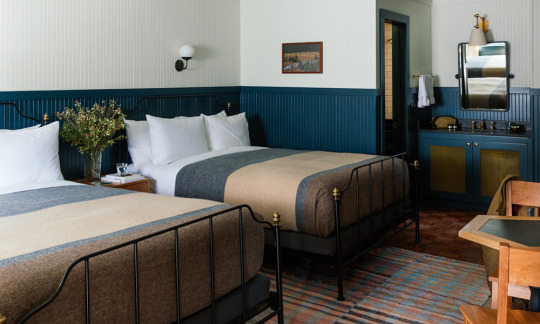
    Earlier this year, Eagle Point Hotel Partners and the Brooklyn-based design firm Studio Tack completed a renovation of the Anvil Motel in Jackson – it’s now the 49-room Anvil Hotel

    Apparently reclaimed motels are the new hospitality trend.

    What I appreciate about their approach, is the emphasis on creating something that feels local and contextual. Here are a couple of snippets from Surface Magazine:

    The designers wanted to avoid a rustic feel, or what Ruben Caldwell, one of Studio Tack’s four partners and an avid backcountry skier, calls “Mountain Modern,” referring to architecture, common in places like Vail, Colorado, and Lake Tahoe, California, that excessively uses reclaimed wood and Cor-Ten steel. “We knew we didn’t want to steer anywhere near that,” says Chou, a long-time snowboarder who more recently got into skiing. “It takes a bit of familiarity with ski towns to know what you don’t want to do.”

    The vibrancy of Jackson’s local culture impressed the design team—and Caldwell so much so that he moved there full-time last year. “As a design team,” Caldwell says, “we’re hyper-aware of the need for projects to be deeply embedded into the local scene.”

    It’s easier to copy and paste. But the results are always better when you take a bit of time to understand a place. 

    Image: Anvil Hotel

  • Design Canada

    Canada has a rich graphic design history and that story needs to be told. Here is a Kickstarter project that’s absolutely worth checking out: Design Canada.

    https://www.kickstarter.com/projects/1002969621/design-canada/widget/video.html

    Greg Durrell (a graphic designer from Vancouver) and Jessica Edwards and Gary Hustwit (of Film First in Brooklyn) have partnered up, and they are looking for your support to produce the very first documentary about Canadian graphic design.

    As a proud Canadian, I am thrilled to see this project. Because this is obviously not just a documentary about graphic design (though in the 60′s and 70′s we were the best in the world). It’s a story about Canada, our history, and our evolving identity.

    If you can’t see the embedded video above, click here to make your way over to Kickstarter.