Daily insights for city builders, delivered every morning at 6 AM ET. I’m Brandon Donnelly — a Toronto-based real estate developer and founder of Globizen. I’ve been writing here since 2013.

Tag: bloomberg

  • Electric vehicles are mostly leased

    At the beginning of this year, Bloomberg published this article talking about how the vast majority of electric car drivers lease, rather than own, their cars. The stats are as follows: In the US, about 80% of electric battery vehicles and about 55% of plug-in hybrids are leased, whereas only about 30% of all vehicles in the country are leased. 

    It is, however, important to note that the above doesn’t include any data points from Tesla. Since they sell their cars direct to customers, as opposed to through dealers, they have no obligation to publicly release this data. And so apparently they don’t.

    Conventional wisdom suggests that if you plan to drive the same car for an extended period of time – the average age of a car on the road in the US is over 11 years – it makes financial sense to buy. But in this case, people seem to be worried about technological obsolescence and the weak resale market for electric vehicles. This may also speak to the type of customers who are currently buying electric vehicles; they are early adopters and don’t want old cars.

    I’ve also seen someone argue that because some states require a percentage of car sales to be zero electric vehicles, it can be more cost effective for manufacturers to sell/lease them at a loss than pay the penalties or buy the ZEV credits. And with a lease, they at least get parts back at the end of the term. But I honestly don’t know much of a factor this plays.

    I hadn’t thought of this before I stumbled across the Bloomberg article, but it all makes sense to me. I find this reversal in ownership interesting because it tells me that how we consume cars can very easily change, and probably will moving forward.
  • Experiences over fashion — or is that really the case?

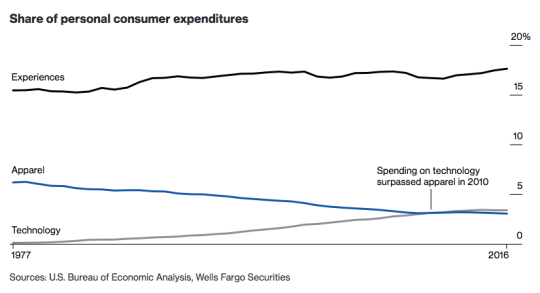
    Bloomberg recently published this interesting piece talking about the death of clothing. The reasons are as follows: we’re spending more on experiences, as well as technology (tech spending surpassed apparel spending in 2010); casual dress in the workplace has become more widely accepted; fast fashion companies like H&M and Zara are putting downward pressure on prices; and social media influencers – instead of big companies – are now the ones showing us what to buy and wear.

    Here is a graph from the article comparing experiences, apparel, and technology expenditures: 

    image

    The first thing I noticed is that experiences, while still increasing, haven’t really spiked since 1977, even though everybody seems to be talking about how social media-fueled Millennials are all about experiences. I was also surprised to see that the share of US employers that allow casual dress every day seems to be closing in on 50%. (Informal survey for the comments and for Twitter: Do you wear casual clothes to work? I’m a no.)

    But perhaps the biggest contributors to this decline are fast fashion and low-cost manufacturing. Stanley Pignal – South Asia business and finance correspondent for the Economist – pointed out on Twitter that since 1982 inflation in US apparel was only 123% compared to 248% for overall CPI. So maybe a lot of the above reasoning is just a distraction.

  • Will autonomous vehicles make location irrelevant?

    I am not convinced that autonomous vehicles will make “location” irrelevant. 

    But I do agree with the following line from this recent Bloomberg article called, A Driverless Future Threatens the Laws of Real Estate.

    “The link between property and transport has been perhaps the most durable in human history.”

    So this remark by David Silver could very well be correct:

    “Real estate might be the industry that is most transformed by autonomous vehicles.”

    Technological advances in mobility have historically brought about decentralization because each advance – from streetcars to the automobile – made it reasonable to travel further distances.

    Of course, autonomous vehicles are also expected to free up our time and focus while in transit – although trains do that for us today albeit with that pesky last mile problem.

    But just like the internet in the late 90′s didn’t make location irrelevant (the opposite appears to have happened), I am similarly unconvinced when it comes to autonomous vehicles. What we consider a desirable location may simply shift.

    So this is not to say that the won’t see profound change in our cities. We will. Which is why we’re all trying to get ahead of it.

  • The case for self-driving electric car fleets

    Below is a presentation by Frank Chen – head of research, deal, and investing at the venture firm Andreessen Horowitz – which makes the case for self-driving electric car fleets.

    He starts the presentation by talking about why he thinks this shift is going to happen faster than most people think. 

    One reason for this is that the batteries are becoming dramatically cheaper and the battery makes up a large part of the cost. By 2025, it is expected that electric vehicles will become cost neutral with ICE (internal combustion engine) vehicles assuming zero government subsidies.

    And by 2038, Bloomberg believes we will hit peak ICE vehicle sales. That is, electric vehicle and ICE vehicle sales globally will hit 50/50. Norway has already hit this threshold but they impose heavy financial penalties on ICE vehicles.

    2025 is not that far away.

    If you can’t see the presentation below, click here.

    [youtube https://www.youtube.com/watch?v=of5j-Lztqrg?rel=0&w=560&h=315]

  • 2017 was a record year for housing starts in Canada, but…

    According to Bloomberg (using data from CMHC), 2017 was a surprising record year for housing starts in Canada: 219,675 units. This is the most since 2007 and is up from 197,916 units in 2016.

    The explanation: job growth (nearly 400,000 new jobs) and population growth were both more robust than expected.

    Multiple unit project starts are also up significantly with 142,840 units starting in 2017. This is a 15% increase from the prior year. Of these units, 102,516 of them were “apartment-like homes.”

    But all of this is nationwide data. Look at what happened in Toronto and Vancouver:

    The increased activity mostly sidestepped land-constrained Toronto and Vancouver, the country’s two most expensive markets, but was robust in the suburbs and less pricey surrounding cities. Starts in Toronto fell 1 percent to 38,738 in 2017, while declining 6 percent in Vancouver to 26,204 units.

    This is not because of a lack of demand. It’s becoming systematically more difficult and more costly to build new housing in these two markets.

  • The most expensive housing market in the world

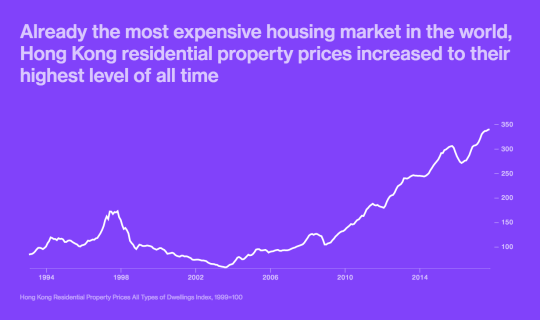
    It’s that time of year again. Time to get contemplative about the last year. Bloomberg recently posted this: 2017 – The Year in Money. Below is a capture from the real estate section.

    Here you can see the run up to the 1997 Asian financial crisis and also the Hong Kong “handover”. Initially, I thought the uncertainty of the handover would have reduced demand, but I guess there were other factors.

    According to the book Hong Kong 20 Years after the Handover, the property and stock markets at the time were being fuelled by high inflation and low interest rates. This made real interest rates negative and created a strong incentive to borrow and invest.

    I love seeing longer range indices because it helps to put things into perspective. If you started your career in real estate in Hong Kong around 2003-2004, you might think that prices generally always go up. 

    But consider how long it may have taken to get back to where you were if you had instead bought at the peak of 1997-1998.

  • Why I write about tech on my city building blog

    I had a friend ask me this week about how I decide what to write on this blog. His comment was that I tend to write about a variety of different topics. He wondered: Isn’t it better to focus on one particular niche?

    The simple answer is that I write about what interests me. And secondary to that is any concern around what will get the most clicks. In fact, I try not to fall into the trap of worrying about the latter. Sometimes it can be paralyzing to fixate on what will appeal most to the tens of thousands of people who read this blog on a regular basis.

    The reality is that my interests are much broader than, say, just design and real estate; though these two topics are clearly central. 

    I learned a long time ago while studying architecture and art history that what we make as a society is generally a product of the cultural milieu at the time. In other words, the built environment doesn’t happen in a vacuum. It is the physical manifestation of what we believe to be true at a particular moment.

    Today, it’s pretty hard to ignore the importance of tech. Think of some of the most valuable companies in the world right now: Apple, Google, Amazon, Facebook, and so on. Now, technology has always shaped our cities, but what makes this moment different is the decisive shift toward software.

    It’s arguably no longer about who can build the best mousetrap. It’s about who can build the best software layer on top of that mousetrap.

    In 2011, venture capitalist Marc Andreessen (previously the co-founder of Netscape) published a widely shared essay called, “Why Software Is Eating the World.” And over the past 6 years he has been proven to be very right.

    The 3 main points he aimed to make with that essay are as follows:

    1. Every product or service that can become software will become software.
    2. Every company will have to become a software company.
    3. The winning companies will be the best software companies.

    Depending on your industry, this may sound ludicrous to you. Certainly in 2011 it probably seemed that way. 

    But a perfect example of this phenomenon is the iPhone. The phone itself is manufactured in China, albeit where a lot of great hardware innovation is taking place. 

    But at this point, phones have become fairly commoditized. The profits that Apple makes from the iPhone disproportionately come from the software layer and the app ecosystem it has developed.

    You could make a similar argument with Tesla. Autonomous navigation – which most of us can agree will have a profound impact on cities – is largely a software challenge. 

    And so if you believe that autonomous vehicles will be a fundamental part of the future of mobility, then it’s not that hard to believe in point number three: the winning car company will also have to be the best car software company.

    Some industries have been less touched by tech and software – real estate being one of them. But if Andreessen is right and it’s not a question of if, but a question of when, then it behooves all of us to think about the potential impacts.

    I love how Andreessen ends this podcast discussion with Barry Ritholtz of Bloomberg and so I’m going to repeat it here to close out this post. He says: “There are no bad ideas. There are only early ideas.” 

    And that’s why I write about tech on my city building blog.

    Photo by Michal Pechardo on Unsplash

  • Power to the people

    Bloomberg columnist Barry Ritholtz recently interviewed Richard Barton about his startup companies. Barton founded Expedia while he was an executive at Microsoft (Gates and Ballmer era) and then went on to cofound Zillow (real estate site) and Glassdoor (jobs site). 

    I’ve been following the work of Barton for many years now because I admire the common thread among his startups: They’re about bringing transparency to industries where transparency is lacking. I used to try and dissect his thinking when I was working on my own real estate/tech startup.

    I believe there’s still a lot of room for transparency in the real estate space, but that doesn’t negate the work that Barton has done. He’s all about using technology to bring “power to the people.” That’s a good thing.

    Click here to listen to the podcast.

  • Current state of renewable energy

    image

    The United Nations and Bloomberg New Energy Finance recently published a report covering global trends in the renewable energy space for 2017

    Here are some of their key findings:

    – 2016 was a record year in terms of renewable power capacity installed worldwide. This includes wind, solar, biomass and waste-to-energy, geothermal, small hydro, and marine sources.

    – The share of global electricity generated from renewable sources rose from 10.3% (2015) to 11.3% (2016).

    – However, overall investment in renewables declined in 2016 for two main reasons. Costs went down (good news). And China and Japan exhibited a dramatic slowdown in terms of investment activity (bad news).

    – Acquisitions of renewal assets, such as wind farms and solar parks, hit a new peak at $72.7 billion.

    – A number of promising new pricing records set in 2016: $29.10 per MWh for solar in Chile and $30 per MWh for onshore wind in Morocco.

    – In one year, the cost of solar generation dropped on average about 17% and onshore wind dropped about 18%.

  • Toronto real estate is out of control

    You can’t have an Easter dinner in Toronto right now without somebody bringing up the topic of our “crazy” real estate market. 

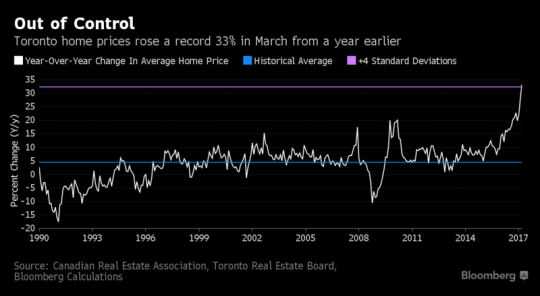
    Below is a chart from Bloomberg showing the year-over-year change in home prices in the Greater Toronto Area since 1990. It also shows the historical average (in blue) and how in March 2017 we hit 4 standard deviations above that. Home prices rose 33% in March compared to a year earlier.

    If I were a realtor, I’d probably tell you that the market is hot hot hot. Now is the time to sell because you’ll get some absurd number above your asking price and now is the time to buy because prices are going nowhere but up. Don’t miss out. 

    I would like to try and be a bit more nuanced than that. Here are 3 thoughts:

    1)

    There’s no question that low rates / cheap money is one of the root causes of the real estate valuations we are seeing today. But frankly I have no idea when or if that will change. There is an interesting argument out there that capital is no longer scarce. Our economy is going through a fundamental shift, which is why real estate is not the only asset class seeing these sorts of valuations and growth figures.

    2)

    There are a number of global factors which are helping to cement Toronto’s position as an alpha global city and destination for human capital. Think Trump, Brexit, and so on. I agree with Richard Florida’s argument that our real estate market will see more – not less – pressure going forward. Here is a snippet from a recent interview with Florida in Toronto Life:

    I think Toronto is going to get an even bigger influx of the creative class. With the rise of Trumpism, more and more people who might otherwise have gone to the United States are going to come to Canada. We’re going to see American tech companies invest more and more in Toronto. And if we think the housing affordability and economic divide we see today is bad, it’s going to grow ever more gaping. 

    3)

    I believe that there are always opportunities in the real estate space, but that you have to be disciplined, focused on fundamentals, and willing to do things that others won’t. What bothers me is when I hear people say things like: “Real estate only goes up. You can never go wrong.” I started my career pre-2008 and lived in both the United States and Ireland. I saw what down looks like.