Daily insights for city builders, delivered every morning at 6 AM ET. I’m Brandon Donnelly — a Toronto-based real estate developer and founder of Globizen. I’ve been writing here since 2013.

Tag: bloomberg

  • Toronto is getting an i-team

    Bloomberg Philanthropies runs a program called Innovation Teams (also called i-teams). It is one of their approaches to driving innovation within cities. What they do is provide grant funds to cities in order to help them assemble a local “i-team”, which they will fund for up to 3 years. 

    They, like me, believe that cities are uniquely positioned to solve some of the world’s most challenging problems. So the teams essentially function as in-house (in-city?) innovation consultants, using an approach that relies heavily on research and data.

    Here are some of the successes they’ve had so far (excerpt taken from here):

    “In New Orleans the i-team helped the city reduce its murder rate by 20% in less than two years. In just sixteen months, Memphis’ i-team leveraged the approach to fill 53% of the empty storefronts in key commercial tracts of the city, giving hope to small business owners and reinvigorating the city’s core. Mayors in pioneer cities successfully deployed their i-teams to decrease homelessness, reduce youth violence, and stimulate economic growth, and these i-teams continue to be re-deployed to solve new and pressing problems.”

    Because of these early successes, the program is expanding. Their latest round of funding will bring i-teams to Durham, Baltimore, Austin, Detroit, Anchorage, Be’er Sheva (Israel), and Toronto. This will be the first i-team in Canada. And I am excited to see what they are able to accomplish.

  • Where do you shop?

    Matthew Townsend of Bloomberg recently published an interesting article talking about the dominance of Amazon.com (and online shopping in general); the shift towards experiences over stuff; and the languishing brick-and-mortar brands that keep saying it’s the macroeconomy, rather their product/approach, which is causing sales to slump.

    Here are a 3 excerpts that stood out for me:

    Lurking behind the cliché is a hard truth these executives are eager to avoid. “All this pleading that the consumer isn’t spending is an excuse, largely from management teams whose product is less relevant,” Kernan said. “The consumer is actually driving the U.S. economy, so it’s a little ridiculous when we hear the excuse of the macro environment is not good.”

    Another hurdle that isn’t going away is the shift to increased spending on experiences such as travel and classes, which make for much better posts on Instagram, Facebook, and Snapchat. “Social media has really fostered a have-done environment, which is not what retailers sell,” Perkins said.

    One characteristic of these struggling brick-and-mortar chains has been direct competition with Amazon. If they don’t go head-to-head with the online giant, they rely heavily on people visiting shopping centers anchored by retailers that do, such as ailing department-store chains Macy’s and Sears. One measure of store visits in the U.S. paints a dire picture, with only a dozen positive weeks over the past two years.

    According to Bloomberg, 55% of online product searches start at Amazon.com. And while online sales in 2016 have only accounted for 11% of all (U.S.) retail revenue, it has represented 54% of all growth! That’s a big number, especially when you think about what that will mean over time.

    Talking about the growth and threat of online shopping has become a boring truism. I know that. But are retail executives taking it seriously? The Bloomberg article gives you the sense that many are not – or at least they’re not publicly acknowledging it.

    When I look around my place right now and think about where I bought each item – everything from the shoes at my door to the protein powder in my cupboard – it’s pretty amazing to think about how much I now buy online. And I’m sure that many of you are the same.

    Groceries aside, I’m probably 85-90% online. What about you?

  • Sharing walls with strangers

    Barry Ritholtz recently published an article in Bloomberg View called: Still a Lot of Negativity on Housing

    He basically says that “many people” should go out and buy a home given the current state of the US housing market and the historically low interest rates. That’s a perfectly fine argument. But it’s not all that interesting.

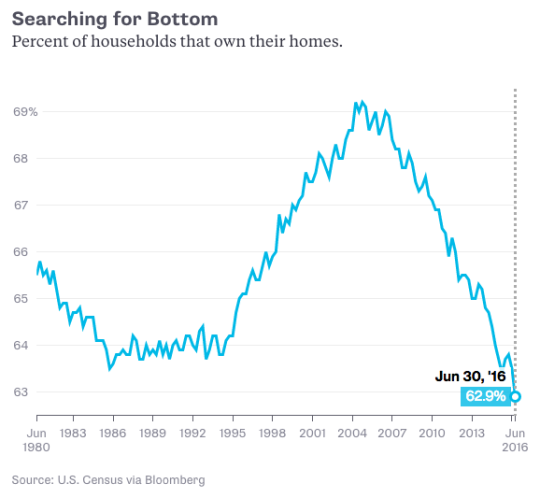
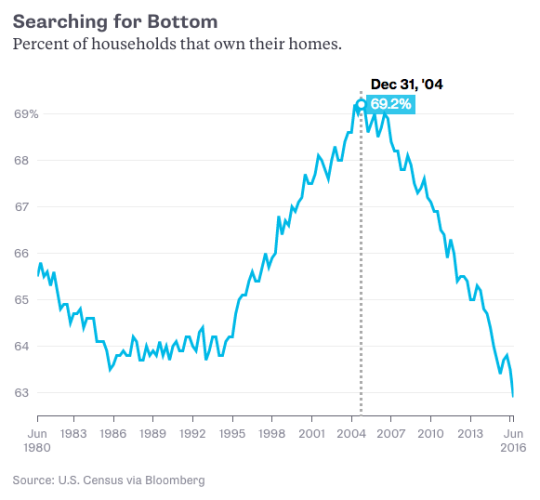
    The article does, however, have a moderately interactive chart showing the percentage of US households that own their homes.

    It shows the pre-2008 peak:

    image

    And it shows, somewhat surprisingly, the recent “search for bottom.” I knew there was a significant post-2008 decline, but I guess I thought it had stabilized. Instead, the US is hitting homeownership rates not seen since the mid-1960s.

    image

    Big cities tend to have a higher percentage of renters. Millennials are flooding into cities. The digital economy now encourages mobility, which contradicts traditional notions of homeownership. There are all kinds of potential hypotheses that could be extracted here.

    But the other interesting thing I noticed in the article, was this:

    However, at some point in life, you probably no longer want to have a landlord telling you what color your walls can be or become tired of having strangers share a wall with you. I am not a zealous believer that everyone should go out and buy a home. However, for many people, buying makes sense – especially with mortgage rates as low as they are (the current rate of about 3.45 percent for a 30-year fixed-rate mortgage is just 0.10 percent higher than the record low).

    I couldn’t help but notice the embedded cultural bias. The inference is that when you rent, you share walls. In other words, you live in some sort of multi-family apartment. 

    But when you finally go out and buy a home, you graduate from that. You no longer need to share walls with strangers. Because an owned home equals a single-family detached dwelling. That’s how you know you’ve made it.

    Well, I have shared walls in my owned home. I guess I’m not there yet. 🙂

  • #donthave1million

    Tiny Park by David Brookfield on 500px.com

    https://500px.com/embed.js

    After I wrote this week’s post about Chinese homebuyers in Vancouver, I was surprised to learn about the racism debate that flared up in the city / on Twitter. I guess this really is a touchy subject. (See: #donthave1million)

    My reaction to the research was: Great to see someone (Andy Yan) putting in the time to try and better understand a market phenomenon. It’s painful how opaque real estate markets can be. Let’s get even more data so that we can make even better policy decisions. I didn’t read it as: let’s deliberately single out a race.

    Because the reality is that we all knew this was happening.

    Bloomberg recently published an interesting and related article that talks about China’s money exodus and how the Chinese logistically get their money out of the country. There are restrictions in place. 

    But first, here are two snippets from Bloomberg that describe the order of magnitude we’re talking about:

    This flood of cash is being felt around the world, driving up real estate prices in Sydney, New York, Hong Kong and Vancouver. The Chinese spent almost $30 billion on U.S. homes in the year ending last March, making them the biggest foreign buyers of real estate. Their average purchase price: about $832,000.

    In total, UBS Group estimated that $324 billion moved out last year. While this year’s numbers aren’t yet in, during the three weeks in August after China devalued its currency, Goldman Sachs calculated that another $200 billion may have left.

    Now here’s how it is being done:

    It works like this: Chinese come to Hong Kong and open a bank account. Then they go to a money-change shop, which provides a mainland bank account number for the customer to make a domestic transfer from his or her account inside China. As soon as that transaction is confirmed, typically in just two hours, the Hong Kong money changer then transfers the equivalent in Hong Kong or U.S. dollars or any other foreign currency into the client’s Hong Kong account. Technically, no money crosses the border – both transactions are completed by domestic transfers.

    And here’s a snippet that stood out for me because it shows how easy this has become:

    While the first exchange has to be set up face-to-face, customers can place future orders via instant-messaging services such as WhatsApp or WeChat, and money changers set no limit on how much money they can move.

    Given the scale and complexity of this issue – housing affordability – I have to believe that cities and policy makers would be far better off with more, rather than less, information. I hope we can work towards that.

  • From stuff to services

    This morning Fred Wilson linked to a Bloomberg article on his blog called, Maybe This Global Slowdown Is Different. There are a bunch of great charts throughout the piece and I’d like to share 3 of them here.

    The first chart shows how per capita energy consumption has dropped remarkably in the United States since the 1990s, but how, not surprisingly, China’s rate is increasing.

    The second chart shows car sales in the US. There was a big drop off during The Great Recession, and though sales have rebounded, they still haven’t reached their late 1990s peak. But that’s not to say that they won’t.

    And the third chart shows the tremendous shift in the US over the last 65 years from the consumption of stuff to services.

    This last one is fascinating. And it ties into the argument that the way value is created in our economy has shifted dramatically.

    But I wonder if this change is really as sharp as it seems. 

    If you look at what makes up “services”, you’ll see that housing (and utilities) and healthcare make up over 50% of what is considered to be personal spending on services. And if you look at housing and utilities spending since the 1960s in the US, it has increased dramatically. 

    So how much of this shift from stuff-to-services is actually being driven by housing?

  • Multifamily vs. single family

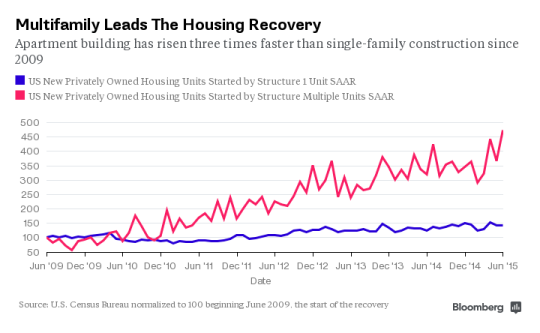
    Since 2009 when the U.S. economy started to recover, housing starts (i.e. new residential construction) have favored multifamily buildings over single family housing. Apartment/condominium construction has grown 3 times faster according to the U.S. Census Bureau (via Bloomberg).

    image

    A lot of this multifamily construction is assumed to be rental apartments, but this category also includes for sale condominiums. The classification has to do with building typology rather than housing tenure. (I would love to see how the above graph breaks down in terms of the latter.)

    The typical explanations for this trend often relate back to Millennials being poor and saddled with student debt. That’s why they’re delaying buying single family homes. But eventually the expectation is that they will resume doing

    (largely) what previous generations have done.

    Money and the economy, I’m sure, have something to do with the above trend. But I’m not convinced that it’s the whole story. 

    There are also shifts happening with respect to consumer preferences and with respect to how we plan and build our cities. That’s why I’m very interested in monitoring family formations and housing choices. 

    At the same time, I’m also a Millennial. And whenever I catch myself thinking a certain way, I assume that there are probably other Millennials out there who feel similarly.

  • Bloomberg Risk Takers: Elon Musk

    Elon Musk is one hell of an entrepreneur. I just finished watching this “Bloomberg Risk Takers” video. 

    [youtube https://www.youtube.com/watch?v=mh45igK4Esw?rel=0&w=560&h=315]

    It’s about 45 minutes long, but well worth it. What’s astounding is both is willingness to go all-in and his commitment to solving big, meaningful problems. Click here if you can’t see the video above.

    Once you’re done watching, you should then read this Quora answer from his first wife talking about what it takes to be that great.

  • Where Uber operates and where it’s banned

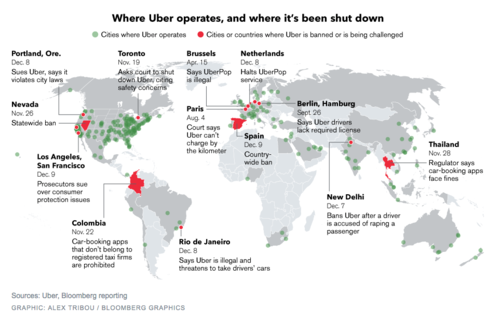
    Earlier this month, Bloomberg published this map showing where Uber operates and where it’s been banned (or is being challenged). You can click on the map for a larger version.

    image

    Uber operates in about 250 cities across the world. But it’s being challenged in a lot of them, including Portland, San Francisco, Los Angeles, Toronto, Rio de Janeiro, Paris, Berlin, as well as others.

    I don’t want to dismiss any of the safety concerns that have arisen lately, because those are very serious and they need to be addressed. Life safety is paramount. But I continue to believe that banning a service that many people clearly want to use isn’t the right solution.

    On top of that, I think it could lull many of the local taxi communities into a false sense of security about the future. Uber is moving incredibly quickly. UberX launched in Toronto in September of this year. And UberPOOL – their new carpool service – is likely next.

    With these releases, Uber is working towards a specific vision for the future: Their goal is to eliminate the need for private vehicle ownership. Should they be successful, this will not only impact taxis, but also car manufacturers and urban mobility in its entirety.

    So as difficult as it might seem right now, I think urban leaders would be better served trying to figure out how to harness these innovations. Cities have been trying for decades to get people out of their cars. Uber wants to do the same.

  • When rent control goes too far

    I was catching up with a friend of mine over coffee this morning and he was telling me about his recent trip to Porto, Portugal. I’ve never been, but it’s fairly high up on my list of places to visit.

    He was telling me about how beautiful the center of the city is and how it’s a UNESCO World Heritage Site. But he was also telling me how eerie it was to see so many abandoned and decaying buildings.

    And part of the reason for this – I learned – is that up until fairly recently, Portugal had some incredibly onerous pro-tenant rent controls in place that dated back to the beginning of the 1900s.

    In fact, they were so onerous that, by some estimates, roughly 150,000 households in Portugal were paying less than €50 per month in rent before the laws were changed!

    Because of this, landlords in many cases could not, and cannot, actually afford to maintain their properties. Buildings were left to decay, and in some cases they were completely abandoned. That was their only option. And it led to a virtually non-existent rental housing market (according to the IMF).

    Clearly, this is a problem. If you have a market distortion as serious as this one – where there’s virtually no incentive to invest – you’re on a highly unsustainable economic trajectory.

    Which is why when Portugal received its bailout package from the International Monetary Fund and European Union following the 2008 financial crisis, it was asked to reform its rent control laws – which it agreed to do.

    The hope was that the reforms would allow Portuguese landlords to charge more reasonable and market-oriented rents, as well as do other crazy things like evict tenants that don’t actually pay their rent. Not surprisingly, many fought the changes.

    I don’t know precisely how these reforms have ultimately played out in the market over the past few years (if you do, I’d love to hear from you in the comments below), but I do believe that liberalization of the market was, and probably still is, needed.

    While paying €5 a month for a 4 bedroom apartment in a desirable central neighborhood might be great for that one individual family, it’s not so great for the economy as a whole. And ultimately that comes around to impact even that household.

    Image: Flickr

  • The role of the private sector in city building

    image

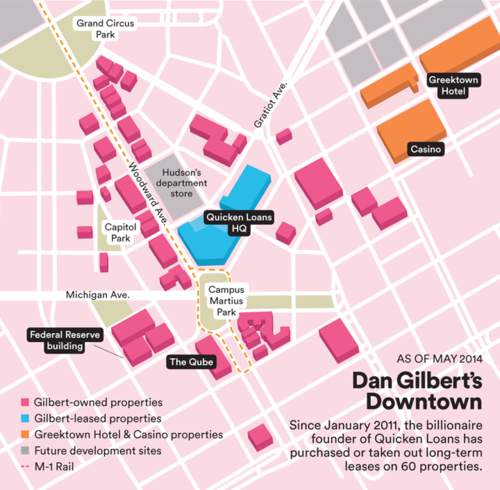
    The New York Times published an interesting and popular article last Friday called The Post-Post-Apocalyptic Detroit. It of course talks all about the efforts of billionaire Dan Gilbert, but it also talks about the initiatives of many small and local entrepreneurs who are doing their part to help revive the city – while at the same time making a profit.

    One thing that I found interesting about the article is the extent to which the private sector has taken over the responsibilities of the public sector. With only 35,000 of the city’s 88,000 streetlights actually working, the city simply doesn’t have the money to pay its bills. When I visited the city last fall, I was told that the city couldn’t even afford batteries for its parking meters. 

    So the private sector has stepped up. 

    In downtown, Dan Gilbert pays for his own security force to patrol the area 24 hours a day both on the ground and through 300 surveillance cameras. And in the Jefferson East corridor, John Stroh III – of the Stroh Brewery Company – is paying for 3,500 hours of private security in order to help transform the area into a walkable retail strip.

    It’s a model that relies on the funding and vision of rich people to catalyze change. And it strikes me as a quintessentially American way of going about it. In Canada, I’m not so sure it would be approached in quite the same way, which I think is both good and bad. I think in Canada there would be more government involvement.

    If the rich people are there and willing to step up (like they are right now in Detroit), then I would assume the capital would be deployed more efficiently and that change would happen more quickly. But if the rich people aren’t willing to step up, then nothing happens and the place declines.

    That might be an oversimplification, but I think there are differences.

    To end, I’m going to leave you with this Bloomberg video about Steve Case’s (former AOL founder) “Rise of the Rest” road trip to Detroit. If you can’t see the video below, click here.

    [youtube https://www.youtube.com/watch?v=_RUG0H4VThM?rel=0]