Daily insights for city builders, delivered every morning at 6 AM ET. I’m Brandon Donnelly — a Toronto-based real estate developer and founder of Globizen. I’ve been writing here since 2013.

Tag: blogging

  • The unbranding of this blog

    You’ve probably noticed that I have removed the Architect This City branding from this blog and gone to just my name. I like to refer to it as unbranding. (Though one could argue that a person’s name is still just another brand.)

    Already I’ve received a few emails from people telling me that they prefer the old look and feel of ATC and that there’s some level of brand equity there. But let me explain my thinking.

    First and foremost, this is a personal blog. I’ve written about that before. And it’s why it’s hosted at brandondonnelly.com. But along the way, as readership grew, I attached a name to it (ATC) and it started to become a kind of pseudo-independent brand. 

    When I would speak at events, people would introduce me as the founder of Architect This City, which always struck me as a bit odd because, again, this is just my personal blog. People also started asking me why I wasn’t turning ATC into some big company and started treating the blog as a media channel. You should see how many press releases I now find in my inbox.

    Of course, these are good “problems” to have. It means my writing is getting out there and I am thrilled about that. But I was starting to feel increasingly uncomfortable with the grey area between a personal and independent brand. I also felt like it was starting to impact my creative writing because I would sometimes wonder if I was going too personal on “Architect This City.”

    To reinforce that point, below is a snippet from a post that Fred Wilson wrote on his blog last summer. His 10+ year old blog has been a huge inspiration for me.

    “There is something about the personal blog, yourname.com, where you control everything and get to do whatever the hell pleases you. There is something about linking to one of those blogs and then saying something. It’s like having a conversation in public with each other. This is how blogging was in the early days. And this is how blogging is today, if you want it to be.”

    So I decided to clarify the brand. I wanted to make it clear that this blog is about my personal musings on city building, among the other things that I’m passionate about. And I wanted it to not pretend to be anything else.

    Ultimately, regular scheduled programming won’t really change for you. The content on this blog is still going to be heavy on city building, real estate development, design, planning and so on. And I will endeavor to create as much value as I can for all of you on a daily basis. (I am humbled by the number of people who now subscribe.) But hopefully it will end up feeling a bit more personal.

    Of course, now there’s the question of what do I do with the ATC brand (and social accounts). Do I let it die or do I spin it off into something else? I’m considering the latter. I’ve been obsessed for years with the idea of crowdsourcing and collecting meaningful real estate and city building activity, so maybe ATC will turn into some kind of open platform for that.

    But for now, I am feeling pretty excited about the unbranding of this blog. Hopefully some of you feel the same way.
  • My approach to blogging

    In yesterday’s post about the city as an egg, I received a comment basically saying that I use this blog to carefully curate my own image and that I would never argue against “dumb Toronto planning” because, after all, I’m a developer. I am going to do what breads my own butter.

    I welcome intelligent debate on this blog. That’s why it is open to anyone who would like to comment. But since I’ve received similar comments in the past, I thought I would use the opportunity to talk broadly about my approach to blogging.

    Firstly, there will always be some level of curation involved. That’s inevitable. We see it all over social media. But I’m a big believer in transparency and I try to do exactly that on this blog. I am keen to push the boundaries in this regard.

    At the same time, part of what makes blogs unique is that they’re often personal. That is the origin of blogging. Some of my favorite blogs to read are the ones that have figured out how to combine a particular niche topic with personal stories. And since ATC is ultimately my personal blog, I am going to continue taking that exact same approach.

    Secondly, I only write about things that I’m passionate about. I get asked all the time to write about and promote specific projects, causes, and events. But almost all of them do not get written about it. Because if I don’t care about it, then I’m not going to write about. It’s as simple as that.

    Thirdly, I believe in positivity over negativity. I believe that optimists, not pessimists, change the world. President Obama won his first term with a message of hope, not despair. To me, that is a stronger motivator.

    I’ve been told before that I’m overly optimistic and that my youthful exuberance will one day wear off. Boy, I sure hope it doesn’t. Because would you rather have a beer with someone who is optimistic or someone who is pessimistic? I will always take the former.

    However, this is not to say that I want to be blind to the realities of the world. Last summer I disagreed with Toronto’s decision to rebuild the elevated Gardiner Expressway East along the waterfront, and I continue to disagree with that decision. 

    When I believe something is a mistake, I am happy to make it public and put it in writing on this blog. But as a developer, I suppose I have certain biases working against me. That’s just the way it is.

    In any event, this is my rough and ever-evolving approach to blogging. As usual, I welcome any and all comments.

  • Pocket two bedroom

    I recently started reading the blog of Michael Mortensen. Michael is a real estate developer and urban planner based in the UK. And if you like my blog, I think you’ll also like his.

    Last week he published a post talking about a UK development company called Pocket and a recent design competition that they organized called “Pocket two bedroom.”

    Historically the firm has been focused on well-designed and compact one bedroom apartments (38 square meters) that they deliver at a minimum 20% discount relative to typical market rate housing in London.

    But over time, they found that they had to turn people away because they were looking for larger – yet still affordable – two bedroom apartments. So the firm decided to figure out how to scale their model to larger units.

    To do this, they went out and asked 19 architects to come up with ideas for a two bedroom Pocket apartment. They then published all of the ideas online.

    Firstly, I applaud them for making their competition results public. Most real estate companies wouldn’t do this.

    Secondly, it’s interesting to take note of the recurring design themes, as they have on page 24-25 of their competition book. 

    Some of the themes include “deep thresholds” that blur private and communal spaces; “thick walls” that allow for storage and servicing; flexible spaces and fewer dedicated spaces; and dual entry apartments.

    This last item was particularly interesting to me. It’s a simple idea – two separate doors leading into one apartment – but it can allow for a number of flexible sharing scenarios. I am already imagining somebody creating an Airbnb rental out of their second bedroom.

    Housing is certainly undergoing a transformation.

  • Urbanism Online: #capital

    image

    For those
    of you from Ottawa, I’m going to be in town this Thursday evening talking
    at an event put on by the National Capital Commission called Urbanism
    Online
    . It’s all about how blogging, social media, and online discussions can
    and are contributing to the betterment of cities.

    The other
    bloggers include:

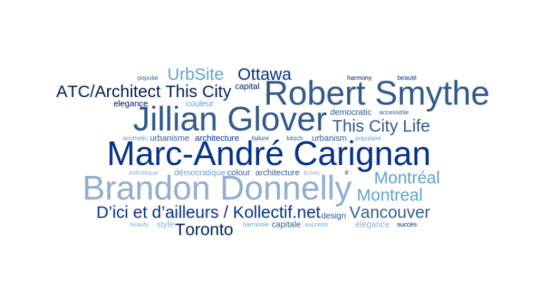
    – Marc-André Carignan, Montreal, Kollectif.net

    – Jillian Glover, Vancouver, This City Life

    – Robert Smythe, Ottawa, UrbSite

    The event is
    now full, but email them or tweet me if you’d really like to come
    and I’ll certainly ask about space availability. I’m sure it’s going to be a great discussion.

    I have a bit of a soft spot for Ottawa. I used to spend a lot of time there when I was working on an office building at 150 Elgin Street. (Key tenants include The Canada Council for the Arts, KPMG, and Shopify.)

    I haven’t been back since the building was completed, so I’m excited to see how it turned out.

    Update: The event will also be streamed on Periscope, here.

  • A year in review — 2015 on Architect This City

    Thanks to this blog, it’s pretty easy for me to go back and look at what I was doing and thinking throughout the year. That’s one of the benefits of writing a daily blog/journal. And as is usually the case, 2015 was a year of ups and downs.

    For my annual ski and snowboard trip with the guys, we went to Banff (Alberta) and Revelstoke (BC). But we got stuck with unseasonably warm weather in the west (the opposite of what’s happening this winter) and I got injured on day 3. That put me in the emergency room and knocked me out of snowboarding for the rest of the season – as well as from the gym for a number of months.

    Shortly after that I also got struck with some family health issues. That was pretty scary for a good solid month, but in the end, everything seems to have worked out. What a relief.

    Towards the end of March, I did a brand partnership between Architect This City and Porter Escapes, which brought me to Quebec City for a weekend. That was a lot of fun and gave me the opportunity to be a real flâneur in one of the most interesting cities in Canada.

    In April, I left my real estate development job at TAS and shortly after I joined CAPREIT (TSE: CAR.UN) to help build out their (real estate) development platform. Previously their/our focus had just been on acquiring existing rental assets. But now it is time to build.

    Later this month I also participated in the Toronto filming of a documentary called Waterfront Cities of the World. That was a lot of fun. But come to think of it, I don’t think I ever watched the final video.

    In May, I started lobbying hard for the removal/replacement of the eastern portion of the Gardiner Expressway East here in Toronto. If you’ve been reading this blog since the summer, I am sure you remember this period. With the help of a colleague of mine, I even started a petition that ended up getting presented at City Council.

    But in June, Toronto City Council voted to demolish and then rebuild the elevated expressway along our waterfront. I am still surprised by that. What a shame.

    In July, we (CAPREIT) announced our first joint venture development project. A mixed-use project – 506 rental apartments on top of about 160,000 square feet of retail – in Toronto’s Liberty Village. 

    In August, I went back to Philly to relive my Penn days. I do that every couple of years just to make sure that Bob and Barbara’s is still offering up “The Special.” The Special is a can of PBR and a shot of Jim Bean for $3. It’s famous in Philly, but it always sounds like a far better idea the night before, as opposed to the morning after.

    In this same month I also hit the 2 year mark here on Architect This City. That’s 2 years of getting up every single day and staring at a blank blog post screen and thinking of something insightful to say. 

    The following month on September 11 (I’ll never forget this date), I got laser eye surgery. More specifically, I got custom wavefront LASIK. And today it’s pretty hard to imagine that I used to have to reach for my coke bottle glasses as soon as I woke up every morning.

    Later in September, I also gave a talk at my alma mater, the Rotman School of Management, to a delegation of about 70 urbanists from Portland. It was an honor to be invited alongside rockstars such as Richard Florida and Jennifer Keesmaat.

    In October, I featured a guest post from the former mayor of Toronto, John Sewell. I don’t often do guest posts on my blog, but John had just published a new book and I thought it would be a good way to change things up here. John and I aren’t necessarily on the same page with many urban issues, but we did agree on the Gardiner East.

    For the remainder of October, it was basically just the Jays.

    In November, I spoke at a Product Hunt event focused on real estate + tech. It was incredibly encouraging to see so many entrepreneurs here in Toronto focused on the intersection of real estate and tech. There are lots of opportunities in this space and I am sure that there are many success stories in the making right now. Toronto is the perfect place for real estate + tech innovation.

    And finally, in December, I crossed something off my bucket list and attended Art Basel Miami Beach. I have wanted to go for well over a decade; pretty much since I started studying art history in undergrad. I don’t know what took me so long.

    Oh, I also announced that I was writing a book on becoming a real estate developer

    What a year. I can’t wait for 2016. 

    What do you have on your to-do list for next year?

  • [Video] Interview with designer Marcel Wanders

    I just got home from Christmas dinner and I am so full that I can barely keep my eyes open. So rather than attempt to write something insightful, I am going to share a 2 minute interview with designer Marcel Wanders.

    [youtube https://www.youtube.com/watch?v=w78Bjfscii0?rel=0&w=560&h=315]

    It’s a short piece, but he covers some interesting topics such as his office culture and the value of Amsterdam for their creative process (specifically the city’s openness and tolerance).

    Regular scheduled programming will resume tomorrow. 

    And sometime before the end of the year I’m going to do a summary of 2015 on ATC and make some predictions for 2016. I haven’t really done the prediction part before, but I think it would be a good practice to start.

    Until tomorrow 😴

  • 16 mobile theses and how tech might change the built environment

    Caucasian woman standing near passing subway in train station by Gable Denims on 500px.com

    https://500px.com/embed.js

    One of the things that I try and do here on this blog is examine the intersection of design, real estate, and technology. I didn’t explicitly set out to do that, but more and more I find myself thinking that way when I’m writing and when I’m giving talks.

    Part of that is because of my passions, but part of it is because there is a big and important overlap. One example of that is autonomous, self-driving cars. The tech community is enamoured with driverless cars, but everyone involved in the built environment should also be thinking about their impacts. Because it’ll be significant.

    Benedict Evans – who is a venture capitalist with Andreessen Horowitz in the Valley – recently published a post called, 16 mobile theses. It’s a look at 16 topics, trends, and shifts that are happening in the tech space. (There’s also a related podcast discussion.)

    If you’re involved in internet products, you absolutely need to give it a read. But I also think it’s interesting to read it through the lens of a designer or real estate person. Productivity is changing. Notions around the living room are changing. And yes, autonomous vehicles are going to have a profound impact on the urban landscape of our cities – just as cars did initially.

    Below are 3 excerpts from Benedict’s post that I really enjoyed.

    The first is about mobile and just how massive it is:

    “The mobile ecosystem, now, is heading towards perhaps 10x the scale of the PC industry, and mobile is not just a new thing or a big thing, but that new generation, whose scale makes it the new centre of gravity of the tech industry. Almost everything else will orbit around it.”

    The second is about how “networked” is quickly becoming a given:

    “Our grandparents could have told you how many electric motors they owned – there was one in the car, one in the fridge and so on, and they owned maybe a dozen. In the same way, we know roughly how many devices we own with a network connection, and, again, our children won’t. Many of those uses cases will seem silly to us, just as our grandparents would laugh at the idea of a button to lower a car window, but the sheer range and cheapness of sensors and components, mostly coming out of the smartphone supply chain, will make them ubiquitous and invisible – we’ll forget about them just as we’ve forgotten about electric motors.”

    And the third is about those self-driving cars:

    “The move to electric and the move (if and when) to autonomous, self-driving cars fundamentally change what a car is, but also what the whole automotive system might look like. Electricity changes the mechanical complexity of cars and hence changes who might build them and what they might look like. Autonomy and on-demand services change who buys them, meaning the buying criteria will be different. But they could also change the urban landscape just as much as cars themselves did – what do mass-market retail or restaurants look like if no-one needs to park?”

    Can you think of other ways in which tech will impact cities and the spaces we occupy?

  • [Video] The Skyline Forum: Architect or Developer?

    I recently had a discussion with Ben Stevens about architecture and real estate development for his video blog, The Skyline Forum. I’ve posted about his blog before because I think it’s a great idea and a great forum for the industry. I sure hope he keeps it up.

    Here’s what we talked about in Ben’s words:

    “In Episode 6, I caught up with Brandon Donnelly of the very popular blog Architect This City. Brandon has degrees in both architecture and real estate development and as such has a unique perspective on the two disciplines. In this episode, I was interested to hear about the rationale behind his decision to pursue development over architecture, his definition of “real estate developer,” and his suggestions for pursuing the kind of work in real estate development which he does (currently in Toronto). It was a great conversation and confirmed for me a lot of things I’d learned through reading his fantastic blog.”

    And here’s the video discussion:

    [youtube https://www.youtube.com/watch?v=_-o_gT9czfM&w=560&h=315]

    A big thanks to Ben for inviting me to participate – he has chatted with some big names. As a published author himself, I also appreciated him encouraging me to write a book. I’ve been thinking about doing that. Oh, and a big thanks to my mom for providing the Christmas poinsettia that ended up being prominently featured in the background 😉

    I haven’t watched the full video yet, but one thing is clear: I’m quite the hand talker.

  • Fabricating a new urbanism

    image

    Last night I was in CityPlace, West Palm Beach. Completed in 2000, CityPlace is a quintessential example of New Urbanism. (For those of you from Toronto, this is a different kind of a CityPlace.)

    In case you’re unfamiliar with this movement, here’s a snippet from The Charter of New Urbanism (via Wikipedia):

    “We advocate the restructuring of public policy and development practices to support the following principles: neighborhoods should be diverse in use and population; communities should be designed for the pedestrian and transit as well as the car; cities and towns should be shaped by physically defined and universally accessible public spaces and community institutions; urban places should be framed by architecture and landscape design that celebrate local history, climate, ecology, and building practice.”

    At a high level, New Urbanism makes a lot of sense. American cities were sprawling uncontrollably and so advocates had decided that something had to change. The Congress for New Urbanism was founded in 1993.

    But the New Urbanism movement has had its share of critics. Here’s how Witold Rybczynski – professor at the University of Pennsylvania – talked about it on his blog:

    “What are the important ideas that have affected American cities in the last 20 years? The development of waterfronts. The renaissance in constructing urban parks. The move of genXers and retirees into downtowns. High-rise urban living and Vancouverism. The popularity of urban bicycling and bike-rental programs. Ditto for Zipcars. Urban farmers markets and community gardens. Urban charter schools. The dramatic expansion in attendance of urban cultural institutions, especially art museums. Urban tourism. Downtown trophy buildings. The emergence of influential big-city mayors. Have any of these been the result of the new urbanism movement?”

    Frankly, I have never been a big follower of New Urbanism. It has always felt artificial to me. But I recognize the immense challenge in transforming car-oriented cities and communities into walkable ones. It’s one of the greatest challenges in city building. You’re asking people to change their habits.

    If any of you are experts on New Urbanism (because I am certainly not), I would love to hear from you in the comment section below.

  • My blogging methodology

    I often get asked about the methodology behind my blogging. (Though I have written a few posts about it already.) 

    Most people seem to assume that I sit down on the weekends. Draft a content calendar. Write a bunch of posts. And then queue them up for the coming weeks. 

    I don’t do any of that (besides sit down).

    Instead, I get up every morning and I write something. Sometimes I wake up with an idea that’s been bouncing around in my head and sometimes I wake up with no idea what I’m going to write about. 

    In the latter case I just start reading the internet over breakfast until something interesting catches my attention.

    But in both cases, what you are reading about is what I am thinking about at that moment in time. 

    Because in addition to a blog about cities, this blog is about a discipline and a habit. It is about taking time every day to step away from tasks, sort through my thoughts, and write something. It’s one thing to think about something; it’s another thing to write about it.

    And so as much as I hope you all get value out of this blog, it also very much about the personal benefits I receive from doing this same thing over and over and over again.

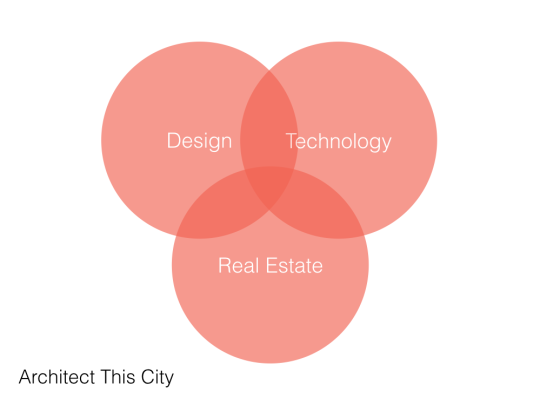
    Now, in terms of the content, the focus is obviously on city building. But I’m more specifically interested in the following 3 areas and their overlap:

    If you’re a regular reader you know this.

    I didn’t set out to focus in this way, but it just happened over time. This is what I’m passionate about and so I naturally started applying it to our discussion on cities and city building.

    And finally, in terms of writing style, I’ve found myself adopting a particular structure.

    I often start with a personal note – almost as if this were purely a personal blog. Then I dig into a particular city building issue and try to uncover one particular way of looking at it. And then I end with a decisive position. I’ve seen this format on other blogs and I really like it.

    Obviously I don’t always follow this structure. For example, sometimes I haven’t made up my mind on a particular issue. But I try to. I lean towards the belief that a decisive wrong answer is better than a wishy washy right answer. So I push myself to take stances and have an opinion. 

    But in the end, the goal of every post is simply to present one idea for all of us to think about and then discuss. I’d like to believe that it keeps us all sharp. Hopefully it’s working for you.