Daily insights for city builders, delivered every morning at 6 AM ET. I’m Brandon Donnelly — a Toronto-based real estate developer and founder of Globizen. I’ve been writing here since 2013.

Tag: blogger

  • People like us

    Seth Godin wrote on his blog today about what it means to be a lifelong fan — whether it be of a sports team, a car company, a political party, or, in his words, “anything where affiliation drives our sense of self and community.”

    There’s a powerful sentence in the middle of his post and it’s this one here:

    People like us do things like this.

    We often make decisions about products, brands, and even where to live based on a narrative that we craft for ourselves. We tell ourselves that I am the kind of person who lives in this neighborhood and drives this car. People like us do things like this.

    There’s an innate, emotional, and sometimes nonsensical desire to be part of what Seth calls our chosen “tribe.” And tribe does really feel like the right word. We all want to be a part of something. It helps to create meaning.

    So what’s your internal narrative? It probably determines how you hire for many of the “jobs” you need filled.

  • Five year anniversary

    Today is the five year anniversary of this daily blog. That’s over 1800 posts. 

    It’s almost hard to believe that it has been that long. It seems like just yesterday I was on year 2 or 3. But at the same time, it’s almost hard for me to remember a time when I didn’t blog every day. I guess we’re calling it a habit at this point.

    One of the most common questions I get regarding this blog is: “Do you pre-write posts?” The answer is never. Okay, almost never. Sometimes I’ll pre-write a post if I know I’m going to be on a plane for 12 hours and I won’t make the timezone cutoff. But generally as a rule I don’t.

    Part of the reason I don’t is because it breaks the habit. This is something I do every day. And I like that routine. I also want the posts to be timely and I want to be able to write about things that may be on my mind that day.

    Momentum is a powerful thing. And when you’ve been doing something for a number of years, and especially something as public as this daily blog, there’s a powerful incentive to keep doing it. That’s how streaks work.

    However, in the world of development, five years is perhaps not that long. It’s maybe one project. Streaks take a lot longer to establish.

    This summer One Delisle by Studio Gang went public and you’re now starting to see (bright neon) teasers for Junction House. Both of these projects are many years in the making. The Junction House story started in early 2016.

    So I reckon that this blog needs at least another five years so that there’s enough time for the really juicy stories to surface. I’ll endeavor to do exactly that. 

    Thanks for reading and making this community what it is. See you tomorrow.

  • Airbnb and affordable housing

    image

    Fred Wilson published a good post last weekend on the proposed bill that went to New York City Council this week regarding new reporting requirements for Airbnb and their hosts in NYC. You can read more about his position on his blog, but he is in favor of a comprehensive bill that would properly legitimize short-term rentals. He is also not opposed to city and state taxes on the service.

    What I wanted to focus on today were his comments around housing. This is already sounding like a broken record, but Fred draws attention to the severe supply-demand imbalance that is occurring in the boroughs of Brooklyn, Queens, and the Bronx, precisely because many/most young people were priced out of Manhattan long ago and want to live in these places.

    But I particularly like his comments around what makes for good policy and what makes for good politics. I agree with his view that it is often a case of the latter over the former. I think a lot of the excitement around Airbnb is a red herring. For me, it’s akin to the fixation on foreign buyers and their impact on the local housing market in places like Toronto and Vancouver.

    Yes, they are factors. But the data suggests they are marginal ones. As Fred points out, they are almost certainly not the root cause of the problem. The reality is that we need a lot more housing – both market-rate housing and subsidized housing. The challenge is that nobody wants to pay for the latter and so we’ve instead decided to focus on things that sound like they’re going to help.

    Photo by Jon Tyson on Unsplash

  • Reblog: The rationality paradox

    A few days ago, Seth Godin published a terrific blog post called the rationality paradox. It’s not very long (like most of his posts) and I like it a lot (particularly the bold part), and so I’m reblogging it in full here:

    If you see yourself as an engineer, a scientist, or even a person of logic, then it’s entirely possible that you work to make rational decisions, decisions that lead to the outcomes you seek.

    The paradox is that you might also believe that you do this all the time, and that others do it too.

    But a rational analysis shows that this is far from true. Almost every choice we make is subconscious. We’re glitch-ridden, superstitious creatures of habit. We are swayed by social forces that are almost always greater than our attraction to symbolic logic would indicate. We prioritize the urgent and most of the decisions we make don’t even feel like decisions. They’re mostly habits combined with a deep desire to go along with the people we identify with.

    Every time you assume that others will be swayed by your logical argument, you’ve most likely made a significant, irrational mistake.

    Your actions and your symbols and your tribe dwarf the words you use to make your argument.

  • The emotional journey of creating anything great

    Welcome to 2017. (We better have flying cars by 2020 or I’m going to be pissed.)

    I found the following chart on Howard Lindzon’s blog. It’s called “The Emotional Journey Of Creating Anything Great" and it’s getting shared around town right now.
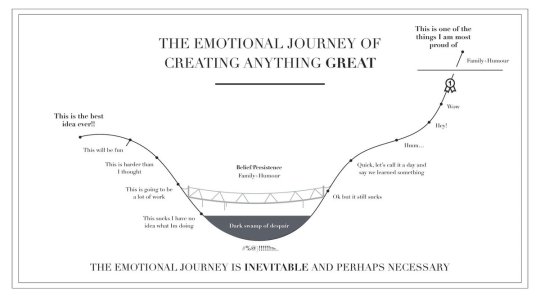
    I’m sure that you’ve seen other similar charts before, but it doesn’t hurt to drive home this point, particularly as all of us kickstart the new year and promise ourselves that we’re going to be better, faster, stronger.

    The point of this chart is that when you’re creating anything new and great, there will always be the period of time that this diagram refers to as the “dark swamp of despair.” This is where you question your life decisions and wonder if you’re wasting your time trying to create this new and great thing.

    I never fully appreciated this phenomenon until I worked on a startup. Though for me, it felt more like a manic depressive rollercoaster. One week I was killing it and the next week I was in a dark swamp of despair searching for a way out. 

    And it’s because when you’re creating something new, you have few, if any, points of reference to reassure yourself that you’re on the right path. If it is truly great, then it’s probably something novel. And if it’s new, then by definition it hasn’t been done before. So it is unknown whether it’s truly a dark swamp of despair or if it just feels that way right now because things are tough.

    Because of the emotional nature of this journey, I have found myself really questioning the worth of things like caffeine and alcohol. I used to think the former made me more productive – the latter certainly doesn’t – but I’m not so sure that is the case. So as an experiment, I cut out coffee last month.

    I don’t believe in new year’s resolutions, so that’s not what all of this is about. It’s far better to talk about the things you’ve remained committed to, than to talk about the things you’re planning to do.

    This is simply a reminder that there will always be ups and there will always be dark swamps of despair. The key is to have the confidence and conviction to charge through those swamps any way you can. Onward my friends. I’m really looking forward to 2017 and I hope you all are as well.


  • I love work

    I spent this morning drafting the third post in my BARED blog series. First one, here. Second one, here. If any of you would like to be featured next, or know of someone who you think should be featured next, please send me an email or tweet.

    At this point, I need to move onto other things today. But I did want to mention a post that Ev Williams (Blogger, Twitter, Medium…) recently penned where he talks about keeping technology in check and the drain of being always connected.

    Here are two interesting excerpts:

    “I’ve spent the last 20 years breathing and building the internet. So I have a good sense for the benefits of always-available instant access and all it entails. I also have a strong appreciation for the drain being constantly connected can cause on your health and sense of well-being.”

    “Building companies requires a ton of work — and I love work. But I’ve also found that working 24/7 no longer produces the best work product or the best life experience (not that it ever did).”

    This really resonates with me, as I am sure it does for many of you. I like being always connected. I like waking up every morning and writing a blog post. I like saying yes to things. And I, like Ev, love work. 

    But it can be draining when your ambition seems to exceed your body’s ability to keep on going. And when that happens, you no longer produce your best work, which is the whole point. 

    So in the end, I think we all need these little checks and balances. Exercise is number one for me. It is well worth the time it takes. What do you do for balance?

  • Should we love bubbles?

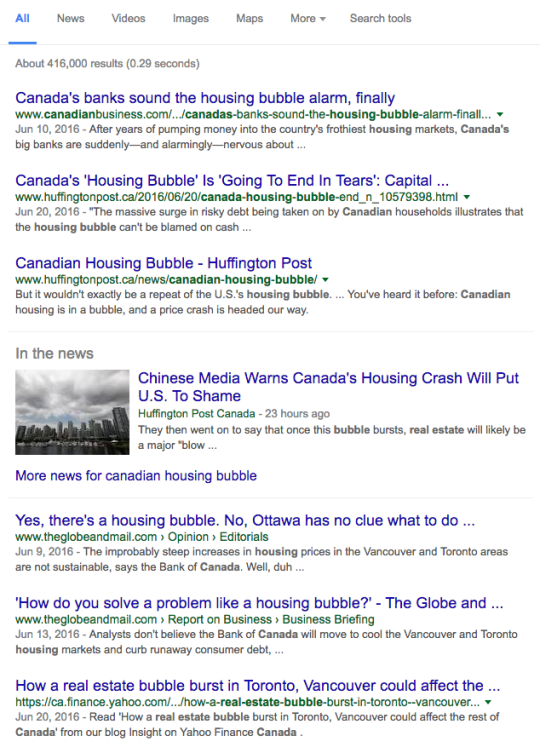
    There’s no shortage of talk about a Canadian housing bubble:

    image

    In Vancouver, the price of a single-family home (as of June of this year) increased 39% to C$1.6 million from the year prior. Does that constitute bubble territory?

    In an effort to stop prices from running away even further, I am sure you all know that the BC government has recently imposed an additional 15% transfer tax on Metro Vancouver homes purchased by foreign buyers (people who are not Canadian citizens or permanent residents).

    The data that I have seen (here and here) suggests that foreign buyers could make up somewhere around 5-10% of the market. Given that many will now get creative in terms of hiding their foreignness, I am not so sure this new tax will have a dramatic impact on affordability. But it certainly sounds nice if you’ve been grouchy about home prices and thinking “those damn foreigners.” We’ll have to see how it plays out.

    Having said all of this, if Vancouver is in fact in bubble territory, would that be so bad? Are we thinking about this the right way?

    Here’s an alternative viewpoint.

    I recently stumbled upon an old blog post by Tom Evslin (2005) called: Why we need bubbles. I discovered it via it Fred Wilson. Tom’s argument is that we need irrational exuberance because it provides the capital that allows for dramatic overbuilding. The overbuilding of things like rail infrastructure, internet infrastructure and – I’m adding this – housing infrastructure. And once this happens, it dethrones the incumbents and paves the way for future economic progress.

    Tom’s focus is on technology, but I couldn’t help but think of the parallels with city building. Is the proposed Rail Deck Park in Toronto so bold that it’s only possible during a period of irrational exuberance? Should Vancouver instead be working to dramatically expand its housing supply instead of trying to tax away a portion of demand? Is a period of irrational exuberance precisely the moment where we lay the ground work for our future successes?

    I’m not saying we’re in a bubble. I don’t believe in or know how to time markets. But I am asking whether the bubble headlines are missing the greater opportunity.

  • Business model innovation

    Fred Wilson has a great post up on his blog today about open protocols. By open protocols he is referring to things like TCP/IP (transmission control protocol and internet protocol), HTTP (hypertext transfer protocol), and SMTP (simple mail transfer protocol). Whether you realize it or not, you rely on these protocols every single day if you go on the internet, browse the web, and write emails.

    If you’re interested in these sorts of nerdy things, I recommend you read his post. I’m not going to write about open protocols today – though I do find them fascinating. Instead, I would like to talk about the last paragraph of his post. 

    Here it is:

    “I believe that business model innovation is more disruptive that technological innovation. Incumbents can adapt to and adopt new technological changes (web to mobile) way easier than they can adapt to and adopt new business models (selling software to free ad-supported software). So this new protocol-based business model feels like one of these “changes of venue” as my partner Brad likes to call them. And that smells like a big investable macro trend to me.”

    This is interesting to me for 2 reasons.

    First, business model innovation is incredibly powerful. Once a company has built itself up around an existing model, it can be painfully difficult to change. Imagine you have a 200 person sales team that would become unnecessary should you pivot your business model. Are you going to fire them and make the switch?

    This is also one of the reasons why some tech companies can exist for so long before they make any money. Sometimes – but not always – it’s because the investors believe that if the company has users, attention or whatever it may be, that they will figure out a way to monetize them/it. And maybe, just maybe, it’ll be a business model that no one has ever thought of before.

    Second, look how he is publicly sharing his investment thesis. Why would he do that? Shouldn’t he just go off and do it and not tell anyone? Clearly, he too believes that there’s greater value in being open and transparent.

  • Going swimming (and being transparent)

    I woke up this morning to this view:

    image

    I then went for a swim. The water tends to be on the cooler side in the Georgian Bay, but with the weather we’ve been having it’s pretty perfect right now.

    At this point I’m thinking about a beer and some reading. I have Capital in the Twenty-First Century by Thomas Piketty sitting in my car. It’s next in the queue.

    I am telling you all of this simply to be transparent. 

    Recently I had someone caution me that I should be careful about being too public and too open. I won’t get into specifics, but I was told that sometimes it’s better to just fly under the radar.

    I recognize that there have to be limits to transparency, but as a rule of thumb I subscribe to the opposite approach. When possible and when appropriate, I would rather be more, rather than less, transparent. 

    This blog is who I am. It’s indicative of how I think. And it discloses what I’m doing. So I don’t see a lot of downside. What you read is what you get. You’ll know if we should be friends and/or do business together.

    After I wrote about what I’m doing next I had a bunch of emails come in from various people telling me what they’re doing and, in some cases, suggesting that we work together. Some people had development sites that they thought I should take a look at. And some people immediately asked if I was hiring.

    I am grateful for each of those emails. But I also know that they’re an outcome of openness and transparency.

  • Positivity at a public meeting

    I’ve been reading the blog 5 Kids 1 Condo for, I think, about a year now. It’s written by Adrian Crook who is a single dad of 5 kids, living in a 2 bedroom condo in downtown Vancouver. And his blog is about just that.

    A few days ago he posted a video of himself speaking at a public meeting in support of a new purpose-built rental building at 18th and Commercial Drive in Vancouver. The proposal includes 110 secured market rental units; 37% of which will be 2 or 3 bedroom apartments. (More information on the project, here.)

    It’s rare to see people come out in support of a project at a public meeting. Usually people only show up when they’re grouchy and upset. So today I’d like to share his speech (click here if you can’t see the video below).

    [youtube https://www.youtube.com/watch?v=q-ENWu__HdM?rel=0&w=560&h=315]

    I’m curious to know what was shouted right at the beginning after he said that he was in favor of the proposal. I listened a few times but couldn’t figure it out. 

    In any event, Adrian’s speech touches on a number of important points that transcend this specific development proposal and that are relevant to many of the topics that we discuss here on this blog.